I am being fed more dire stats that adds to the overall urgency of reviewing this space with a critical eye; it has raised alarm bells in Canada, especially given another unconscionable statistic. And that is, the untimely deaths of numerous international students aged 18 to 25 — happening at a rate of at least five a month.</p>
<figure id="8106">
<div>
<div>
<img class="ratio" src="http://placehold.it/16x9">
<iframe class="" src="https://cdn.embedly.com/widgets/media.html?type=text%2Fhtml&key=a19fcc184b9711e1b4764040d3dc5c07&schema=twitter&url=https%3A//twitter.com/pressprogress/status/1615085867193827328%3Fref_src%3Dtwsrc%255Etfw%257Ctwcamp%255Etweetembed%257Ctwterm%255E1615085867193827328%257Ctwgr%255Ee0e23f1d5fd1a1990705ccf67355e4cf592a551f%257Ctwcon%255Es1_%26ref_url%3Dhttps%253A%252F%252Fpressprogress.ca%252Finternational-students-dying-canada-federal-government-20230202%252F&image=" allowfullscreen="" frameborder="0" height="281" width="500">
</div>
</div>
</figure></iframe></div></div></figure><p id="1a97">Despite this concerning pattern, the federal government seems to lack concrete statistics and has not provided a substantive response to address this escalating issue. Together with this critical post, the problem is nothing short of complex. Granted, there are those who say that they knew what to expect; I disagree. The personal stories tell me otherwise.</p><blockquote id="f0d3"><p><b>Related post: <a href="https://pressprogress.ca/international-students-dying-canada-federal-government-20230202/"></a></b><a href="https://pressprogress.ca/international-students-dying-canada-federal-government-20230202/">https://pressprogress.ca/international-students-dying-canada-federal-government-20230202/</a></p></blockquote><h1 id="bcfc">The costs of a Global North education for Global South students</h1><p id="20c7">In our confirmed “globalized” world, the allure of Western education remains strong. For many in formerly colonized countries, the dream of studying in Europe or North America is seen as a pathway to success. However, this aspiration comes at a steep price — both financially and culturally. There is a mindset ingrained in previously colonized nations: the belief that the highest quality education is only available in countries like Canada, the UK, and the USA.</p><p id="c38d">Families spend their lives saving to afford this opportunity for their children. However, it’s time to question the true cost of this pursuit. Is the financial and emotional burden truly worth it, considering the changing global educational landscape? A known fact is that college and university campuses are microcosms of the larger society and if this saying is true, then, the future looks gloomier than I thought.</p><p id="bb48">This situation is disheartening, as it reflects a growing reality. It is also reflected in the number of International students currently using foodbanks. But that is for another post. This silent crisis is also finding voice on a growing number of YouTube channels in YouTube videos like the following:<i> “Struggles of Nigerian and Indian International Students.” </i>And this is but a drop in the bucket of social media commentaries on the topic- this one focuses on the plight of finding work as international students.</p>
<figure id="4d9b">
<div>
<div>
<img class="ratio" src="http://placehold.it/16x9">
<iframe class="" src="https://cdn.embedly.com/widgets/media.html?src=https%3A%2F%2Fwww.youtube.com%2Fembed%2FVGIwRz2Zwzo%3Ffeature%3Doembed&display_name=YouTube&url=https%3A%2F%2Fwww.youtube.com%2Fwatch%3Fv%3DVGIwRz2Zwzo&image=https%3A%2F%2Fi.ytimg.com%2Fvi%2FVGIwRz2Zwzo%2Fhqdefault.jpg&key=a19fcc184b9711e1b4764040d3dc5c07&type=text%2Fhtml&schema=youtube" allowfullscreen="" frameborder="0" height="480" width="854">
</div>
</div>
</figure></iframe></div></div></figure><p id="1606">Stories of the many Bharavis with similar negative experiences need a voice. While this qualitative stories are prevalent, the details are in the number. For those new to this space, here, for example, is rough idea of the comparative fees for a doctoral program, at the average Canadian university.</p><p id="9084" type="7">Take for example the case of tuition for Applied Economics program — all domestic including out of province it is 2,234 plus 584.63 incl. 6tax (provincial HST varies) as an incidental fee; comparatively for International students it is7, 396.00 plus 836.63 incl 6 tax (provincial HST varies), which is the incidental fee. And this is per term. So, in simple terms, the cost comparison per term between domestic and international students is:</p><blockquote id="6f8a"><p><b>Domestic students: </b>2,824.63.</p></blockquote><blockquote id="7cae"><p><b>International students: </b>8,238.63.</p></blockquote><blockquote id="f3ff"><p><b>Difference: </b>8,238.63 — 2,824.63 = 5,414.</p></blockquote><p id="68ce">So, international students pay 5,414 more per term than domestic students; this numbers represent the cost of one term so multiply each by three</p><blockquote id="7e9f"><p><b>Domestic students:</b>8,473.89 per year.</p></blockquote><blockquote id="7ee4"><p><b>International students: </b>24,715.89 per year.</p></blockquote><p id="db04">Now multiply each of these by 4 to represent the cost for the the average university program. So, the entire duration of an average four-year university program, the total costs are:</p><blockquote id="5c96"><p><b>Domestic students:</b> 33,895.56.</p></blockquote><blockquote id="c362"><p><b>International students: </b>98,863.56.</p></blockquote><h2 id="6168">*At some universities is it as high as 5 times the domestic rate.</h2><figure id="c73a"><img src="https://cdn-images-1.readmedium.com/v2/resize:fit:800/1*c_WI-LpyousH00ytMRlQfg.png"><figcaption>University of Waterloo Doctoral — Domestic</figcaption></figure><figure id="d2fd"><img src="https://cdn-images-1.readmedium.com/v2/resize:fit:800/1*Da7_tXDF7S8NtMaJpCoT9A.png"><figcaption>University of Waterloo Doctoral — Out of Province</figcaption></figure><figure id="5f5f"><img src="https://cdn-images-1.readmedium.com/v2/resize:fit:800/1*V50mvTL-Q-qez_z4Vih-sw.png"><figcaption>University of Waterloo Doctoral — International</figcaption></figure><h1 id="6545">The Financial Burden</h1><p id="4472">The issue of exorbitant tuition fees is a major barrier for students from developing countries seeking education in Western institutions. They are often charged significantly higher rates due to international student fees, coupled with ineligibility for many forms of financial aid available to domestic students. Beyond tuition, the cost of living in Western countries presents another substantial hurdle. Basic necessities like housing, food, and transportation are often far more expensive compared to their home countries.</p><p id="e553">Furthermore, the currency disparity exacerbates these financial challenges. Students from less affluent nations find themselves at a disadvantage due to unfavorable exchange rates, which can dramatically increase the overall financial burden of studying abroad. This combination of high tuition, steep living costs, and currency disparities creates a daunting financial landscape for many international students, particularly those from the Global South.</p><div id="c90e" class="link-block">
<a href="https://monitor.icef.com/2022/05/nigeria-most-students-want-to-study-abroad-but-many-also-need-financial-aid/">
<div>
<div>
<h2>Nigeria: Most students want to study abroad but many also need financial aid - ICEF Monitor …</h2>
<div><h3>An annual survey exploring Nigerian students' perceptions of study abroad and the main motivations for their decisions…</h3></div>
<div><p>monitor.icef.com</p></div>
</div>
<div>
<div style="background-image: url(https://miro.readmedium.com/v2/resize:fit:320/0*SdlD7LwSDu4Y4S0R)"></div>
</div>
</div>
</a>
</div><h1 id="16fa">Cultural and emotional costs</h1><p id="245b">Cultural displacement is a significant challenge for students from non-Western backgrounds pursuing education in Western countries. The transition often involves coping with cultural shock and a sense of isolation as they navigate unfamiliar social norms and educational systems, which can be vastly different from their own. Additionally, language barriers pose a considerable obstacle. Even for students proficient in English or other Western languages, the subtleties and colloquialisms inherent in these languages can be difficult to master, potentially impacting their academic performance and social integration. Some un
Options
iversities have suggested to TA’s like myself that we must make allowances for those with English as a Second Language (ESL). To me, personally, it bears the marking of a depreciating value of the education systems that we once knew. In the race to put money over people, this is where we are.</p><div id="c633" class="link-block">
<a href="https://campusmentalhealth.ca/toolkits/international-students/">
<div>
<div>
<h2>International Students - Centre for Innovation in Campus Mental Health</h2>
<div><h3>A resource hub for administrators, coaches, athletic staff and athletes on our campuses.</h3></div>
<div><p>campusmentalhealth.ca</p></div>
</div>
<div>
<div style="background-image: url(https://miro.readmedium.com/v2/resize:fit:320/0*wmi3NPv7t3maZWqa)"></div>
</div>
</div>
</a>
</div><p id="7ac6">Moreover, the immense financial and emotional investment involved in studying abroad creates a high-pressure environment for these international students. This pressure is not just about excelling academically but also about justifying the resources and expectations invested in their education, often leading to significant mental health challenges. This multifaceted burden of cultural adjustment, language challenges, and the pressure to succeed underscores the complex reality faced by international students in Western educational settings.</p><h1 id="818c">The Impact of Colonial Legacies</h1><p id="b27c">The perceived superiority of Western education, a legacy of colonialism, continues to influence global educational dynamics. This perception often leads to the undervaluing of local educational systems and indigenous knowledge in former colonies, perpetuating a belief that true academic excellence can only be achieved in Western institutions. This mindset not only undermines the quality and relevance of education in these countries but also fosters a form of academic neocolonialism. Simultaneously, the consistent flow of students from developing nations to Western countries can be viewed as an extension of colonial-era economic patterns.</p><div id="cf0c" class="link-block">
<a href="https://link.springer.com/chapter/10.1007/978-3-030-00716-4_4">
<div>
<div>
<h2>Canada's Legacy of Colonialism: Implications in Education</h2>
<div><h3>Despite the common Canadian claim to embracing social diversity and multicultural values, Eurocentric knowledges and…</h3></div>
<div><p>link.springer.com</p></div>
</div>
<div>
<div style="background-image: url(https://miro.readmedium.com/v2/resize:fit:320/0*BfiTvq3gDha1dw26)"></div>
</div>
</div>
</a>
</div><p id="6957" type="7">This movement represents a transfer of wealth and resources from the periphery (developing nations) to the core (developed Western nations), reinforcing economic dependencies established during colonial times.</p><p id="51b4">The educational migration thus becomes a modern manifestation of these historical patterns, with significant implications for both the economic and educational landscapes of the involved countries.</p><p id="6549">The pursuit of Western education by students from formerly colonized nations presents a multifaceted challenge — one I often refer to as a wicked problem. On one hand, it offers valuable opportunities for personal and professional growth and also I am a supporter of young people leaving home to explore the world and learn new things; I had that privilege. However, it simultaneously perpetuates deep-seated inequalities and imposes considerable financial and psychological burdens on these students. In light of this, it is imperative for educational institutions, activist in the decolonization space, as well as policymakers to critically address these disparities.</p><p id="1f69">Efforts must be made to ensure that the global exchange of knowledge is equitable and does not disproportionately disadvantage students from less affluent backgrounds, and especially as we know there is a deep and complex historical divide that is continuously perpetuated. Creating a more balanced educational landscape is essential for fostering true global collaboration and understanding, ensuring that the pursuit of knowledge is a right accessible to all, not a privilege of a few.</p><blockquote id="9a59"><p><b>Related posts</b></p></blockquote><div id="ce29" class="link-block">
<a href="https://kemlaurin.medium.com/our-outdated-educational-system-is-failing-todays-students-b062ef668257">
<div>
<div>
<h2>Our outdated educational system is failing students</h2>
<div><h3>Mismatch between traditional education and the future of work</h3></div>
<div><p>kemlaurin.medium.com</p></div>
</div>
<div>
<div style="background-image: url(https://miro.readmedium.com/v2/resize:fit:320/1*cjRIvG5Kh9qdMeRvu9L0Bg.png)"></div>
</div>
</div>
</a>
</div><div id="09d1" class="link-block">
<a href="https://kemlaurin.medium.com/our-kids-are-not-okay-the-great-education-heist-31678f42d059">
<div>
<div>
<h2>Our kids are not okay — The great education heist</h2>
<div><h3>Draining life savings into a broken system</h3></div>
<div><p>kemlaurin.medium.com</p></div>
</div>
<div>
<div style="background-image: url(https://miro.readmedium.com/v2/resize:fit:320/1*aus2C1Emtxe6tYzKdYI9HA.png)"></div>
</div>
</div>
</a>
</div><div id="fcc1" class="link-block">
<a href="https://kemlaurin.medium.com/unmasking-the-failure-of-higher-education-56f6658402a0">
<div>
<div>
<h2>Unmasking the failure of higher education</h2>
<div><h3>Universities are not preparing our students for the real world</h3></div>
<div><p>kemlaurin.medium.com</p></div>
</div>
<div>
<div style="background-image: url(https://miro.readmedium.com/v2/resize:fit:320/1*zLar51dHG5Js5BaLr4q-9g.png)"></div>
</div>
</div>
</a>
</div><div id="f731" class="link-block">
<a href="https://kemlaurin.medium.com/10-reasons-why-schools-need-to-teach-resiliency-during-formative-years-f9b335a3cc13">
<div>
<div>
<h2>10 reasons why schools need to teach resiliency during formative years</h2>
<div><h3>Bounce-back basics 101: building better brains in the classroom</h3></div>
<div><p>kemlaurin.medium.com</p></div>
</div>
<div>
<div style="background-image: url(https://miro.readmedium.com/v2/resize:fit:320/1*G5KuSPp61uB3CGQ0qoKPZQ.png)"></div>
</div>
</div>
</a>
</div><figure id="20b4"><img src="https://cdn-images-1.readmedium.com/v2/resize:fit:800/0*qErlWl_LohCaCbJ2"><figcaption></figcaption></figure><div id="ddc2" class="link-block">
<a href="https://www.humantechfutures.ca/">
<div>
<div>
<h2>Human Tech Futures</h2>
<div><h3>At Human Tech Futures, we're passionate about helping our clients navigate the future with confidence! We specialize in…</h3></div>
<div><p>www.humantechfutures.ca</p></div>
</div>
<div>
<div style="background-image: url(https://miro.readmedium.com/v2/resize:fit:320/0*r8crnCvDnpzxelHg)"></div>
</div>
</div>
</a>
</div><p id="7a53"><b><i>About me:</i></b><i> Hello, my name is Kem-Laurin, and I am one half of the co-founding team of <a href="http://www.humantechfutures.ca/">Human Tech Futures</a>. At Human Tech Futures, we’re passionate about helping our clients navigate the future with confidence! Innovation and transformation are at the core of what we do, and we believe in taking a human-focused approach every step of the way.</i></p><p id="647d"><i>We understand that the future can be uncertain and challenging, which is why we offer a range of engagement packages tailored to meet the unique needs of both individuals and organizations. Whether you’re an individual looking to embrace change, a business seeking to stay ahead of the curve, or an organization eager to shape a better future, we’ve got you covered.</i></p><p id="1751"><i>Connect with us at <a href="https://www.humantechfutures.ca/contact">https://www.humantechfutures.ca/contact</a></i></p></article></body>
The cost of a Western education — global south heist by the global north
A critical view at the global education landscape
“International students are an asset that is very lucrative.” — Canadian Immigration Minister, Marc Miller
As a part-time lecturer, a PhD Candidate, a mother, and a daughter of immigrant parents, I find myself standing at a reflexive turn. With both of my children teetering on the brink of their higher educational futures, I am compelled to turn my attention to the escalating costs of university education in Canada. My unique stance, shaped by my academic, professional, and personal journey, casts a revealing light on the daunting landscape of Western education, particularly within the Canadian context.
The prospects, both exhilarating and intimidating, prompt a critical examination of the paths that lie ahead for not only my children but importantly the many international students who now sit at the crosshairs of the Canadian “edu-business”. It is a scene that, too, has stirred the attention of domestic Canadians who argue that Canadian born children are being displaced in high numbers — unable to find spots at higher educational institutions.
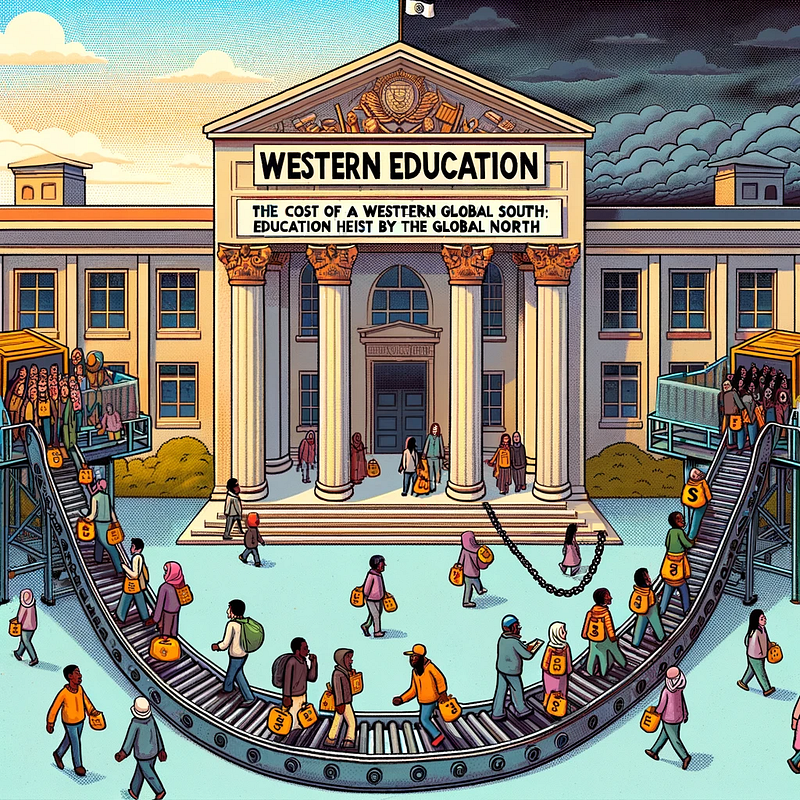
Instead, the reality is that international students, who pay anywhere from four to six times the cost of tuition are now being viewed afresh — mere pawns in a heist of the greatest magnitude.
So, it is no surprise when in the slip of the tongue, Canadian Immigration Minister, Marc Miller has received vocal rebuke in September 2023, when he said the quiet part out aloud: “International students are an asset that is very lucrative.”
The situation has often been described as a troubling scheme, where it seems the Canadian government, in a questionable alliance with Canadian colleges and universities, appears to have engaged in a practice that some liken to a Ponzi scheme. This controversial perspective suggests that there may be more beneath the surface of the educational system’s operations, prompting a need for deeper scrutiny and understanding.
In 2000, when I completed my undergraduate program, the average cost for a semester in the humanities at a Canadian university was about $1,000 per semester; I think I owed about $12,000-$15,000 after graduation — the details are but memory. Even then, we students thought this was already a high cost, considering the lower rates of my European friends at the time. I attended the university of Ottawa, before finishing a Masters, with partial scholarship at the University of Waterloo. I was able to pay back the small amount I owed for my undergrad in two years of paying the bare minimum: sadly, this is no longer the case.
Side bar: Two days after starting this post, the news broke here that the Canadian government will reduce the number of international students by 35 percent. Perhaps their ears are to the ground listening to the sow rumble of an impending crisis.
While this decision is a step in the right direction, it fails to address the high costs borne by students from the Global South, particularly those from previously colonized regions. This issue represents a minor aspect of a larger and more complex problem. Let me digress briefly to provide some perspective on the comparative costs of education, specifically for a typical doctoral degree at the University of Waterloo, with which I am most familiar. I will outline the fees for domestic and cross-province students in contrast to those for international students.
But, before exploring further, however, I wish to share a personal story from one of my most memorable students. To protect her identity, I will call her Bharavi.
International student in Canada — Braravi’s story
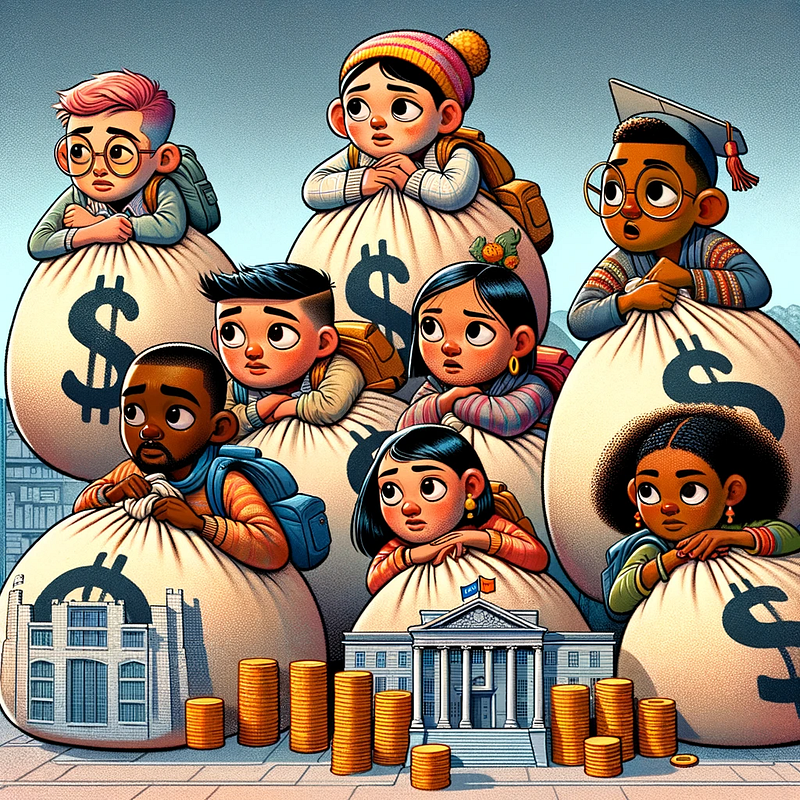
Bharavi was my student in a 3rd year course I recently taught at a local university. She came to Canada, from India, to study four years ago and will soon be graduating. We shared a few after class chats and nearing the end of the term, where it is typical, students tend to stay back to say their goodbyes to their professors. It is a time for more personal exchanges and Bharavi, and we discussed what was next for her.
I asked her if she intended to pursue a graduate degree, as she seemed the perfect candidate for such a pursuit, given here academic prowess. To this, she said, “yes” but first she needed to find a job to pay off debts for her education first. The Canadian government gives international students a 90-day window to ideally find a job after graduation So, Bharavi was undoubtedly stressed. Also, she suggested that she was soon to be married and her prospective fiancé will also help the process. But for now, she could go no further, academically and allow her parents to take on the cost of her education by themselves.
For Bharavi, even after being here for four years, she was shocked by the exorbitant tuition fees for international students — more than three times the amount paid by domestic students. She also mentioned being “shamed” to even admit the cost to me. While the families of these international students, like Bharavi, are often aware of these costs, the burden remains significant. Bharavi supplemented her parents’ contributions by taking on-campus jobs (maxed at 20 hours a week and at a minimum wage), and receiving support from local relatives — an aunt or uncle, I believe.
It was enraging to hear this as a parent and frankly a human being.
While she lived on campus, she took an intra-city bus to visit family in nearby Brampton, a place known for a large Indian population. Like Bharavi, many international students live on campus, again adding to the educational cost.
Bharavi, about 23 or 24, struck me, particularly because she considers herself “behind” because she had taken some mental time off and was just in the frame of mind of completing her expensive degree at all costs. Any failures add to the cost of repeating classes, and she could not afford to do so. I often had to accommodate her as she was perpetually stressed and anxious. Undoubtedly, it was in part, about her future job prospects, especially considering the challenges posed by AI disruptions in her field. she was a humanities student, doing a minor is Sociology.
Her parents, not affluent, simply wanted the best for their child. And here she was already burdened with financial struggles even beyond that of the Canadian student in the same predicament.
Another student experience a similar story. He told me that just to afford his Canadian education he was forced to live with 4 other students in a 1 bedroom apartment. He is now married now and have since left the city for more affordable housing. The cost of housing in Canadian is a topic for another time. These are only the stories I know. And there are so many more.
Sadly, as I am writing this post, I am being fed more dire stats that adds to the overall urgency of reviewing this space with a critical eye; it has raised alarm bells in Canada, especially given another unconscionable statistic. And that is, the untimely deaths of numerous international students aged 18 to 25 — happening at a rate of at least five a month.
Despite this concerning pattern, the federal government seems to lack concrete statistics and has not provided a substantive response to address this escalating issue. Together with this critical post, the problem is nothing short of complex. Granted, there are those who say that they knew what to expect; I disagree. The personal stories tell me otherwise.
The costs of a Global North education for Global South students
In our confirmed “globalized” world, the allure of Western education remains strong. For many in formerly colonized countries, the dream of studying in Europe or North America is seen as a pathway to success. However, this aspiration comes at a steep price — both financially and culturally. There is a mindset ingrained in previously colonized nations: the belief that the highest quality education is only available in countries like Canada, the UK, and the USA.
Families spend their lives saving to afford this opportunity for their children. However, it’s time to question the true cost of this pursuit. Is the financial and emotional burden truly worth it, considering the changing global educational landscape? A known fact is that college and university campuses are microcosms of the larger society and if this saying is true, then, the future looks gloomier than I thought.
This situation is disheartening, as it reflects a growing reality. It is also reflected in the number of International students currently using foodbanks. But that is for another post. This silent crisis is also finding voice on a growing number of YouTube channels in YouTube videos like the following: “Struggles of Nigerian and Indian International Students.” And this is but a drop in the bucket of social media commentaries on the topic- this one focuses on the plight of finding work as international students.
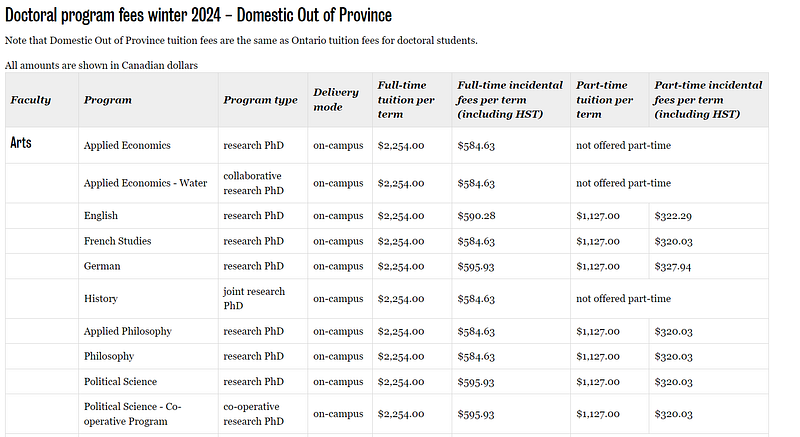
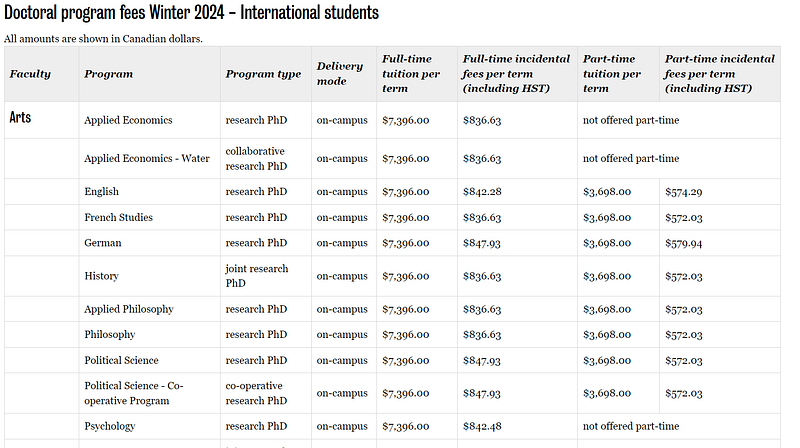
Stories of the many Bharavis with similar negative experiences need a voice. While this qualitative stories are prevalent, the details are in the number. For those new to this space, here, for example, is rough idea of the comparative fees for a doctoral program, at the average Canadian university.
Take for example the case of tuition for Applied Economics program — all domestic including out of province it is $2,234 plus $584.63 incl. 6$ tax (provincial HST varies) as an incidental fee; comparatively for International students it is $7, 396.00 plus $836.63 incl 6$ tax (provincial HST varies), which is the incidental fee. And this is per term. So, in simple terms, the cost comparison per term between domestic and international students is:
Domestic students: $2,824.63.
International students: $8,238.63.
Difference: $8,238.63 — $2,824.63 = $5,414.
So, international students pay $5,414 more per term than domestic students; this numbers represent the cost of one term so multiply each by three
Domestic students:$8,473.89 per year.
International students: $24,715.89 per year.
Now multiply each of these by 4 to represent the cost for the the average university program. So, the entire duration of an average four-year university program, the total costs are:
Domestic students: $33,895.56.
International students: $98,863.56.
*At some universities is it as high as 5 times the domestic rate.
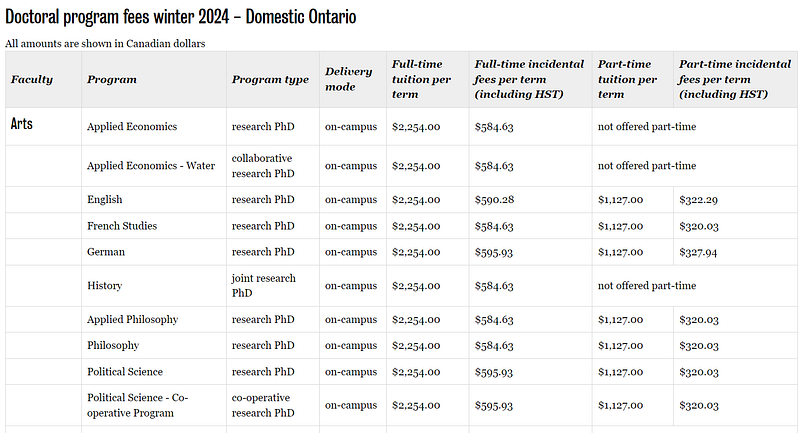
University of Waterloo Doctoral — DomesticUniversity of Waterloo Doctoral — Out of ProvinceUniversity of Waterloo Doctoral — International
The Financial Burden
The issue of exorbitant tuition fees is a major barrier for students from developing countries seeking education in Western institutions. They are often charged significantly higher rates due to international student fees, coupled with ineligibility for many forms of financial aid available to domestic students. Beyond tuition, the cost of living in Western countries presents another substantial hurdle. Basic necessities like housing, food, and transportation are often far more expensive compared to their home countries.
Furthermore, the currency disparity exacerbates these financial challenges. Students from less affluent nations find themselves at a disadvantage due to unfavorable exchange rates, which can dramatically increase the overall financial burden of studying abroad. This combination of high tuition, steep living costs, and currency disparities creates a daunting financial landscape for many international students, particularly those from the Global South.
Cultural displacement is a significant challenge for students from non-Western backgrounds pursuing education in Western countries. The transition often involves coping with cultural shock and a sense of isolation as they navigate unfamiliar social norms and educational systems, which can be vastly different from their own. Additionally, language barriers pose a considerable obstacle. Even for students proficient in English or other Western languages, the subtleties and colloquialisms inherent in these languages can be difficult to master, potentially impacting their academic performance and social integration. Some universities have suggested to TA’s like myself that we must make allowances for those with English as a Second Language (ESL). To me, personally, it bears the marking of a depreciating value of the education systems that we once knew. In the race to put money over people, this is where we are.
Moreover, the immense financial and emotional investment involved in studying abroad creates a high-pressure environment for these international students. This pressure is not just about excelling academically but also about justifying the resources and expectations invested in their education, often leading to significant mental health challenges. This multifaceted burden of cultural adjustment, language challenges, and the pressure to succeed underscores the complex reality faced by international students in Western educational settings.
The Impact of Colonial Legacies
The perceived superiority of Western education, a legacy of colonialism, continues to influence global educational dynamics. This perception often leads to the undervaluing of local educational systems and indigenous knowledge in former colonies, perpetuating a belief that true academic excellence can only be achieved in Western institutions. This mindset not only undermines the quality and relevance of education in these countries but also fosters a form of academic neocolonialism. Simultaneously, the consistent flow of students from developing nations to Western countries can be viewed as an extension of colonial-era economic patterns.
This movement represents a transfer of wealth and resources from the periphery (developing nations) to the core (developed Western nations), reinforcing economic dependencies established during colonial times.
The educational migration thus becomes a modern manifestation of these historical patterns, with significant implications for both the economic and educational landscapes of the involved countries.
The pursuit of Western education by students from formerly colonized nations presents a multifaceted challenge — one I often refer to as a wicked problem. On one hand, it offers valuable opportunities for personal and professional growth and also I am a supporter of young people leaving home to explore the world and learn new things; I had that privilege. However, it simultaneously perpetuates deep-seated inequalities and imposes considerable financial and psychological burdens on these students. In light of this, it is imperative for educational institutions, activist in the decolonization space, as well as policymakers to critically address these disparities.
Efforts must be made to ensure that the global exchange of knowledge is equitable and does not disproportionately disadvantage students from less affluent backgrounds, and especially as we know there is a deep and complex historical divide that is continuously perpetuated. Creating a more balanced educational landscape is essential for fostering true global collaboration and understanding, ensuring that the pursuit of knowledge is a right accessible to all, not a privilege of a few.
About me: Hello, my name is Kem-Laurin, and I am one half of the co-founding team of Human Tech Futures. At Human Tech Futures, we’re passionate about helping our clients navigate the future with confidence! Innovation and transformation are at the core of what we do, and we believe in taking a human-focused approach every step of the way.
We understand that the future can be uncertain and challenging, which is why we offer a range of engagement packages tailored to meet the unique needs of both individuals and organizations. Whether you’re an individual looking to embrace change, a business seeking to stay ahead of the curve, or an organization eager to shape a better future, we’ve got you covered.