
The Cosmos Plays like a Wild Child
Nature’s lawless creativity and the death of natural purposes

The idea that nature obeys “laws” is due to an outdated, deistic metaphor.
The early modern scientists who searched for the hidden laws that could explain natural patterns generally presupposed that the universe wasn’t natural, after all, that the universe is rather a giant machine, a construct of an intelligent designer. Only in that case would it literally be true that there are laws of nature since these laws would be like the purposes that govern our artifacts when we assign them their functions and when we manufacture them to achieve those purposes.
A shovel is supposed to dig holes, and if it malfunctions, as when the handle breaks in half, the shovel fails to obey the “law” — the social expectation — for shovels. The necessity here is normative and it’s based on the designer’s or the tool-user’s purpose that’s stipulated. Given the blueprint for some artifact, or what Aristotle called the thing’s “final cause,” the artifact is subject to that law or expectation in the way that people are subject to social laws. We, too, can fail to abide by the law, as when we commit a crime, and this is because the social laws are teleological, meaning they have a normative aspect.
Artifacts are extensions of us, so they’re quasi-social too, meaning they’re bound by their assigned function and can malfunction, in which case we might treat them as outlaws. The clearest way to make that metaphor work and to extend this sociality a second time, from human artifacts to the natural order would be to posit an intelligent designer of nature. Hence the deism of early modern science, according to which God created the universe and left it to run its course, that is, to obey its blueprint.
To find the laws of nature would be to read God’s mind, or to discover that blueprint for stars, planets, molecules, organisms, and so on.
The death of natural teleology
Yet as the institutions of science evolved, scientists found objectification to be more useful than teleology. Teleology offered only pseudo, quasi-theological explanations, whereas reducing things to value-neutral, physical structures or causes and effects proved more enlightening and progressive. God never reached down into nature and congratulated us for discovering his laws, so maybe there was no such lawgiver in the first place.
But the death of that lawgiver spelled the demise of the teleological metaphor, too. If there’s no intelligent designer of nature, there are no discovered laws, nor is there necessity in the natural order that’s due to a divine designer’s creative stipulation (in the way that a novelist stipulates what happens in the narrative’s plot).
Now, it’s worth pointing out that there’s a way of saving the concept of “laws of nature,” on atheistic grounds. We just assume these laws depend not on any cosmic designer but on nature’s users, such as us. Scientists posit the laws as a prelude to how we intend to alter the natural order, to domesticate the broader wilderness.
These laws would be necessary not because a deity orders them so, but as part of civilization’s pragmatic self-confidence: we’d assume for the sake of argument that the empirical generalization is necessary if it passes our scientific tests, because that assumption is useful in extending our hegemony over the wild results of nature’s physicality.
This necessity would be subjective and anthropocentric, though, just as the deist’s natural laws would be subjective in that they’d be relative to the creator’s will.
In any case, nature itself wouldn’t be obeying these laws, so that the metaphorical meaning of “natural law” would still be misleading.
Nature’s private language
What, then, is nature doing if it’s not obeying laws? Can we stretch our minds to fathom nature’s inhuman form of creativity?
Something that might help us here is Ludwig Wittgenstein’s concept of the private language. He argued that languages are necessarily public because the meaning of symbols is socially given. This assumes that individual speakers live in an environment that includes other speakers, so that conventions emerge to mark the collective will. Thus, a dictionary supplies us with the publicly acceptable meanings of words in a language.
We could invent a language and stipulate that the made-up symbols mean this or that, but these meanings would lack conventional force. There would be no public pressure to force these meanings on anyone, including the language-inventor, because the language wouldn’t be the product of a relationship between a social environment and an individual.
The relevance of this is that, on atheistic grounds, the natural order seems nevertheless to be like someone who’s inventing a private language. There is no environment beyond what natural elements, forces, and initial conditions generate to force nature to abide by certain conventions. That is, there’s no prior, supernatural pressure from a personal lawgiver.
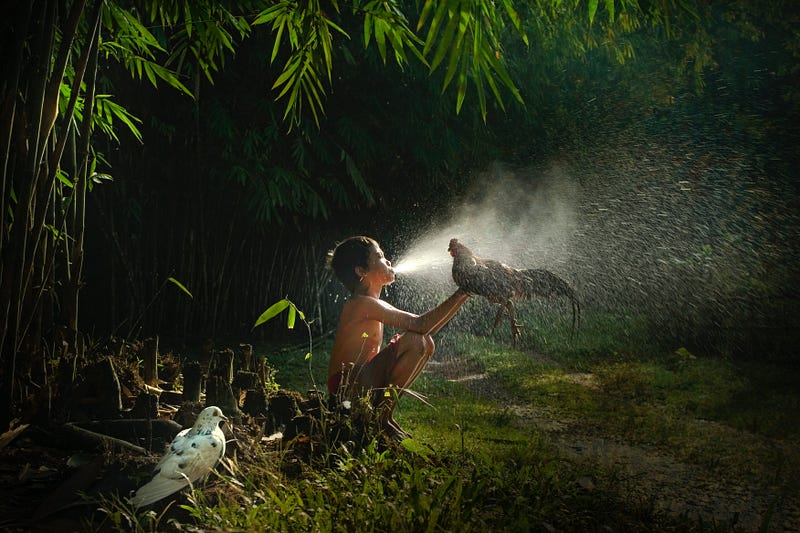
We must imagine, then, that the universe is like a child who grows up in a vacuum and somehow manages to be creative despite the lack of social input.
If a human child grows up wild, he or she would still be subject to the natural environment’s course-corrections. That dynamic might result in a primitive language that governs the wild child’s imaginary friends or the child’s various impulses that would stand in for a united self.
But what would it be like to grow up in no pre-existing environment at all? That’s the position of the godless universe.
Would such growth be subject to laws? No, because that deistic metaphor would break down. There would be no pre-envisioned ideal for nature’s development, no authoritative expectation for nature to work in one way rather than another. Indeed, this lack of lawfulness is just what’s meant by a “wilderness.”
And what we find at the bottom of nature’s physicality is as wild as can be imagined: an endless field of virtual particles subject to quantum mechanical craziness, infinite potential bubbling up in countless trials and errors to generate stable complexities such as molecules, solar systems, and stages of cosmic evolution, as well as nature-devouring black holes and dark energy that threatens to tear apart the universe.
Nature’s wild creativity
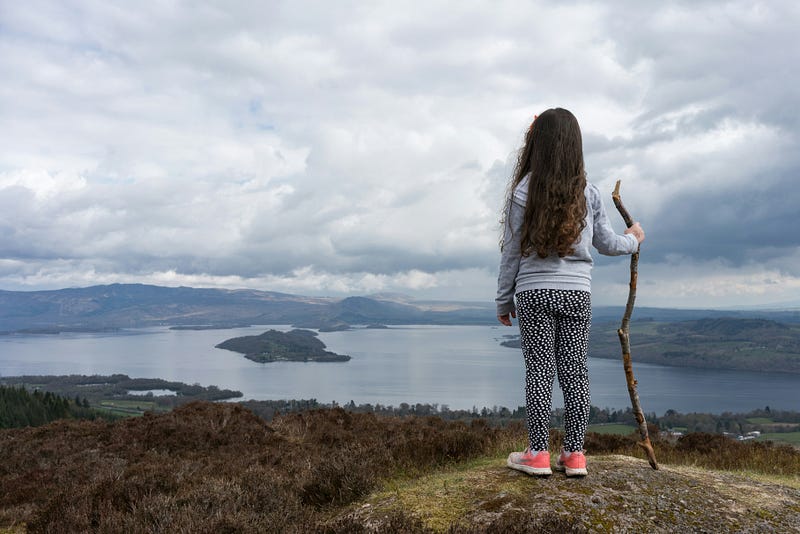
What we’re trying to fathom here is the prospect of truly wild creativity. This would be godless, lawless, and non-normative, meaning there’s no standard to which nature is bound, and no external source of direction.
That last point must be qualified, though, because it turns out that nature evolves living things that do provide an external vantage point and even a set of standards that determine how intelligent beings intend to alter nature. But those standards are ours rather than nature’s and it’s just a weird depth of vanity to suggest that our species speaks for the universe.
Indirectly, nature may be evolving laws to alter its direction, by developing minds that can understand what nature’s doing and what can or ought to be. Yet these purposes wouldn’t apply directly to the natural order, nor would they have governed the universe’s ancient periods of lifeless growth.
Regardless, to understand lawless creativity is to understand wildness. Wildness is the key. As ordered as nature presently seems to scientists and to our daily experience, at the bottom of that order is profound lawlessness and mindless, savage creativity. Nature’s orderliness is in some sense an illusion, an artifact of our limited perspective. We ignore the luck, the accidents, the trials and errors, the ground-level quantum bizarreness, and we focus on the overall patterns and by-products because as an ambitious, Machiavellian species, we mean to exploit the results of nature’s savagery.
Wildness is alien to us because we aim to domesticate ourselves, that being the price of entrance to civilization (for the sheeple who discount the prominence of high-powered sociopathic exceptions to the social rule). We’re most wild when we’re young, when we can dimly appreciate what we’re doing, and when we have the least respect for social expectations. When we’re children we prefer to play, and we learn the most by playing.
Maybe the universe learns what it is by playing too, by throwing up possibilities with quantum fluctuations, and by trying all possible combinations in countless solar systems and perhaps even stages of cosmic decay and rebirth (as in Roger Penrose’s model of a cyclical universe).
The sheer ferocity of that creativity, resulting in all possible eventualities would falsify any simplistic law or model we might propose to capture the supposed essence of what nature’s doing. In place of a platonic essence or inherent mathematical form, there would be a wild child at play.
Scientia damnat. Ars redimit.
I collect my Medium writings in paperback and eBook forms, and I put them up on Amazon. Check them out if you’d like to have them handy and to support my writing in that way. The newest one is Questing for Epiphanies in a Haunted House, and its 600 pages include 99 recent, wide-ranging articles of mine.


