
How Russian Oligarchs Got Rich
The Corrupt Privatization of Russian State Enterprises — How it Happened
I was there when it was happening, and little did I know the part I was playing…
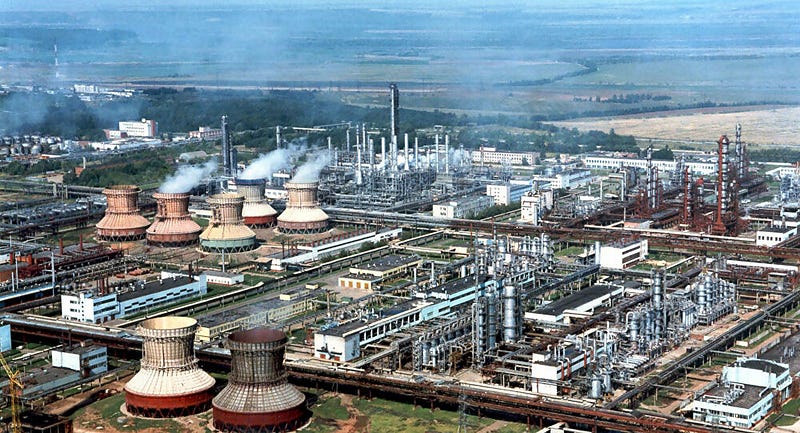

It was the early ’90s. Over a 2 year period I lived and worked in Russia, starting in St Petersburg. After that I was based mainly in Moscow but getting out to such places as Krasnodar (Cossack Country), Nizhni Novgorod (ex- Gorky and home then of Russia’s avionics industry), Siberia (cold, with a heavily polluting aluminium smelter and low life expectancy) and quite a few other places besides.
It was a fascinating period in my career and I learned a lot about the Russian people and culture — and vodka too. And yes, I even visited a dacha and did the sauna and plunge pool bit. They’re a great bunch of folks in general and it’s sad to see what their country has been brought to by a madman.
When I was first in Moscow, I stayed for a few weeks in the Hotel Metropole (I don’t know how long that link will be alive and no, I have NO affiliation). Okay, it was only an attic room at a special rate, but you know, Thatcher and Mao Tse Tung had stayed there too — but not in the attic! Then I moved to an apartment, still near the city centre. A previous occupant had been found dead, stabbed in the bath. I even saw Yelstin speak outside St Basil’s Cathedral. Stories galore to dine out on!
Anyway, the company I then worked for had developed PC software for use in the privatization of Russian industry.
And that’s really what my story is really about.
The privatization process
The privatization of Russian industry took place in two stages, the first stage being from 1991 to 1992 and the second stage taking place from 1993 to 1995.
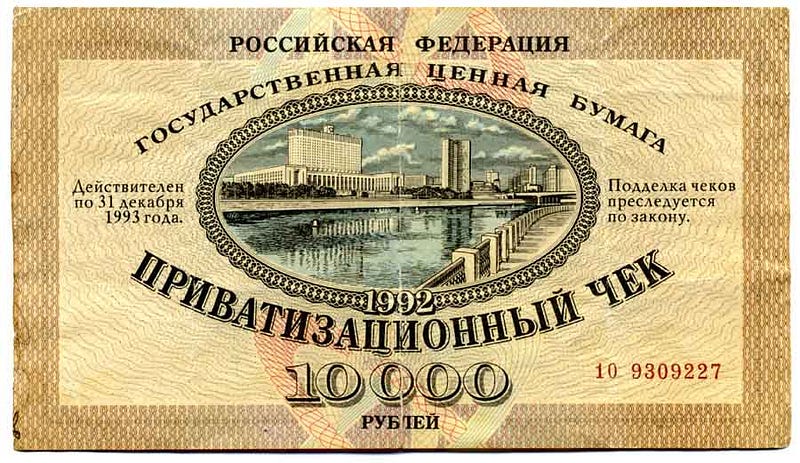
The voucher privatization scheme was introduced in Russia in 1991. This scheme allowed citizens to purchase shares in state-owned enterprises using vouchers. The voucher system was introduced as a way of quickly privatizing Russian industry. However, it was often chaotic and led to a number of legal disputes.
In 1992, the first stage of the privatization process ended. In this stage, state-owned enterprises were divided into shares which were then sold to individual citizens through the mechanism of vouchers. These shares could then be traded on the open market.
Curiously, perhaps, the voucher system was designed to prevent to accumulation of shares and power by individuals such as ‘buzinessmen’ and Mafia gangs. But it didn’t work out like that.
In 1993, the second stage of the privatization process began. This stage saw the shares offered for sale to foreigners and Russian companies. This was done in an attempt to raise money for the Russian government. However, many of these sales were cancelled due to the economic recession.
The privatization of Russian industry was largely successful. However, it did lead to a number of legal disputes and created a number of billionaires. It also led to a significant increase in inequality between the rich and poor as a result of corruption in the auction process. Oligarchs were the main beneficiaries of this process.
It was a controversial process. Share ownership and control of the state enterprises became concentrated in the hands of a group of young entrepreneurs who were the main beneficiaries of this process. 30 years later we now know them as Russian oligarchs with names such as Deripaska, Abrahmovich and Usanov. There was also a significant increase in inequality between the rich and poor as a result of corruption in the auction process.
The voucher system
I was a small cog in a big wheel, working with a mixed Western/Middle Eastern/Russian team of software developers. The Russians were hugely capable, well educated and there were several Ph.Ds in our team, yes, even including a rocket scientist.
The software we developed was to be used to manage the share auctions, which were being done oblast by oblast (state by state) and by enterprise (embracing the manufacturing, financial services and energy sectors) within those oblasts. The software would collate the bids (an individual’s bid being say 10 vouchers per share for an iron foundry). Then when all the bids were in and the clock stopped, a button would be pressed and after analysis a strike-price would be set for one share. I don’t recall whether there were bulk prices.
Of course many of the industries were hopelessly inefficient and many Russians saw them as bankrupt and their vouchers worthless. Some others didn’t and bought up the vouchers street by street for peanuts. Then they put their bids in. Now they are oligarchs.
The Russians had their own software — there were many small local firms trying to get a grip on the market. The oblasts (who were running the auctions) did not have hard cash for Western-developed software.
But they had other stuff besides cash. I was at a party one night and was offered 400 tonnes of Red Army diesel fuel, loaded on a barge and ready to go down the Moskva River. Not for the team you understand, but for me, personally. Like I could do something with it?
As a team we were once offered aluminium saucepans in bulk for software. And also, the Russians often asked us to ‘sweeten the deal’. They’d buy if we’d throw in 100 IBM PCs (which we never did). It was like the Wild West there — and the outlaws were real, as I discovered.
The auctions
There were many scams, disputes and a few murders, but I was gone by then, on to Kazakhstan to get involved in their privatizations. It all sound very grand but all I really was a lowly consultant, planning rollouts of the software (which never seemed to happen, the big wheel did not turn).
But even when I was there we were aware that there were organised collections of vouchers taking place— it was perfectly legal and not secret. People — and gangs — were openly seeking them. Most Russians would rather have a day’s food than a ‘valueless’ piece of fancy paper. The danger came when an individual had amassed a pile of them.
There were forged vouchers too, despite them being printed to bank note standards.
The outcome
The process went on for several years. Despite the problems, the privatization of Russian industry was, arguably, a positive development for Russia with industries rapidly adapting to survive — or dying. It was Darwinism in the commercial world. Nothing on that scale had ever been done before in a ‘modern’ economy, so there was no model.
It allowed for the creation of a more efficient and competitive economy. It also led to the development of a number of new businesses and industries.
And it created many Oligarchs.
But in reality Russia has a small economy, about $1.3 trillion GDP — the size of Italy’s, so that gives you a perspective. Most of Russia’s wealth is in the ground — minerals and hydrocarbons — diamonds, gold, oil and gas. And it looks like it will stay there for quite some time now that export markets are, in the main, closed off.
So, they can’t even auction the stuff in the ground. And they can’t get at their gold in Switzerland, or sell their prime properties in the world’s great cities (except, perhaps, Moscow).
My one disappointment was never visiting Volgograd (ex-Stalingrad).
Here’s a little more background:
Tongue in cheek —
Roman Abrahmovich and his ownership of Sibneft —
About me: If you follow me I guarantee variety in your inbox! I write on a variety of topics including humor, tech and travel, together with daily news events and the minutiae of my daily life living on a boat. I also write techno-thrillers…and about…
…my Wild West days in Russia
If you enjoy reading stories like these and want to support other writers and me, consider signing up to become a Medium member. It’s $5 a month, giving you unlimited access to incredible stories on Medium. If you sign up using my link below, I’ll earn a small commission at no extra cost to you.
You can follow me on Facebook Twitter @jamesmarinero . On Pinterest you will find many of my research photos from around the world. Check out my website where I occasionally have a free book on offer.