
The Correct Way Of Reading Articles Under The New (Medium Payment Methodology) So Authors Will Get Paid
Medium’s new payment algorithm does not recognize all types of Reading styles as “real” Reading

I know many members of Medium who are members of Medium Partner Program are well meaning folks, and when they read their colleagues articles, they genuinely would like to see their colleagues get paid for their hard work. Unfortunately a closer look indicate that people have been reading their colleagues articles the “old way”, so their reading is often not being recognized by Medium’s algorithm as a “read”.
Remember towards the end of October, Medium Changed it’s payment methodology. Now many people who have gotten use to a certain way of reading their colleagues articles may think that following the same style of reading will be recognized by Medium’s algorithm.
Unfortunately this is not the case. Although no one knows exactly how Medium’s algorithm actually works, it is prudent to predict that Medium will fine tune the New payment algorithm to weed out “suspicious reading” and other forms of inconsistent reading.
What that means is that unless people go to extra lengths to read articles in-depth, consistently and avoid “suspicious reading”, the authors of the articles they are reading are not going to get paid.
Research shows that there are so many ways that people approach their reading, unfortunately since money is involved when it comes to recording “member read time”, and compensating the authors of the articles being read, the Medium algorithm is not going to recognize all types of reading styles as “real” reading.
This means members have to educate themselves on the different types of reading that exists, and which of these types are likely going to be recognized as “actual reading” by Medium’s algorithm.
So what are the different types of reading that exist?
According to researchers at the University of New Zealand, there are three different styles of reading:
1) Skimming
2) Scanning
3) In-depth reading.
Each of these styles of reading is employed by the reader for a good reason.
Skimming
Skimming means to read a page or handout using a “skip read” method.
This is done by reading the headings and first sentences of each paragraph or section. It usually takes three forms: Preview, Overview and Review.
Scanning
The Scanning style of reading differs from skimming in that the reader do not deal with all of the content, but search through the material for a specific purpose or a specific word (or its synonym).
For example, readers who are trying to find answers to a question, or seeking an appropriate quotation reference or statement, trying to locate names in a directory, words in a dictionary, prices in a catalogue, etc, are not going to read the whole article. These type of readers are still reading, but they will utilize the scanning method of reading to find what they are looking for.
Now take note that when you scan, you cover only as much of the content as is necessary to accomplish your purpose, but this type of reading is still engagement with the article, because most readers who employ this style of reading, end up finding answers to what they are looking for from an article.
In-depth reading
There is no doubt that In-depth (or detail) reading is the most involved and most engaging style of reading. The purpose of this style is to understand the concepts and arguments that the text contains. Readers who employ this style of reading, sometimes do so only after skimming the text.
So you see, all the three major reading styles are employed by readers to accomplish a certain purpose. None of these three reading styles is superior to the other. Each one is efficient and very effective at accomplishing the purpose for which it is used.
Now although I will personally recognize all the three types of reading as “real reading”, I am not the creator of Medium’s algorithm.
The creator of the algorithm has most likely made it to disregard the Skimming and Scanning types of reading styles, and and is only recognizing the “in-depth” style of reading as actual reading.
How do I know this?
I like doing experiments to prove things, so I conducted an experiment and had my friend read three different articles I have written using the three reading styles that I have enumerated above. At the end of the experiment, the two articles that were read by my friend using the Skimming and Scanning reading method recorded that someone has “viewed” the article, but did not read it. On the other hand, the article that he employed the in-dept reading style as his reading method, was quickly recorded by the algorithm as having been viewed and read.
So the point I am making is that if you are going to open your colleagues article to read, take into consideration that there is a “new algorithm” in town. The old ways of doing things no longer work very well when it comes to recognizing “member read time”. The new algorithm seem to only recognize the in-depth reading style.
The way the new algorithm recognizes the in-depth reading style is to immediately check when you open any article, what the article’s read time is. This is usually indicated at the topmost right corner of the article. See illustration below:
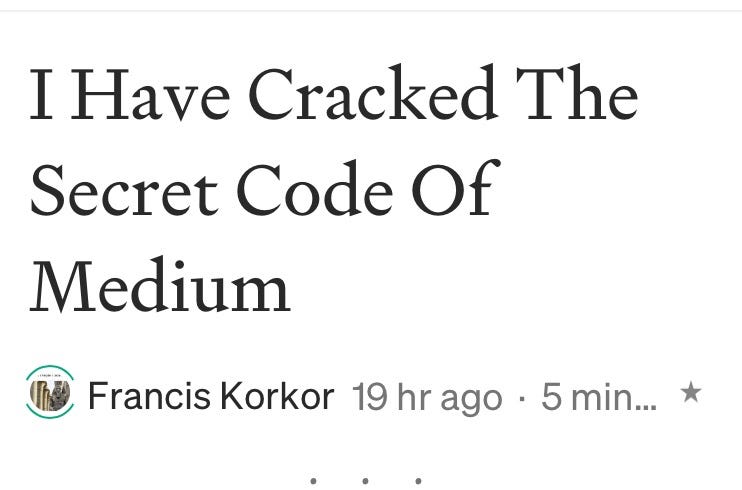
Now let’s say you open an article and see an article read time of 5 minutes at the top right corner of the page. You the reader has to read the article and try not to complete the reading earlier than the article read time of 5 minutes. Also whiles reading, the reader has to periodically touch the screen (in the case of a smartphone), or slide the cursor in the case of those reading from a desktop computer, to indicate that they are actively reading the article.
In my experiment with my friend, we realized that it is only by doing all the above that the reading was recorded by the algorithm as an “actual read”.
So in conclusion, I know in-depth reading is hard, but please let us recognize that writing an article is even harder. Therefore if we decide to read the articles of our colleagues and we truly want them to be compensated by Medium for their efforts, then we should use the in-depth reading style for all articles.
The old approach of quickly skimming or scanning through an article and skipping to the end to clap, highlight and comment. is no longer being recorded as “member read time” for payment purposes.