
The Conflict Between Religion And Philosophy
Fundamental differing
Any conception that attributes a specific function to religion and does not reduce it to a subsidiary activity of morality or of life in general, must recognize that philosophy and religion are only two degrees (or different manifestations) of a single activity, which can be generically called, in a broader sense, religion.
These two degrees essentially differ in the distinctive character of the respective theoretical conception. In the first, which we can say religion in the strict sense, it is mainly an imaginative, aesthetic conception.
In the second, which is called philosophy, it is largely a rational construction, a logical system.
Secondary differences are then knitted to this fundamental difference.
Religion (in itself) is generally based on a tradition, expressed in a collective life, while philosophy is, in a greater degree, a personal creation, experienced to an individual level.
The intermediate forms (philosophical religions, theosophical sects, schools of Greek philosophers, etc.) confirm this distinction. Nominal characterization is most often applied based on external differences.
Hence, it can still be understood why the word philosophy is generally used to designate the theoretical side (an abstraction, most of the time) of that activity, which in its totality should only be entitled to this name.

Symbolic war
That said, how does history present us with an incessant conflict between philosophy and religion, and that this conflict persists today, despite repeated attempts at conciliation, as an incurable inner contradiction of the spirit?
The reason for this conflict lies in the same affinity, indeed the identity of nature of philosophy and religion.
It is futile to hope that this struggle will end one day, because it is the struggle of the superior forms of religious life, against traditional and ancient forms.
This will become clear to us if we take the process of religious evolution in its essential moments, somewhat more closely.
Origins
Every particular form of religious life is always at its beginning the creation and life of a brilliant individuality.
Religion, as a historical fact, is the result of an ingenious tradition, in which each symbol represents the memory of a religious intuition, even if it, like the works of art of a remote civilization, no longer contains anything that you can recall to your mind the primitive sense.
From the creative individualities, religious life spreads in an ever wider circle for the same process of imitation that occurs in all forms of social life and that only makes it possible to initiate the multitude to a higher life.
But this expansion of religious life is inseparable from a kind of degradation, which we shall call the paganization of religion. It consists in what imitation propagates the symbol of the higher religious life, but cannot, due to the mental inferiority of the subject, reawaken the corresponding inner life in it.
Hence, either we have the pure and simple transmission of the symbol, or, as most of the time happens, the symbol passes to cover lower and pre-existing forms of religious life, which continue to live in the new form, without a sensible elevation.
The paganization of Christianity in the first centuries of the era, the passage of conceptions and customs of Germanic polytheism in medieval Christianity, the theistic and polytheistic degenerations of Buddhism give us numerous examples of this degeneration that accompanies the extension of religious symbols.
In between, we recall the divinization of religious heroes.
Buddha conceived his mission as something purely human and did not want his followers to have other object of veneration than the doctrine he preached.
This did not prevent popular faith from making him a god and weaving life into miracles.

He too voluntarily descended from heaven and incarnated himself in the womb of a virgin. Miraculous signs accompany his conception and birth.
An old hermit is drawn from these signs to the city where he was born, prophesies of his future mission and regrets that he can no longer see those times.
The young Buddha excellence surpasses all men and teaches his own teachers; his preaching is preceded by the temptation by the devil, Mara.
Even his death is accompanied by wonders: even Buddha rises for a moment, in order to show himself again to his disciples.
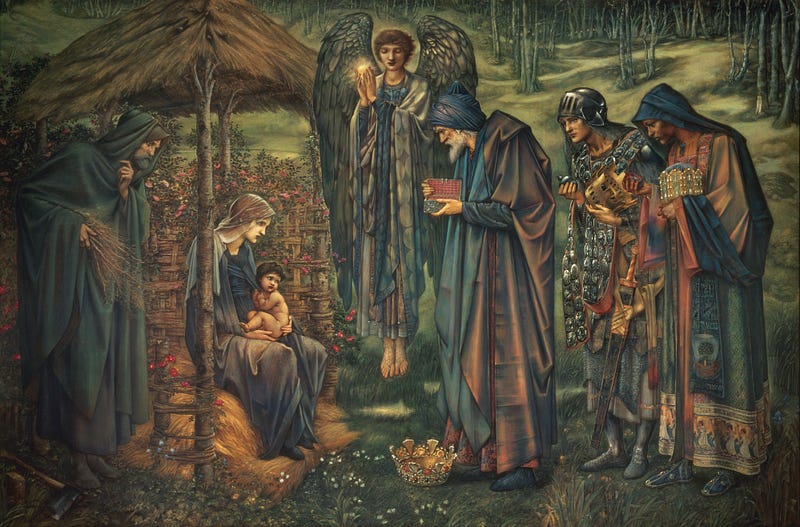
Secondly, let’s remember the flourishing of polytheism in higher religions.
In Buddhism, the ancient Vedic gods are preserved and welcomed in the Buddhist sky, although degraded and subjected to Buddha, indeed to the countless Buddhas and Bodhisattvas.
The Buddha himself is surrounded by the cohort of countless past and future Buddhas; and even in Buddhism, the need for personal worship can make its way into the worship of Maitreya (the Benign), which is the next Buddha.
It is hardly necessary to remember how the Tibetan church believes it has an ever-present incarnation of the Buddha in his pontiff, in the Dalai-Lama.
Thus, in the Christian church, the gods of paganism are recognized by the church fathers, but as demons! And their place is taken by angels.
The thriving cult of heroes, which was the essential part of the ancient popular cult, continues with the veneration of the saints and martyrs who have the same place in current popular Christianity.
The replacement is clear in the highest degree in some cases, in which, in some sanctuary or sacred place, was only superimposed on the worship of a god or hero that of a Christian hero.
Mutation
Finally, let’s remember the degradation of practical symbolism to a magical, theurgic materialism.
Baptism, for example, is no longer just the sign of an inner purification, but it is a magical act, which has for itself the virtue of erasing the original impurity.
The sacred dinner is no longer a symbol of an inner communion, but a magical transformation of consecrated species.
It is no wonder that symbolism thus understood is accompanied by the use of amulets and other practices, proper only to inferior religiosity.
This adaptation of a religious concept to the lower collective mentality is revealed, moreover, as well as in symbols, also in discipline and morality.
It is well known that Buddhism, which was initially an ascetic congregation of monks, had to welcome the secular world around it, as a third-order species with less rigorous observance.
Even primitive Christianity, so hostile to the world, also had to spread its part to the world; and thus, alongside the morality of the perfect ones, as a sort of minimal program, to welcome a lower morality even too reconcilable with the demands of eternal life.
Now, of course, all this is not without provoking a reaction in sincerely and highly religious souls. In the history of religion, this process of exteriorization, of paganization, is constantly opposed by a process of internalization, of elevation, which manifests itself variously, according to the circumstances, such as asceticism, as mysticism, as heresy.
Hence, with some reason it has been possible to say that the true history of religion is the history of heresy.
This is called a “mystical reaction”.
Most of the mystical sects and heresies that flourished in the West in the second half of the Middle Ages represent a mystical reaction against the paganization of Christianity.
In fact, they agree in general not only in the aim of bringing the Church back to the purity of the primitive faith, but also in the rejection of most of the sacraments and rites, in the contempt for external and superstitious formalism.
The pietism was a revitalization of the mysticism that had already inflamed the great reformers, a reaction against the arid formalism in which Lutheranism had degenerated, a movement in favor of religious piety.
But the brightest example of this form of reaction of religious conscience is given to us by Jewish prophetism.
The purpose of the prophets (especially up to Jeremiah) is not so much to fight against the particularism and anthropomorphism of the Jewish conception of Yahweh, but to purify the cult of Yahweh from superstitions of local and foreign origin that continually re-pecked within the very bosom of mosaic Jahvism.
And it is noteworthy that when, after returning from exile, the prophetic ideal of the Mosaic theocracy was realized, the ideal, realizing itself, fell, in other forms, into that same corruption that the prophets had fought and the ancient superstitions revived in priestly worship.
The cult was then addressed only to Yahweh, but it became a purely formal cult and polydemonism arose in the dogmatic representation of angels and demons.
The ritual ceremonies of purification and expiation replaced the magical rites of popular naturalism. The religious conscience of the post-exile prophets rose up against this new paganization of mosaics.
And this reaction, of which we have the first beginnings in the pious religiosity of the Psalms, had its highest representative in Jesus.

Awareness
The mystical reaction should in its purity be a restoration, an inner revitalization of an undisputed system of symbols.
And although it is never really such, because a pure and simple restoration is historically absurd, and because other motives always flow into it, is doubtful that in many cases it constitutes the essential moment of religious renewal.
But this renewal can proceed in certain cases also from another reason.
It can present itself as a reaction not only against the degradation of symbols, but also against the very constitution of these symbols, as an expression of their insufficiency in the face of the progress of religious life.
Each system of religious symbols is always originally also a theoretical construction based on a brilliant vision of reality.
This vision constitutes the “highest form of knowledge”.
The same need, however, that gave rise to the first symbols (the fixation and transmission of religious life) pushes the spirit towards the creation of a conceptual, logical symbolism.
Under the same pressure of a wider and intellectually refined religious life, the logical thinking, exercised already by practical needs, opens itself to the disinterested consideration of the whole and tries to fix this religious attitude in adequate symbols, in a conceptual system of universal and objective value.

Action-Reaction
However, this action most often has conciliatory tendencies at its beginning and is applied to transforming, rather than breaking down, the ancient aesthetic symbolism.
Then there is a kind of balance between the interests of religious conscience and those of logical thinking.
The followers of religion are the most fervent proponents of knowledge and culture; the system of religious symbols folds, due to the natural faculty of adaptation, to changes in the intellectual environment.
But this balance, which marks the golden age for religion, is extremely unstable in its nature. The ability to adapt and assimilate has limits, while on the other hand the progress of knowledge recognizes no boundaries.
There, therefore, necessarily comes a time when religion and logical thinking are found as two hostile forces.
The tireless work of conciliation and assimilation no longer succeeds in erasing the nascent divergence, destined to become greater every day.
And then there is, from the religious conception, that form of degeneration which we will call “dogmatic stiffening”.
This, as for an attitude of defense, is fixed in a closed system, hostile to every penetration of new intellectual elements; poses itself as something absolute and unchangeable and projects this definitive integrity into most remote past.
Well known is the tendency of Catholicism to date ceremonies, cults, dogmas that arose only much later and little by little from its origins.
And equally in Judaism, after the exile the theocratic legislation is traced back to Moses, which is the ultimate result of prophetic activity.
And since habit and tradition have linked in an indissoluble way the benefits of religious life to that conception, its cause becomes the cause of religion.
It is consecrated and defended in the face of criticism of the intellect for a kind of piety, scrupulous, as the ancient and rough images are preserved out of pity, preferring them also to the most perfect creations of art.
In this we must undoubtedly see a manifestation of the instinct for conservation, which performs a similar function in religious life to that of political conservatism.
The closest example to us is that of the establishment of Christian dogma, especially in its most rigidly conservative form, in Catholicism.
See, for example, how the living and profound conceptions of ancient thought have crystallized and immobilized in it.
Hence it is further explained how this dogmatic tightening is frequently accompanied by intolerance.
Those who consider their truth as a truth of divine origin, consecrated, as well as from its origin, from the authority of tradition, are naturally taken to consider this truth as the only truth and faith in it as the conditio sine qua non of religion.
Any other belief can only be an inexcusable mistake, because it leads to irreligion.
Now, those who see religion as a right and the supreme good of humanity and must therefore promote its conservation, must also fight for the integral preservation of the faith, for the repression of all contrary beliefs and persecute those who profess them as enemies of religion and true piety.
It is natural that when a religion has not only undergone the process of degradation that provokes the mystical reaction by the force of things, it has closed itself in a system of dogmas hostile to intellectual life, which is also the active foundation of religious life.
It provokes a much more intense and profound religious reaction, a reaction that must aim not only to reform religious life in its interior, but also and more to renew its theoretical foundation.
The religious renewal movement then has a character that is both mystical and speculative.
All ages in which an intense spiritual movement preludes to the formation of a great religion present us with both distinct aspects.
Brahminic ritualism, which had systematized Vedic polytheism in a vast theological system, was based on a conception, which, as we already see from some of the more recent Vedic hymns, was inferior to the new demands of thought; on the other hand, it included in itself rites and animistic elements belonging to previous religious periods.
The reaction that led to the Buddhist revolution presents itself on the one hand as pantheistic speculation (Upanishad, pre-Buddhistic philosophies), on the other as an ascetic and mystical reaction.
The latter is the character that prevails in Buddhism, which, although unwittingly based on the anterior speculation, disdains speculation and reacts in particular against the superstitious formalism of Brahmanism.
Thus, the religious current that led to the establishment of Christianity has its roots in that mystical reaction against pagan polytheism which already begins with Greek orphism.
On the other hand, it has its speculative antecedent in the development of Greek philosophical thought, from the Eleatics to the Neo-Platonists.
And both elements are found equally in the movement that precedes the reform. Movement conditioned both by the flourishing of mysticism and by the intense intellectual renewal of humanism.
These two aspects of religious reaction generally constitute two distinct currents; but this does not mean that the mystical character excludes the speculative character or vice versa.
Indeed, it can be said that the distinction between the two currents is given only by the prevalence, not by the exclusive presence of one or the other character.
In the Orphic current, there is also a certain speculative movement, while on the other hand the religious and mystical character also permeates Platonic speculation.
Nor is it any wonder that the mystical spirits, who react especially against religious paganism, also partially feel the need for a reworking of the theoretical foundation.
A need that is often found in them due to an allegorical interpretation of ancient dogmas, in a form that can cover even the most daring speculations.
So, in some cases it is difficult to decide whether we are faced with a heretic or a philosopher. In most cases, one character clearly prevails over the other.
Where the reaction is mainly mystical, we have a religious reform or heresy.
Where it is mainly speculative, we have a philosophical movement.

Conclusions
This fleeting glance at the process of religious evolution allows us to characterize in a precise way the place that philosophy occupies in it.
It is a speculative renewal of the theoretical material of religious symbols and its rise is closely connected with the passage from aesthetic symbolism to rational, logical symbolism.
It is therefore always, when considered in its totality, in which discordant and opposite moments are integrated, aspect and vital factor of a great religious movement; and its apparent conflict with religion is not the sterile antagonism of two foreign and hostile forces, but is a simple form of that struggle between conservative and innovative tendencies, which in every field of life prepares progress towards forms superior.
What we have called from a temporary point of view the degradation of religious life is, from a more universal point of view, extension and consolidation, conversion of brute and hostile forces.
And what in philosophy can rightly appear to religion as irreligious denial, is always, from a more comprehensive point of view, an interior preparation for a more intense and profound religiosity.
Hence it still appears how superficial and vain is the hope of an agreement, of any reconciliation between religion and philosophy, by means of a subordination or a mutual delimitation.
As in any other field, the utopia of an idyllic peace, which thought sometimes pretends to be the future term of the process, has no other meaning than to be the figurative representation of an ideal norm relating to the present.
Only a definitive evolutionary step for humans may overcome this struggle.


