
3 Steps To Build Your Unique Niche
Make the world accept you for who you are

Personal Monopoly, termed by David Perell, is the epicenter of a personal brand. It’s the unique intersection of your skills, talent, and experiences that allows us to carve your path in the overflooded world of the internet.
In his book, How to Fail at Almost Everything and Still Win Big, Scott Adams, founder of Dilbert comics, talks about two valuable ways to become invaluable to the world. The first one is to the Lebron James of your craft, i.e., to be the best at what you do. To be in the top 1% takes years of hard work and practice, and 99% of people fail to get there.
The second way to become valuable is to combine two or more skills to build a Talent Stack. You may not be best in one thing, but you’re above average in two or more, and that could be your monopoly.
“Build a talent stack. For instance, I’m pretty good at drawing but not the greatest. I’m pretty funny but not the funniest. And I’m pretty good at business but not the best.”
— Scott Adams
The first time I heard about combining two things and building a new niche was from James Altucher. In his book Choose Yourself, James talks about Idea Sex, which is nothing but combining two or more ideas to build a new one.
Many great personal brands have been built by being above average in multiple things, including Altucher himself. His interest in writing, podcasting, and stand-up comedy separated him from tons of other investors. He confesses that he isn’t the best at any of it, but he’s probably the only person who’s the best at combining all these skills. As he says
“Take two things. Take three. Combine them. Now you are the best in the world at the intersection.”
The central idea of creating your niche is letting go of the prerequisite notion that you have to choose one thing and then spend 10,000 hours perfecting it.
Another excellent example of creating your niche is Naval, founder of Angel List, investor, and philosopher. In his interview with Joe Rogan, he mentioned how — “No one can compete with you on being you.”
If you look closely, you’ll know that all the greatest brands and personalities around us are a mixture of all their interests. The reason they succeeded was that they were not competing against anybody. They were their only competition, be it Oprah, Elon, or the famous YouTuber Ali Abdaal.
“Truly groundbreaking ideas are rare, but you don’t necessarily need one to make a career out of creativity. My definition of creativity is the logical combination of two or more existing elements that result in a new concept. The best way to make a living with your imagination is to develop innovative applications, not imagine completely new concepts.”
— James Altucher
If we follow our curiosity and focus on what areas we are good at, we can also create our niche.
3 Ways to Build a Personal Monopoly
1. Self-Awareness
Internet is the Ginnie that can make your wish come true, but if you don’t know what you want, the Ginnie can’t help you either.
Before you even think about building a business or a personal brand, you have to know who you are, what makes you different from others, how’s your brand is different from millions of other brands in the market. When it comes to building a personal monopoly, you have to know where your interest lies and then spend some time to figure out what’s vital for you and what needs to be eliminated from your brand.
A few tips for practicing self-awareness
- Focus on where you’re spending your free time. Are you playing a particular type of video game or a genre of books you can’t keep down?
- Journaling prompts are another way to find out more about yourself.
- What do you think about most when you’re free?
To make people know how you are, you’ll have to know yourself first. Self-awareness is required to understand your likes and dislikes. Once you figure yourself out, you can dive deep into what you find curious.
2. Curiosity
Following your curiosity allows us to unleash our imagination.
Steve Jobs's curiosity made him attend that typography class, which became Apple’s core differentiator in the market. Elon’s curiosity about space made him build SpaceX, which became the first privately funded liquid-fueled rocket to reach orbit. The first personally developed liquid-fueled rocket to put a commercial satellite in orbit.
When I got hopeless about not finding my passion, I started spending my time on hobbies that made me curious. I would read various books on mindset and listen to different podcasts. It led me to start my podcast and build a business around it.
Elizabeth Gilbert, the author of Eat Pray and Love, divided people into two categories: passion — jackhammers and hummingbirds.
- The Jackhammers are the ones who have known their passion all their life, like herself. They learn early in their lives whether they want to be writers, actors, or inventors.
- Hummingbirds discover their passion by experimentation, cross-pollinating various ideas, and following their curiosity.
I would be lying if I didn’t mention that I am a Jackhammer. Ever since I was 13, I thought of being a writer. But I know I am far from being a great writer, and there are tons of writers in the world. To make my way in the world, I followed the Hummingbird approach and followed my curiosity to journal writing. The whole shebang gave me the idea to design an interactive book (a prompt-based journal).
At that time, I had no idea what I was doing; I just kept digging deeper into writing therapy and journaling. But now, Silver Lining Journal has become my identity.
“I have no special talent. I am only passionately curious.” — Albert Einstein
3. The First Principles Thinking
Aristotle defined a first principle as “the first basis from which a thing is known.”
When we try to get out of our comfort zone, our assumptions get in the way. When we try to get rid of such premises and beliefs forced by society our parents challenge us.
First-principles thinking allows us to think from a blank canvas and draw a new painting from scratch. A whole new world of possibilities opens up when we are free of prejudices and beliefs.
All the tech companies serving the world came up with groundbreaking ideas because of first principles thinking. Who would have thought that you booking a taxi on your phone was going to be a norm(Uber), staying at someone’s home was better than staying at a hotel(Airbnb), or people would be interested in finding a date online(Tinder).
Well, somebody did.
If you want to find a unique voice for yourself or build your monopoly, you’ll have to think differently. What’s going to make you memorable hasn't been done before, and if you don’t believe in the first-principles thinking, you’ll never be able to build a personal monopoly.
Instead of handicapping your ideas, focus on the possibilities.
- If you have an idea you love, but people call it stupid, asking FIVE WHY’s will change your approach. It’s creating a cross-training way to get to the root of an issue.
- First-principles thinking is the opposite of the dogma and questioning the pre exquisite notions. Be okay to be the only one believing in your idea.
Nobody is a better example of First Principle’s Thinking than Elon Musk. In his own words
“I think it’s important to reason from first principles rather than by analogy. The normal way we conduct our lives is we reason by analogy. With analogy, we are doing this because it’s like something else that was done, or it is like what other people are doing. With first principles you boil things down to the most fundamental truths…and then reason up from there.”
How To Create Your Niche Using Your Personal Monopoly
Once you’ve understood your drive and learned enough about yourself, you can follow the DICE method to build a custom niche.
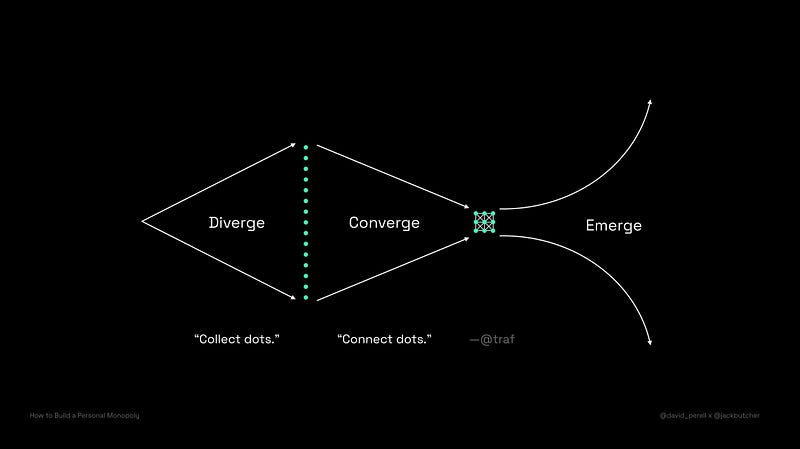
Jack Butcher, the founder of Visualise Value, explains how he managed to create his niche using the DICE framework.
- Diverge: Experiment with various ideas and experiences and explore multiple domains to develop a pool of ideas and interests.
- Converge: Once you have enough raw material and experiences to work on, converge it down to two or three groundbreaking ones.
- Emerge: Once you find that mix and that specific idea that has come from 100s of other ideas combined — build a product/service/content to share it with the world.
However, there’s a downside to the DICE concept—it can work for people who have some idea about what they want to be known for and what kind of brand they want to build. They have concrete ideas and are already in the process of building a personal monopoly.
Conclusion
- Building a private monopoly starts with self-awareness. Knowing your unfair advantage can help you find the groundbreaking idea that can kickstart your career. Your unusual experience can be your unfair advantage and can help you build your monopoly.
- The best part about building a personal monopoly is not worrying about the competition. Sure, people will still copy you here and there, but you are the innovator, and competitors will struggle to keep up with your Talent Stack.
- Being an innovator and creating your niche wasn’t possible a few years ago, but the internet has allowed us to embrace and explore all our interests. If you fail once, you can try again. Remember, most people you admire also start from scratch.
“Creativity is simply the ability to connect the dots that others might never think to connect.” — Carolyn Gregoire
We all have the liberty to be the renaissance man and create our very own masterpiece.
Use this link to get full access to Medium and read gazillion exciting articles. You can stay in touch with me by joining my free email list.


