
The Concept of Li (理) in Confucianism
The Uniqueness of Japanese Confucianism — Part 1
Series Introduction
Confucianism has never been limited geographically to China. It has influenced the intellectual traditions of practically every nation in Asia; an influence which can be seen even today.
Japan is no exception.
In this series of essays I will argue that, while Japan has been influenced by Chinese Confucianism, Japan has not simply bought wholesale into the tradition but rather has developed a uniquely Japanese form of Confucianism.
This uniquely Japanese form of Confucianism is noticeable with regard to the idea of li (理 , ri in Japanese).
In this three part series I will:
- Provide a brief description of the historical development of li in Chinese Confucianism,
- Look at Ito Jinsai’s and Ogyū Sorai’s interpretation and critique of li in Confucianism
- Through comparison of the Chinese and Japanese interpretations of li, argue for the uniqueness of Japanese Confucianism.
Let us turn to part 1.
Chinese Understandings of Li (理)
An important concept in the Confucian tradition is li; which has traditionally been translated as “principle.”
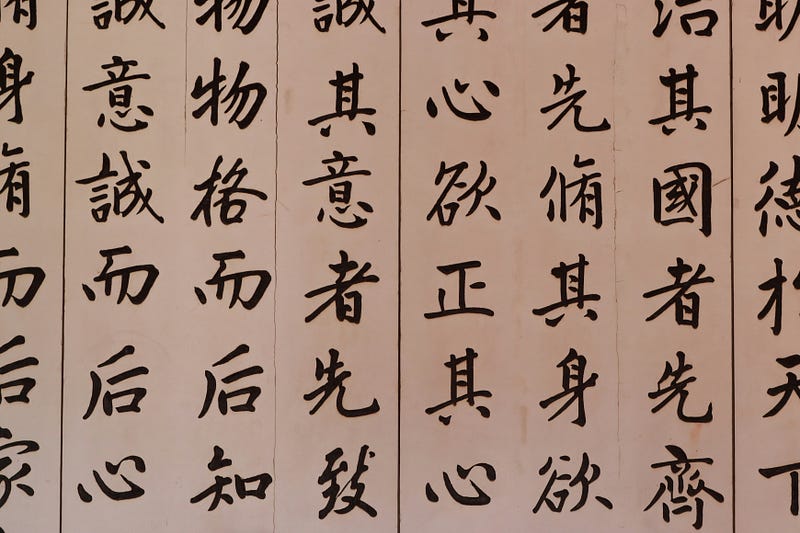
Looking at the character itself (理), it is easy to see that how li might be translated as “principle”. The character literally represent the natural patterns in a piece of jade. “Principle” is drawn from the governing rules or laws by which something is divided such as the natural patterns in a piece of jade.
Yet this translation misses a vital aspect of li. Brook Ziporyn says that,
In its earliest uses, li is a verb meaning to organize raw material by dividing it up in some particular way, including dividing it up by cutting something away from a background, and to shape it into a coherent object that further coheres with some human values. [1]
He claims that translating li as “coherence/cohering” is a more complete translation as it includes not only the dividing up of something but also the forming of something that fits within a framework, something that coheres with other things.
Thus, li constitutes not just simply the rules that govern things, but the way in which the rules work together to form a complete and coherent whole.
Ziporyn goes on to say that
li is a harmonious coherence, which, when a human being becomes harmoniously coherent with it, leads to further harmonious coherence. [2]
Li is a vibrant notion, one that changes according to the things which are part of it.
Roger Ames and David Hall add that,
li establish the ethos of a given community. As such li may never be considered as independent of context….li constitutes an aesthetic coherence. [3]
Despite the importance of such a concept, li does not appear even once in the Analects and occurs only seven times, in three different passages, in the Mencius.
Four of those times li refers to “stripe like orderliness” used to describe musical harmony with stripe like orderliness referring to the clear start and end of sections or pieces of music that allow for properly harmonious music (Mencius 5B1).
The only other meaningful use is in comparison to how “coherence and rightness” pleases the heart-mind (心) like good food pleases the mouth (Mencius 6A7).
While the idea of coherence is in line with the uses of li in Mencius, it is not until later Confucian thinkers that li comes to be used more abundantly and in a more technical manner.
Xunzi and Neo-Confucianism
Xunzi is first after Confucius and the Mencius to fully develop a concept of li. The term goes from being used only a few times in the Analects and the Mencius, to appearing over 200 times in Xunzi’s writing.
The increase in the amount of times li is used is primary due to the fact that Xunzi equates li with what is good. Ziporyn says that
order per se is for Xunzi a near-synonym for value…when Xunzi says “bad,” he means disordered, that is, incoherent in the sense of self-conflicted.
What is good or correct is then what is ordered and coherent without any inherent self-contradiction. This is an important developmental step since, as noted in the previous section, the notion of li did not have value necessarily associated with it for Confucius and Mencius.
The attribution of good to li is a result of a legalism that was popular in Xunzi’s time.
The view held that everything was in chaos and order and structure, li, needed to be sought in order to overcome such a state. With this rituals (禮) become more tightly defined and regulated as a means of achieving order. The rituals become a codified practice and not simply the common practices of a culture.
Xunzi, however, is still largely in agreement with Ames and Hall’s interpretation of li in early Confucianism. Xunzi argues for a li that is fundamental to society as it is the communal harmony that a society strives to establish.
Ziporyn says that according to Xunzi li is not to be “found” in the world. Instead it is what the great sages that have selected form a myriad of possibilities. Once a li is established, it cannot undergo wholesale change but only incrementally as need dictates.
Again this speaks to the idea of coherence as to simply remove or alter a part of the structure would lead to a collapse of the entire system like the removing of a rifle from a mutual supporting stand of rifles.
Further support for the cohering nature of li can be found in the relationship between li (理) and li (禮). Xunzi claims that ritual li (禮) is a subset of li (理).
Ziporyn argues that:
“If li meant anything like “reason” or “truth” or “principle” or “order”, we would expect the exact opposite claim: li would be those eternal truths that can be culled from human rituals, the unchanging moral principles. Xunzi’s view is the reverse.”
The rituals are what are fixed, by the sage kings, to form a coherent system that dictates proper action. There is no general li which one can appeal to in order to alter the established system, rather li simply is the coherence of the various ritual li working together to create an ideal community.
With Xunzi one then sees an understanding of li that starts to fill out the notion of coherence.
While focus remains on proper human action, Xunzi introduces metaphysical aspects to li in order to help account for the rightness of the prescribed proper action in that they exemplify li. Such actions, or the ritual li, are part of a coherent harmonious system established by the wise sage kings in order to bring about the most peace and prosperity in the world.
Zhu Xi continues this shift in his work.
Zhu Xi and Li
For Zhu Xi li becomes even more removed from particular actions and takes on greater metaphysical and universal importance.
Zhu Xi explicitly attributes li to the universe with his notion of the Great Ultimate (太極) or the center of all centers. He says that the Great Ultimate is “nothing other than principle,” containing within it:
All actual and potential principles are contained in the great ultimate, which is complete in all things as a whole and in each thing individually.
This equating of li with the Great Ultimate established a dominantly metaphysical li due to the fact that the Great Ultimate is not physical. Rather it is when li and qi (氣) are combined that physical forms arise.
This leads to li being prior to qi in at least the logical sense according to Zhu Xi. He says that there was no time when li was separated from qi. But li is still primary to qi in that it “exists” before qi.
Despite this shift of focus to a metaphysical li, Zhu Xi does not do away with the physical and particular instances of li. He speaks of individual things as having li in two different ways.
Zhu Xi claims that each things has a li that is particular to that thing and also that all things exemplify the same li in different ways.
This makes it unclear if the li of individual things are essentially distinct from the universal li or if they are simply the same li though with different characteristics attached to it. Either way, li serves as a unifying characteristic in some way binding everything together in a comprehensible coherent way.
Zhu Xi expands on the notion that li is good as well.
He says that
Original mind is principle in itself, unmoved and perfectly good, while physical nature on the other hand, is principle mixed with material force; it is the aroused state, involving both good and evil.
Thus it is not the individual li that is good, but it is li in its pure form, abstracted from physical matter. It is the job then of humanity to bring about as much of this abstract li as possible, mainly by coming to know the pure coherence of everything.
Despite the abstract nature of such coherence this is possible since the mind shares with everything the same li, and since it shares the same li as everything it can investigate everything to the fullest extent.
Further li is good in that life is a result of li. Zhuxi speaks of life “flowing from” li. While qi is the material force of things, life flows from li as it is li that dictates the kind of thing something is. Qi combined with the li of a human makes something a human and instills a kind of life that goes along with being a human.
Further Zhuxi claims that there is human welfare built into li. People, particularly the sages, given their ability to come to know the li of other things are able to work with the li of other things in order to achieve harmony in the world.
Having now looked at the development of li in Confucianism, it is possible to give distinctive features that encompass a vast majority of the tradition, something which will facilitate a comparison to Japanese interpretations of Confucianism.
First, there is an overarching theme of an established coherence or harmony. Even with the expansion of li to include more overtly metaphysical aspects, li is the formed coherence from the acts of humanity, particularly the sages. This generated or organized li, is the harmony among individual things that are inseparable from the group.
Second this constructed coherence is something valuable, that is something that is good as it is in contrast to chaos and suffering.
Finally, this view of li is expanded to include heaven (tian 天) such that the entire cosmos processes a coherence in and of itself that is realized by a society. These characteristics of li are what the Japanese interpretations distinguishes itself from and provides its own interpretation of.
In Part 2, I will look at two Japanese Scholars during the Tokugawa era to see how li was interpreted in a Japanese context.
Thank you for reading. If you enjoyed it and would like to support me, there are several ways, all of which I would greatly appreciate.
- Engage with this article by clapping, commenting, highlighting it.
- Subscribe to not miss anything
- Check out more of my work on my website
- Buy me a coffee so I can keep writing
References
- Brook Ziporyn, Beyond Oneness and Difference: Li and Coherence in Chinese Buddhist Thought and Its Antecedents, Suny Series in Chinese Philosophy and Culture (Albany: State University of New York Press, 2013).
- Wing-tsit Chan, A Source Book in Chinese Philosophy, princeton pbk. ed. (Princeton, N.J.: Princeton University Press, 1969, ©1963).