
The Complicated Queerness of this Year’s Oscars
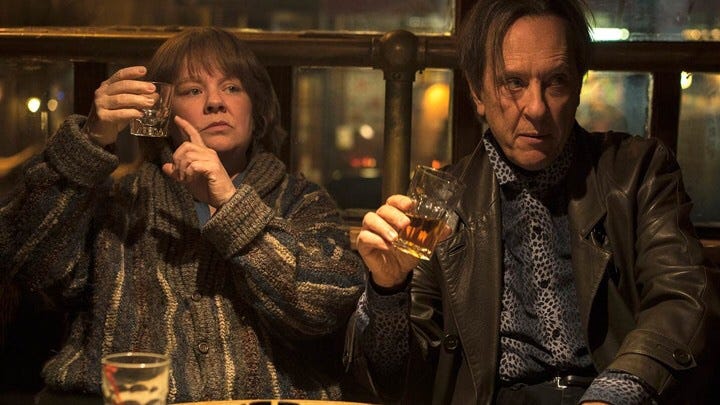
With 7 out of the 20 nominated performances and 3 out of the 4 acting winners going to actors playing sexual minorities, the Oscars made a large step forward in their embrace of LGBTQ stories this year. Unfortunately, many of the stories they feted provide problematic representations of the queer experience.
[Author’s Note: This article reveals plot points for several Oscar-nominated films. Proceed at your own risk.]
The Post-Oscar Narratives
The dominant narrative in the wake of last night’s Oscar ceremony could and should be about race. There were tremendously positive moments regarding inclusion last night, including historic wins for the Afrocentric Black Panther, a long overdue competitive Oscar win for Spike Lee, and acting wins for the extraordinarily gifted Regina King and Mahershala Ali (who became only the second black actor ever to win more than one Oscar).
Yet these spectacular moments exist side-by-side with the coronation of Green Book as Best Picture. It is a film that pushes racial tolerance but through a disconcertingly white lens. Its critics, myself included, argue that the film is actually not about the experience of black people during the Civil Rights era but a white man’s heroism for befriending and defending a black man. This was evident in how the all-white male recipients of the Best Picture Oscar failed to thank its black subject or acknowledge the horrors of the Jim Crow era but instead said “It all started with [the film’s white star] Viggo [Mortensen]!” It is not an evil movie, but a misguided one. One that I do not think we should be putting on a pedestal. And one that I do not think history will look upon kindly.
But there is another narrative here that is being relatively overlooked. And that is about the portrayal of sexual minorities in this year’s Oscar nominees.
A quick look at the cold, hard facts suggests that this was a banner year for LGBTQ inclusion. Of the fifteen films nominated in the top eight categories, six involved LGBTQ characters or themes in some significant way. Of the twenty nominated performances, seven went to actors playing queer characters (The Favourite’s Olivia Colman, Emma Stone, and Rachel Weisz; Can You Ever Forgive Me?’s Melissa McCarthy and Richard E. Grant; Bohemian Rhapsody’s Rami Malek; and Green Book’s Mahershala Ali). Even more impressive is that the three of the four eventual winners went to actors playing queer characters (Colman, Malek, and Ali).
Although it looks like a watershed moment for progress in LGBT representation, a deeper dive into these films reveals that the story is a lot more complicated than that.
LGBTQ Representation in Film
The journey toward affirming and accurate portrayals of the queer experience has been a long and rocky one, particularly in film. (I would argue that on the whole television and theater have done better, at least in the modern era.) Traditionally, LGBTQ characters were either played for laughs or scorn (e.g., I Now Pronounce You Chuck and Larry, Braveheart); as criminal deviants (e.g., Cruising, The Silence of the Lambs, Dog Day Afternoon); or as tragic figures who were almost always met with a horrible fate (e.g., The Children’s Hour, Philadelphia).
There has been significant improvement in the last two decades. We have had films that were tragedies but had profound respect for their queer subjects (e.g., Brokeback Mountain, Boys Don’t Cry, Milk); broad comedies that relied on stereotypes but nevertheless provided hopeful, nuanced portrayals (e.g., In & Out, The Birdcage); moving romances (e.g., Call Me By Your Name, Carol); and, recently, even a mainstream film that gave hopeful and happy endings to young queer people (read more about my reaction to the terrific Love, Simon here.)
Despite the undeniable progress, representations of LGBTQ people in film still have a long way to go in terms of quantity and quality. Here, I take a look at the six movies with LGBTQ characters or themes that were nominated this year in the top eight categories (Best Picture, Best Director, the four acting categories, and the two screenplay categories). I have ranked them from what I deem most problematic to least problematic.
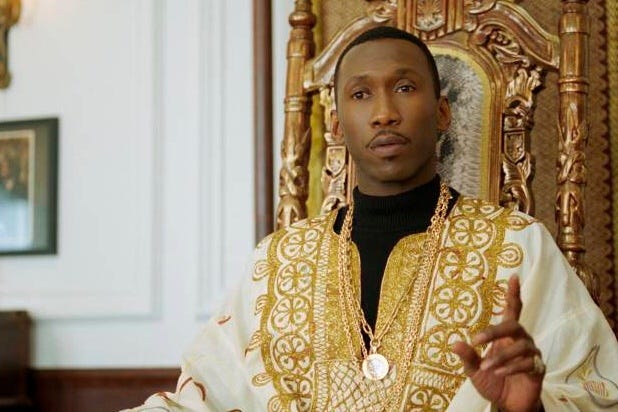
6.) Green Book. There are hints that Don Shirley, the virtuoso musician at Green Book’s center, is not straight from his opening scene. He lives in over-the-top opulence, is adorned in long-flowing robes, and speaks with an elegance that all adhere fairly closely to traditional LGBTQ stereotypes. But his character’s queerness is not fully revealed until what for me was the film’s most problematic scene. Don’s bodyguard is called to the scene of the local YMCA, where Don has engaged in an anonymous sexual encounter with another man. The police have arrested them and they are sitting naked and humiliated on the bathroom floor. Don’s (white and straight) bodyguard hero quickly arranges for his release. In the following scene, Don — deep in shame — asks for forgiveness for his behavior. It is never mentioned again.
Risky, random sexual encounters between men do occur and there is absolutely no problem with Green Book choosing to portray this aspect of Shirley’s experience. What is problematic is how it handles the scene. It is completely through the focus of the white, straight protagonist — his surprise, his discomfort, his heroism — and not for the lived experience of the black, queer man in the scene. Not only does it fail to delve into his personal experience, but it also fails to even make a nod to the virulent racist and homophobic climate that forces men into underground sexual encounters like these. It reinforced an ugly stereotype without any context or humanity or resolution.
5.) Bohemian Rhapsody. Much has been written about how the Freddie Mercury biopic portrayed the star’s sexuality, so I will briefly summarize rather than belabor the points. Queen frontman Freddie Mercury was a musical genius and a queer icon. The movie is very interested in the former but deeply uncomfortable with the latter. The first section of the film heavily emphasizes Mercury’s relationship with his girlfriend Mary, leading to the all-too-familiar scene where Freddie tearfully admits his deep shame about being bisexual. She quickly corrects him and tells him he’s gay (problematic in and of itself). Then what we get is the expected descent into drugs and booze and anonymous sexual encounters, leading to the HIV infection that will inevitably kill him.
Not only does the film stigmatize Mercury’s character in its portrayal, but it then shames him for his lack of pride in his identity in a scene where his eventual partner Jim Hutton tells him he can’t be with him because he doesn’t love and respect himself. It is the classic double bind faced by so many minorities. Society will denigrate and humiliate them mercilessly and then respond with disgust when they do not demonstrate a level of self-respect deemed appropriate.
The film also reinforces the stereotype of the predatory gay as it makes the not-so-subtle argument that his manager Paul Prenter (Downton Abbey’s Allen Leech) seduced him into this lifestyle and then blackmailed him with it. My guess is there is more nuance to that story, but even if it was a case of evil there was a more humane and thoughtful way to portray it.
Furthermore, the fact that the film was directed by a gay man who has been widely accused of sexual misconduct toward minors adds context to Bohemian Rhapsody’s queer problems that I cannot begin to unpack here.
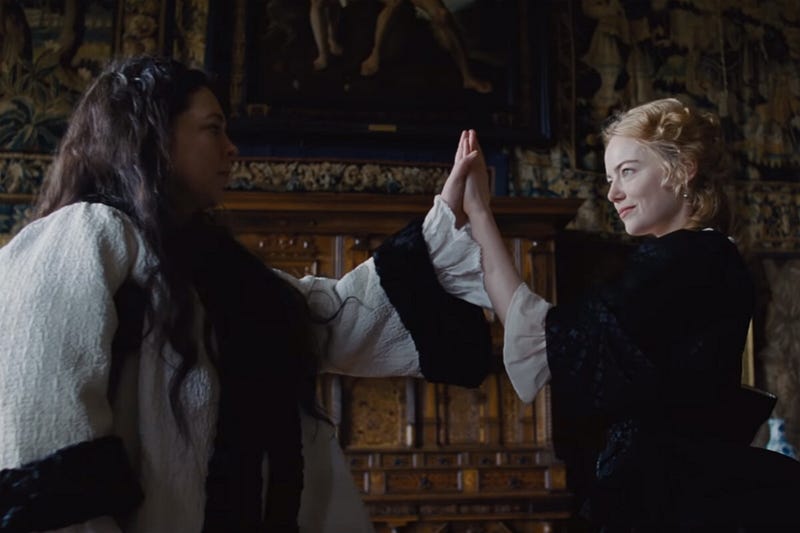
4.) The Favourite. By far the most fun and salacious film on the list, The Favourite focuses on a love triangle between three women — Queen Anne of Great Britain, Duchess Sarah Churchill, and Baronness Abigail Masham. The film is hardly a history lesson, but is rather a queer reimagining of court intrigue and backstabbing. (It ignores not-so-minor historical truths, like the fact that Queen Anne had a husband that she was close to.) The film is refreshingly unapologetic in its queerness and does not shame any of the characters for their same-sex dalliances (there are, however, appropriately scandalized responses). The film is focused on female pleasure and female relationships, also refreshing. But even though it is leagues beyond the previous two movies both in its portrayal of queerness and its overall quality, it has its problems as well. The film is ultimately about two predatory women who may or may not have same-sex attractions who exploit the sexual longing of a deeply physically and psychiatrically ill woman in order to gain power. Thankfully, the vileness of this is recognized by the filmmakers and gives the film a tone that is darkly savage. I loved this film, but it’s hardly one I would use to help people better understand and appreciate the LGBTQ experience.
3.) A Star is Born. When Jackson (Bradley Cooper) first meets Ally (Lady Gaga), she is performing a cover of Edith Piaf’s “La Vie en Rose” in a gay bar run by drag queens. It is clear that this is the one of the only places Ally has ever felt safe and affirmed and her connection to her friends and coworkers is evident. When Jackson enters, he is unfazed by his surroundings and interacts charmingly with the staff. It is a scene that did not have to take place in a gay bar but did. It does not play the setting for laughs or shock, but rather for narrative purpose and demonstration of inclusivity. It gets bonus points for casting some high profile drag queens in the scene and not just dressing up extras in funny outfits. After this scene, the only real queer presence in the film is Anthony Ramos’s Ramon, Ally’s best friend who is mainly a shoulder for her to cry on the rest of the film. Oh, and then there’s the bisexual LGBT icon Lady Gaga whose mere presence makes the film a queer-friendly space.
2.) Vice. Former Vice President Dick Cheney’s lesbian daughter Mary (Allison Pill) is not a major on-screen presence in Adam McKay’s Vice but she does figure prominently into some key scenes. When Cheney agrees to be George W. Bush’s Vice President, it is under the condition that he will not be forced to make a stance against same-sex marriage given that he loves and respects his daughter. This theme returns at the film’s ending when Dick and Lynne’s approval of their other daughter Liz coming out against same-sex marriage for political gain appears to fracture the family. In a strange and unexpected way, Vice does an admirable job of portraying LGBTQ issues. Mary is a completely respectable (if not entirely nuanced) figure and the issue at hand is not her sexuality but in everyone else’s discomfort with it. Who knows the degree to which this is all based in fact and given the Cheney family’s reclusive tendencies, it seems unlikely we will ever know.
1.) Can You Ever Forgive Me? By far the best and most interesting portrayal of LGBTQ issues among this year’s Oscar nominees, Marielle Heller’s adaptation of writer Lee Israel’s memoir about the foray into literary forgery that derailed her career is remarkably refreshing. The sexual identity of Israel (Melissa McCarthy) and her friend/partner-in-crime Jack Hock (Richard E. Grant) is at once incidental to the plot (you can describe the entire arc of the film’s narrative without really getting into it) but it is absolutely essential to understanding the characters and their experience. This is not a “gay issues” movie (not that there’s anything wrong with those; it is only a problem when those are the only gay movies depicting gay people). It does not deal explicitly with homophobia in any major way, but nevertheless the characters’ internalized shame and isolation indicates a world that has been profoundly unkind to them. (For context, it takes place in the early 1990s.) These are two characters that seem remarkably unlikely friends, but their shared feeling of being on the fringes of society bring them together (as is so often the case).
Israel initially comes off as a misanthrope (think Jack Nicholson in As Good As It Gets) but is quickly humanized by her connection to Jack, her love for her cat, and — most heartbreakingly — her complete and utter confusion when a kind, attractive woman takes an interest in her. There is so much truth and emotion packed into these scenes. The same is true for Jack. Although he takes the same trajectory as Freddie Mercury — hard drugs, sexual liaisons, and eventual death from AIDS — the screenplay is deeply interested in the factors (both individually and societally) that led to this.
Ultimately, Can You Ever Forgive Me? is one of the most effective, surprising, and nuanced queer films of recent years. It tells a deeply humane story about queer people without putting big queer issues center stage.
Naturally, it went home empty-handed on Oscar night.
In sum, this year’s Oscars lineup had an unprecedented level of inclusion of queer stories and characters, but a deep dive into the films shows that many were problematic portrayals.
And that is not even mentioning the fact that the vast majority of these roles were written, directed, and portrayed by cisgender heterosexuals. According to an impressively documented database on Wikipedia, of the 380 acting nominations this century, only four (1%) have gone to actors who publicly identify as LGBTQ (Ian McKellen, Ellen Page, Angelina Jolie, and Lady Gaga). And all four played straight people. (During that same time, dozens of cisgender heterosexual-identified actors have been nominated and won for playing LGBTQ characters.) You would have to go back to Ian McKellen in 1998’s Gods and Monsters to find a case of an openly LGBTQ actor playing an LGBTQ role. And if these facts don’t demonstrate that we still have a long way to go for LGBTQ representation, well then I don’t know what to tell you.
To read more about this year’s Oscars check out my recap of the Oscars ceremony and Part I and Part II of my detailed analysis of the nominees in the Top 8 Categories
Check out other articles I have written re: LGBTQ issues in media, including articles about Love, Simon, Brokeback Mountain, The Hours, and Ellen.
Consider following me on Medium and/or Twitter for more commentary on Hollywood happenings.


