
Innovation
The Complete Guide to Be a Critical Thinker
A Journey Towards Creativity and Innovation

Introduction
In the discussion of innovation and intellectual progress, critical thinking emerges as the linchpin. This essential skill transcends mere ideation, delving into the realms of judicious evaluation and strategic refinement of thoughts. It represents a potent blend of imagination and analysis, guiding individuals through the complex maze of their minds. Critical thinking is not just about generating ideas; it’s a transformative process that turns abstract concepts into concrete realities. It demands a harmonious fusion of creativity with a healthy dose of skepticism and an unwavering commitment to meticulous scrutiny.
This intellectual odyssey is far from a straightforward path; it is a dynamic interplay of questioning, exploring, and refining. It’s in this rigorous examination and re-examination of ideas where the true essence of critical thinking lies — a process that not only nurtures innovation but also fosters a deeper understanding of the world and our place within it. As we board on this journey of critical thinking, our first step is to dive into the process of ideation and collection, where creativity begins, and ideas start taking shape.
Part I: From Conception to Collection
In the initial phase of critical thinking, the journey of ideation and collection plays a pivotal role in shaping the path toward innovation. This stage is akin to embarking on an exploratory voyage into the depths of one’s mind, where the seeds of creativity are sown and nurtured. It’s a process of delving into the rich series of experiences, thoughts, and insights to unearth potential ideas that could transform into groundbreaking innovations. Drawing inspiration from Michael Michalko’s “Thinkertoys: A Handbook of Creative-Thinking Techniques,” this phase emphasizes the importance of an open mindset, vigilant documentation, and systematic organization of thoughts.
It’s about creating a fertile environment where ideas can germinate, grow, and be prepared for the critical process of evaluation and refinement. As we venture through this phase, each step is designed to capture the essence of our creative potential, paving the way for ideas that are not only imaginative but also ripe with the possibility of actualization. Each step from the five steps (Diagram 1) in this initial phase of ideation and collection represents a crucial milestone, guiding us through a methodical process of nurturing and capturing our creative insights.
Step 1: Open Your Mind to New Experiences:
Ideation, the birth of innovation, begins with openness to new experiences. Every new interaction, learning opportunity, or unique situation can spark the creation of ideas. As Michael Michalko in “Thinkertoys” suggests, embracing diverse experiences is key to widening the net of your subconscious, allowing a variety of ideas to surface.
Step 2: Document Every Spark of Thought:
Once the seeds of ideas begin to sprout, capturing them becomes crucial. Michalko emphasizes the importance of not letting any idea, no matter how small or fleeting, slip away. Like a gardener jotting down notes on different plant varieties, keep a journal or digital note-taking tool handy to record every thought. This process ensures that the raw, creative energy from your mind is not lost in the chaos of daily life.
Step 3: Create an Idea Repository:
As ideas accumulate, organizing them into a coherent repository is essential. This could be a physical file, a digital folder, or specialized software. The key is to have a dedicated space where all your ideas are accessible and can be reviewed and revisited. Michalko advises using various creative-thinking techniques to explore these ideas further, allowing you to see connections and potentials you might have initially overlooked.
Step 4: Cultivate a Rich Environment for Ideas:
Your environment plays a critical role in the ideation process. Create a space that inspires creativity, whether it’s a quiet home office, a nature-filled garden, or a vibrant studio. Surround yourself with objects, images, and tools that stimulate your thinking and imagination, as suggested in “Thinkertoys.”
Step 5: Regularly Review and Reflect on Your Ideas:
Periodically review your idea repository. Reflect on each idea’s origin, the context in which it was created, and its potential impact. This reflection helps not only organize your thoughts but also recognize patterns and themes in your ideation process, which can be crucial for the next stage of idea development.
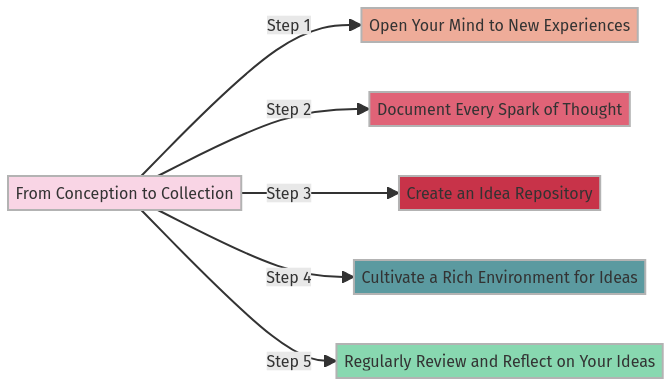
Through these, you can effectively navigate the initial phase of critical thinking, setting a strong foundation for the subsequent stages of idea evaluation and execution. With a rich list of ideas now gathered, we move forward into the world of refinement and realization, where these concepts undergo rigorous scrutiny and alignment with our core objectives.
Part II: Refinement and Realization
As we delve deeper into the journey of critical thinking, we enter the crucial stages of “Refinement and Realization.” Here, ideas incubated in the fertile grounds of imagination undergo rigorous evaluation and alignment with core values and visions, preparing them for the eventual leap into reality.
This phase, drawing from the insights of Chip Heath and Dan Heath in “Decisive: How to Make Better Choices in Life and Work,” is where critical thinkers fine-tune and synchronize their ideas, ensuring they are not only imaginative but also feasible, impactful, and aligned with their goals. In this next pivotal phase (Diagram 2), our ideas face the crucible of evaluation and synchronization, a transformative process that shapes them into viable and impactful innovations:
1. The Art of Idea Evaluation:
As we delve into the art of idea evaluation, it’s essential to apply critical criteria to assess each idea’s viability, ensuring that our creative endeavors align with practicality and purpose.
- Criterion 1: Feasibility and Practicality: Evaluate the practical aspects of your ideas. Can they be implemented effectively? Do you have the necessary resources? Assess the logistical and operational feasibility of bringing the idea to life. Reflect on examples like the Wright brothers, who meticulously evaluated the feasibility of sustained flight, balancing their vision with practical engineering challenges.
- Criterion 2: Alignment with Goals and Vision: Ensure your ideas align with your long-term goals and personal or organizational vision. Do they contribute to your overarching objectives? Consider how Howard Schultz’s vision for Starbucks was not just about coffee but creating a third place between home and work, aligning each new idea with this broader vision.
- Criterion 3: Potential for Impact: Assess the potential impact of your ideas. Will they bring about the desired change or improvement? How will they influence your target audience or market? Think of how Tim Berners-Lee’s idea of the World Wide Web revolutionized information accessibility, profoundly impacting global communication.
2. Synchronizing with Your Idea:
Transitioning from the analytical to the personal, we now enter the stage of synchronizing with our ideas. This phase marks a deeper, more intimate connection where ideas resonate with our innermost values and visions, setting the stage for passionate pursuit and realization.
- After the evaluation, the next step is to deeply connect with your idea. This goes beyond mere acceptance; it’s about internalizing the idea so that it resonates with your values, passions, and abilities. It’s a fusion of intellect and emotion, where the idea becomes a part of your identity. Akin to Elon Musk’s commitment to sustainable energy and space exploration, this synchronization is about embodying the idea, ready to champion and breathe life into it, irrespective of the challenges that lie ahead.
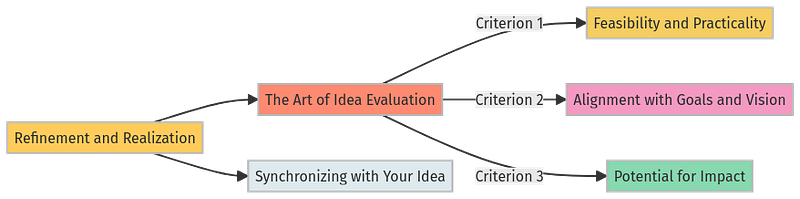
This phase, “Refinement and Realization,” is not just a methodical process but a transformative journey. It’s where critical thinking morphs from an abstract exercise into a concrete force driving innovation and change. It’s a testament to the power of aligning one’s passion with practicality, creating a synergy that propels ideas from the drawing board into the real world, reshaping landscapes, and defining new frontiers of possibility. Having refined and synchronized with our ideas, we now approach the critical stage of execution, where these concepts are brought to life, marking the final frontier in our journey of innovation.
Part III: Bringing Ideas to Life — Execution
In the journey of critical thinking, the phase of execution stands as the definitive stage where ideas transition from abstract concepts to tangible realities. Drawing from Scott Belsky’s “Making Ideas Happen: Overcoming the Obstacles Between Vision and Reality,” this part of the process requires meticulous planning, adaptive implementation, and continuous refinement.
Here, we outline the key stages in bringing your ideas to life, transforming them from mere thoughts into impactful innovations. In this final phase five steps (Diagram 3) of execution, we traverse through detailed planning, adaptive implementation, and continuous refinement, turning our well-crafted ideas into tangible, impactful realities.
Stage 1: Detailed Planning and Resource Allocation
- Begin by laying out a comprehensive plan that outlines each step needed to bring your idea to fruition. This involves identifying the resources required, setting realistic timelines, and preparing for potential challenges. As Scott Belsky highlights, organizing your resources effectively is crucial. This means allocating financial resources, gathering the necessary materials, and assembling a team capable of executing the idea.
Stage 2: Adaptive Implementation and Problem-Solving
- Once the planning is in place, the next step is implementation. This stage demands flexibility and adaptability as unforeseen challenges may arise. Belsky emphasizes the importance of being prepared to pivot and make adjustments as needed. Problem-solving skills become vital here as you navigate through obstacles and refine your strategies to align with the evolving dynamics of your project.
Stage 3: Review and Refinement
- After implementation, continually review and refine your project. This involves assessing what is working, identifying areas for improvement, and making the necessary adjustments. In line with Belsky’s advice, create a feedback loop where you can learn from each phase of the execution process. This could involve customer feedback, team reviews, or personal reflection.
Stage 4: Measuring Impact and Success
- Evaluate the success and impact of your idea. Have you achieved your objectives? How has your idea influenced its intended audience or market? Belsky suggests using quantitative and qualitative measures to gauge the effectiveness of your execution. This could range from financial success to societal impact, depending on the nature of your idea.
Stage 5: Scaling and Expansion
- Consider the potential for scaling or expanding your idea. Can it be adapted or grown to have a broader impact? Belsky advises looking at scalability as a way to maximize the potential of your idea. Think about ways to enhance, replicate, or broaden the reach of your project.
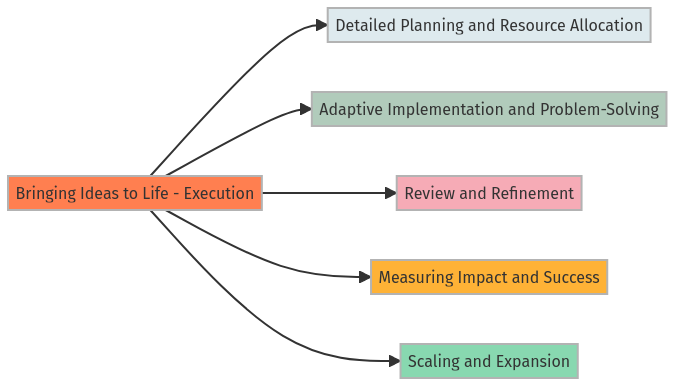
In this final phase, “Bringing Ideas to Life,” we see the culmination of the critical thinking process. It is where the rubber meets the road, and ideas are tested against the realities of the world. This stage is not just the endgame but a continuous cycle of growth, learning, and evolution. It’s where thinkers become doers, and ideas, once mere figments of imagination, become catalysts for change, innovation, and progress. As our journey of bringing ideas to life culminates, we reflect on the essence of critical thinking in innovation, recognizing it as a continuous cycle of growth, learning, and transformative impact.
Conclusion
Embarking on the path of critical thinking is to embark on a voyage of limitless discovery and creation. It is a commitment to nurturing a mindset that relentlessly pursues inquiry, challenges norms, and deconstructs ideas to reveal deeper insights. In this journey, ideas are not ephemeral musings but are potent seeds of innovation, each holding the potential to blossom into transformative breakthroughs. The critical thinker’s journey is characterized by a relentless quest for understanding, a drive to explore uncharted territories of thought, and a steadfast dedication to turning speculation into reality.
This path is one of rigorous exploration and persistent endeavor, a journey that transcends mere personal achievement and extends to contributions that have the power to redefine paradigms and sculpt the future. It is a path where each step taken in the pursuit of knowledge and innovation not only leads to individual growth but also paves the way for collective advancement. In this odyssey, the critical thinker emerges not just as a seeker of truth but as a catalyst for change, inspiring others to join in this perpetual dance of intellectual evolution. In embracing this path, one becomes a torchbearer of progress, illuminating the way for others and leaving an indelible imprint on human history.
Author’s Note
This post contains affiliate links from Amazon. If you make a purchase through these links, I may receive a small commission at no extra cost to you. 🙏Consider sharing and participating in the conversation if this content speaks to you. For any queries, collaborations, or comments, reach out to me at [email protected]. Thank you for supporting my work!


