
The College Admissions Scandal Is About Far More Than Criminal Celebrities
Despite what the Trump surrogates shout, the college admissions scandal that broke this week is not about celebrities behaving badly. Rather, it is about the insidious nature of privilege and the corruptibility of higher education in America.
Naturally, a week later something happened that I found to be really really interesting. So interesting that I couldn’t help but return to my blog.
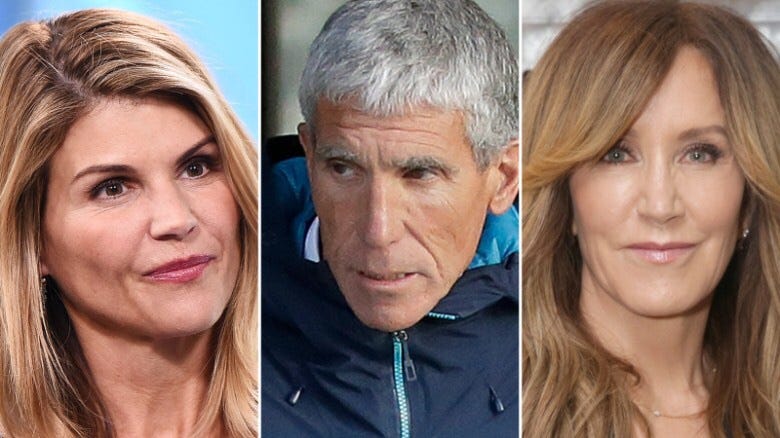
Because 2 of the 50 charged were fairly well-known actresses (Desperate Housewives star Felicity Huffman and Full House star Lori Loughlin), the initial headlines treated it like a run-of-the-mill “celebrities behaving badly” scandal. It brought to mind Martha Stewart’s insider trading or Wesley Snipes’s tax evasion. Honestly, I can’t blame the media for focusing on the famous names. It certainly drew attention to the story to have familiar faces attached. Furthermore, the specific names attached to the story provided more than their fair share of shock value.
Emmy winner and Oscar nominee Felicity Huffman is one of the most highly respected and well-liked actresses in Hollywood. The fact that her most famous role was as one of the protagonists on a show about wealthy women willing to go to often criminal lengths to protect their families (Desperate Housewives) makes the fact that she was involved all the more fitting. (Bonus points for the fact that the “spouse” of hers referred to in the documents is beloved, multiple award winning actor William H. Macy, star of Fargo and Shameless). Lori Loughlin hardly commands the same industry respect that Huffman does, but she is well known to generations of television viewers as kindly Aunt Becky on Full House and its ongoing revival Fuller House, not to mention her numerous wholesome television movies for the Hallmark Channel. Both actresses were undoubtedly near the very bottom of any reasonable person’s list of Hollywood’s “Most Likely to be Indicted.”
Naturally, Trump’s surrogates used this as an opportunity to lambast the hypocrisy of “liberal Hollywood,” with Donald Trump Jr. and Kellyanne Conaway immediately releasing scathing retorts. But, as the details emerge, it has become increasingly clear that the fact that the crimes involved two well-liked actresses is one of the least interesting — and certainly the least important — aspect of it.
The college admission scandal is first and foremost about two things.
First, it is about the insidious nature of privilege.
At their core, the various crimes involved all come down to one thing — immensely privileged people using their power and wealth to break the rules for personal gain. They lied about their children having disabilities so that they could cheat on college entrance exams. They faked photos of their children to pass them off as star athletes in sports they never even played. They funneled their bribes through a nonprofit so that they could double as a tax write-off (arguably my favorite part of the scheme).
It might seem reasonable to ask, “How did they think they could get away with this?” The answer to that is simple: Because they have for millennia. Sure, we have some examples of the powerful and corrupt getting their comeuppance throughout history — various overthrown monarchies, a disgraced president, the fall of Bernie Madoff. But these are far and away the exceptions. Similar perversions of morality, ethics, and law are committed daily across the globe by the rich and powerful and it is only in the most exceptionally rare cases that they face any consequences. If you need a citation to back this up, look at just about any news story about any of the criminal probes into our current president’s inner circle.
What enrages me and disgusts me far more than the privileged using their money and influence to bend or outright break the rules for their own gain, is the collateral damage they leave in their wake. Just as many of the (mostly white) elite have vilified the poor to distract the masses while they create some of the most profound income inequality in world history, they have successfully convinced people that it is the special treatment given to underrepresented minorities via affirmative action that is the true college admissions crime. They further undermined the opportunity of success for members of long-oppressed groups so that they could keep maintain their privilege. Sure, it’s possible that they are just spectacularly hypocritical and truly believe affirmative action law is unfair and their illegal rigging of the system for themselves is perfectly moral. But I suspect something far more sinister is at play.
Hopefully it goes without saying that this is not how all of the rich and powerful behave. There are countless examples of people who are privileged who also do good work for society and play by the rules. Privilege does not have a causal relationship with corruption. But there is one hell of a correlation. There is no single or straightforward explanation of the relationship between privilege and corruption, but I believe that any theory that doesn’t have the insidious nature of privilege itself as a central tenet is suspect.
When an individual or a group becomes privileged in a system — either by birth or accomplishment — several dark forces go to work. The privileged are susceptible to drastically undervaluing the role of chance in their rise and can easily become deluded into think that they have earned their status due to some sort of inherent superiority. Their extreme wealth can protect them from legal and social consequences to such a degree that they lose all sense of morality and fairness. The fabulous benefits associated with privilege and the extreme pressure to maintain it can lead to frantic efforts to prevent a fall in status.
Although I believe that what I have outlined above are all valid points, we need to remember that the rich and powerful attain and maintain their privilege through the institutions that at best accommodate them and at worst collude with them. That brings us to the role of the universities themselves.
Second, it is about the corruptibility of higher education in the United States.
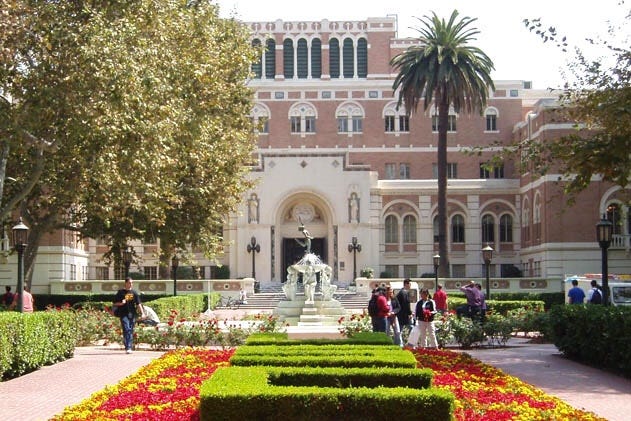
Naturally, within minutes of the scandal breaking, the institutions featured in the scheme (e.g., Yale, Stanford, USC) quickly sought to distance themselves. They placed the indicted coaches on leave and painted themselves as the unwitting victims of a vast conspiracy. But is that really the case?
The cost of a college education has increased at an alarming rate. Even after adjusting for inflation, the cost of attending a four-year-college has more than doubled in the past 20 years. The average college tuition has grown at a rate that is 8 times faster than the rate that average wages have increased among Americans. Is it all going to improving the quality of education and facilities? I sincerely doubt it. Clearly some folks are getting rich.
And even more appalling than the rapid increase in tuition is the profitability of college sports, which is utterly mind-blowing. Even if you accept the fact that academic standards at top-tier universities should be lowered for exceptional athletes (I personally don’t accept this), the sheer amount of money involved in the whole endeavor in and of itself makes it a breeding ground for corruption.
In addition to being a glaring example of capitalism run amok, the drastic changes in universities over the past couple of decades also stems from other additional issues in our society. For example: Think about how many new top tier universities opened for business in the last 20 years (practically none) and how many existing top tier universities drastically expanded their enrollment (very few). Now, think about the steady growth of the U.S. population and how increasingly normative it is to attend college. The result is that schools are becoming markedly more competitive by the year. And when so many people are fighting to get in, money becomes an even more powerful tool.
Assuming they are found guilty, the parties should certainly be punished. Frankly, I am more eager to see all involved get a good old public shaming and a court order to force them to use their wealth and privilege to help the more deserving students they screwed over than I am to see hard jail time. In fact, there is an ever-so-small part of me that almost feels bad for them when I consider that their alleged crimes likely pale in comparison to those of countless other high profile individuals who remain unscathed. But then I remember how many people are in jail for lesser offenses — mostly poor people and minorities — and I start chanting “lock ’em up.”
Real justice at the societal level would be if this scandal resulted in a mobilization of the masses against unchecked privilege and a careful re-evaluation of the growth of institutions of higher education in the United States.
But let’s face facts — real justice is unlikely. Real justice rarely (if ever) occurs for the rich and powerful. Thus, I am afraid that the sole good that will come out of this is the inevitable all-star Oscar-winning film that will someday be made of it. After all, the story has it all — a sting operation by the federal government, indictments of high profile individuals, fascinatingly amoral behavior, and deeply thought-provoking themes about wealth, power, and equality.
I have no doubt that the movie that they make out of this is going to be fabulous. I just wish it could have been fiction.