
The Cold Hard Truth to Becoming a High Performer
3 lessons for career growth and fulfillment.

Attitude is everything
Are you engaged in your work? Do you find that there are parts of the job that you like? The answers to these questions can change based on the state we are in. If you find yourself thinking about ‘engagement’ after a particularly defeating day, you’ll probably feel disconnected. Like there has to be more to life. Contrast that with a good day where you find flow and productivity. The answer to the questions on this day is going to lean toward higher engagement. What’s the difference between these two days? Without knowing the details, we may assume that the first day involved putting out a bunch of fires. While the ‘good day’ might have been filled with positive feedback, and project completion. More likely though is that these two days were more similar than they were different. The biggest difference between a good workday and a bad one is our attitude. There are contributing factors like, how we handle the unexpected or our confidence levels in solving the problems of the day. How we feel about our day is directly related to our perceived ability to handle challenges. In 2018 an employee engagement survey from Gallup Inc. showed that only 34% of employed individuals consider themselves engaged with their work.
The percentage of “engaged” workers in the U.S. — those who are involved in, enthusiastic about and committed to their work and workplace — is now 34%
In this article, I will share three key concepts that will help you to become a part of the 34%. Even if your dream is to work for yourself one day you will still need these skills to find joy in work. It’s not about what you do it’s about how you do it.
1) Discover what you like.
Discovering what you like about your current position instantly changes the view of your work. When you start framing your mind to look for the answer to this question, your perception changes. Imagine that for the next couple of workdays you ask yourself “What am I enjoying about my job?”. You keep this question with you on Monday- Friday. Sitting with it. You may notice that an hour quickly went by because you were immersed in a project. That’s when it hits you. Certain tasks that are more fulfilling than others. This is the starting point. You’ll start to notice that you are incredibly effective at these intervals. This is how our strengths evolve. Finding enjoyment in our work becomes a discovery process. Instead of grinding constantly and feeling frustrated, you focus on what you can control.
Why does this work?
Rob Dial, recently highlighted the usefulness of the reticular activating system (RAS) on an episode of his “Mindset Mentors” podcast. This is a wonderfully useful concept that explains that we ‘see what we look for. Through a process called ‘habituation’, our minds filter out information that is not important to us.
When we focus on ‘finding’ what we like, we start to find more of what like’. This works for us because we are more conscious of finding the parts of our job that give us joy. Additionally, we try to create more of these moments because they are satisfying to us. Without a guide or prompt, our thoughts kind of wonder and react. While having a strong mantra or question provides a focus for the wondering brain. While applying this concept in this way could admittedly fall into the realm of pseudoscience it can be helpful in our quest for high performance. Try this: Write down a question or prompt on a sticky note. Put it somewhere you work every day. Get in the habit of looking down and pondering. Train your brain to look for the things that you do like.
2) Control your time
This concept builds off the previous one. As we start to find enjoyment in our job, we want to build on it. To do that we have to permit ourselves some autonomy. The reason why is because we want to create more of these enjoyable moments in our day. With the assumption that these moments are mutually beneficial to both you and your employer.
It would behoove you to structure your days to have more flow, happiness, and more motivation. Of course, it’s called a job for a reason. There are still things that we can’t delegate or otherwise neglect. Our control may be limited, but still, we must exercise the freedoms we do have. If we do this in a way that is good for us and good for the employer, we can earn more control. It’s only fair. When I was in new sales. My job mostly consisted of outreach. I would spend a lot of time in the morning picking up the phone and dialing. Over the course of a couple of months, I noticed a pattern. My calls in the morning were energetic and often engaging. However, after lunch, my effectiveness severely dropped. The afternoons were not effective prospecting hours for me. In the afternoons I was much better at creative deep focuses tasks such as building slide decks, and presentations. With a good chunk of prospecting done in the morning, I felt comfortable slowing the pace down to work on afternoon projects. Over time, I modified my workdays so that my best prospecting was done at the times when I was most effective. This strategy led to more consistent appointments. Which then prompted me to create time blocks to work sales presentations. This focus made them crisper. With these habit changes, I was able to increase my first-year sales numbers by 44% YOY while finding more enjoyment in my work.
Why does this work?
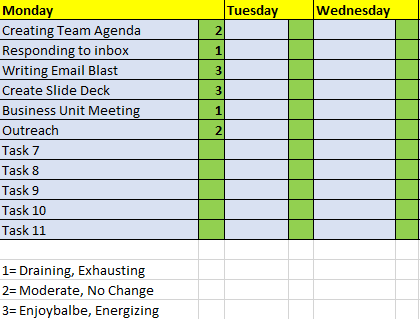
This works well because it gives us our freedom back. Instead of feeling like a slave to the structure of an hour day, we learn how to work within that framework. Over time our workdays become elements of our creation. It’s the intention of becoming more than a cog that makes it so. When we become highly cognizant of our ideal work conditions, we work to re-create that environment. The lack of engagement that many of us feel is because we don’t have control of our time. It can make one feel like a hamster on a wheel. However, if you remove the mental constraints that this has to be done this way — you create space for authentic creativity. That is using your strengths to make positive changes. It is our responsibility to set up our days to do more of what we enjoy. However possible. Show that changes in your schedule or tasks are mutually beneficial to you and your employer. Do this slowly and build trust as you go. If you prove that your way works, you earn the right to make changes. Try this: Use a version of the template below to track the tasks you have to complete in the day. Noticing and rating each task you have 1–3. 1 meaning the task dragged and 3 meaning you thoroughly enjoyed what you did.
3) Focus on solutions.
How do you change your attitude for the better? Focus on solutions. Focus on solutions as an alternative to complaining, venting, and gossiping. Let’s face it the mind needs stimulation. At work, when we get overwhelmed it’s easy to start looking around and noticing all the parts of the job that suck. This is a problem-focused approach. It identifies flaws in your place of employment but does nothing to address those problems. This one goes beyond work to our own life. In our attempts to live a good life, we often identify what’s missing and then seek out to fill that gap. This is one approach to improving our lives. However, we have a choice of what we want to focus on. What if instead, we committed to improving what we do have instead of we lack.

You see this isn’t about being content about a bad situation. Rather it’s focusing on ways to improve our situations. To give effort to improving rather than sitting here feeling helpless. We are capable of creating better lives. This includes enjoying our work more. It takes effort. It takes intention but it’s within the realm of what is possible. It is ok to want more, but we should also put in the same effort to enjoy what we have. To improve our outlook on the current situation is a skill worth cultivating. It's ok to know what we want and go after it. That doesn’t mean we shouldn’t be grateful. Gratitude is what helps us to build on what we have.
Why does this work?
Our mind at rest naturally looks for problems. Our highly evolved brains are constantly at work. Scanning our environment looking for something to stimulate it. If we don’t find a healthy focus for our mind, it starts to find things on its own. Coming back to the RAS concept. We can control our outlook with strong intentions, mantras, and focuses. Don’t give yourself the chance to complain. Become obsessed with improvement by having a strong outlook on top of mind. Bob Dylan once said don’t criticize what you can’t understand”. Let’s keep those words in mind and modify them for a mantra.
“Don’t criticize what you are not willing to help improve” This has to be a constant. I had great insight from a mentor recently. When I go into a meeting without any type of prompts. I find that I default to complaining. I think “well this is a stupid idea”. However, if I instead go in with a perspective of “let’s uncover some challenges”. I am trained to look for answers. Try this: Use the multiply vs add concept to identify solutions in your own work. As you go throughout your work weeks, concentrate on ways to make your job easier. That could be processes, templates, and/or approaches. If you find something that works, share it with others that may benefit. If this 1 thing makes you 1% more effective, imagine how valuable you will be if you can make a team of people 1% more effective
Final Thoughts
Work can suck and not every job is perfect. There may be some jobs that will never be a fit for you, but you can’t truly determine that without giving a role a fair shake. Regardless of ‘how happy’ you are at your current place of employment, do yourself a favor and try. Try to figure out what works for you. Figure out the areas where you are strong and what you truly like doing. Not only will this benefit you in the short term, but it helps you to create skills that will benefit you for the rest of your life.
“The way we do one thing is the way we do everything.” — Iyanla Vanzant