The cold email that helped me land my first full-time Product Manager role

In part seven of this series, I want to focus on how cold emailing can help you land your first or next role in product management — as a new or aspiring product manager. Here is the previous post from this series.
1. Landing Your First Role in Product Management Requires Someone to Make a Bet on You
Breaking into product management wasn’t easy. The tweet below summarizes how you can get into product management. Getting into product requires someone to make a bet on you. The question is — how do you get someone to bet on you?
The truth is — if you are reading this, you are capable. You have the curiosity to become a PM. With a belief, anything is possible. You just need to put the work in, and the results will come. You must work to develop the core skills a PM needs. I wrote four articles below that will help you learn those skills. Through effort, you can become a PM and someone who can learn to excel in the role.
- Why writing is important — as a new or aspiring product manager
- The power of verbal communication — as a new or aspiring product manager
- Learn to design & code — as a new or aspiring product manager
- Why you should build a business — as a new or aspiring product manager
2. The Cold Email That Helped me Land my First Full-Time Product Manager Role at a Startup
Cold-emailing is a great method for — 1) developing relationships with founders & product teams at startups and 2) finding a product role or product-adjacent role at a startup.
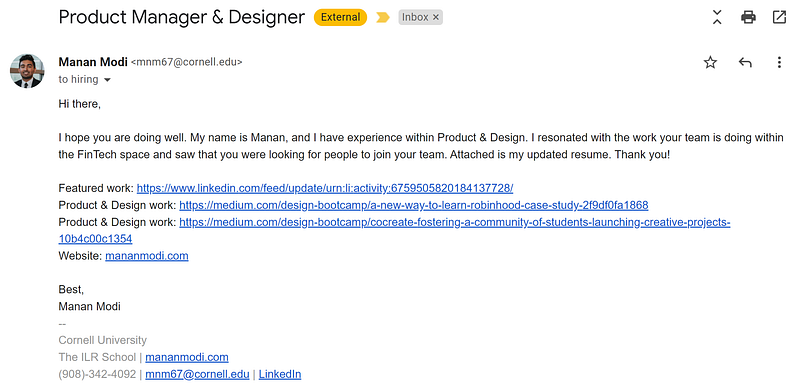
The email below helped me land my first full-time role in product management at a startup. Now, this is a great starting point. However, I would recommend a few suggestions to tailor your emails effectively.
3. How to Write a Better Cold Email
- Keep it concise. The cold email I wrote was around two lines on my desktop. Try making it even shorter than that — this is your first impression, and you need to show you can be direct and articulate as a PM.
- Personalize it. If you’re reaching out to someone, say “Hi [insert name],” at the beginning. You need to specifically say why you are interested in the company. Now, my wording was a bit vague. I said “I resonated with the work your team is doing within the FinTech space.” This isn’t the best way to approach a company. Ask yourself a few questions. Do you have a suggestion for their product? Have you used the product and gained any insights? What about their mission resonates with you? Have you read any articles or watched any videos on the company? Answer these questions and incorporate them into your outreach.
- Get their attention in the subject line. People are busy. Founders are definitely busy. Now, this is up to you — but you need to grab their attention quickly. I said “Product Manager & Designer” in my header because I previously did part-time work in product management and also created design case studies. I knew that I had some foundational skills, though I didn’t have full-time experience yet. You have to pitch yourself as who you will become. You have to believe you are already there.
- Show you can add value. This, in my opinion, is the most important part. You add value by showing your skills. I said I had experience in “Product & Design.” I showed that I had two design case studies, I told them that my work was featured by a product manager on LinkedIn (Lewis C. Lin), and I gave them my personal website. I used social proofing as a way to show that I was ready for the role. My role at the company ended up being primarily in product management, but showing that you have another skillset (design, marketing, coding, etc) is valuable. It means you can learn multiple things and be scrappy. This is important at a startup.
- Ask them to connect. You need to have a specific ask. I casually said that I “saw that you were looking for people to join your team” — you can even ask the question: “do you have a few minutes to connect?” At the end, you can say “thank you for your time.”
- Follow up. Founders may miss your email. Don’t take it personally. If you’re truly passionate about a company and a role, try sending a kind follow-up email a week later. And when you do meet with them, you can follow up after that call. Be respectful of their time and don’t send too many emails.
- Be curious. Now, I went ahead and sent my resume & work. Number 7 is different than the previous numbers because you can take a more diplomatic approach to this. You don’t need to send your resume immediately. If you’re excited about the product, mission, team, or anything else — focus on that. You can provide suggestions on the product, talk about how you would envision the future of the product (be careful with being overly prescriptive), or ask them a question if you are curious. You can develop the relationship first and get to know the team before you say that you are applying for a role. This is another alternative to what I mentioned in #1–6.
4. How to Get in Touch With a Startup Founder
You can guess a founder’s email: it’s likely [email protected].
- Let’s say you’re emailing “Rohan,” and he is a co-founder at a startup called “Music Artists.” Musicartists.com is the domain name you found on Google. You can likely try “[email protected]” as the email address. You may be able to verify this on the company website or on their LinkedIn profile.
There are also other ways to get in touch with a Startup team:
- Alternatively, you can find an HR or hiring email on the website directly (musicartists.com).
- You can always try this out with the other co-founders as well. Let’s say Cam is the other co-founder. You can email “[email protected]” as well.
- You can try connecting on Twitter or LinkedIn and write a short message too.
- You can reach out to a VC who has this startup in their portfolio.
If none of these options work, you can try other creative options that you may think of. If you’re excited about a company, you can find a way to nicely ask to get in touch and connect!
Lastly, I recommend focusing both on the quality of your outreach and the volume of your outreach with different companies. You need to write emails well to the companies you reach out to. You also need to reach out to several companies. You may or may not get an initial call or find that perfect fit with the first few companies you connect with. Keep going!
Now, you know how to cold email. The next article will focus on how you to find and identify the startups to join. Finding the right fit is the most important decision you can make when considering a startup, especially as a PM.
Feel free to reach out if you want to talk about anything on early career product advice, software, design, product teams, or early stage investing!
—