The Codex Gigas is called the Satanic Bible. It is the largest medieval manuscript in the world
Many relics remain from the Middle Ages, as fascinating as they are enigmatic. One of those, which an aura of mystery surrounds with the tightest ring, is the Codex Gigas. There is a disturbing legend associated with the creation of the great manuscript, and on one of the pages of the book there was a “signature” meant to authenticate it. What do we know about the Devil’s Bible? The answer to this question can be found below.
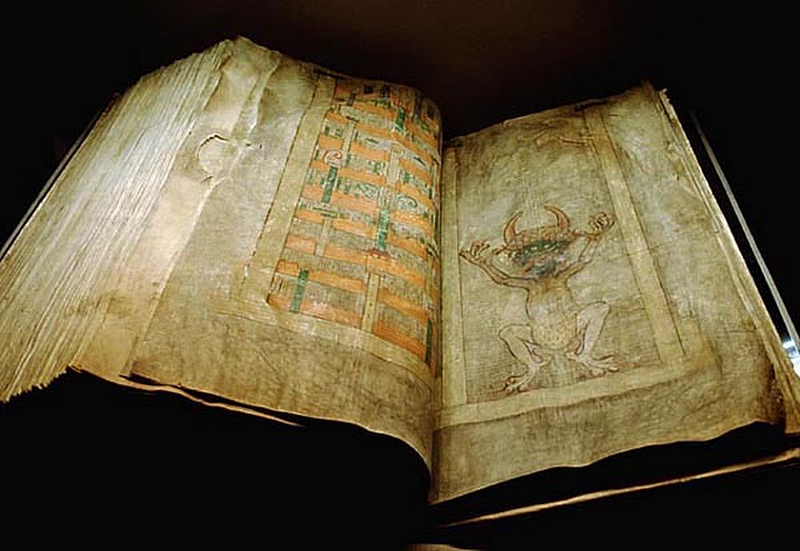
The Catholic world has always stigmatized and punished conspiracies with the devil, but in the Middle Ages the fight against those allegedly associated with the forces of hell took a particularly harsh form. As an example, one need only cite the Malleus Maleficarum, or Hammer for Witches, a treatise on witchcraft written at the end of the era, de facto being nothing more than an instruction manual for killing women who were to bludgeon themselves with magic.
It should be noted, however, that the alleged deals with the devil were also supposed to be made by those who dedicated themselves to the propagation of the faith and vowed to fight against unclean forces — the clergy. The powers of hell are said to be behind the creation of the Devil’s Bible, one of the most vivid reminders of the fascinating yet dark Middle Ages.
What is the Codex Gigas?
The Codex Gigas, or Great Codex or Great Book, is the largest of all known medieval manuscripts. The work was written down at the end of the 13th century, in a Benedictine monastery located in the town of Podlažice (Bohemia). The manuscript conveys the text of the Old and New Testaments, but that’s not all, as the following pages contained many additional texts.
The manuscript written on pages made of velin (a high-quality, very thin calfskin parchment) has often been compared to the seven wonders of the world, and some have considered the book the eighth miracle. No wonder, because it is really hard to believe that such a huge book could have been created by the hand of one man.
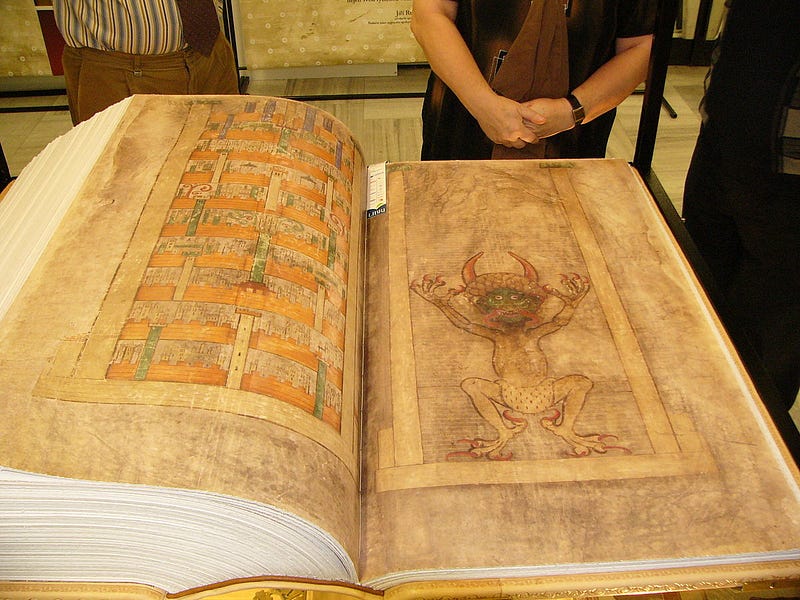
Dimensions of the Devil’s Bible
What does the epithet “huge” mean in this case? The manuscript originally consisted of 320 pages. Each was written in two columns consisting of 106 verses. Doesn’t sound too impressive? On the contrary. The book’s enormity is best evidenced by its dimensions. The Codex Gigas, bound in wood and leather-covered covers with metal decorations, measures 91 cm high, 50 cm wide and 22 cm thick. The entire book weighs as much as 75 kg! Impressive values, right?
Legends around the Codex Gigas
Earlier I mentioned that the impressive manuscript is likely the work of one man. There is a legend associated with it, based on which Codex Gigas began to be called the Devil’s Bible.
The author of the book was supposed to be a Benedictine monk. Why did a single scribe decide to write down such a voluminous work? The man was supposedly sentenced to a slow death by being walled up in a cell. So he must have committed a grave sin, perhaps breaking a monastic rule. The man was said to have begged for an opportunity to do penance for his transgressions.
As the legend relates, the monk offered to write down a religious work the night before his slow execution, which would contain all human wisdom and make the order famous throughout the world. Religious dignitaries acceded to his demand. In the end, the condemned monk undertook an impossible task at his own request.
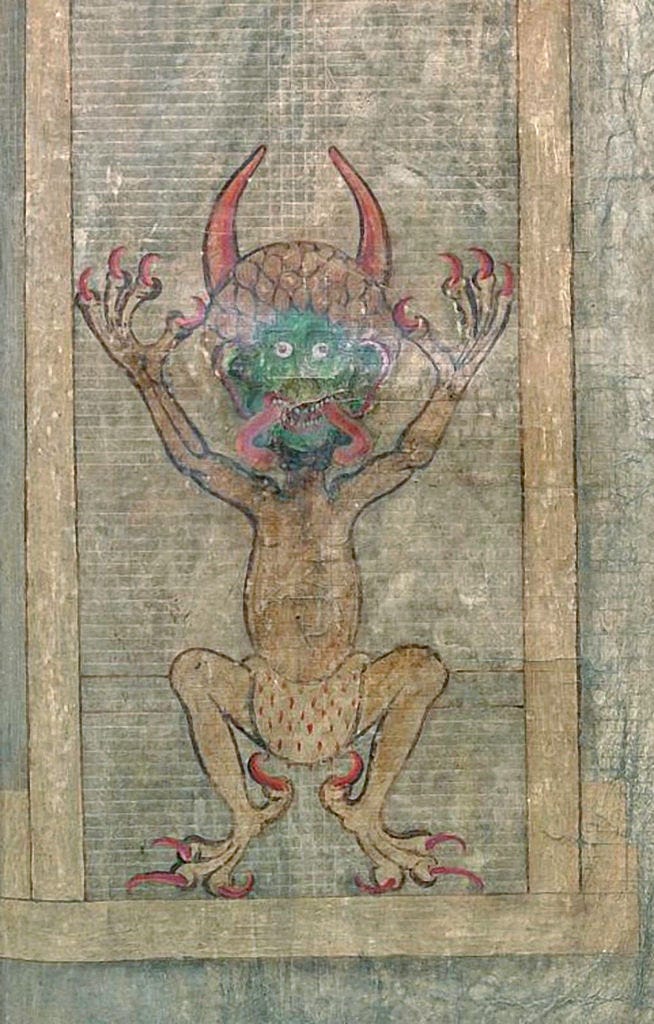
Around midnight, the condemned monk realized that he would not be able to save his life. That’s when he was about to start asking for help from a higher power. However, he did not pray to God, but to Satan. The fallen angel acceded to his request and guided the monk’s hand. This is to be confirmed by the 290th page of the manuscript, on which appeared the image of the Prince of Darkness himself — a telling signature of the alleged actual author of the book.
Who is the author of the Gigas Code?
So much for the legend of the monk who sold his soul to the devil. Let’s now focus on the scientific findings. Research has confirmed that the Codex Gigas may indeed be the work of a single man, as indicated by the homogeneous nature of the writing and the equal gaps between words. Ink analysis also points to only one author. Its results prove that the manuscript was written with a single type of ink, which allows us to assume that it was created in one place at all times.
It is clear that such a voluminous book simply could not have been written down in one night. Researchers have determined that, working with enormous sacrifices, one man wrote down the manuscript over many years. Some believe the work may have taken 12 or 20 years. Others point out that a more likely time frame is 20–30 years.
There is no doubt that the Codex Gigas, written down flawlessly and with incredible care, was the life’s work of the scribe who undertook the task. Did the creator of the work actually create it as a punishment?
Most likely, we are dealing here with the effect of voluntary penance. The thesis of being walled up alive involves a mistranslation of the Latin word inclusus. For years it was thought that it referred to a punishment providing for bricking up alive. Modern findings, however, indicate that inclusus refers not so much to punishment as to penance. Most likely, it points to a monk who has voluntarily isolated himself from the world.
Have scholars been able to determine who the scribe was who wrote down the great manuscript? Most likely, the book came out of the hand of a monk named Herman the Outcast.
What does the Codex Gigas contain?
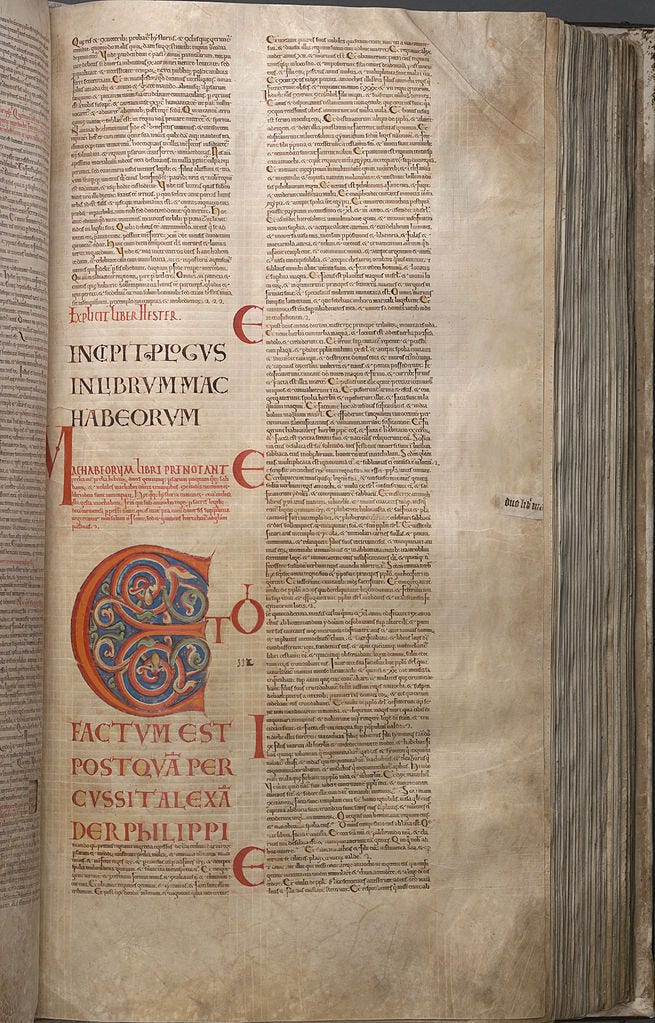
Not only the form and size, but also the content of the manuscript inspires genuine awe. Codex Gigas contains the entire Bible (Old and New Testaments) in the Latin Vulgate translation. That’s not all, however. The following pages transcribe the Etymologiae, or encyclopedia, by Isidore of Seville, Antiquitates and De bello Judaico by Josephus Flavius. In addition, the book contains many treatises, not only historical, but also etymological and medical (five from Greek or Byzantine times and three translated by Constantine the African. There were also detailed descriptions of religious rituals and magical incantations.
In a historical context, one of the most valuable works transcribed in the Devil’s Bible is the Chronica Boemorum, or Chronicle of Kosmas. This remarkable work is to Bohemia what Gall Anonim’s Chronicle is to Poland. The text contained in the Devil’s Bible most likely represents the oldest and most faithful copy of the source of Czech history.
Trivia facts
The very legend associated with the creation of the Codex…. makes it possible to consider this work as one of the most unusual souvenirs of the Middle Ages. If we add to this its size, craftsmanship and contents, we can easily understand why it still arouses so much interest today.
Above I have listed the most important facts about the Devil’s Bible. Finally, I left some intriguing tidbits about the medieval manuscript.
- The Codex Gigas is the only known Bible with an image of Lucifer.
- The work on the Devil’s Bible was completed around 1230.
- The Codex Gigas had 320 pages, but 8 of them were removed. Why? It is not known. Some researchers believe that the missing pages wrote down the rules of life in a Benedictine monastery, which could not spread outside the walls.
- Calfskin obtained from as many as 160 animals was used to make all the velin pages of the manuscript.
- Analysis showed that the ink used to write the manuscript pages was made of heavy metals and smashed insect nests.
- The Devil’s Bible was kept in Bohemia for more than 400 years. It was seized by the Swedes in 1648. Today, it is still in the Swedish collection’s holdings. In 2007 the manuscript returned to Prague, but as a loaned exhibit it remained there for only a few months.
- In 1697, the Codex Gigas may have ceased to exist. A fire at Stockholm Castle had significantly damaged the royal library, but someone had consciously thrown the book out the window. This did not leave its condition unaffected, but it did not succumb to the destructive elements and survived.
- The order of the books of the Bible in the Codex Gigas corresponds to the one used in the Carolingian period. This order was no longer used in the 13th century, when the manuscript was created.
- The few pages preceding the page with the image of the devil clearly stand out. They are blackened, which adds to their dark character. So did the Prince of Darkness himself actually have his fingers in the creation of this great book? No. It must be assumed that the image of the devil has always been in high demand. Consequently, this page and the pages preceding it were often exposed to the outside world, which led to the darkening of the parchment.
- Researchers agree that the compilation of such a voluminous manuscript by one man required many years of hard work. What seems all the more puzzling is that graphological analysis did not reveal any changes in moods, illnesses or any signs of the scribe’s aging.
- The weight and size of the manuscript suggest that the book was not used in religious ceremonies. However, there is plenty of evidence that clearly indicates that Codex Gigas did indeed have a practical use.
- The Devil’s Bible presents an unusual image of the prince of darkness. Most engravings depict the devil in his hellish realm. Meanwhile, the portrait on the 290th page of the Codex…. shows Satan locked in a prison, a chamber of evil.
Thank you for reading! If you enjoyed this content, please consider giving it a clap, leaving a donation, or offering a tip to support my work. Your generosity helps me continue creating valuable content.