
The Climate’s Ticking Clock
A Personal Journey from 315 to 420 ppm
This year was likely the warmest of the past 100,000 years. Formulating it this way in my opening sentence sounds like living to witness this moment is like winning the national lottery. However, the reality is less joyful, and a culmination of misbehavior should never be treated as a celebratory event.
Our Impact on a Fragile Planet
We, Homo sapiens, have only been around on this planet for the past few hundreds of thousands of years. I applaud our pre-historic predecessors for their hands-off attitude towards climate change. Although they may have been pretty destructive for the biodiversity among large land-based mammals, they were innocent in their burning of fossil fuels.
Considering the planet’s history as a 24-hour clock, we arrived only at 11:58:43 PM. It makes us the ultimate party poopers of the universe: latecomers who mainly stayed silent for more than a minute on that same clock and quietly gathered nuts and berries on African plains. But then, in milliseconds before the midnight hour, we suddenly changed into the most destructive form of life the planet had ever experienced.
The Alarming Reality of Rising CO2 Levels
We started wiping out other species at unprecedented rates, polluted everything from the deepest trenches of the ocean to high levels in the atmosphere, and in the past decades (a fraction of the last millisecond of the 24-hour clock), we efficiently started the project that will assure that more intelligent forms of life in a far future will forever remember us as the villains of the planet; long after we have died out, we’ll be known as the species altering the temperature of Earth while calling ourselves sapiens.
When I was born in the 1960s, we had just started to leave the kind of safe zone of fluctuating carbon dioxide concentrations that we and other species were used to. Before the 20th century, atmospheric CO2 levels ranged between 170 and 300 parts per million for a million years. Many scientists believe it was about time to slowly swing low into another glacial period. Instead, the greenhouse gasses we produced in moderate quantities by today’s standards started to show their insulating qualities in the atmosphere. By the time of the First World War, we had crossed the 300 level. When I was born half a century later, we had modestly grown another 15 points to about 315 ppm.
A Chilling Experience
The climate wasn’t stable, so even while the ice ages must have been quite a chilling experience, our planet’s warmer and colder periods were part of the Earth’s usual pattern. But the 315 parts per million CO2 concentration in my birth year worried some scientists. A next generation of scientists found years later that, while we grew just 15 points above the high 300 ppm level in the half-century since the First World War, we gained more than 100 ppm in the next half-century to about 420, where we are today.
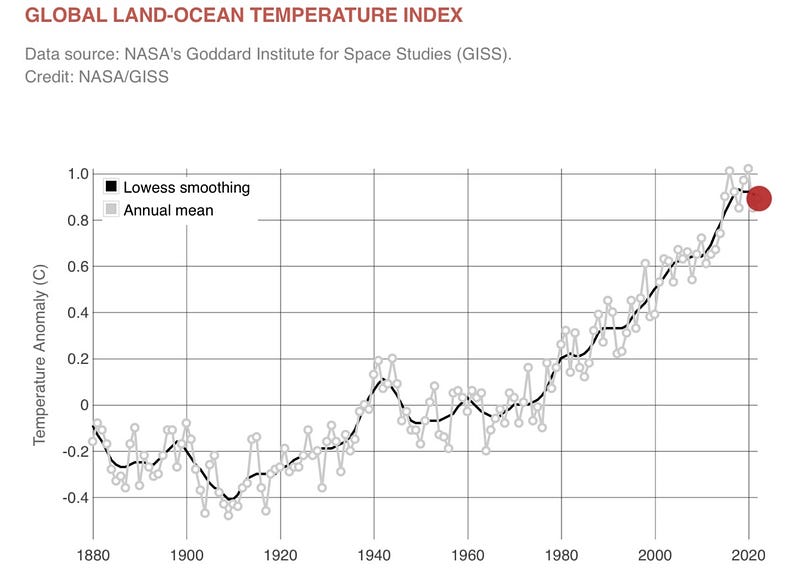
By the time I left kindergarten, the slow warming rate of our planet of around 0.04 degrees Celsius per decade suddenly increased to 0,19 degrees Celsius between 1970 and today. You can see that in this graph by NASA.
I have worked for many years on climate change issues, and for most of those years, I had to convince people that climate change was already changing our planet and that the urgency and severity made it a climate crisis. But I often felt like a doctor breaking the bad news to a seemingly healthy patient that he should fear for his life because of a deadly disease. If you don’t see, feel, or experience it, it is too easy to deny a problem’s existence. Those days are over now; it will be hard to find a friend or family member who doesn’t add to the dinner conversation by describing one of their experiences of a recent climate extreme example.
Too Soon to Tell
In the next years and decades, we will all have front-row seats to witness how, in a fraction of the next millisecond of the world’s 24-hour clock, the world as we know it will either be further destroyed by climate change or how the destroyers of the planet manage just in time to change their course and avoid complete disaster by halting the use of fossil fuels and find innovative solutions to keep the planet’s temperature under control.
It’s too soon to tell, especially since predicting what the world’s leaders will do is difficult. But judging on their past inertia to collectively take effective action to prevent further climate change and thinking about the way worldwide climate records were smashed this year, I fear we will all have to drink a poisonous cocktail of climate change-enhancing events that may change the course of history in far worse ways than most of us dare to admit.
A Feverish Planet
Maybe in a few years, you will read the news that scientists have noted a worrying increase in the rate of climate change. Part of that may then be explained by the successful efforts of governments to reduce aerosol pollution. While we pumped more greenhouse gasses into the atmosphere this year than ever before, it is another year that we start to notice more of the effects of reduced industrial pollution and, thus, cleaner skies. In other words, we add another blanket of CO2 and other gasses to trap heat on the feverish planet while reducing the protective aerosol umbrella that used to protect us somewhat from the sun’s incoming energy heating the atmosphere.
Two climate experts I admire most, who greatly respect each other’s work and have a solid reputation for predicting climate change impacts, now have different views on what to expect in the following decades. James Hansen expects the pace of global warming to increase, while Michael E. Mann is more cautious.
Extreme Extremes
Although I’m deeply worried by the extreme extremes of this year’s climate data, I leave it to the world’s best experts to give it the scientific interpretation we need. And while we wait and see who’s right and what will happen, let’s not stay as spectators to the climate science debate but support climate action. However intriguing the different views between climate scientists may be, it is good to realize that there is no disagreement between the two about the urgency to act and to rapidly reduce greenhouse gas emissions while taking other forms of climate action.
Maybe that is an excellent message to embrace in 2024: vote for leaders who prioritize climate action, support those who act on climate, think about where you can make a difference for a better planet, and take action. A better 2024 starts with each individual believing in our power to change, and don’t ever believe you’re not part of the history we are all making right now. Your time left on Earth may be a fraction of a split mini-second on that 24-hour clock of the Earth’s history, but remember that what you do matters to others. You can contribute to the change you aspire to see and live out the values you believe can transform the world around you. The Planet and future generations will be grateful to you.
Subscribe to receive email notifications when I publish new articles.


