The Climate Consequences of Israel’s War in Gaza
Military Emissions Exceed The Annual Emissions of the 20 Most Climate-Vulnerable Nations in Just Two Months.
Every morning on my bus ride to work in Patagonia, Argentina, the local Mountaineering Military School catches my eye. You can’t miss that bright orange, ancient snowmobile parked at the entrance, standing out against the green surroundings and demanding attention.
During the winter, while backcountry skiing, I often encounter the military. They go to the mountains for their practices, dressed in heavy clothes and armed with seemingly WWI-era guns. No planes or helicopters are hovering over the school, and even when wildfires require air intervention, we have to rely on aid from the other side of the Andean Mountain Range, using Chilean aircraft.
Gunshots, tanks, bombs? I’ve never seen any of those around here. This corner of Patagonia is as military-free as it gets, considering I can see the imaginary border with Chile from my balcony. And so, their emissions are almost non-existent.

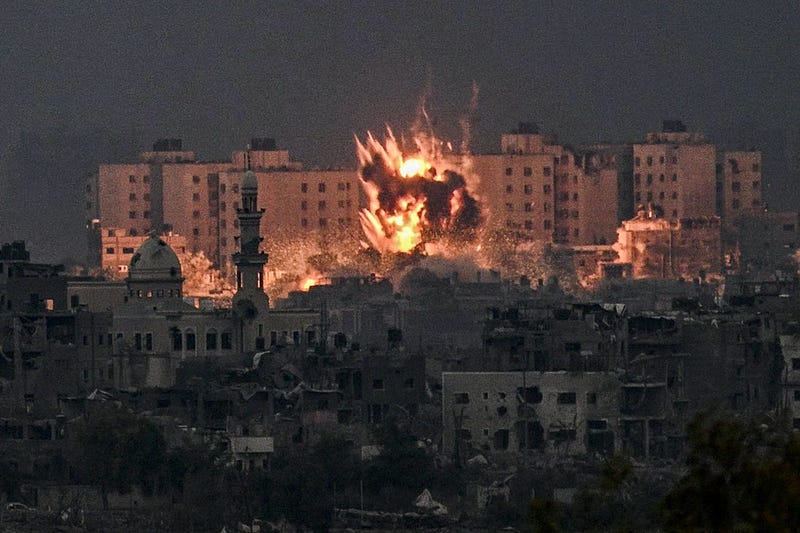
Quite the opposite is happening in the Middle East. In just two months, Israel’s military actions in Gaza unleashed more planet-warming gases than over 20 climate-vulnerable nations emit in a year, according to a groundbreaking study.
And military emissions are the least regulated and even less accounted for, so this is certainly an underestimation.
‘Gobsmackingly’ Scorching 2023: Where’s the Accountability?
In 2023, global temperatures smashed the record for the hottest year by a significant margin, potentially extending thousands of years. Earth was 1.48 C° hotter than the pre-fossil fuel-burning era (between 1.34 C° and 1.54 C° above pre-industrial levels across different temperature datasets), approaching the 1.5C target set in the Paris Agreement.
The year was the warmest ever over land AND oceans, and each month from June to December set new temperature records, with September breaking the prior record by a “gobsmacking” 0.5 C°. Like this, 77 countries — including China, Brazil, Austria, Bangladesh, Germany, Greece, Ireland, Japan, Mexico, the Netherlands, South Korea, and Ukraine, areas where 2.3 billion people live — registered their warmest year on record. Arctic and Antarctic sea ice witnessed alarming reductions, with Antarctic sea ice hitting a new record low extents for the corresponding time of the year in 8 months. This traduced into sea levels reaching new record highs, adding a new ingredient for unseen weather patterns worldwide: extreme ocean heat, floods, wildfires, unpredictable tropical storms escalating into category 5 hurricanes, and deadly heatwaves.
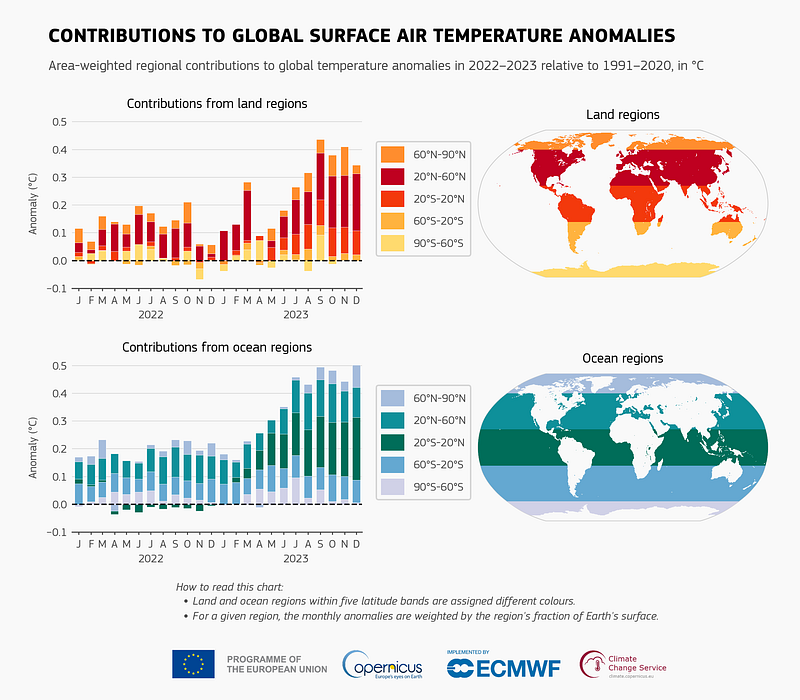
There are many questions about what precise factors have driven the exceptional warmth. Carbon emissions, methane, and nitrous oxide reached an all-time high. Natural events like unprecedented wildfires in Canada added to the warming equation. Even El Niño — the usual suspect behind record-warm years — does not clearly explain 2023 temperatures. The current El Niño is expected to peak soon and is forecast to dissipate by the middle of 2024. Nonetheless, its legacy will likely contribute significantly to warm global average temperatures in 2024. Carbon Brief predicts that temperatures will likely surpass those of 2023, setting new all-time records.
But one thing is clear: amidst these uncertain future marked by climate extremes, there’s a concerning lack of accountability from those contributing to the irreversible environmental challenges. Big Oil, pathetically leading COP28, continues to evade responsibility for its ecological impact and projecting expansion projects. And then, we are back to the incomprehensible military’s “environmental exceptionalism,” exemplified by Israel’s Gaza War emissions.
A Matter of Life and Death
Even under optimal conditions, addressing climate change requires a profound societal, economic, and cultural transformation. In conflict zones, where the focus is survival, authorities are ill-equipped to prioritize climate-related challenges and inadequately prepared to respond to lesser adversities.
Yet, since the October 7 Hamas attack, the world has watched Israel explicitly committing war crimes, cutting off essential resources to the two million people trapped in the world’s biggest open-air prison, a.k.a. Gaza. The damage has not only been with one of the most intense bombing campaigns in modern war, equivalent to two nuclear bombs, but with the invisible emission of carbon dioxide.
Over 99% of the estimated 281,000 metric tonnes of CO2 equivalent produced within the initial 60 days after October 7 can be pinned on Israel’s aerial bombardment and ground invasion. This is like burning at least 150,000 tonnes of coal, or more than the bottom 20 most climate-vulnerable nations emit in a year. The study accounts for emissions from aircraft missions, tanks, vehicle fuel, bomb production, and explosions, excluding methane. Notably — but unsurprisingly — almost half of the CO2 emissions resulted from US cargo planes transporting military supplies to Israel.
Hamas? A mere 713 tonnes of CO2, equivalent to about 300 tonnes of coal. Where Israel burnt 500, Hamas burnt 1 tonne of coal, underscoring the glaring asymmetry in the environmental toll of each side’s war machinery.
The research highlights that previous studies indicate the actual carbon footprint could be five to eight times higher if emissions from the entire war supply chain were considered.
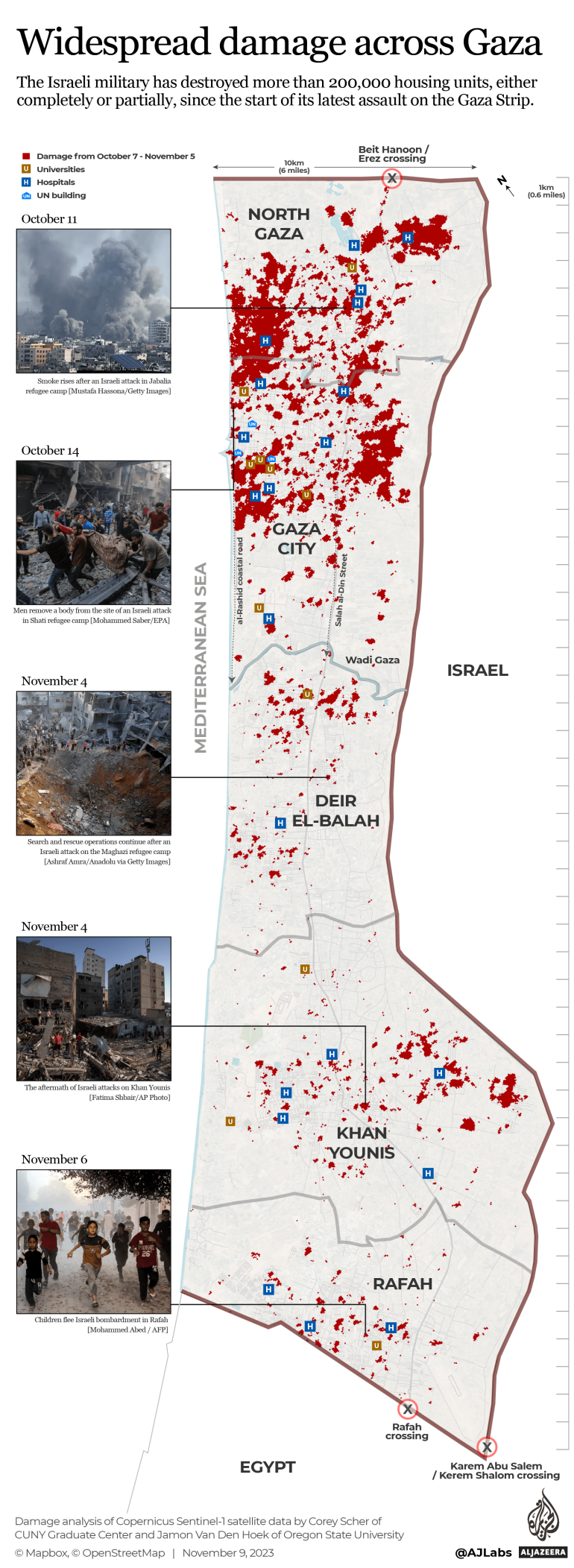
Between 36% and 45% of Gaza’s buildings — homes, schools, mosques, hospitals, and shops — have been destroyed or damaged, and construction is a major driver of global heating. Just consider that rebuilding Gaza’s 100,000 damaged buildings using contemporary construction methods would generate over 30 million metric tonnes of warming gases, equivalent to New Zealand’s annual CO2 emissions and surpassing those of 135 other countries and territories.
“The military’s environmental exceptionalism allows them to pollute with impunity as if the carbon emissions spitting from their tanks and fighter jets don’t count. This has to stop. To tackle the climate crisis, we need accountability,” says lead author Neimark.
And beyond the immediate suffering of Gaza, causing widespread death and destruction with 1,200 Israelis and nearly 23,000 Palestinians, primarily women and children, killed and thousands more buried under the rubble presumed dead, the conflict only worsens the local climate emergency.
There Is No Place to Run In Gaza
International organizations have been sounding the alarm about the perilous state of infrastructure and sanitation in the Gaza Strip, home to 2.2 million people, for decades. With just 365 square kilometers of land — a 41 km by 6–12 km rectangle — Gaza is home to 2.2 million people, translating to a population density of approximately 6,000 individuals per square kilometer and 5th worldwide in population density.
Climate consequences, including rising sea levels, drought, and extreme heat, were already threatening water supplies and food security in Palestine. The environmental situation in Gaza is now catastrophic, as much of the farmland, energy, and water infrastructure has been destroyed or polluted, with devastating health implications probably for decades to come.
My hometown, Bariloche, is two-thirds of Gaza at 220 square kilometers and one of Patagonia’s most densely populated cities, accommodating around 146,000 people. This results in about 663 people per square kilometer, ten times less than Gaza. And even like this, it feels overpopulated. But then, you transcend the invisible margins of the city and dive into the real Patagonia, which, as a whole, has a density of 2 (no typo here) lost souls per square kilometer and plenty of natural resources. As I said before, I am a very lucky person.
Yes, there’s no doubt that the primary driver of vulnerability in Gaza is conflict. But the compounding impacts of climate change, including rising temperatures, diminishing precipitation, escalating sea levels, and more frequent extreme weather events, exacerbate people’s vulnerability.
In recent years, intense floods wreaked havoc in Gaza, damaging hundreds of buildings and rendering entire drainage systems inoperable, displacing numerous residents. Facing severe restrictions on basic needs, the local population lacks the means to cope with another extreme weather event.
An MIT study predicts a 10% to 30% decrease in average annual precipitation by 2100, coupled with a 3 to 5-degree Celsius temperature increase, impacting agricultural productivity and food supply and causing price instability and shortages. And these environmental sufferings are exacerbated by the political conflict, with Israel using water as a weapon by targeting critical infrastructure and cutting off supplies to more than 2 million people in the besieged Gaza Strip — as did Russia when it destroyed the Kakhovka dam in southern Ukraine. Cutting off or denying people access to safe water violates international humanitarian law and the Geneva Conventions, constituting a war crime, according to UN experts.
The World Health Organization (WHO) noted the lower limit of water per person per day is 100 liters (26 gallons). The average Israeli consumes 369.5 liters of water per day. Even before the current siege began, the average consumption was 45 liters in Gaza, 50 in Jerusalem and the West Bank, and 20 in some areas under Israeli control. Now, it is estimated to be at 3 (!) agonizing liters a day of water for drinking and basic needs.
The “sacred land” is on the brink of transforming into an uninhabitable desert. The region is currently warming at twice the global average rate, with the average number of high fire-risk days per year increasing by 2.5 times. Large parts of the coast are projected to disappear due to rising sea levels of the Mediterranean, warming much faster than the rest of the world.
Aggravating the situation and as reported by the NY Times, the Jordan River’s flow is less than 10% of its historical average, and the Yarmouk River, a significant tributary, is greatly diminished. The Dead Sea, fed by these rivers, is disappearing.
The aftermath is straightforward: over 660,000 Palestinians living in Jerusalem and the West Bank have insufficient access to water, while 1 million in Gaza suffer from water scarcity. Water scarcity in Gaza has led to drastic measures, with 97% of the population relying on unregulated private water sources and households spending one-third to half of their income on water. All while the land is a battleground and at risk of becoming a barren wasteland.
One adaptation strategy is to move in search of more fertile land or water. That is not an option here. Because, simply put, there is no place to run from climate or conflict in Gaza.

Military Emissions: US and Israel in the Hot Seat
In 2022, the US military’s carbon footprint outpaced the yearly emissions of 150 out of 195 nations in the world, including large emitters like Norway, Ireland, and Azerbaijan. Just take a look at the following chart:
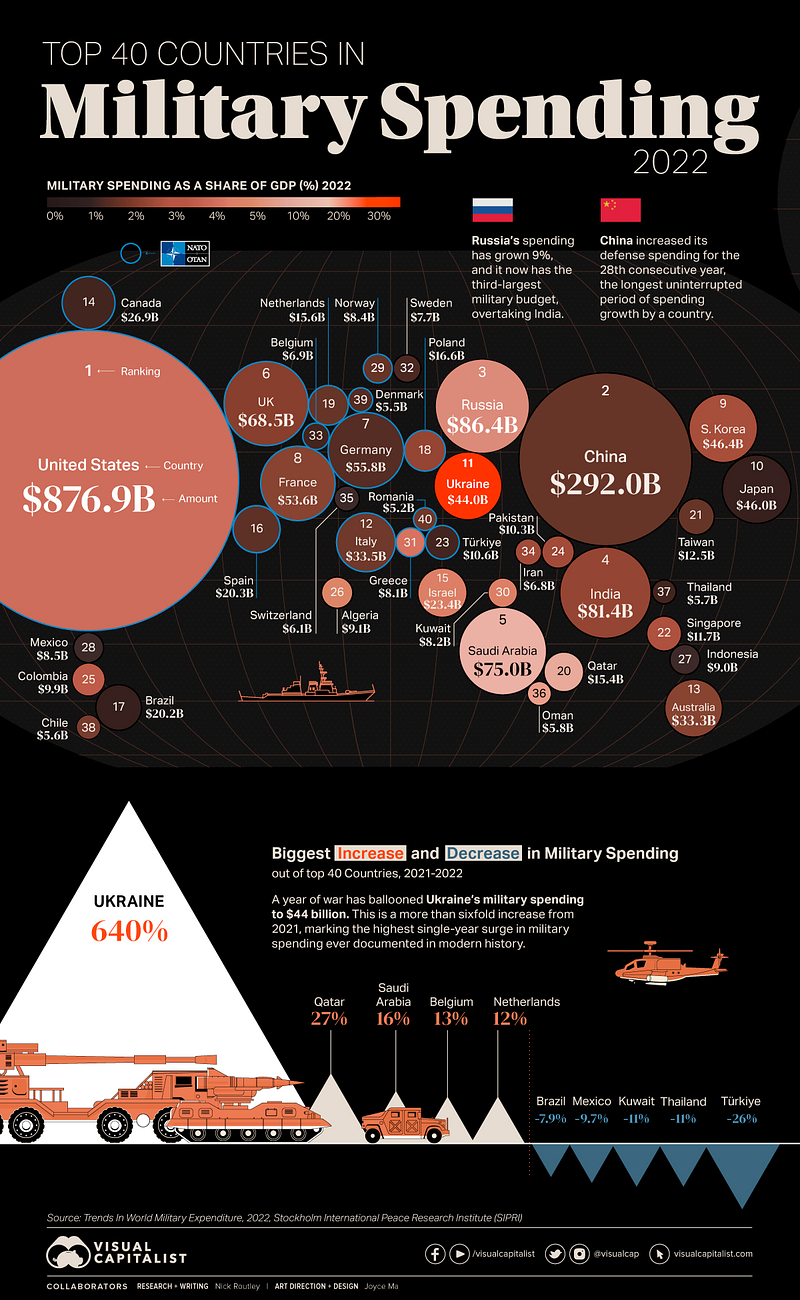
The US’s disproportionate role in military carbon emissions (and spending) not only comes from its particular actions but also because of channeling billions into military aid, weapons, and gear for Israel’s use in Gaza and the West Bank. By December 4, 200 American cargo flights had unloaded 10,000 tonnes of military equipment in Israel, spewing an estimated 133,000 tonnes of CO2 — eclipsing Grenada’s emissions last year. The root cause? You guessed it — fossil fuels.
Plain and simple, the US is gearing up for the wrong risks, putting too many eggs in the military basket when there’s a much more dire climate emergency that affects us all. Who cares, right?
The global impact of war and occupation remains shrouded, with militaries enjoying a culture of environmental exceptionalism, thanks to the US’s insistence. An exclusion in the 1997 Kyoto Protocol turned into voluntary reporting under the 2015 Paris Agreement. Only four countries submit partial data to the UN Framework Convention on Climate Change (UNFCCC), leaving a substantial gap in comprehension.
A recent study reveals that militaries contribute nearly 5.5% of global greenhouse gas emissions annually — surpassing the combined emissions of aviation and shipping. This places the military carbon footprint as the fourth largest globally, trailing only the US, China, and India. Israel’s annual baseline military carbon footprint, excluding conflict, was nearly 7 million metric tonnes of CO2 equivalent in 2019, surpassing Cyprus’s emissions and exceeding Palestine’s total by 55%.
This has got to change.
Rather than propelling nations away from fossil fuels, conflicts intensify fossil fuel securing efforts, diverting from greener sources. In this scenario, defense stocks surge and oil prices rise, reminiscent of fears during the Yom Kippur War 2.0 and the Arab oil embargo’s impact on energy markets.
Each day these conflicts between nations extend is another day we ignore climate change for the world. On the contrary, we find ourselves captivated by sadistic injustices, unable to look away from the sick, short-term fascination with the violent and tragic.
The dual threats of war and the climate crisis demand recognition that the status quo is unsustainable. The call for systemic change is glaring — our planet is indifferent to politics or conflicts, crumbling beneath our fossil fuel addiction. The countless climate change studies should compel world leaders to take immediate action to prevent a self-made apocalypse.
The military remnants will continue to live in the soil, the earth, the sea, and the bodies of the Palestinians living in Gaza — just as it does in every other barren postwar context.
The writing on the Western Wall is already too clear.
And scorching hot.
Thank you for your thorough reading and support! Subscribe for immediate insights and join the 400+ Antarctic Sapiens community for weekly thought-provoking content.