
The Clearing in the Breezy Peaceful Quiet
Please note that this is a work in progress. The running title for my manuscript is Finding Satori Within Nature. There are currently 14 chapters being edited. I will attempt to post the following chapter within 2 weeks.
Thank you for your collective interest.
Previous chapter:
The Quotes Journal: Part Three
Good morning reader. Good night to myself when I finish compiling this journal tonight. I have the entirety of a 15-hour temperate Summer Tuesday to relinquish the rest of the Quotes Journal. Along with me, I’ve brought an antique briefcase to the Sherburne NWR filled with the following items:
- A 1977 Olympia De Luxe portable typewriter
- A stack of crisp paper
- This Proper Journal
- 2 fountain pens, freshly re-inked
- 2 binders, one with the manuscript, the other for rough drafts
- A cushioned lap desk
- ½ gallon of artesian well water
- A pint of blueberries and an apricot nut bar
I am currently unpacking all of this onto an outdoor concrete table at the Burr Oak Welcome Station in Zimmerman Minnesota. I’ll explain why in a bit here. I plan to type up chapter eleven out here on this perfect weather day. Following the precedent set during the Water and Fire Journal editing sessions from chapters 1–5, I am dedicating a day at a park to reread an old journal of mine. Instead of simply writing, “I can’t tell you just how beautiful this place is,” I want to write out observations of what is occurring around me while I typewrite. And since I have the entire day off today, why not? This is what I am doing today. All necessary chores are done, all bills have been paid, my cell phone is off, and the Sun has risen.
I want to show what it’s like to be in the moment. So bear with me through the typos and crossed-out words of my sloppy script if you are reading directly from this journal. When I am ready, I will manually type this chapter and retype (and retype and retype…). Once I am confident in the entry’s coherence, I will type it in my manuscript Google Doc. In the meantime, let me catch you up on the pocketbook I started this morning.
The Sherburne National Wildlife Refuge, North Kiosk, Zimmerman, Minnesota, United States of America.
5 years have passed since I wrote the Royal Journal in a hammock upon completing my undergrad.
Alright! Here I am. Here I is. Here is a display board that reads ‘Meet the Neighbors’. Two Sandhill Cranes are pictured and…
As the car door is closed, pen in hand, we interrupt this story to bring you a pair of real cranes directly behind the kiosk! They lift off in a whoosh and bugle out, ”KKRROKRKRKROOO.”
Their 2 million year old trumpeting call is one humans can’t physically imitate. They have flown across the dirt lot to a marsh across the road to be at peace again.
This…this moment exactly…is why the park was established in the first place. It provides space for migratory birds to have places to be undisturbed by us. The patch of woody wetland, where they now reside, is off-limits to humans year-round.
The sign I was about to read, before I was so graciously interrupted from, says,
“95% of the refuge was purchased through the Migratory Bird Conservation Fund…which is mostly funded by Duck Stamp sales. 98% of these sales go toward purchasing land and easements.”
The Sherburne NWR is home to Lupine fields, Blanding’s Turtles, River Otters in the St. Francis River, Red-headed Woodpeckers, Bull Snakes, giant eagle nests (called aeries), and of course large migratory birds such as the cranes, swans, geese, and herons. According to the guidebook I carry (A Field Guide to the Natural World of the Twin Cities by John Moriarty. 2018.)*, Bull Snakes grow up to six feet long, but I’ve heard locals say they’ve seen as long as eight. *Not sponsored.
So, first things first, let me get my bearings and create some exposition for you. I want the setting today to be within the famous Prairie’s Edge Scenic Wildlife Drive. It’s the touristy presentation of the park to divert visitors into one area, but nonetheless, a fine drive for viewing opportunities. The Quill Journal (from which the Water Journal was edited through) was written on the Mahnomen trail about 5 miles Southeast from where I stand.
Water was edited there three years ago this month. Those were my first real editing sessions. It was the first time I realized the joy of rearticulating thoughts into a readable perspective. Remember that back then I did not have a typewriter. I so wanted one. No, I think I actually mentioned wanting a typewriter in Fire. Regardless, I have three now! Not to mention the extensive pocketbook system I created. Numerous pocketbooks have been sifted into many journals. The journals have been transcribed into my old unused university notebooks. The notebooks were then typed into Google Docs. I printed them off and edited the crap out of them several times over with my typewriters. I would make edits with a red pen through every sentence, typewrite the pages, and repeat the process until the paragraphs were readable. Today I have the rest of the Quotes Journal from 4 years ago to type up. It’s hard to believe Chapter 6 was written 5 years ago.
Across from the kiosk here is the intersection of county roads 3 and 5. This park provides an example of what Life was like before we destroyed it. Please note that in the last century, we effectively and efficiently diminished over ⅓ of the world’s biodiversity. I will put a reference here in post if you want to learn more about what we’ve done. Here at the refuge, there is a capacity to house over 11,000 Sandhill Cranes all at once. It is an American pride that we have the National Wildlife Refuge System.
I’m getting a call.
A prospective employer just interviewed me. I’m flattered they reached out, but I turned the electrician job down as I have no interest in a career that doesn’t have any environmental aspects. I ethically have to or I’ll have no interest.
I’m ready to head into the park to begin today’s writing.
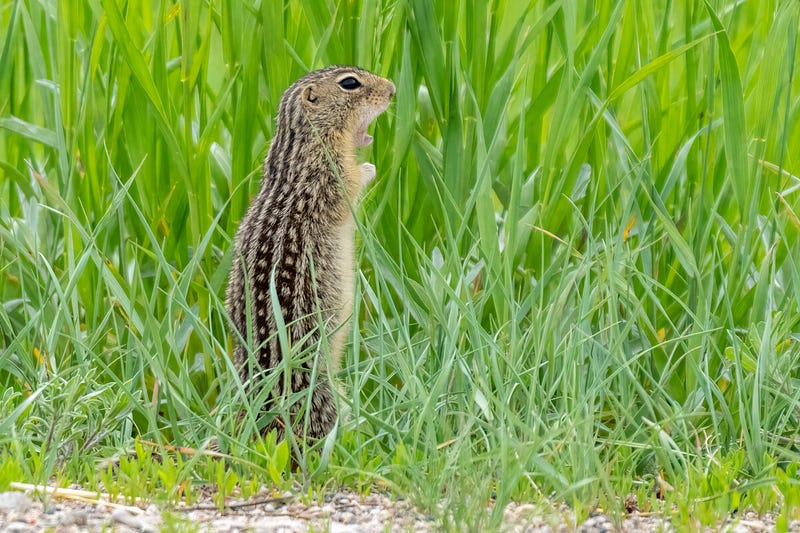
I have arrived at the Burr Oak Welcome Station 5 miles South of the kiosk. The first animal to make an appearance is a 13-lined squirrel. Their brown backs have what looks like a sequence of interstate highway lines; spotted lines separated by solid lines. The 7 or 8 lines on this little guy are residing well while in the tall grasses. The ones here are displaying their bipedal nature, how curious. He walks through the prairie with his eyes looking at the tips of the various grasses five times his height. He spots one, what I believe is a Big Bluestem, with a plethura of tiny yellow flowers. With eyes toward the sky, he grabs the stalk and lazily walks it down until the flowers are at mouth level. He has a bite, let’s go, and the grass flows back up to become straight again. Each pod has 6 or 7 of these little snacks, and each flower has 40 or so pods. These squirrels have several hundreds of bites per bush. With hundreds of bushes per field and dozens of fields in this park, they will have a sufficient food base for their entire population into perpetuity. That is, if it is not mowed down for another pipeline. Humans could learn from consumption cycles like this. The animals consume less food than what is produced.
I move on from watching the 13-lined Ground Squirrel at the trailhead and enter into the small loop. There are several elements of Life presenting themselves as I scout out a place to type at. Trumpeter Swans are calling out in a marshy pool below a wooden observation deck, no doubt to let each other know of my presence. Monarchs are flying idly about. There are more species of flora than could possibly fit on this page.
A butterfly flies directly at my face to capture my attention. He or she lands on a Burr Oak leaf. Many animals and insects are known to become martyrs by guiding predators away from their nest/offspring. This butterfly is not scared of me in the slightest. As I look closer, I am easily within biting distance. A tongue’s length away. The wings are mostly purple with black outlines. The torso is hairier than expected. The legs are bent 90 degrees to form a cube/diamond shape. The Oak leaves are trembling around in the wind, yet the butterfly remains fully attached, along for the ride.
A wildlife biologist has pulled into the station in a truck. She walks up the path to unlock a display panel. She takes out a pencil and proceeds to add yesterday’s bird survey data to the board.
“Hello,” she offers as I approach. She is on guard and does not offer a smile, likely having dealt with the occasional creep or druggie out here in the middle of nowhere. Though she sees I have a journal in-hand and asks a question.
“I haven’t seen any birds beyond what you’ve written so far,” I respond.
I wish her well and she is giving me a frown for some reason. I guess I’ll just head back to the trail.
A table has been spotted. I’ll head back to my car to grab my portable desk. Oh, I would also like to take down all the birds she wrote down that have been spotted at the park.
Canada Goose
Trumpeter Swan
Wood Duck
Blue-Winged Teal
Mallard Duck
Mourning Dove
Great Blue Heron
Double Crested Cormorant
Wilson’s Snipe
Sandhill Crane
Black Tern
Red-bellied Woodpecker
Northern Flicker
Eastern Wood Pewee
Eastern Phoebe
Eastern Kingbird
Blue Jay
House Wren
Grey Catbird
Song Sparrow
American Robin
Cedar Waxwing
Grasshopper Sparrow
Field Sparrow
Baltimore Oriole
Swamp Sparrow
Eastern Towhee
Eastern Meadowlark
Common Yellowthroat
American Redstart
Red-winged Blackbird
Brown-headed Cowbird
Yellow Warbler
Willow Flycatcher
Rose-breasted Grosbeak
Warbling Vireo
Brown Thrasher
Chestnut-sided Warbler
Dickcissel
Least Flycatcher
We are now caught up with the pocketbook. My goal today is to type up the rest of the Quotes journal and surround it with the context of the park. A sort of curation of entries out and away from the ephemera of daily journaling. Let’s see first then, how many entries did I write in Quotes?
9 entries.
Quotes was the second journal I picked up, yet the fourth one finished. You have already read part of it. The trip to Carlos Avery WMA was from Quotes as well as a resignation letter from Sodexo at Bethel and the research that led me to the Conservation Corps. When I was done writing that day at the Carlos Avery WMA, the ‘blank journal’ that I painted my Smart Car in pastel was what eventually became the Fire Journal.
So here’s the thing, after finishing Fire, I needed to not be constricted by lined paper. The Square Journal was a sketchbook, really. Quotes became a background set of pages with behind-the-scenes entries. Writing in all three at the same time was fun at the time, but became a mess in trying to continue a thought. My idea today is to wrap up the last of this trio to see if any of the last entries are worth retelling while I drive along the Wildlife Drive. Oh, this is going to be so much fun. Who am I kidding, I’m already having fun.
I must reiterate just how perfect the weather is today. There is a steady and non-threatening Sun, not a mosquito is in the air, and the breeze is soft to the hair. So! I will go right ahead and type up the first entry here at this picnic bench. Then I’ll drive to the Prairie Trail, find a spot to type over there, and finally, I’ll type out the last Quotes entry at the Woodland Trail.
With a shake of hands,
Paper has been reloaded.
Here I go again.
Hey.
Hi.
I finished the Fire Journal this morning. The only paper I have on hand is this Quotes Journal that never became of anything. That’s a sad statement and really not true. A lot came from Quotes: Carlos Avery, CCMI research, and my resignation letter from Bethel university.
The process has begun to condense what I have written into a gifted 200-paged paisley notebook. This journal has been set to the wayside because really, fire training and my girlfriend have grabbed all of my attention. I had forgotten that this still has many available pages! May I use this as a sort of behind-the-scenes then. Less about full entries and more about what is happening in my life. The more I write, the more I find out that sometimes I write to remember, and in other times, I write to forget.
The longer I am with the Corps, the more I am realizing we are getting the short end of the stick with forestry work. We do the sort of work that the full-time staff at Three Rivers feel they don’t have time to waste on. The CCMI, as well, is taking 2/3rds of a pay cut out of the paychecks from Three Rivers. I understand D___ gets paid 5 times as much as we do, but then again he is a careered forester. To work at the Corps, you almost have to be a wealthy person already to get by.
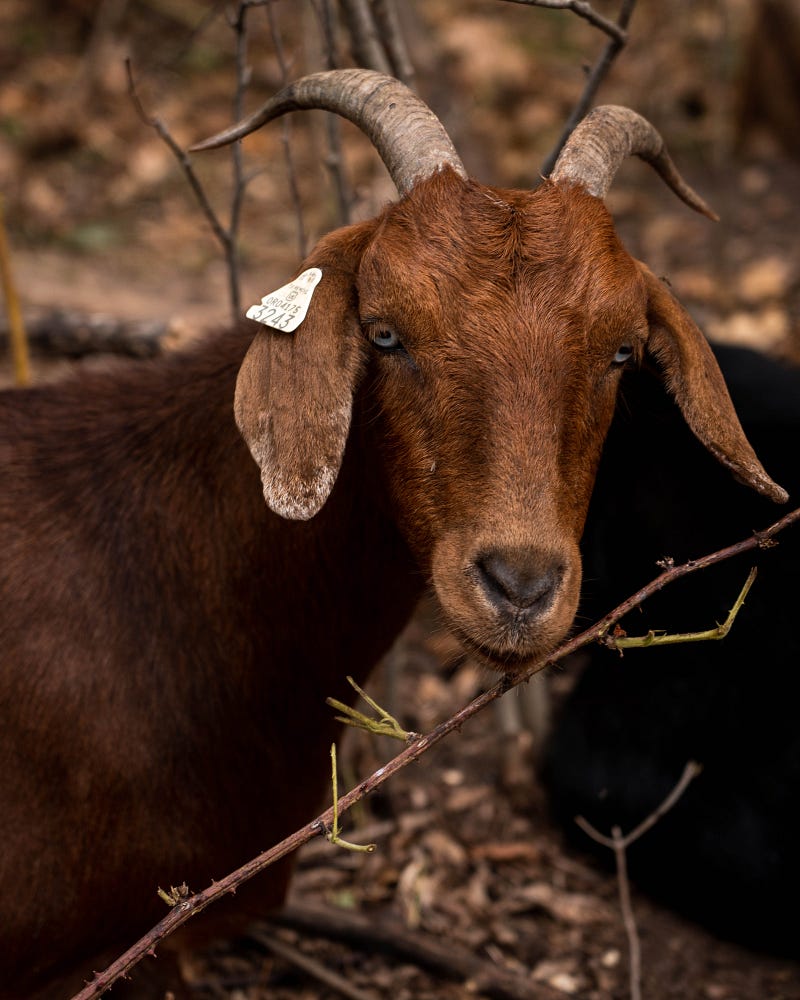
Earlier this week, D___ took our crew to a previously mismanaged fenced-in woodlot where goats have been eating away everything for vegetation control. They are effective as invasive species lawn mowers if they are left to their devices. The goats have been sent back to their farm and here we are, scraping the bottom of the barrel to make sure to remove the rest of everything that remains.
We have dealt with this situation the best we could.
As this is the Quotes Journal there is a quote every several pages:
“You can never have too much sky” -Sandra Cisneros
Today we are joined by the man who interviewed me. M___ joins us here at Lake Rebecca Park Reserve to see how we’re doing and to admittedly get out of the office. He is watching me write this and suggests I take down daily metrics when I can. How many trees are we planting, with how many people, while using which equipment? He gives an example of when he was using metrics just this morning to plan an outing for us coming later in October. Sounds like we’ll be helping out a Hmong farm. Sounds like they are excited to host us.
Earlier, M___ was teaching us about epicormic growth. It’s what I’ve been describing internally as the Herculean dragon effect. Hercules fought a dragon that regrew a double-head with every decapitation. The ancient story honestly may have been an allegory for certain invasive species. When Buckthorn is cut and cut again and cut again, it will hedge. This is exactly why we should be pulling out the root systems of these stumps and not just stump-dabbing. Epicormic growth is a stress response saying, Nah, Imma stay alive damn it. Plenty of species do this. I remember cutting an Elm tree in my parent’s backyard and it did exactly that. A trunk emerged sideways out of the stump. It’s silly that people think chemically treating plants is efficient when the nutrients can just be sent down into the roots to grow in a different direction. Simply put, if you have to get rid of a plant, isolate and remove it in its entirety, roots and all. There is no need to spray toxins.
M___ says he enjoys working for the Corps. I don’t see any regret in his eyes when he says this. He takes out his phone and gnaws on a simple ham sandwich. He looks like he is ready to check out of the conversation, but he turns the phone around to show a picture of a huge Ironwood tree he found. It is the biggest I’ve ever seen.
“It’s in that direction,” he gestures with his chin to the East uphill several hundred meters over a clearing.
We look out to the clearing in the breezy peaceful quiet.
On the next page of the journal is a set of painted mountains with the following quote:
“It’s Morning again, little hope, and the world’s drying off with fresh-laundered sunshine. Life’s face is never the same though we may look at it for all eternity”
-Kolbein Falkeid.
I’m going to edit another small entry before heading out.
One minute until a loaf of focaccia is baked for this week’s meal prep. While this was cooking this morning, I made a few playlists on Spotify:
-Songs from artists I’ve seen performed live
-Songs for hands-in-pocket strolling
-Songs I’ve Played For Her
That one is a bit personal.
I’m meeting my father for lunch in the Lynlake neighborhood of Minneapolis. In our monthly catch-ups, I can talk about fire training and the freckles of the girl whom I sat next to.
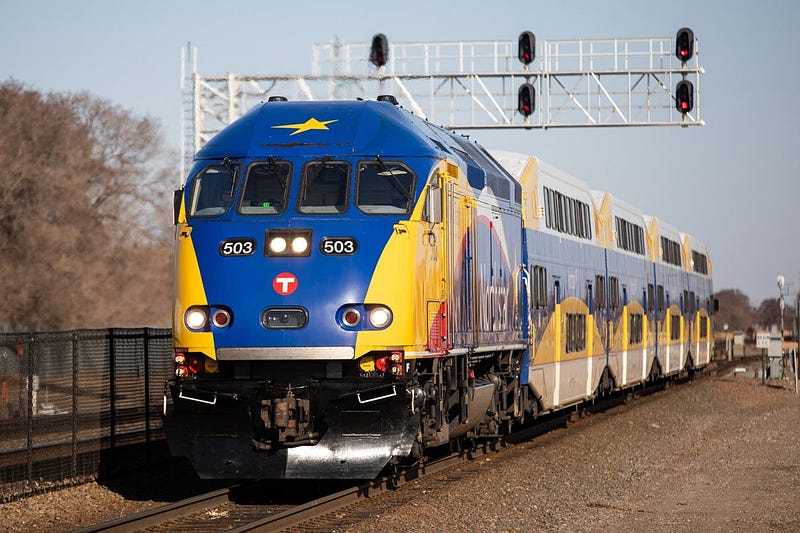
The loaf has been sliced. A stirfry containing cabbage, celery, broccoli, carrots, and asparagus was separated into containers. I find myself writing this on a train from Elk River to Downtown Minneapolis. Trains, commuter trains that is, are just the best way to travel in my opinion, honestly. I wish we had more of them in operation. The Northstar Rail rides smoothly along tracks bringing us passengers Southbound in just 45 minutes to the Cities. This is faster than by car I would like to clarify, especially during rush hour. Through the Green Line, one can reach the Union Depot in St. Paul which connects with interstate tracks. The Blue Line goes through Minneapolis, stops by the airport, and ends at the state’s greatest tourist trap. The Mall of America is not exactly a regular destination for locals.
I’m not taking either of those lines today. Today, my dad and I are having a bite at Trio in Downtown for some good soul food.
On the train here, on a seat table, there is a camera, a wallet, this journal, and a letter from my friend S_______ which reads,
You, ___, and I are all moving closer to doing what we love in this life — and isn’t it proving to be a worthy fight after all?”
We are all in agreement to visit this Summer. Maybe they will make the drive out here. I can tell them about all the parks I’ve been to with the Corps. I__ can talk about the EP he started to record. S_______ can talk about the poetry book she is selling on Etsy. Maybe I could take them on the train while they’re here.
“Now arriving at Fridley Station,” the conductor tells us over the intercom. Could I use the Metro transit system to visit with other friends too? Does this connect with Duluth? The lighthouses there are delightful and the hiking on the North Shore is top-notch.
Another quote will end this chapter. See you at the next trail for the next entry.
“O World, I cannot hold thee close enough!” -Edna St. Vincent Millay
If you would like to see this project turn into a tangible published book, consider donating here.
Next chapter:
Copyright 2024 Casimir Curney. All rights reserved. No portion of this book may be reproduced in any form without written permission from the author, except as permitted by U.S. copyright law.