
The Clash of Progressive and Evangelical Christianities
Is either kind of religious faith on safe ground?
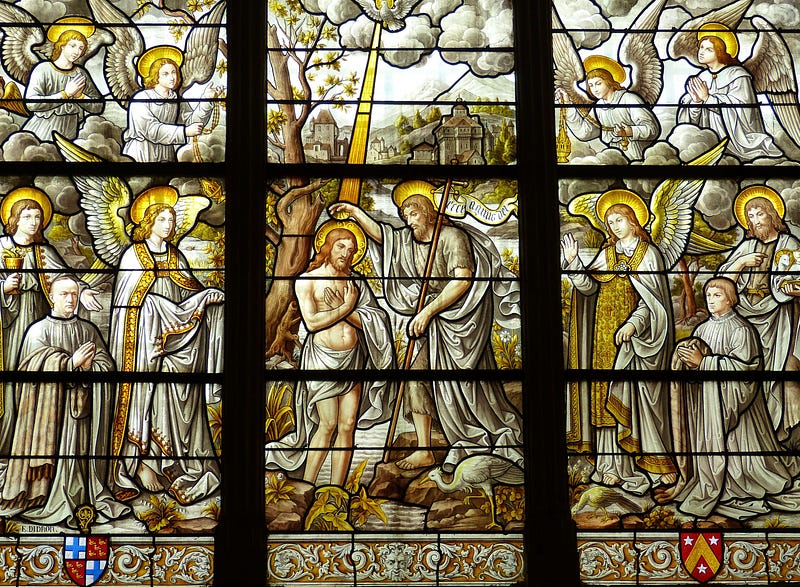
What happens when progressive Christians meet conservative evangelical ones?
The progressive Christian takes flagrant Americanism to be irrelevant to an ancient religion, and emphasizes Jesus’s socialist teachings and altruistic, world-renouncing practices, as presented in the gospels.
Meanwhile, the born-again fundamentalist Protestant leaps headfirst into Americanism, defining Christianity as a personal relationship with God that happens to be compatible with all manner of imperialism, nationalism, patriarchy, warmongering, consumerism, and libertarian selfishness.
How can a religion contain such multitudes?
Progressive Christianity
Liberal Christianity sprang from Enlightenment criticism of the Bible, when scientific facts were rigorously distinguished from myth, fantasy, and obscurantist propaganda. Instead of leaving Christianity altogether, once its dogmas had been naturalized and the literalistic readings of the Bible were discounted as naïve, self-serving, and tribal, the liberal Christian found existential meaning in the Christian myths.
In short, the liberal Christian concedes that science calls the shots when it comes to reason, evidence, and facts. But science is silent on questions of meaning and value. To make life worth living despite our penchant for overthinking and doubting, we tell stories to humanize natural reality. Without that mythologization, nature is physically and objectively meaningless or even monstrous and inhuman.
The story of Jesus’s death and resurrection, then, becomes a criticism of social conventions that are blind to the worth of idealistic, enlightened, and existentially authentic people who are typically marginalized or persecuted for resisting nature’s default, pyramidal distributions of power, namely the hegemonies so prized by conservatives.
The hope is that although these spiritual elites can only fail to succeed in natural, economic, or mainstream cultural terms, because mass society is a hotbed of vile, antispiritual or animalistic competition, the secret elites whom Jesus called “poor in spirit” might somehow be honoured by a higher judge.
Jesus’s resurrection dramatizes the higher calling by positing a judge who stands apart from Rome and Judea and who can see Jesus the radical outsider for what he is and appreciate his vision of an ideal social order. The gospel narrative is a fantasy for marginalized people of all stripes, including introverts, radicals, hippies, bohemians, starving artists, losers, outcasts, mystics, and idiots (in Dostoevsky’s sense).
But Jesus’s moral radicalism — according to which the poor deserve to be rich and the rich deserve to be poor — fires the imagination of progressive Christians, inspiring their battles for social justice and for reining in the capitalism and consumerism that threaten the planet’s ability to support our species.
Born-Again, Evangelical Christianity
By contrast, born-again Christianity is compatible with the conservative, authoritarian, and individualistic mindset, according to which we can call upon Jesus alone to save us. There’s no salvation from the government or from human cooperation, ingenuity, insight, or any other mortal effort. Only God can improve our situation, so the hope for social progress by following reason, using technology, and learning to cooperate and to think collectively is sinful and futile.
According to this conservative Protestant Christianity, we’re saved and guaranteed eternal glory in the afterlife just by recognizing that Jesus saved us when he died on the cross as a sacrifice to pay for all our sins. That recognition leads to a personal and thus private relationship with the risen Jesus.
All the public aspects of life outside the church, then, including politics, economics, business, academia, sports, arts, and so on are fallen and vain. God can intervene or judge certain social eventualities, as when he ordains or punishes certain kings or presidents or grants victories to your favourite boxer or American football team. But none of those arenas is sanctified; on the contrary, the secular world is governed by demonic fallen angels until the final judgment at the end of time (1 John 5:19, John 12:31, Eph.6:12).
How, then, is the born-again experience made consistent with right-wing nationalism, free market economics, and various outpourings of authoritarian bigotry? Partly by cherry picking verses in the Bible, in a book that’s complex and poetic enough to support any form of saintliness or wickedness you can imagine.
But more crucially, the compatibility is established by the public-private dualism which goes back to Martin Luther’s individualism and to Augustine’s Platonism. If you can testify to the strength of your religious faith and to the intimacy of your emotional bond with Jesus, you’re already saved no matter what else you do in life.
Of course, if you go around killing and eating babies and yet you profess to be born-again in the blood of Jesus, few will believe your profession of faith. Still, if you avoid the most obvious and grievous sins, any other conduct can be explained away as sins paid for by Jesus’s sacrificial death, the benefits of which are credited to you if you merely believe in that connection. And you demonstrate that faith not so much by your actions but by the intensity of your inner relationship with God.
Faith without good works may be dead, as said in James 2, but for conservative Protestants faith is foundational and the value of good deeds is only in their indicating the strength of the doer’s faith and the reality of the born-again conversion. The good deeds don’t help anyone unless they strengthen religious faith, because the world is corrupt and irreparable without divine assistance.
Why not, then, withdraw from fallen society and live as a Christian monk in the wilderness, content with the private relationship with Jesus? Why not sell all your possessions and abandon the illusions of earthly power? Wouldn’t that saintliness be the ultimate sign of an inner bond with God?
The white conservative evangelical answers that he or she is supposed to spread the gospel, to enter the lion’s den of secular society, as Jesus entered Jerusalem, and help convert others to save them from hellfire.
Thus, Christians are forced to participate in the fallen world to show they’re not afraid and to shine the light of Jesus in the darkness. Christians are forced to start families because the Bible clearly includes such Jewish patriarchal commandments (even though producing offspring would be unnecessary were the second coming of Jesus imminent, as the early Christians presumed).
And Christians are forced to earn a living to support themselves in their religious mission. If Christians should become wealthy in the process, better that a born-again Christian should decide what to do with that wealth than to pay large taxes to a secular government.
The evangelical’s bigoted, sanctimonious, and conservative policies are inherited from the Bible’s anachronistic tribalism or are rationalized as having instrumental value in spreading God’s message and in strengthening the all-important faith and the private, one-sided, virtually unfalsifiable and vacuous relationship with God.
Evangelical Obtuseness
Amusingly, in praising a book that defends evangelical Christianity against the progressive kind, Tom Gilson, an evangelical writer said that the progressive’s Jesus “looks a lot like one manufactured to give divine approval to contemporary culture, though, not the God who stands above us all in holiness.”
Gilson is thus doubly oblivious. First, he seems unaware of how socialist, collectivist cooperation long predates modern liberalism or progressive politics. The members of cults and of underground religious movements from ancient times protected each other as spiritual family members. That’s why the New Testament refers to fellow Christians as adelphoi, meaning spiritual “brothers and sisters.” And the “socialist” instinct to act for the benefit of the group is based on our hundreds of thousands of years of having lived in prehistory as clans of egalitarian hunter-gatherers.
Second, Gilson is blind to how fundamentalist Christianity accommodates virtually every conceivable vice and organized villainy, and how the white conservative variety in his country has evidently been Americanized. After all, roughly eighty percent of these “Christians” voted for Donald Trump in both 2016 and 2020. With his selfishness, arrogance, con artistry, bluster, and reptilian survival instincts, Trump is quintessentially American, and no one could be more anti-Jesus or less spiritually inclined than him.
Before Trump there were Sarah Palin, George W. Bush, Newt Gingrich, and Ronald Reagan, whose policies were expressions of amoral social Darwinism or of national pride, dressed up with Christian platitudes.
White evangelical Christianity in the US is a form of political propaganda for the Republican Party, whereas African American Protestants vote mostly for Democrats. This shows the flexibility or rather the emptiness of Christian fundamentalism. For that matter, Protestant individualism shattered Christianity into thousands of denominations, each going its way and marrying its variety of sin or spiritual imperfection with the vulgar minimalism of its creed.
How Evangelical Christianity Refutes Itself
Gilson celebrates this anti-progressive, evangelical book, though, for calling upon “facts, evidence, and chapter upon chapter of solid, cohesive thinking to build up historic orthodox Christianity.”
Of course, there is no one “Christianity” in any historical period. Even if you presuppose that orthodox teachings are always best and the heresies always wrong, Christian orthodoxy evolved as it was challenged by heterodox possibilities, as the official church split into its Eastern and Western branches, and then as the Protestant Revolution produced many more Christianities. So coming from a Protestant in 2021, the appeal to “historic orthodox Christianity” is fatuous.
More interestingly, Gilson shows inadvertently how his religion channels not only Americanism but the scientism at the heart of the Age of Reason. Since when are “facts,” “evidence,” and “solid, cohesive thinking” so important to a religious way of life? Evidently, evangelicals like Gilson need to pretend the facts are on their side because Christianity has been undermined by science and Western philosophy over the last several centuries.
But that battering has been so one-sided that even the most defensive Christians adopt the standards of their sworn enemies. Western secularism and philosophical naturalism have gotten into the heads of these Christians, so the latter deem it a religious virtue to trivialize their myths by reading them as mere news reports.
They fear that treating their scriptures as fictional would mean these works could be easily dismissed. Yet great works of fiction are still celebrated around the world as having an inner power to entertain and to enlighten. See, for example, the literary greats from Dickens to Tolstoy to Kafka, and even the likes of the Star Wars and Harry Potter franchises. We uphold fictions by suspending our disbelief.
Indeed, we should rather dismiss as charlatanry the pretense that a transparent fiction like any of the gospel narratives should be read as being literally true or factual. Orwellian doubletalk is needed to treat religious faith in the supernatural as rationally justified. Reason deals with natural facts; faith and fiction deal with how we feel, what we value, and what we hope for.
By confusing the two, Gilson prevents himself from writing about his religion in good faith and he sets himself up for disappointment: scientists, philosophers, and critical historians will always get the better of such misguided fundamentalist Christianity, because the latter is internally conflicted and self-refuting.
The Perils of Progressive Christianity
This isn’t to say the way is clear for progressive Christianity. The latter is less obnoxious and presumptuous than the evangelical movement but is still on shaky ground. By understanding the difference between fiction and nonfiction, and by recognizing the Jesus narrative as being, at best, subjectively true and Jesus’s teachings as being only more or less useful for social purposes, the progressive or liberal Christian takes her religion to be in competition with all other stories and social policy programs.
Christianity would be subject to aesthetic evaluation in which case its stories could lose their emotional power by becoming archaic cliches. Two thousand years make for a long time to be telling the same story.
When the church had the power to prevent authors from telling non-Christian stories, they gave their religion a pyrrhic victory, since they only built up a collective hunger for fresher, more relevant narratives as the times changed. In the postmodern context, when everyone and their grandmother are writing and publishing stories, the Christian narrative is bound to suffer according to the progressive’s sophisticated, aesthetic standards.
Likewise, egalitarian ethics and neighbourly love would be subject to pragmatic assessments. For example, does forgiveness always have a healing effect or is this kind of charitable attitude a form of repression that forces the more natural, negative feelings to go underground and to be vented in unconscious ways, as Freud thought? Would an altruistic society be progressive or self-destructive in so far as such a society would be exploited by human predators and parasites?
The progressive Christian would have to accept the aesthetic and empirical verdicts, in which case her religion might be on a slippery slope that leads to forthright secularism.


