
The Church of Pauli Murray
My arrival at the church of Pauli Murray started with Lunch-and-Learn ticket.
I’d moved to North Carolina over a decade before my lunch, with a job that required me to work remotely from a Washington, DC, office. At the time, the arrangement was novel. Every morning, I’d click the buttons that got my modem to warble into an Internet connection, then I’d cruise the Peruvian and Colombian press I monitored as a researcher for Human Rights Watch.
My office overlooked my across-the-street neighbors. It’s safe to say that I knew more about their home-to-work to home schedules than I did about the history of North Carolina or Durham, my adopted home.
Buying that lunch ticket was a way to remedy that. I’d seen Murray’s childhood home in Durham’s West End, then a dilapidated dwelling backed onto Maplewood Cemetery, for many decades whites-only. As importantly, I’d read Proud Shoes: The Story of an American Family, Murray’s memoir of growing up Black in segregated Durham.
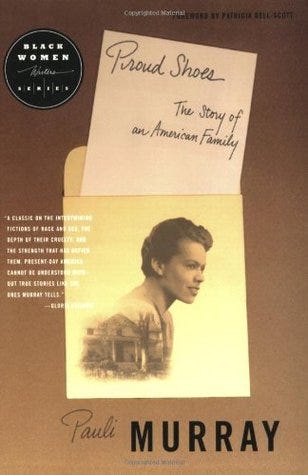
The memoir riveted me as much for Murray’s engaging voice as for the message she meant to impart. Murray was a tremendously gifted writer, able to draft persuasive legal analysis (inspiring such titans as First Lady Eleanor Roosevelt and Supreme Court Justices Thurgood Marshall and Ruth Bader Ginsberg), searing poetry, fiction, autobiography (Song in a Weary Throat: An American Pilgrimage), and richly detailed family history. Her message in Proud Shoes is, like much of what Murray wrote and did, well ahead of her time.
The subtitle is as important as the title. From the cover, Murray lays claim to a deeply American identity that so many Black people have marched for and still must fight to claim.
My lunch led to a planning session with Barbara Lau, the lunch presenter and one of the designers of the Face Up: Telling Stories of Community Life project, part of Duke’s Center for Documentary Studies. Face Up paired artist Brett Cook with Murray’s neighborhood and helped build a sense of community through art, creating murals of Murray as a child, civil and human rights activist, and (the final act of a very full life) the first Black woman ordained as an Episcopal priest. Murray’s intimate relationships also made her part of the LGBTQ community and she confronted the gender roles of her day by her more masculine presentation and professional aspirations.
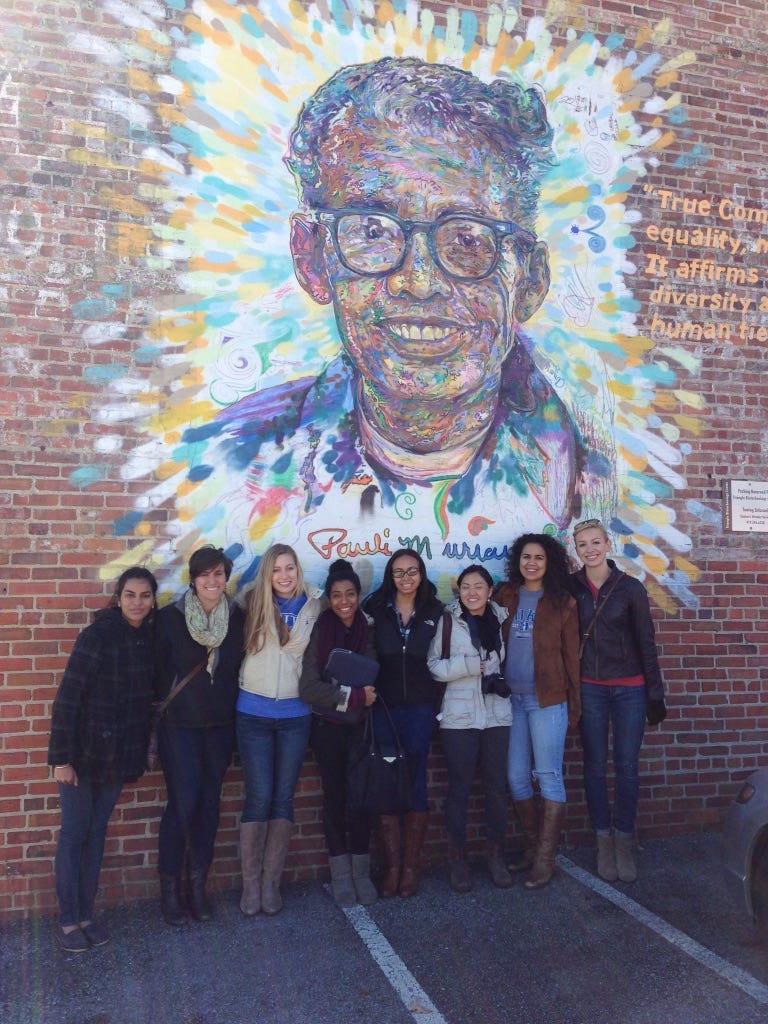
Face Up was intentional and deeply collaborative, centering on community engagement more than any product. Several of the murals feature Murray and were in part made by neighbors. Lau and I decided to ground a new project in the fledgling Duke Human Rights Center, to do human rights at home and centered on the house. We never planned on a period reconstruction. With the support of local activists and leaders, we wanted a project that embodied Murray’s activism and engaged in deep history-telling and a commitment to justice.
For me, the work linked to larger human rights questions on how we deal with a violent past. In countries like South Africa, Chile, Hungary, and Northern Ireland, among others, communities that have lost loved ones and seen their neighborhoods and countries razed. They aspire to tell those stories in ways that promote rights and justice. A Murray quote from Proud Shoes — and included on the mural closest to her family home — guided my thinking. “It has taken me almost a lifetime to discover that true emancipation lies in the acceptance of the whole past, in deriving strength from all my roots, in facing up to the degradation as well as the dignity of my ancestors.”
Like so much of Murray’s legacy, we are only now catching up. Murray taught me that we have to engage with terrible stories, not hide them, to truly understand ourselves and grasp the dignity of the fight for social justice. In South Africa, that means grappling with the legacy of apartheid and acknowledging it in architecture, art, the legal system, and what is said in museums, monuments, and schools. The same can be said for Chile, which has a Museum of Memory and Human Rights to document the human rights atrocities of the past and teach its citizens about their fundamental rights.
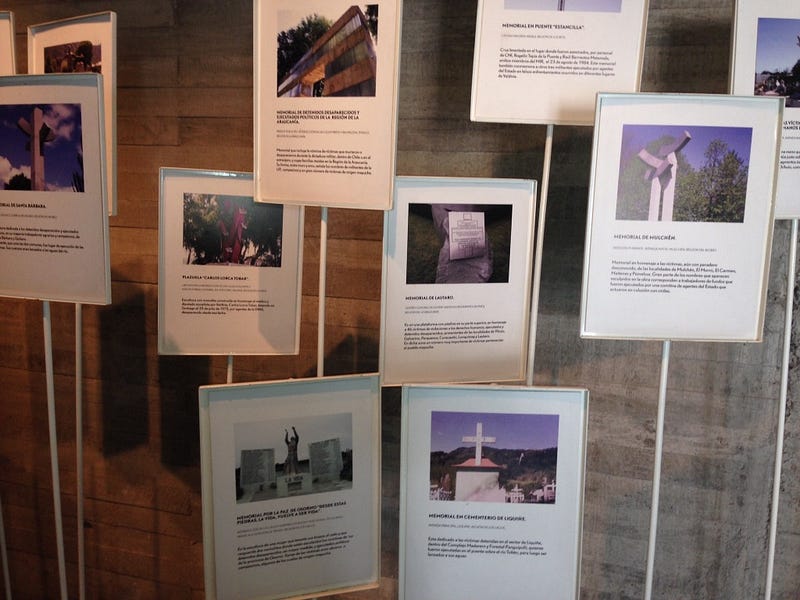
Other countries, including the United States, have yet to truly come to terms with the past. That is true nationally as well as in North Carolina, where our school children still don’t learn about the 1898 Wilmington massacre of Black residents by white people; or the depth and violence of lynching, memorialized in the Montgomery, Alabama-based Equal Justice Initiative’s National Memorial for Peace and Justice.
Murray also taught me to be cautious and deliberate in this work. That was brought home to me recently, when professors from the University of North Carolina at Chapel Hill’s history, political science, sociology, and Peace, War, and Defense departments announced that they were asking to change their building’s name to honor Murray. Americans have been on a history binge as we’ve watched statues and names come down, some pulled from their bases and others carefully winched or chipped away. The discussion over why and what the statues mean is necessary and long overdue. Less common, though, is a nuanced discussion of what’s next. What names and monuments do we want to uplift?
Murray had complex feelings about Durham and UNC. As Murray describes in Proud Shoes, her great-great-grandfather and a UNC alumnus, Sidney, was a plantation owner who raped Harriet, Pauli’s great grandmother. Harriet was also raped by a second son, Frank, also an alumnus. Pauli’s great-great aunt, Mary Ruffin Smith, donated land for the campus. Cornelia, Harriet’s daughter and Pauli’s grandmother, was born enslaved and Smith had her baptized at Chapel of the Cross, an independent church on the UNC campus.
When Pauli applied for admission to UNC’s PhD sociology program in 1939, UNC president Frank Porter Graham personally wrote them rejection based on her race. In 1978, the university offered Murray an honorary degree, but before the degree could be conferred, the federal government threatened to cut funding to UNC over the issue of expanding the number of Black students. Pauli attempted to broker a resolution, but when that failed she withdrew her acceptance.
Would she agree that UNC has now done enough to merit her name? What about other Black people who helped change UNC? Among them is Floyd McKissick, who in 1951 was one of the first four Black law students at UNC and later went on to lead the Congress of Racial Equality and become a judge. Or Karen Stevenson, the first black woman to be granted a Morehead Scholarship in 1975 and also a Rhodes Scholar, the first woman from the university, and the first Black woman in the nation to receive the honor.
Lau, following the lead of local residents involved in the SW Central Durham Quality of Life Project, now directs the Pauli Murray Center for History and Social Justice. The Center has not only secured and partially renovated the Murray home but has (with a lot of help from activists) won the site recognition as a national treasure by the National Trust for Historic Preservation in 2015 and a National Historic Landmark, a designation by the National Park Service, in 2016. This is precisely the kind of work that has raised Murray’s profile enough for UNC to take notice — and is a model for how we should be telling the stories of the people who have made the change we still need to perfect.
My Lunch-and-Learn ticket was my entry into the Church of Pauli Murray and perhaps one of my most astute investments, though I couldn’t have known it at the time. Those of us who have come to know Murray and her work soon realize that we are only just beginning to catch up to this trailblazer. North Carolina should be proud to call her one of our own.