
The Chronicles of the Ether Realm: Journey Through the Ethereum Universe 📜🌌🖲️
Immerse yourself in the thrilling odyssey of Ethereum. Look in to the world of Ether, dApps, and the voyage from Web2 to Web3.
In the vast digital cosmos, a new star is born — Ethereum. With its iridescent glow of potential, it captivates onlookers worldwide, attracting the gaze of innovators and visionaries. Yet, Ethereum is not just a twinkling star; it’s an entire galaxy expanding in the limitless universe of technology, bursting with opportunity.
At the heart of Ethereum’s galaxy is a pulsating core, Ether. Not merely a digital asset, Ether is a beacon of value, an enabler of transactions and computational services in the Ethereum cosmos. As the native cryptocurrency of Ethereum, Ether is a driving force, fueling the ceaseless exploration of this thriving digital universe.
Circling around this dynamic core are decentralized applications, dApps. These are the planets of the Ethereum universe, each with its own unique characteristics, each orbiting on the principles of Ethereum’s blockchain. It’s an App Store of the future, where the applications know no bounds or singular control.
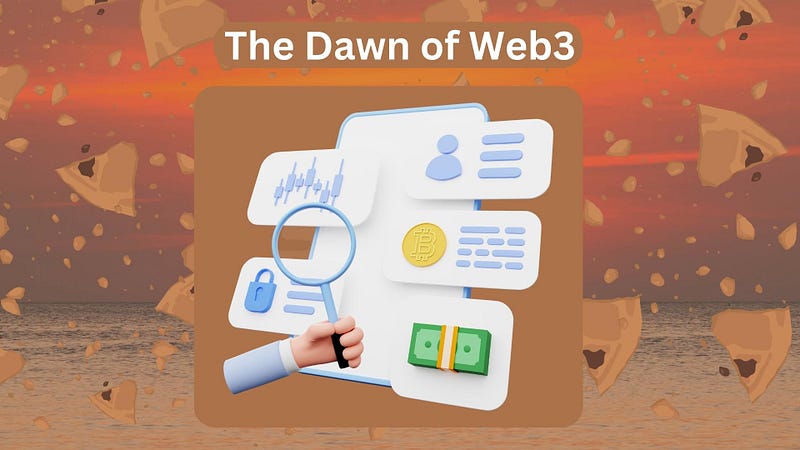
On the horizon, a new era dawns — the era of Web3. We are embarking on a thrilling expedition from the well-trodden paths of Web2, the internet we’ve grown accustomed to, centralized and controlled. Web3 emerges as a decentralized, democratic manifestation of the internet, with Ethereum pioneering the way.
In Ethereum’s celestial sphere, you’ll discover constellations named Accounts, Transactions, and Blocks. They form the galactic blueprint of the Ethereum universe. Accounts are your identities within this cosmos, transactions form the state transitions, and blocks record these transactions, maintaining the harmony of the Ethereum universe.
At the very nucleus of Ethereum’s universe is the Ethereum Virtual Machine (EVM). The EVM, much like a supernova, radiates power and influence across the galaxy. It’s the birthplace of smart contracts in Ethereum, enabling complex agreements to be coded and executed on the Ethereum blockchain.
Fueling the Ethereum cosmos is ‘Gas,’ representing the computational effort required to execute operations. Much like how a spaceship needs fuel to journey through space, transactions on Ethereum need Gas to reach their destinations.
Across the vast expanse of the Ethereum universe, numerous nodes and clients form a cosmic web. Each node, a unique point in this web, contributes to the network’s integrity, and clients enable these nodes to interact with the Ethereum network. Diversity among clients adds robustness, preventing a single-point failure from causing a cosmic calamity.
Traveling through Ethereum’s cosmos, you’ll encounter different types of nodes — Light clients, Archive nodes, and Bootnodes. Light clients are nimble, only downloading a fraction of the blockchain, while Archive nodes store the entirety of Ethereum’s history. Bootnodes serve as cosmic guides, aiding new nodes to navigate and connect within this vast universe.
Ethereum isn’t a lone galaxy but part of an interconnected universe of networks — the Mainnet being the thriving center, with Testnets and local development networks forming smaller, critical constellations around it.
In this cosmos, the stars (nodes) find alignment through a consensus mechanism. It’s the law of the Ethereum universe, maintaining order and agreement on the blockchain’s state. Initially, Proof of Work (PoW) was the fundamental law, but Ethereum is evolving towards the more efficient and scalable Proof of Stake (PoS), representing a monumental shift in the cosmos.
Delving deeper into the fabric of Ethereum, you’ll encounter the complex anatomy of smart contracts, an integral element of this universe. Crafted in diverse languages like Solidity, they’re tested, compiled, deployed, verified, and upgraded, ensuring the constant evolution and security of the Ethereum ecosystem.
The Ethereum universe is not static; it is perpetually expanding. With Layer 2 solutions, Oracles, and Ethereum Improvement Proposals, Ethereum is stretching the boundaries of what’s possible, paving the way for a new era of digital exploration.
In Ethereum’s galaxy, every individual — every ‘average user’ — plays a crucial role. They trade tokens on decentralized exchanges, lend or borrow assets on lending platforms, collect digital art, and even play games. All it takes is an Ethereum wallet and a dash of Ether to be a part of this cosmic journey.
So here we are, cruising through the cosmos of Ethereum. A voyage of discovery, innovation, and infinite possibilities awaits us in the universe of Web3. As we navigate through this galaxy, we aren’t merely spectators but active participants in the unfolding of a Digital Renaissance.
Ether is more than just a digital asset — it’s a revolution, a paradigm shift, a brave new world. It’s the currency of Ethereum, a blockchain-based platform that’s setting new benchmarks in the world of decentralized applications (dApps) and smart contracts. And it’s as exciting as it is baffling.
Foundational Topics
Ethereum is the brainchild of Vitalik Buterin, a programmer from Canada who envisaged a blockchain that could execute scripts using an international network of public nodes. And Ether? Well, Ether is the native cryptocurrency of the Ethereum network, used to facilitate operations within the ecosystem.
Intro to Ethereum
Ethereum takes the principles of blockchain and stretches them beyond their original confines. At its core, it’s a platform for dApps, apps that operate on a P2P network of computers rather than a single computer. Imagine having an App Store where the apps don’t have an overarching authority.
Intro to Ether
Ether, often mistaken as ‘Ethereum,’ is the native currency for the Ethereum network. It’s more than a tradable cryptocurrency. It’s used to pay for transaction fees and computational services on the Ethereum network.
Intro to dApps
dApps, or decentralized applications, are a hallmark of Ethereum. They use Ethereum’s blockchain for their back-end, existing on a network spread across many computers. dApps are immune to control from a single authority, resulting in fairer, more secure applications.
Web2 vs Web3
Web2 is the internet as we know it, centralized and controlled. Web3, however, represents a vision of the internet that is decentralized and democratically owned by the users. Ethereum is at the heart of this movement, providing the foundational technology for this new version of the web.
Ethereum Name Service (ENS)
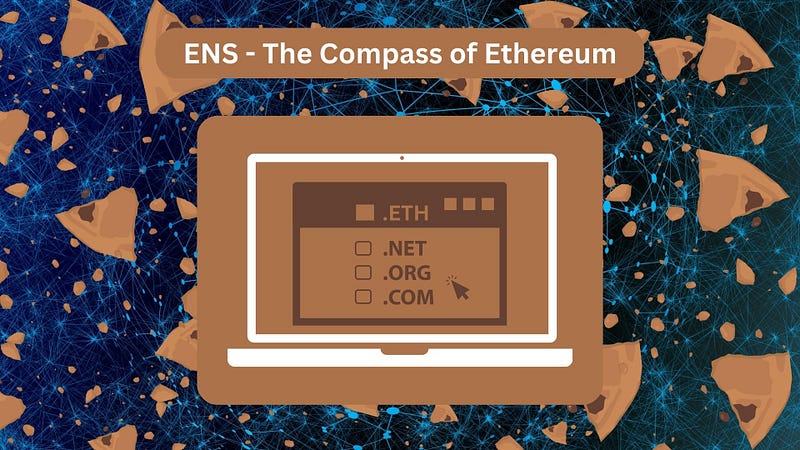
The Ethereum Name Service (ENS) is another remarkable entity in the Ethereum cosmos. Imagine ENS as the signposts, the GPS of this vast expanse. It plays a pivotal role in making navigating within Ethereum user-friendly and accessible.
In the traditional internet universe, DNS (Domain Name System) translates the human-readable web addresses to machine-understandable IP addresses. It’s akin to saving a contact in your phone — you don’t dial the number each time; instead, you tap on a name, much easier to remember and use.
The ENS serves a similar function, but in Ethereum’s realm. It maps complex Ethereum addresses, a lengthy string of numbers and letters, to simple, memorable, human-readable names. Instead of sending Ether to an address like ‘0x4c…’, you’d send it to ‘yourfriend.eth’ — much simpler, isn’t it?
In the unchartered territories of Ethereum, the ENS emerges as the compass, guiding users seamlessly across the blockchain landscape. It’s not confined just to addresses; ENS also extends to decentralized websites with the ‘.eth’ suffix. So instead of accessing a decentralized website by its IPFS hash, you can reach it by a simple ENS name.
By simplifying interaction with Ethereum addresses, ENS is making the Ethereum universe more accessible, accelerating our journey in this exciting era of Web3.
Accounts, Transactions, Blocks
An account in Ethereum is your identity. Transactions are any state transitions in Ethereum, while blocks are records of some or all of the recent transactions made.
Ethereum Virtual Machine (EVM)
The EVM is the runtime environment for smart contracts in Ethereum. It’s completely isolated from the main Ethereum network, which makes it a perfect sandbox for testing smart contracts.
Opcodes
Opcodes are the elemental operations performed by the EVM. They form the building blocks of Ethereum smart contracts and allow for the programming and execution of complex contracts on the blockchain.
Gas
Think of gas as the fuel for Ethereum. It measures how much ‘work’ an action or set of actions takes to perform.
Nodes and Clients
A node is any computer that participates in the Ethereum network. Clients, on the other hand, are software applications that connect nodes to the Ethereum network.
Archive Nodes
Archive nodes are Ethereum nodes that store everything, including historical states. They’re essential for developers who need access to all historical data on the blockchain.
Bootnodes
Bootnodes serve as entry points for new nodes joining the Ethereum network. They provide a node with its first connections to the network, enabling it to discover other nodes.
Node Architecture
In the Ethereum network, nodes are integral. They validate and relay transactions, keep a copy of the entire blockchain, and add security to the network.
Light Clients
Light clients download a small fraction of the entire blockchain. They’re ideal for devices with limited resources, offering an efficient way to interact with the Ethereum network.
Run a Node
Running a node means hosting a copy of the blockchain, validating transactions, and maintaining network integrity. It’s not just about supporting the network; it’s about having a front-row seat to the Ethereum revolution.
Client Diversity
Client diversity refers to having different types of software implementations on the Ethereum network. This diversity increases the network’s resilience against single-point failures.
Nodes as a Service
Nodes-as-a-service are hosted solutions that allow you to interact with Ethereum without having to maintain a node yourself. It’s a great way for businesses and individuals to tap into Ethereum’s potential without the technical hassle.
Networks
Ethereum isn’t just one network; it consists of a series of interconnected networks. These include the main network (Mainnet), the test networks (Ropsten, Rinkeby, Goerli), and local development networks.
Consensus Mechanisms
The consensus mechanism is how Ethereum agrees on the state of the blockchain. It has used Proof of Work (PoW) since inception but is transitioning to Proof of Stake (PoS) in Ethereum 2.0.
Proof of Work (PoW)
PoW is a consensus mechanism that requires nodes to solve complex mathematical problems to validate transactions and create new blocks. It’s the original consensus algorithm in Blockchain, but it’s resource-intensive.
Mining & Mining Algorithms
Mining is the process of adding and verifying new transactions on the Ethereum blockchain. It uses the Ethash algorithm, designed to resist the kind of centralized mining seen in other PoW coins.
Proof of Stake (PoS)
PoS is a more energy-efficient consensus algorithm. It chooses validators based on the number of Ether they hold and are willing to ‘stake’ as collateral.
PoS Rewards and Penalties
In PoS, validators receive rewards for validating new transactions. Conversely, they can lose (or be ‘slashed’) a part of their stake if they validate fraudulent transactions.
Keys
Private and public keys are vital components of Ethereum. A public key is like your email address, and a private key is like your password. Always keep your private key safe.
PoS vs PoW
PoW is the traditional method of maintaining consensus on the blockchain. PoS is a newer model designed to be more scalable and energy-efficient.
Ethereum Stack
The Ethereum Stack is a suite of software services that collectively allow developers to create and interact with the Ethereum blockchain.
Smart Contracts
Smart contracts are self-executing contracts with the terms of the agreement directly written into lines of code. They’re a significant feature of Ethereum and other blockchains.
Smart Contract Languages
The primary language for writing smart contracts on Ethereum is Solidity, a statically-typed programming language.
Smart Contracts Libraries
Smart Contract Libraries are chunks of reusable code that help developers avoid re-writing common functions every time they create a new contract.
Testing, Compiling, Deploying, Verifying, Upgrading Smart Contracts
These processes ensure the validity, functionality, and security of a smart contract before, during, and after its deployment on the Ethereum blockchain.
Smart Contract Security
Security is paramount when dealing with smart contracts. It’s important to adhere to best practices, thorough testing, and frequent audits to ensure your contracts are secure.
Composability
Composability is a system design principle in Ethereum where different components (like DeFi protocols) can interact and build upon each other, leading to innovative solutions.
Development Networks
Development networks, like Ganache, are local blockchain environments for developers to test their dApps before deployment.
Ethereum Client APIs
Ethereum client APIs allow developers to interact with the Ethereum network and perform actions like sending transactions, compiling contracts, and subscribing to events.
Data and Analytics
Block explorers, dApp analytics platforms, and network health monitors are tools that allow users to extract insights from Ethereum’s data.
Storage
Ethereum employs decentralized storage systems, such as IPFS and Swarm, to reduce reliance on traditional, centralized servers.
Integrated Development Environments (IDEs)
IDEs, such as Remix, are powerful tools that help developers write, test, and deploy smart contracts on Ethereum.
Programming Languages
Ethereum supports a range of programming languages, from JavaScript and Python to Go and Rust, offering developers flexibility in their choice of language.
Advanced Topics
This includes cutting-edge concepts such as Layer 2 solutions (rollups, state channels), Oracles, MEV, and Ethereum Improvement Proposals (EIPs).
Services for the Average User
Ethereum offers a plethora of services for the average user. You can trade tokens on decentralized exchanges, lend or borrow assets on lending platforms, play games, collect digital art, and more. All you need is an Ethereum wallet and some Ether to get started!
Well, there you have it, an all-encompassing guide to understanding Ethereum and the fascinating world of Web3. The Ethereum wave is upon us, and it’s time we learned to ride it.
A Message from InsiderFinance

Thanks for being a part of our community! Before you go:
- 👏 Clap for the story and follow the author 👉
- 📰 View more content in the InsiderFinance Wire
- 📚 Take our FREE Masterclass
- 📈 Discover Powerful Trading Tools