
The Christmas Truce of World War I Was Much More Complicated Than Advertised
Some soldiers attempted to start a truce but were shot
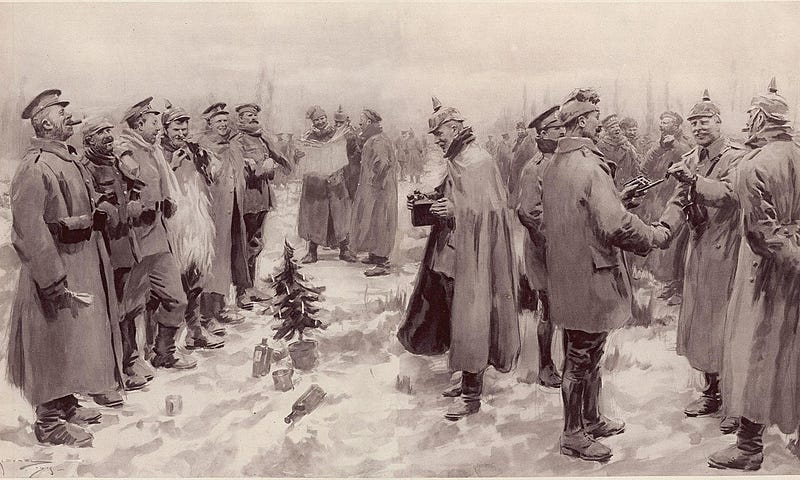


It’s a famous and miraculous story about one of the worst wars in human history. German and British soldiers both stopped their momentary fighting during Christmas Eve in 1914 and sang Silent Night together. The two sides would fraternize and stop fighting, exchanging cigars and playing football together, and had a brief respite to bury their dead.
It was a unique time when the enemy was treated with respect and recognized the other side’s humanity, as the story goes.
In 2023, a lot of people might dismiss this truce as a bunch of White guys obviously empathizing with people who look like them and share their culture. But it was significant regardless as a time when both sides could celebrate their shared humanity just for a moment, and nothing like it has happened since during a time of a major conflict. It doesn’t seem like anything like it will happen again, especially in light of wars capturing the whole world’s attention in Gaza and the Ukraine.
In times of war, the holidays were a time of opportunity. George Washington and his colonial army famously invaded Trenton the morning after Christmas and surprised the vastly superior Hessian mercenary soldiers. The Japanese invaded Hong Kong and killed about 2,000 Allied troops and civilians on Christmas Day in 1941. The Ethiopian army launched a Christmas counteroffensive against the Italians in the 1935 Ethiopian War. The Viet Cong used the Lunar New Year holiday to launch its famous Tet Offensive, which completely demoralized public support in the U.S. for the Vietnam War.
The Christmas Truce of 1914 is almost a myth today, a silver lining during one of the worst wars in human history.
The first thing to note is the Christmas truce did not happen everywhere.
The truce was much more common between British and German soldiers than between French and German soldiers and Belgian and German soldiers. The Germans had recently invaded France and Belgium and occupied the territory of both countries and there was significant bad blood. Not only that, but King George V of Great Britain and Kaiser Wilhelm II of Germany were first cousins.
In some places, the fighting continued. In some parts of the western front, some soldiers attempted to start a truce but were shot. Private Percy Huggins was trying to negotiate with the enemy on Christmas Day in 1914 when a German sniper shot him in the head. His sergeant, Tom Gregory, was enraged and tried to avenge Huggins, but was soon killed by a sniper himself.
Naina Bajekal at TIME Magazine notes the idea was originally proposed by Pope Benedict XV, but the idea was rejected by political leaders. Only soldiers themselves had to start the truce on their own. No one knows how it started or began, but historians estimate that approximately 100,000 people participated in the truce.
One major barrier was the language barrier. Most British soldiers did not know German, according to David Brown at the Washington Post. But a lot of German soldiers knew a small amount of English, and German soldiers usually initiated these truces and fraternizations. A British machine gunner, Bruce Bairnsfather, said that he heard the Germans singing carols, and the British started to sing carols back. A German soldier shouted and said, “come over here.” The two sides would have, essentially, a holiday party where tobacco and wine were exchanged, and enemy combatants were shaking hands.
The war was expected to be a quick and easy victory for the Germans, but it was not. With the war starting in August of 1914, the fact that the fighting continued into December with the brutality of trench warfare demoralized a lot of soldiers. Everyone was told, after all, that the war would be over by Christmas. With Christmas incoming, forces were particularly demoralized, and every combatant in the war celebrated Christmas besides Indian soldiers in the British Army. Many German soldiers from Saxony and Bavaria even shared a Roman Catholic faith.
By Christmas, German soldiers were receiving candles and small Christmas trees from home. British soldiers were being sent boxes with tobacco products, candy, and pictures of Princess Mary, the daughter of King George V. For the soldiers, the war was also demoralizing because of the conditions of rain, mud, and constant killing. No one could be buried because “no man’s land” was where all the corpses were, and a soldier trying to bury their dead would likely end up a corpse too.
The Germans would usually initiate singing songs like Silent Night. The two sides would exchange cigars, and some German and British soldiers even described soldiers cutting each others’ hair. German Lieutenant Kurt Zehmisch described a football game that ensued after an English soldier brought out a soccer ball from their trench.
According to the Imperial War Museum, some officers were very unhappy their soldiers engaged in this truce. Among these officers included a 25-year-old German corporal named Adolph Hitler, who said:
“Such a thing should not happen in wartime. Have you no German sense of honor left?”
At the end of the day, it was just a truce, not the end of the war. By the end, the war would come to be known as the Great War for a reason. 14% of the soldiers who fought were killed, including 1 million British soldiers and 2 million German soldiers. Many of the soldiers who participated in the truce would be killed as well. World War I ushered in a grotesque and barbarian level of military technology not seen before, including machine guns, tanks, and poison gas.
The incident represented a disconnect between soldiers on the ground and their commanding officers. Some officers on the ground, including British soldier Murdoch Wood, saw the war as one instigated by political leaders and one that soldiers on the ground did not want. That is, perhaps, the case for a lot of wars, and many generals, including Horace Smith-Dorrien on the British side, said, “on no account is intercourse to be allowed between opposing troops,” and other generals threatened court marshals if there were any future truces.
As a historical moment, Bronwen Everill, a history professor at the University of Cambridge, notes that truces were common in pre-modern warfare, including during the U.S. Civil War and the South African War of 1889.
But World War I stands out because of its horror and because it marked the transition from pre-modern to modern warfare, and the Christmas truce stood as a relic of an older time where soldiers on the frontline initiated truces instead of the “permanent, professionalized, and bureaucratic” network of states. The Viet Cong and the United States attempted a Christmas truce in 1965, organized by top officers on both sides, but then both sides accused the other of violating the truce, devolving the truce into a propaganda war over, as Everill puts it, the side proposing the truce as humane and the violator of the truce as inhumane.
In this day and age, Christmas or holiday truces are often used for propaganda, as even Vladimir Putin ordered a truce during Orthodox Christmas in 2023. But there are also strategic implications: truces allow both sides to rearm and resupply their forces, and holidays can often also be seen as opportunities to attack the other side during a time when their guard is down and they are weak. Undoubtedly, the former was also true of the Christmas Truce of 1914, as both sides could repair their trenches. The Yom Kippur War of 1973 is likely the most famous example, but Everill also cites Operation Ramadan during the Iran-Iraq War of 1982.
A Christmas truce does seem incredibly unlikely in Gaza, the holy land for Jews, Christians, and Muslims, as Palestinian health officials have reported airstrikes have killed 78 people on Christmas Eve.
I think a lot of people want a lot more than just a truce. But the story of the Christmas truce almost seems too good to be true, and in a lot of ways, it was. It was the start of a very brutal war when people were still naive about how long it would take or how many people would be killed.
There is very unlikely to be another time when two sides at war start exchanging cigarettes, shaking hands, and playing football together. Because of the nature of today’s wars, it’s just another sign of how the enemy is seen in today’s day and age: the inhuman other.