The Christmas Doll’s Gift
A short story about a child’s faith in prayer giving her strength.
It was the Christmas season of 1958.
I was ten years old. My mother, me, and my 8 siblings lived in Phoenix, Arizona. My mother was very ill, so she stayed in bed most of the time. I was the oldest girl, so this left child care, housekeeping, and most of the cooking to me.
We were poor and survived on the kindness and generosity of our neighbors.
Our neighbors shared their government commodities with us. To get commodities, you had to have a car to go pick them up. We didn’t.
Our neighbors had a way of sharing that never made me feel like I was receiving charity. They seemed happy having things we could use.
That Christmas season in 1958, I learned about a different kind of sharing. A sharing that felt chilly and made me feel dirty.
Church congregations collected food, clothing, personal care items, and toys. These items were packed in boxes and distributed to the poor so that no child would go without a Christmas.
Their intent was generous.
They hoped every family in the congregation would have a Christmas in the ideal of A Christmas Carol. It was kind of the church people to share with our family. But for me, their sharing felt different. It was a kind of charity that became a haunting, far different from the haunting in the Charles Dickens story.
On Christmas Eve morning, a group of men came to the door with boxes from the church. The men were dressed in nice tidy suits and wore proud, puffed up expressions.
It was kind of them to take time away from their family celebrations to bring our boxes. My brother Benny thanked the men and Mick gathered the ‘little kids’ and got them outside.
I felt that I owed these men, but I didn’t know what I owed them. My arms and legs felt tingly and kind of like filth.
Filth I couldn’t wash off. I decided the people from the church must have collected and distributed the boxes out of Christmas kindness, but I remained haunted.
There were several boxes of food.
In these boxes of food, there was canned cranberry sauce, lima beans, tomatoes, tomato juice, corn, peas, green beans, pumpkin pie filling, and potatoes. There was also flour, sugar, and lard. I don’t remember a turkey or ham, but that only means that I don’t remember.
After we had all the much-appreciated food put in our cupboards, we began the difficult task of searching through the boxes to find toys for the ‘little kids.’ After we sorted, we would hide the toys so they could magically appear on Christmas morning.
We three older children had Christmases in the past. So we knew. We knew what to do. And I knew what was wrong with these ‘gifts.’
I had a habit of making up little tunes.
I sang these tunes to the ‘little kids.’ I would not sing out loud the tune that popped into my head as I examined the items in the boxes.
Books without covers cars without wheels trucks with sharp edges and shoes with worn heels. Half-empty bottles socks with no mates, these are not gifts they are things to hate.
But I don’t remember us hating. I just remember us working together to dig through the trash to find things we could use. I can’t remember us complaining. I can’t remember us wanting anything for ourselves.
So, we gathered up all the broken and worn items to see what we could clean up or fix and if we could not fix it — it went to the trash.
I remember feeling like we were the trash.
I made up my mind never to do anything where I would be ‘owin’ to the men from the church dressed in nice tidy suits — or to anyone else. I also decided to think of each person as unique and of equal value.
Despite my newfound convictions, I remained haunted by the feelings of unworthiness and filth that I received along with those boxes of charity.
The boxes of toys did have items we could use as gifts for the ‘little kids.’ My brothers were wiser than me and often reminded me that the ‘little kids’ wouldn’t know things were broken or chipped. We’d argue it out and eventually agree on things suitable for gifts.
Benny grabbed a doll from the box.
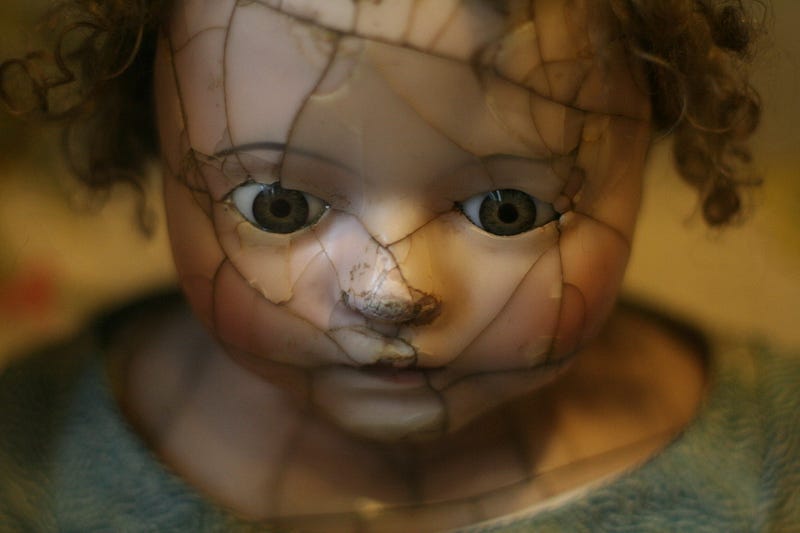
He shouted, “Terry would love this!” as he held up the scuffed up doll with cracks on her forehead.
Where hair once was, there was nothing but dark stubble. Her clothes were worn and tattered. I knew this was a doll that should be tossed in the garbage.
But my brothers were excited. I said, “No, it’s trash, and should go into the trash pile!”
Little pink buttons and pretty blue bows Long shiny hair and a curled up nose These are the things every doll should possess And this is something every girl knows.
What do boys know about dolls? Nothing, but they won. They won the argument, and they gave the ratty old doll to my little sister. I felt ashamed and sad for her. I prayed and prayed she would not notice the dreadful condition of her Christmas doll.
I don’t remember anything else about that Christmas day.
I just remember the doll. That doll and my pretty little sister. They sat together happily, bouncing and singing and cuddling. My sister took off the raggedy clothes and put them back on again. I was full of sadness as I watched each tender action.
Even though I don’t remember anything else about that Christmas day, I must have functioned. My little brothers would have needed their diapers changed. All the bedding would have needed to be washed and put back on the beds.
We had a washing machine, but it didn’t work, so I did the washing by hand. I had two big tubs outside the back door. One was my wash water and the other my rinse water. I piled everything by my tubs and grabbed each item to scrub back and forth on my washboard. I wrung out all the clothes by hand and hung everything neatly on the lines to dry. I was really good at it and proud of the nice clean smelling clothes.
Yes, I must have functioned or there would have been no clean diapers and the house would have smelled. I would have noticed and remembered a bad-smelling house.
Certain memories never disappear.
The next thing I remember, after watching my sister and her Christmas doll, was when it was time to go back to school. It was the tradition for children to take one of their Christmas gifts on the first day back from Christmas break.
My sister, being, I think smart, would have remembered the teacher telling her this, and she wanted to take her doll. I wished my sister had not been so smart or at least spent most of her time in a fog, like I did. I figured that was the difference between being smart and not smart. Those of us who were not smart had foggy brains.
But I noticed when I was teased. I noticed looks on people’s faces when they discovered I could barely read. I noticed when other people were teased. I knew my pretty little sister would be teased, and the thought caused a great pain to solidify in my heart.
“You can’t take that doll to school!” I yelled at her.
“You can’t tell me what to do!” She yelled back, stomping her feet. I asked my brothers to stop her, but they did nothing.
I wanted the power that morning.
I wanted the power to make the world right. To make the world a place where everyone was treated fairly and all little girls had lovely dolls with:
Little pink buttons and pretty blue bows Long shiny hair and a curled up nose These are the things every doll should possess Along with lots of ruffles all over her dress.
But I had no such power! And off to school, she went as happy as can be with her tattered doll — the doll with dark stubble where hair used to be and cracks on her scuffed up face.
I stayed close to her on the long walk to the bus stop. I held my head high as if to defy anyone to give a negative glance. This stance was unusual for me. I think the difference in how I held myself drew attention to me and allowed my little sister and her doll to escape unnoticed.
Fights, bloody fights, were the norm at our bus stop.
The worse fights for me to watch were those where a face was rubbed into a patch of bullheads, (which are like sandburs but with tough sharp spikes) until nothing but raw flesh and blood could be seen as angry eyes retreated.
Knife fights were less painful to watch but sometimes ended in serious injury or death. When someone dropped to the ground, we just got on the bus as usual. Police and emergency professionals did not venture into our part of town until groups dispersed.
That morning I did not pray for the kids at the bus stop like I usually did. My only thoughts and my only prayers were for my sister.
A girl shoved into my sister as we got on the bus.
I looked at that girl, she went for me with her fist and I took that fist and moved her around so her back was in front of me.
When she attempted to swing herself free, I took her other arm and held her tight. Every time she wiggled, I tightened my hold. She yelled. “Pinche cabron! Fight me, chicken! Fight dirty gringa!” I still remember the feel of her body as I held her.
I remained quiet until I said, “I will not fight you. But I will hold you here as long as I need to.” I took a deep breath and waited until her body relaxed.
Then I asked, “Are you ready for me to let you go?” As she uncurled to look me in the face she asked, “Why won’t you fight? You’re strong. You could beat me.” As I moved from the aisle of the bus and into my seat I replied, “I don’t believe in fighting, that’s all.”
My attention found its way back to protecting my little sister.
The scent of the desert air seemed to mingle with the smell of church incense. A feeling of peace surrounded me as the fragrance filled my head.
I heard the clear sweet soft sounds of Sunday morning mass as if angels were singing. The solidified pain in my heart melted away. As I looked about the bus, searching for my sister, each youth, one after the other, looked bright and clear and not like anyone I needed to fear.
Pausing in amazement at the change in each youth, I noticed there was no anger. There was no hate. All eyes were on me, but I didn’t feel embarrassed as I looked towards where my sister sat happily with her Christmas doll.
She was all cozied up with her doll in her lap as she hummed and tilted her head. The dread and anguish I’d been feeling were lifted from me by the scent and sounds in my head.
I always had lunch with my friend, Connie.
Connie looked after me, protected me, and saved me from the boys at school many times. Her mother packed a lunch for both of us. Connie said it made her mother happy to give me lunch. I was grateful.
We sat in our usual spot and talked. I shared my concerns for my sister and we watched for her, ready to spring into protective action.
My overwhelming dread was lifted. But I was still afraid we would be needed.
And then we saw her.
My pretty little sister, with her round angelic face, sat on the ground playing with her doll. She seemed circled with light like on a soft moonlit night, and her doll’s clothing seemed clean with no tears or holes.
I didn’t remember her doll’s dress having little pink buttons or pretty blue bows. I saw no cracks on her forehead and she had long shiny hair and a cute little turned-up nose.
My sister held her doll, with ruffles all over its dress, high in the air, and if anyone would look, I prayed they would see what I wanted them to see. As she cuddled her doll back down in her lap, I heard her singing as her doll took its nap.
Connie mentioned the kids on the playground were stepping aside with looks on their faces, which they made no attempt to hide. She said their attention was focused on me as they whispered and nodded their heads.
My fears had come true. They were mocking and pointing, and I, again, filled with dread. I would not let them hurt my sister, and I began getting ready to act.
I had no power to make the world a better place.
I had no power over others. But I would not let anyone hurt my sister or tease her about her Christmas doll.
Connie grabbed my arm as she did when protecting me from harm. Then she said, “Katie, they’re not looking at your sister, they’re looking at you.”
The girl I had restrained that morning led a group of her friends to where Connie and I sat. They were friendly and told me she’d told them what I’d done so they wanted to meet me.
I didn’t understand. Why weren’t they picking on my sister and her poor tattered doll?
The girl I had restrained said, “Everyone fights. But you don’t fight, not because you’re chicken, but, because you don’t believe in fighting. We respect that, that’s all.” One by one they took my hand and shook it as I sat in awe.
A Christmas doll gave me an important gift.
That Christmas season in 1958, when we lived in the shadow of Sky Harbor Airport on South 39th Street, I was given the gift.
Someone in the church had donated a poor tattered doll, with black stubble where there used to be hair to the Christmas charity collection. When my sister Terry got the doll, she saw nothing but a pretty doll in an equally pretty dress.
I had been in anguish with my heart full of pain, but I prayed. I prayed that my sister would not be picked on or teased or made to feel shame.
I wanted the power to make the world a better place. The gift I received from the experience with that poor cast-off doll was that prayer and my actions had the power to influence everything happening around me.
I’d always been a prayerful child. I loved being in church to sing and pray. Jesus was my friend and with me in everything I did. His love was very real to me.
Everything I’d learned about his life taught me to care about others, to be kind, and how not to fight even when angry.
It was Jesus who guided my arms to restrain rather than punch. I did not have the power to change the way the world was, but I had the power to pray and choose how I behaved.
The doll’s gift was to show me that prayers can be answered as they were answered that Christmas season in 1958 when we lived on South 39th Street in Phoenix, Arizona.
This is a sad story, but I remember it as the first time I felt strength. I don’t attend the church anymore, but my faith in God has remained strong and guided my behavior.
Whatever your faith and wherever you live in our world, from my home to your home — from my heart to your heart —
Have a blessed and Merry Christmas.
Katie Michaelson tends plants and people from her 120-year-old home and small garden. She sees strength in the injured spirit and finds significance in the insignificant.


