
The Christic Message of Polymorphonuclear Granulocytes
How Outgunned Neutrophils Spin DNA Nets, Their Sacrifical Counterstrike at Infectious Invaders
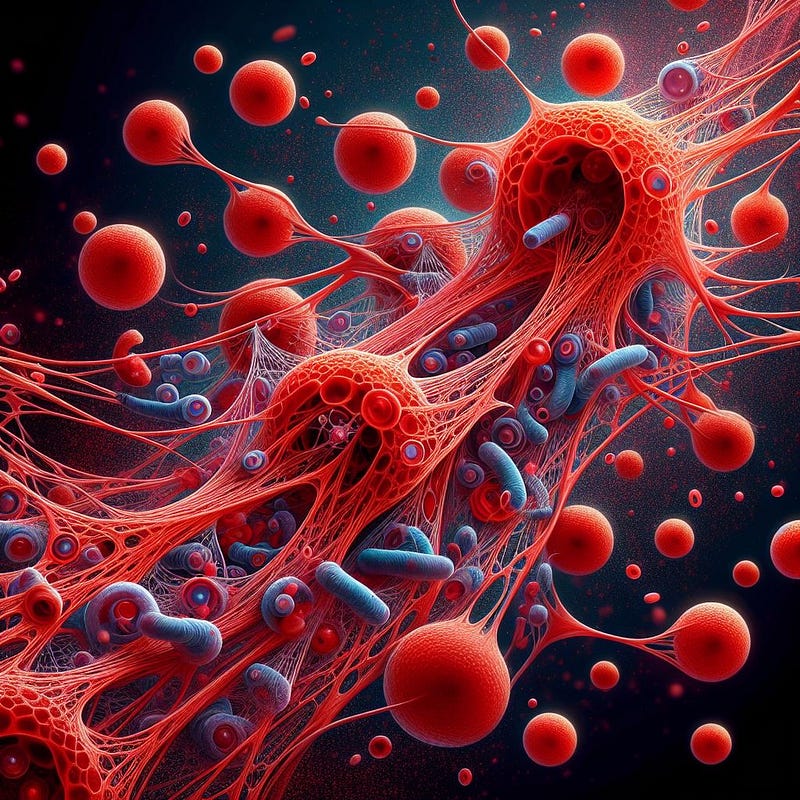
In the blood vessels flow the white blood cells, tireless warriors in defence of our body. They are tiny cells, almost invisible under the microscope, yet they have a fundamental role: to protect the organism from infections. Like an army they patrol our tissues, ready to fight pathogenic agents.
Among the white blood cells, the polymorphonuclear granulocytes, also called neutrophils, are on the front line in this silent immune battle that takes place every day inside us. They are the first soldiers to rush to any attack by bacteria or viruses, determined to annihilate the enemy. Their daily sacrifice protects us from diseases and suffering.
In particular, neutrophils are the first to rush to the front at any infection. Equipped with highly sensitive receptors, they sniff out the presence of the enemy and migrate rapidly towards the infected site. Neutrophils have an irregular nucleus that allows them to move agilely. In the cytoplasm, they contain many granules full of powerful poisons against microbes. When the neutrophil engulfs a pathogen, these granules pour their deadly content inside, destroying the enemy with digestive enzymes and oxidizing substances. They are cells equipped with a formidable chemical arsenal to fight infections.
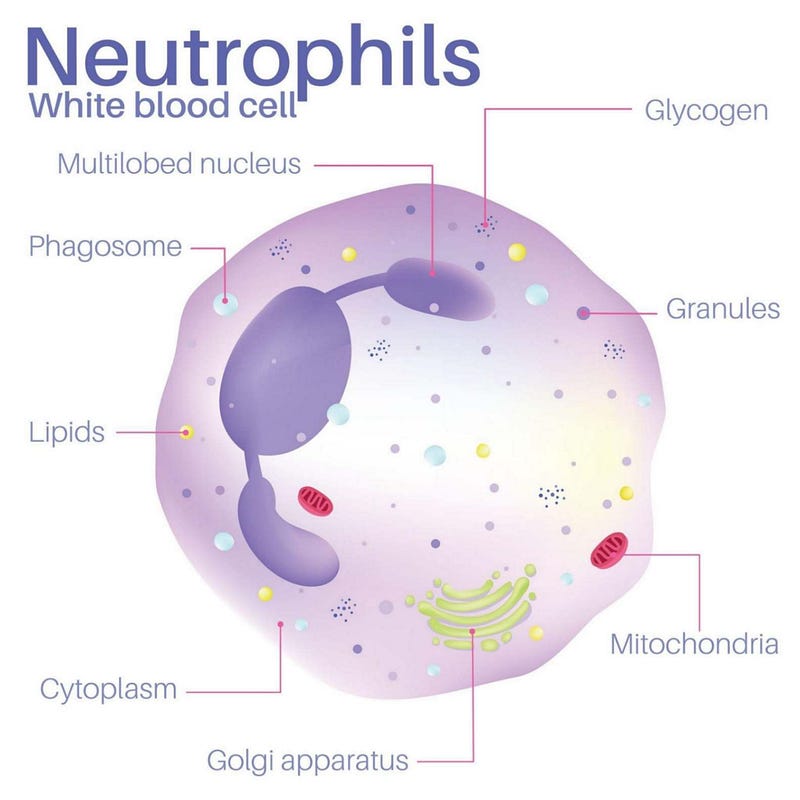
Once at their destination, neutrophils throw themselves into the fray with indomitable courage. Their only purpose is to annihilate the pathogen, even at the cost of their life. They envelop it in their cellular tentacles to phagocytize it in a deadly grip. In the phagosome they pour all their deadly arsenal of digestive enzymes, oxidizing substances, and antimicrobial peptides. It is a summary execution that leaves no escape.
But sometimes the enemy is too big and slippery. The hyphae of fungi, like viscous serpents, writhing from the claws of neutrophils, are too large to be engulfed. After vain attempts to capture them, neutrophils change strategy: it is time for the ultimate sacrifice. They activate the production of NETs (Neutrophil Extracellular Traps), intricate nets of DNA that envelop and imprison the hyphae in their lethal coils. Neutrophils immolate themselves to stop the invader.
It is an unequal struggle, yet the tiny white blood cells do not lose heart. They fight to the last breath, until they disintegrate, to fulfil their supreme duty: to preserve the integrity of the organism. They do it without glory or recognition, guided only by an instinct of service.
We should learn from these silent sacrificial cells the meaning of total dedication to a greater cause. They teach us that even the smallest has an essential role in the great design of life. That every act of altruism can make a difference, even if it goes unnoticed. That giving all of oneself for the common good is the noblest thing one can do.
Neutrophils have a short life, only a few hours or days. Their accelerated metabolism rapidly wears them out. Yet, in this period, they fight ceaselessly to protect us, silently fulfilling their essential task. They are microscopic warriors who fight for us every day, even if unknown to most.
Paraphrasing the phrase attributed both to Albert Einstein and Antoine Magnan: “According to aeronautical scientists, the bumblebee should not be able to fly. But the bumblebee does not know this and flies anyway”, I would say that granulocytes guided by the consciousness that regulates the complex machinery of the microworld of our organism, ignore what it means to preserve their own life, and therefore selfishness, live briefly and sacrifice themselves anyway. They respond to a universal intelligence that harmoniously coordinates every part to preserve the whole.
The little warriors in our blood vessels offer us a Christic message, teaching us to live with integrity, dedication, spirit of sacrifice. Their silent example is a profound life lesson. We can draw inspiration from their daily self-denial to also be bearers of light. It takes little: an act of kindness and service can make a difference.
There is a hero inside each of us, as inside every neutrophil. It is up to us to listen to its silent voice urging us to act for a greater ideal. If many men and women lived like this, the world would change. From the small heroes visible only under the microscope we can learn the great lessons of life.