The Chocolate Meltdown Is Underway
How record-breaking prices expose the unsustainable truth of an exploitation system enhanced by climate change.

When you go to that vending machine, chasing a Snicker bar to calm that sugar thirst, do you ever think about where the chocolate coating comes from? Or even know the shape of the cocoa fruit?
Maybe now you should ask: will my — insert favorite chocolate treat — survive the chocolate meltdown?
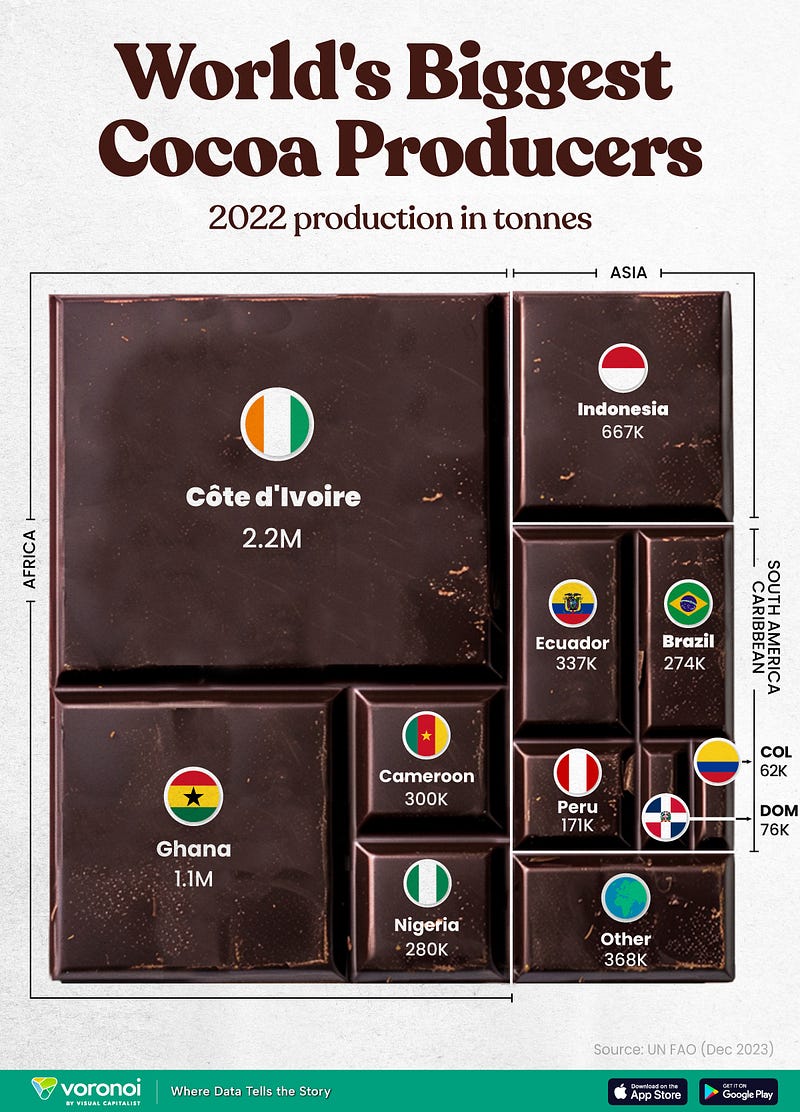
Cocoa trees and their ovoid-shaped, yellow fruit holding our beloved cacao beans flourish in a narrow band of 20 degrees north and south of the Equator. They are the lifeblood of West Africa, with Côte d’Ivoire, Ghana, Nigeria, and Cameroon leading the world in cocoa production. This region is responsible for 75% of global cocoa output, producing together more than 3.5 million tons of the commodity. With 2.2 million tonnes of cocoa in 2022, Côte d’Ivoire is the world’s largest producer, accounting for a third of the global total.
The outsized cocoa industry in Côte d’Ivoire was shaped by Félix Houphouët-Boigny, the cocoa farmer who became the first Ivorian president after independence from France in 1960. Houphouët-Boigny lured African farmers to cocoa cultivation by offering land ownership. And the high cocoa prices of the 1970s fueled economic growth he used to reshape the country, building a new capital city, Yamoussoukro.
Since then, and because millions of West African farmers were trapped in poverty, we’ve been gorging on cheap chocolate. But the low prices have had consequences.
Cocoa farming never evolved into a large-scale plantation industry. The prices in the 1990s and 2000s didn’t make commercial sense. The money has always been in processing chocolate — not planting, growing and harvesting cocoa trees. Finally, the lack of reinvestment has caught up with growing chocolate demand. The 2023–24 harvest season marks the third consecutive year global chocolate consumption has outpaced production, a scenario not seen since the early 1960s. And it’s all thanks to an unsustainable system.
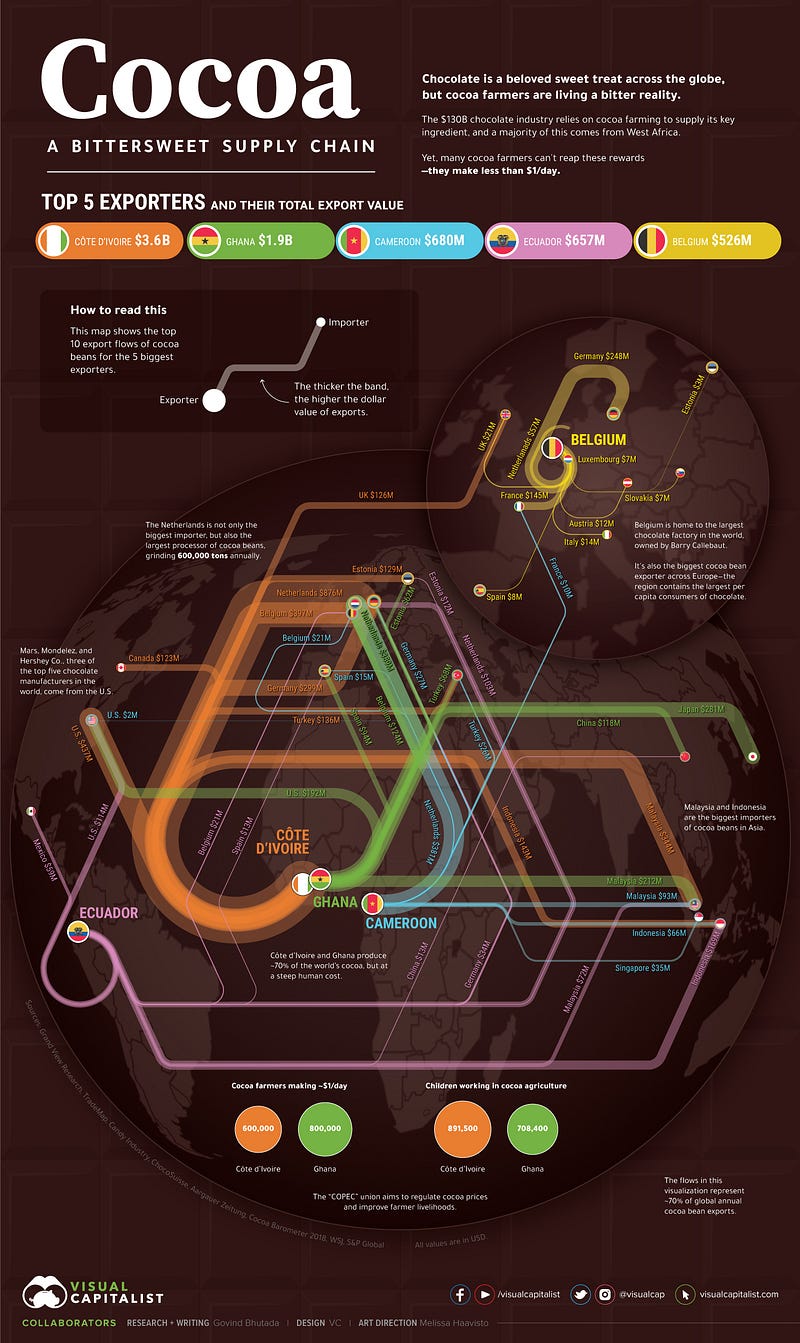
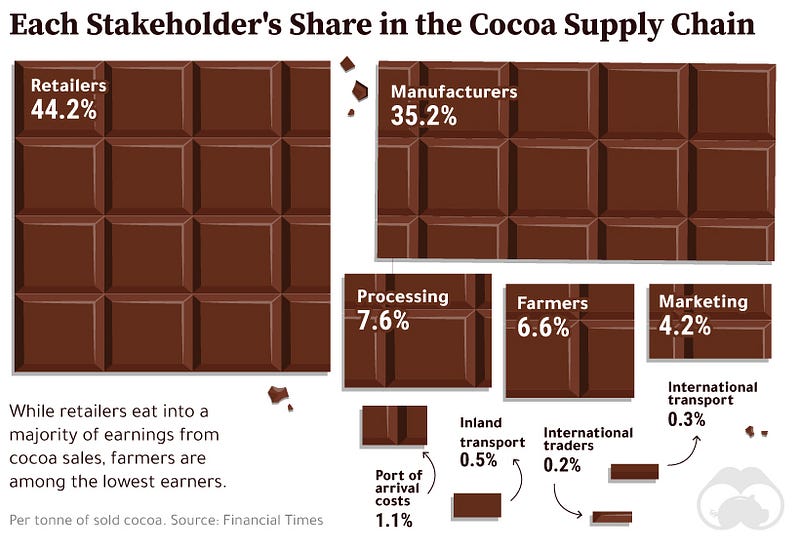
From bean to bar, the cocoa supply chain is a bittersweet one. While we enjoy chocolate, cocoa farmers are being shortchanged. The $130B chocolate industry relies on cocoa farming for the supply of chocolate’s key ingredient. Yet, many cocoa farmers make less than $1/day. This makes cocoa a poor man’s crop.
And now, the markets are confronting the inevitable chocolate crisis.
A necessary wake-up call induced by corporate negligence and abuse and powered by the relentless assault of climate change. No big surprise.
Everything Starts With Demand And Supply
At the close of 2023, only four major commodities were still trading below their 1970s price peaks — cocoa, sugar, Arabica coffee, and silver. However, this 46-year-old record was shattered on March 12, 2024, as cocoa prices soared past the $7,000 per tonne mark, a figure last seen in 1977. The price now sits at $8,140, bringing year-to-date gains to 94% and 197% for the calendar year. If anyone saw this coming and made a move, jackpot.
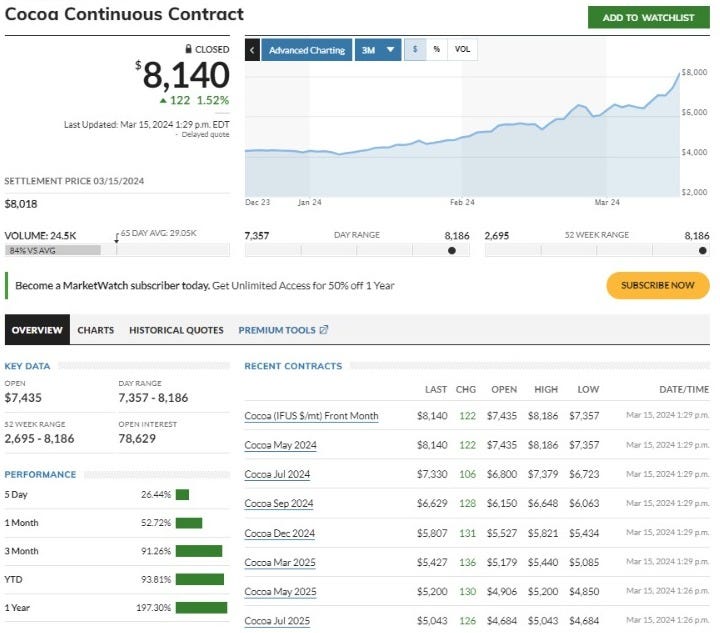
Factoring in inflation, the $7,000 price of cocoa in the 1970s corresponds to a staggering $36,890 per tonne today. Yet, what can’t be disputed is that the cost of cocoa has doubled in a year, and it’s causing panic. Major confectionery brands like Lindt, Mondelez, and Hershey are on high alert, raising prices, shrinking packages, or introducing new products using less cocoa.
The cocoa crisis is far from a hoax. It’s starting a wave of price hikes and ‘shrinkflation’ that will undoubtedly hit the sweet tooth around the world. No sugar-coating it.
Historic Shortage
As said before, the root of the problem is at the very start of the supply chain in West Africa, where leading producers are all facing disturbing crop shortfalls.
The last major tree planting in West Africa happened around the early 2000s. Now, these trees are past their prime, yielding less and being more susceptible to bad weather exacerbated by climate change and diseases that reduce yields and kill cocoa plants. Both factors are at play this year. And then we have to add to the equation the declining farming practices of an industry dependent on poor smallholders that can barely make ends meet, less to say, reinvest in fertilizer and pesticides.
Ghana’s output is predicted to hit a 13-year low, and Côte d’Ivoire’s yield is slated to be its poorest in seven years, a worrying 30% down from last year’s levels. These countries alone account for about 60% of the world’s cocoa.
What does this mean? Well, if West African cocoa supply continues to dwindle without any significant drop in demand, New York cocoa futures could skyrocket to between $7,000 and $10,000 a ton, according to analysts. This means prices may not fall until the second half of 2025.
The situation is a brutal mismatch between supply and demand. Even taking into account the dampening effect of high prices on consumption, according to The International Cocoa Organization and Swiss chocolatier Barry Callebaut AG, we’re looking at a deficit of 374,000 to 500,000 tons. This equates to a 7% to 10% supply deficit, the largest in at least 65 years, possibly ever.
Demand is far outpacing supply, resulting in a projected drop in inventories for the third consecutive year. Cocoa stockpiles could plummet to a mere 25%, mirroring the record lows of the 1970s. Considering shipping delays, this signals that the industry is approaching a state of virtually zero inventory.
The structural issues in West Africa, like disease and aging tree stocks, are certainly concerning. Then, there is the climate crisis elephant in the room.
The Chocolate Meltdown
The climate crisis in cocoa powerhouses Ivory Coast and Ghana, is driving global food inflation and squeezing local living costs. Data reveals that rainfall in West Africa has doubled the 30-year average since the onset of the rainy season in May 2023.
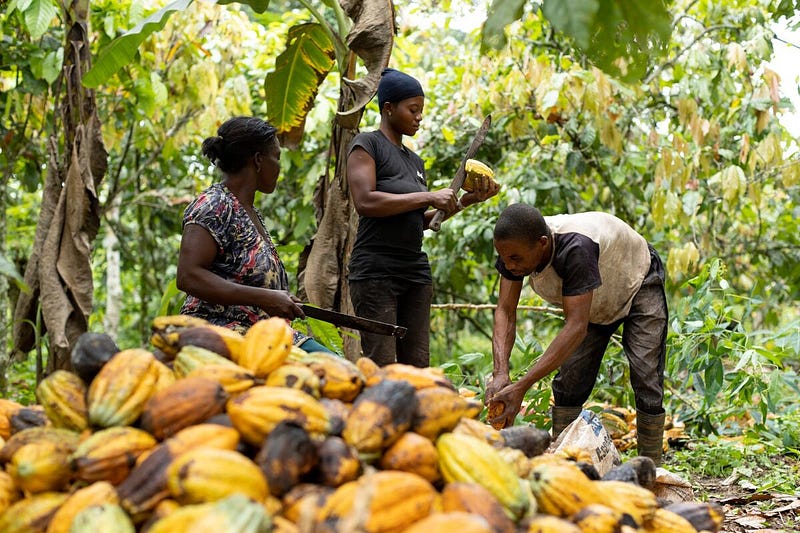
Right now, it’s prime harvest season. However, constant downpours have transformed dirt roads into untraversable swamps, wiped out budding flowers, and spawned a fungal infection that rots cacao pods into black mush. This is decimating output, delaying harvests, and leaving black pod disease untreated.
The only feasible solution to halt the infection is a bi-weekly spray of the buds, known as cherelles. But it’s an expense too steep for many to bear.
Adding to the misery, the El Nino weather pattern may cause more trouble ahead as it typically brings dry conditions across West Africa.
It takes 1700 liters (450 gallons) of water to make a typical 100-gram chocolate bar from 105 to 140 cocoa beans taken from 2–3 cocoa pods. That’s about ten bathtubs (!) of water for one bar of chocolate.
Business as Usual: Higher Income For Corps, Not Farming Communities
Despite cocoa prices hitting a 46-year high, growers in Ghana and Ivory Coast are not reaping the benefits. These farmers are being ripped off, even with a $400-a-ton premium added as the living income differential.
Government-controlled local markets in these countries set official prices, which leaves farmers out of the loop when prices rally. The 2023–24 crop sees Ivorian farmers earning just 1,000 Central African francs ($1.63) per kilogram, a staggering 70% less than the current wholesale price. This price was locked in a year ago when futures were around $2,500 a ton.
An 11% pay rise reported by Confectionery Production last October in Ivory Coast hardly made a dent in living standards, with many farmers still earning less than $1 a day, which is below the UN-defined poverty-level wages. Ghana showed a more positive picture with a 63% pay rise. But as prices continue to soar, no further wage adjustments have been reported.
Under normal circumstances, a price boom of this magnitude would encourage more planting. But cocoa farmers are stuck in a vicious poverty cycle. Their low earnings prevent them from reinvesting in their farms. This lack of investment damages crop yields and intensifies their financial struggles. And now, they are prisoners to the rain and can’t afford additional help and buy chemicals to fight off black pods.
Back then, it was the rest of the world feasting on cheap chocolate. Now, as usual, it’s Big Corps feasting on the higher profit from processing the still-cheap-from-source chocolate till the market updates.
For all of that time, farmers have been cash cows’ profit sources for all interests but themselves. Governments and their heavy taxes; traders and Big Corps safeguarding a surplus of beans to keep chocolate prices low while boosting sales to an expanding group of candy lovers; and consumers, who have seen chocolate go from a luxury to an everyday treat.
Cost-Opportunity
Not everyone agrees that current prices are a problem.
Sure, the soaring prices are a headache for the confectionery industry. They’re faced with a serious problem: whether they can pass the rising costs onto consumers without damaging their bottom line. If they can’t, margins will plummet, potentially slowing or even reversing the growth in demand for chocolate. So good for abusive Big Corps.
Mass-market chocolate producers will bear the brunt of this. And we-the-consumers will, inevitably, have to dig deeper into our wallets.
But what is a hurdle for one is a blessing for the other. Farmers outside West Africa are already cashing in on the cocoa crisis, as their beans are now a hot commodity. Those in Ecuador, Brazil, Indonesia, and Peru are selling at sky-high prices. They’re capitalizing on West Africa’s disaster, using their windfall to plant more cocoa trees.
Even within West Africa, there’s a silver lining. Côte d’Ivoire farmers will likely see prices rise by next season, injecting much-needed cash into their operations. This scenario would certainly delight Houphouët-Boigny, who envisioned Côte d’Ivoire dictating cocoa global prices.
This is a necessary crisis. As the etymology of the word puts it, crisis is a “vitally important or decisive stage in the progress of anything, especially a period of uncertainty or difficulty.”
The world needs higher prices to incentivize farmers to replant millions of old trees and better maintain their existing ones. If every farmer could improve their plantation care, cocoa production could bounce back.
But the real issue here is the power abuse and imbalance between large corporations and the small to medium-sized producers who are the backbone of the industry. Cocoa is a microcosm in a worldwide ecosystem of predatory capitalism, which does not understand people, devastated resources, or critical climatic situations, but only (bittersweet) profits.
Be loud.
Thank you for your thorough reading and support! Subscribe for immediate insights and join the 400+ Antarctic Sapiens community for weekly thought-provoking content.