The Children Were Burnt Alive
Armenian Genocide — The Inconvenient Truth
The decision was made around March/April 1915 to exterminate Armenians in Turkey. The Armenian Genocide was the systematic mass murder and ethnic cleansing of around one million ethnic Armenians from Anatolia (Asia Minor) and adjoining regions by the Ottoman Empire and its ruling party, the Committee of Union and Progress (CUP), during World War I.
Children Burnt Alive
Below, the children with carefree and innocent eyes are the Armenian girls of the Mush orphanage with their Teacher Margaret.
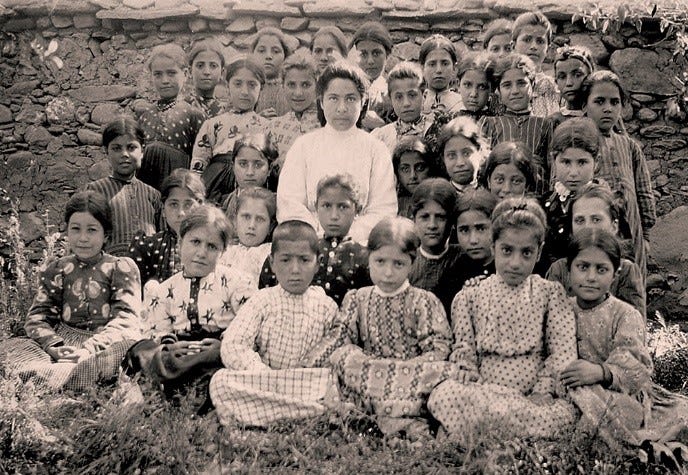
In the summer of 1915, the city of Mush was set on fire by the Turkish army, who burned thousands of Armenians alive in their houses. During the massacres of the Armenian population in Mush, Teacher Margaret and her children were also burnt alive. A direct witness of the Turkish crimes, Sister Biørn (photographer) suffered intense anguish losing all the children of her orphanage in one day, to whom she had given her maternal love and care over years. The screams and calls of help from the helpless children were embedded in the memory of Bodil Biørn, who has worked in the orphanages of Mush and Mezre.
The Armenian Genocide enabled the creation of an ethnonational Turkish state of Modern Turkey, after the destruction of more than two millennia of Armenian civilization in eastern Asia Minor. The Armenian Genocide was widely considered the greatest atrocity in history before the 2nd World War. In 2021, on the anniversary of the Armenian Genocide, the USA finally decided to join 30 other countries to recognize the events as genocide after 106 years.
The Armenian Genocide in Pictures
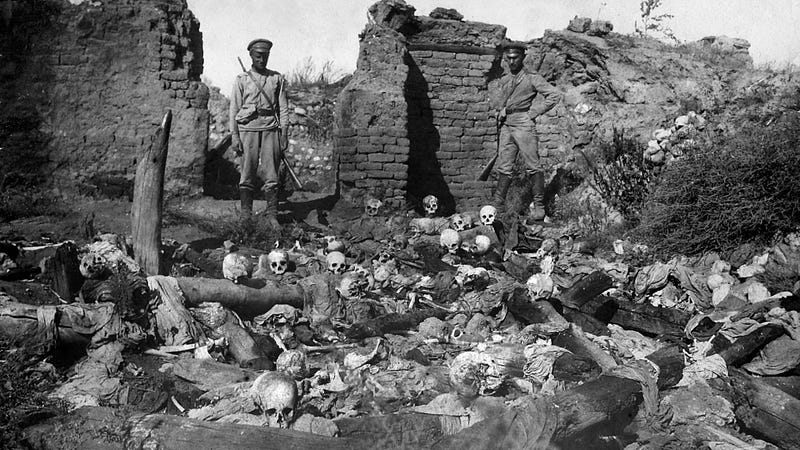
Russian soldiers pictured in the Armenian village of Sheykhalan (also spelled Sheyxalan) during the Armenian Genocide.
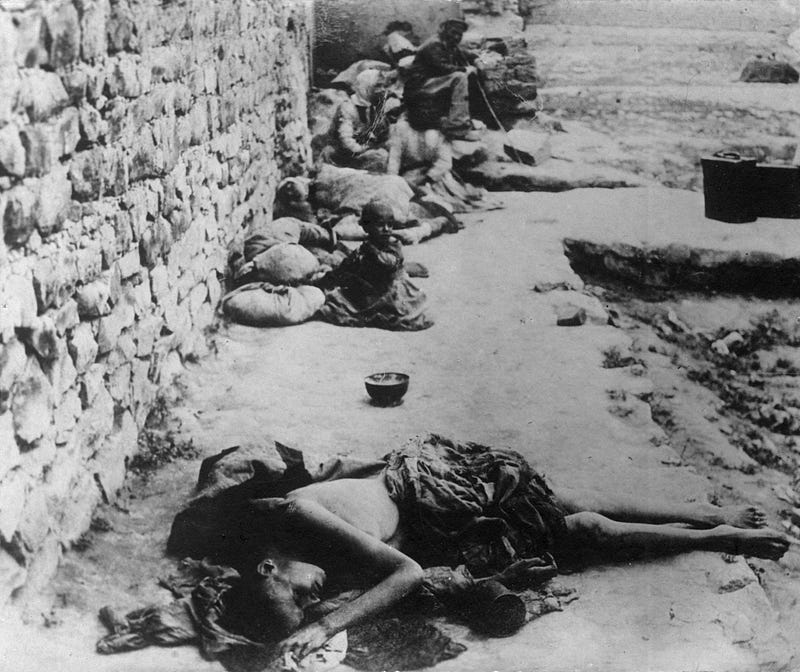
From Arkivverket showing starving children on the street in the Armenian republic.
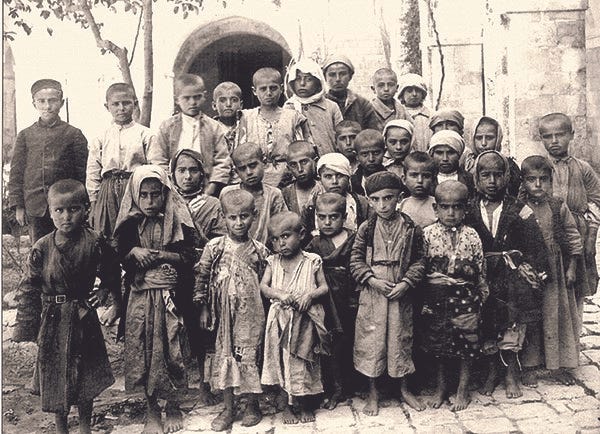
The above photo of Armenian orphans gathered from deserts and brought to Jerusalem in 1918. These tattered, barefoot and bald headed boys are of different age groups. Most of them did not speak Armenian and had lost their national identity. It took some time to turn them back to their national Armenian identity. In 1915–1923 as a result of the Armenian Genocide thousands of the Armenian children were left orphans and converted to Islam. Many of them had died of hunger and various epidemics raging at that time.
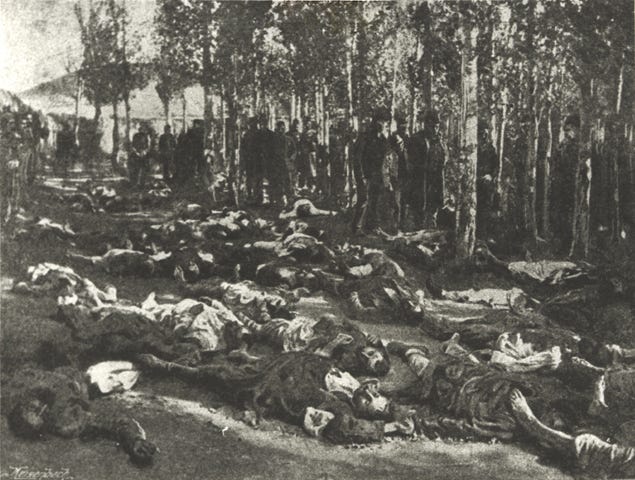
Above photograph depicts the victims of a massacre of Armenians in Erzerum on October 30, 1895, being gathered for burial at the town’s Armenian cemetery. “What I myself saw this Friday afternoon [November 1] is forever engraven on my mind as the most horrible sight a man can see. I went with one of the cavasses of the English Legation, a soldier, my interpreter, and a photographer (Armenian) to the Armenian Gregorian cemetery. The municipalty had sent down a number of bodies, friends had brought more, and a horrible sight met my eyes. Along the wall on the north …. lay 321 dead bodies of the massacred Armenians. Many were fearfully mangled and mutilated. I saw one with his face completely smashed in with a blow of some heavy weapon after he was killed. I saw some with their necks almost severed by a sword cut. One I saw whose whole chest had been skinned, his forearms were cut off, while the upper arm was skinned of flesh. I asked if the dogs had done this. ‘No, the Turks did it with their knives’. A dozen bodies were half burned.” … “A crowd of a thousand people, mostly Armenians, watched me taking photographs of their dead. Many were weeping beside their dead fathers or husbands.” — W. L. Sachtleben, “Letter to the Editor”, the London Times, December 14th 1895 (quoted in G. Aivazian, “Sachtleben Papers on Erzurum”, in “Armenian Karin/Erzurum”, ed R. G. Hovannisian).
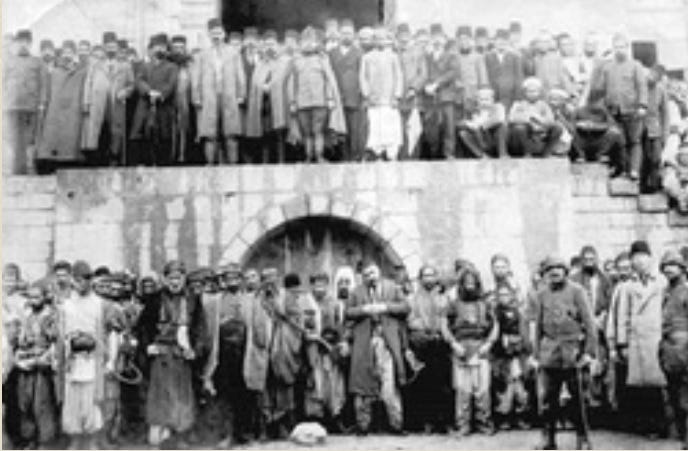
Above photo shows a group of Armenians from Zeytoun who have forcibly moved to Marash in May 1915: soon after the photo had been taken they were all burnt and massacred by the Turks. Marash governor is in the top row.
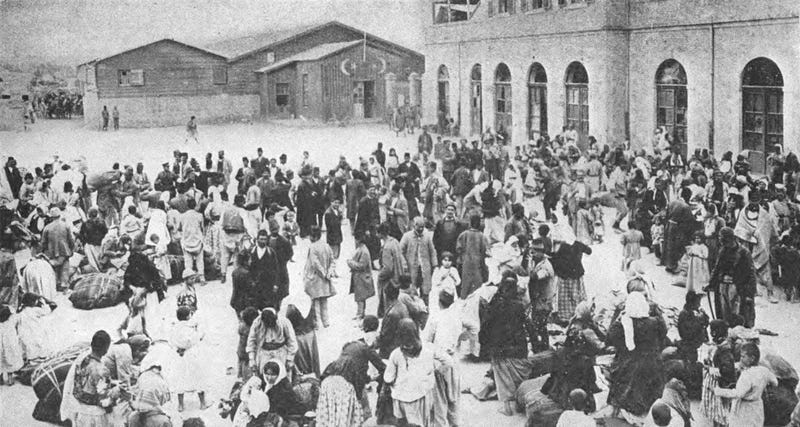
Above photo shows Armenians ordered by the authorities to gather in the main square of the city to be deported and eventually massacred.
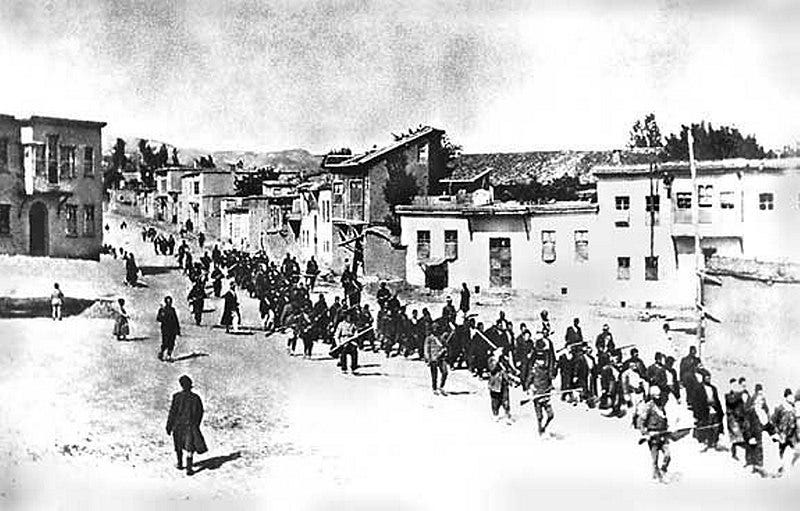
Above photo shows Ottoman military forced march Armenian men from Kharput to an execution site outside the city. Kharput, Ottoman Empire, March 1915-June 1915. Published by the American red cross, it was first published in the United States prior to January 1, 1923.
Eye-Witness Accounts
Einar af Wirsen was a Swedish Military attache in the Ottoman Empire during the First World War. He was an eye-witness of the Armenian genocide and had personal conversation with the main Turkish perpetrators and foreign diplomats accredited in Constantinople. He wrote his memories in the in his 1942 book “Memories of Peace and War” published by Albert Bonnier Foriag, Stockholm.
The following are excerpts from his Chapter “The Murder of a Nation”:
“The Turkish government acted with great guile. The deportation orders were as a rule oral and kept strictly secret; this gave the authorities more leeway in carrying out the planned massacres. The methods used in the murders were unheard-of since the Middle Ages.”
“The deportees were often sorted out into groups, the men kept separate from the women and children.”
“Men were murdered in mass quantities, young women were sent to Turkish harems.”
“The children were left to die of hunger unless, as it was done in several provinces, they were tied together by the hundreds, put on rafts and drowned in the Euphrates.”
“It also happened that children had their arms cut off and then left to die in the desert.”
“Most of the deportees had to walk naked in the desert in the scorching heat but this was not one of the worst atrocities.”
“Cruel torture was used; the Head of the Constantinople Police was confessed to the American Ambassador that the Turks had been studying the methods used by the Spanish Inquisition and modeled their activities from it.”
“Even the Armenians who avoided deportation were subjected to mass killings.”
“I learnt from various Consults that on several occasions, policemen knocked on the doors of foreign officials and, without so much as a word, shot all the Armenian servants, after it honored and left.”
“Those who were not murdered died of starvation which was purposefully organized in the most outrageous circumstances.”
“I saw with my own eyes a mound of earth near the Euphrates which, as they told me, contained the remains of several thousand Armenians who were murdered or dead.”
“General von Lossow, the German military representative in Constantinople, defended the Turkish course of action to some extent, told me eye-to-eye: ‘The massacre of the Armenians is the most terrible bestiality of world history.’ ”
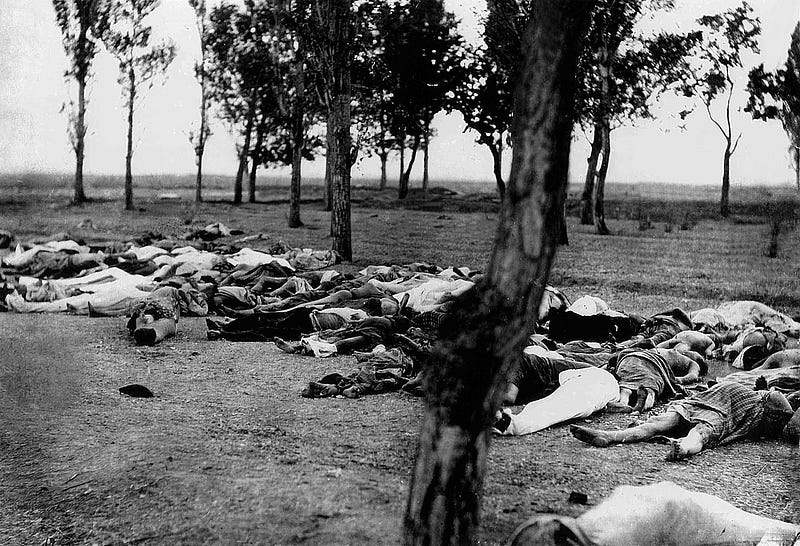
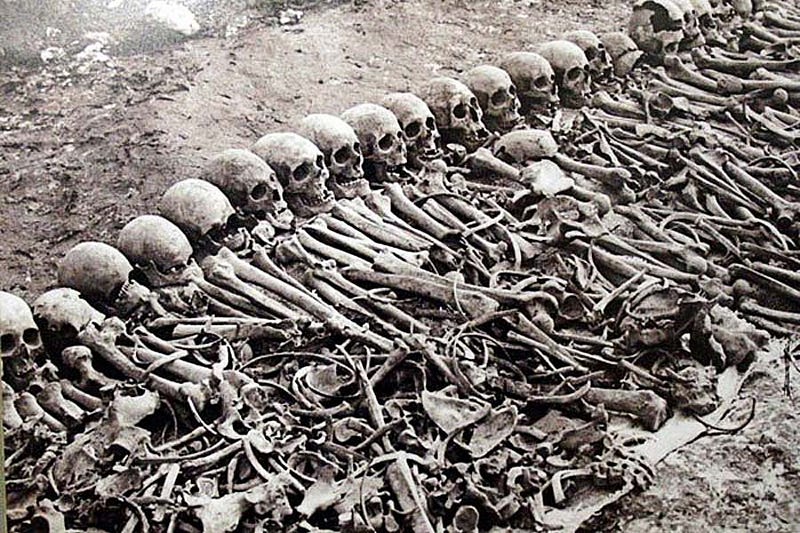
Above photo showed Armenians killed during the Armenian Genocide, was taken from his 1918 book “Ambassador Morgenthau’s Story” by Henry Morgenthau, Sr.
“Scenes like this were common all over the Armenian provinces, in the spring and summer months of 1915. Death in its several forms — massacre, starvation, exhaustion — destroyed the larger part of the refugees. The Turkish policy was that of extermination under the guise of deportation”
Henry Morganthau Sr was the US ambassador at the time. He further recalled in his memoirs: “When the Turkish authorities gave the orders for these deportations, they were merely giving the death warrant to a whole race; they understood this well, and in their conversations with me, they made no particular attempt to conceal the fact.”
Winston Churchill had also noted that with the backdrop of World War I, “the opportunity presented itself for clearing Turkish soil of a Christian race.”
The goal of the Armenian Genocide was to get rid of all Armenians in the Turkish State about to be formed.
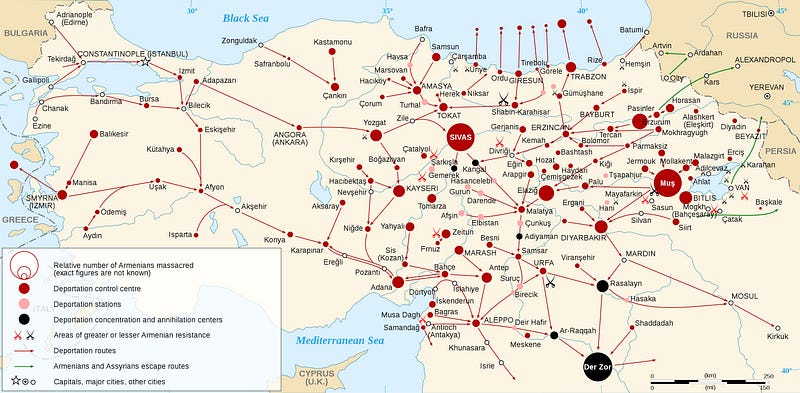
Following the defeat of the Ottoman Empire in 1919, Grand Vizier Damat Ferid Pasha officially declared that a “crime” had been perpetrated against the Armenians and the empire’s foreign minister admitted that some 800,000 Armenians had been deported.
Mustafa Kemal Ataturk, the father of modern Turkey, when opening his new country’s parliament in Ankara on 24 April 1920, called the Armenian Genocide a “shameful act of the past”; even though subsequent Turkish governments to this day have refused to utter the word nor admitted to the historical truths.
Turkey’s Denial of Genocide
In spite of her Founder’s admission, Turkey continues to deny that the deportation of Armenians was a genocide or wrongful act
In denial mode, Turkey argued that the tragedy was the result of a reasonable and understandable response of a government to a rebellious and seditious population in time of war and mortal danger to the state’s survival. Essentially, there was no genocide, and the Armenians were to blame for it. They were rebellious, seditious subjects who presented a danger to the empire and got what they deserved. There was no intention or effort by the Young Turk regime to eliminate the Armenians as a people despite the purported existential threat posed by the Armenians and their Russian allies to the survival of the empire.
The official Turkish view is the belief that the Armenian Genocide was a legitimate state action and therefore cannot be challenged on legal or moral grounds.
Turkey portrayed Armenians as terrorists and secessionists, shifting the blame to the Armenians themselves. According to this bizarre logic, the deportations of Armenian civilians was a justified and proportionate response to Armenian treachery, either real or as perceived by the Ottoman authorities.
However, in citing the doctrine of military necessity and attribute collective guilt of all Armenians for the military resistance of some, Turkey ignored the fact that the International Law of War criminalizes the deliberate killing of civilians.
Furthermore, Turkey blames Armenian deaths on factors beyond the control of the Ottoman authorities, such as weather, disease, or rogue local officials. The role of the Special Organization is denied and massacres are instead blamed on Kurds, “brigands”, and “armed gangs” that supposedly operated outside the control of the central government.
Scholars have since found no evidence of Armenian conspiracy to topple the Ottoman government. There is just no evidence of a coordinated Armenian master plan for revolution. It is conclusive that the Armenian deportations were not the result of an Armenian rebellion. On the contrary, Armenians were deported when no danger of outside interference existed. In fact, Armenians near front lines were often slaughtered on the spot and not deported. The deportations were not a security measure against rebellions but depended on their absence.
Another wave of massacres was ordered in 1916, leaving about 200,000 deportees alive by the end of 1916. Around 100,000 to 200,000 Armenian women and children were forcibly converted to Islam and integrated into Muslim households. Massacres and ethnic cleansing of Armenian survivors were carried out by the Turkish nationalist movement during the Turkish War of Independence after World War I which led to the dissolution of the Ottoman Empire with the formation of modern Turkey.
The German Complicity in the Armenian Genocide
Germany was the unshakeable supporter of the Ottoman Empire. The Austrian Ambassador and the German charge d’affaires did address a letter to the Turkish government asking for explanations but they were told that those were transportations for military reasons. The only person who could have prevented the bloodshed was the German Ambassador Baron von Wangenheim who approved of the Turkish actions by not interfering.
Germany was lock-step with the Turkish’s Armenian Genocidal plan, and did nothing to stop it. Germany herself was to perpetrate a similar genocidal plan 25 years later in 1939 against the Jews in Germany as well as her occupied territories during the 2nd World War.
In a June 2005 statement, Germany’s Bundestag (parliament) finally expressly apologized to the Armenian people for the fact that the then German Empire did not undertake steps to stop the killing. In 2016, the Bundestag passed a non-binding resolution on the “Remembrance and commemoration of the genocide of Armenians and other Christian minorities in 1915 and 1916”. Strangely notable is that then German Chancellor Angela Merkel, then Vice-Chancellor Sigmar Gabriel, and then foreign minister and later Federal President Frank-Walter Steinmeier, did not participate in the vote. Have they forgotten so soon the Holocaust genocide unleashed for the Jewish Question not so long ago?
Germany has a history of committing and supporting genocides. It was only in 2004 that the German government formally recognised and apologized for the colonial atrocities perpetrated in German South West Africa. In 2015, the German government officially recognised and apologized for the atrocities to constitute Völkermord (genocide). The atrocities referred to German attempts to exterminate the Herero and Nama people in German South West Africa.
The German genocide of the Herero and Nama people as one of the biggest genocides of the 20th century. The UN Whitaker Report determined and ranked the German genocide among “the Ottoman massacre of Armenians in 1915–1916, the Ukrainian pogrom of Jews in 1919, the Tutsi massacre of Hutu in Burundi in 1965 and 1972, the Paraguayan massacre of Ache Indians prior to 1974, the Khmer Rouge massacre in Kampuchea between 1975 and 1978, the contemporary Iranian killings of Baha’is and the Germany’s earlier Holocaust”. I must add that The Nanjing Massacre as well as the Sook Ching campaigns of the Japanese during the 2nd World War should also be included as genocide.
The United Nations Convention on the Prevention and Punishment of Genocide, which went into effect on January 12, 1951, defines genocide as “acts committed with the intent to destroy, in whole or in part, a national, ethnic, racial or religious group.” Most historians say that intent is clearly documented in historical source material. Many countries have officially recognized the crimes committed against Armenians as genocide, among them, the Federal Republic of Germany
FINAL RECKONING
The United Nations should demand an apology from Turkey for the Armenian Genocide, or face exclusion from all UN agencies participation and funding. UN efforts and resources should be deployed for the re-construction of lost Armenian cultural heritage and practices, with the assistance of Armenia. The UN should also initiate dialogue and discussions for the return of Armenian land and cities seized during the Ottoman Empire and currently occupied by Modern Turkey. More than the Eastern half of Turkey actually belonged to Armenia. Over the longer-term, a solution should be found for the return of Armenian properties and stolen rights. Until and unless an example is made of Turkey for her direct culpability in the Armenian Genocide, other regimes would be emboldened and empowered to commit equally or worse genocidal atrocities in the future.
Please enjoy my recent Articles.