
The Child Separation Policy Was the Worst of the Trump Atrocities
There were so many. But that was the worst.
I try not to get too angry about politics, not because it’s not worth getting angry about — it almost always is, particularly over the last seven years — but because if you’re not careful, you’ll always be angry. And that’s no way to live, even if it’s justified. (Especially if it’s justified.) I find that I have to pick and choose my spots. Otherwise, I’ll give myself a heart attack.
While the Biden era has not exactly led to the lowering of the collective blood pressure we were all hoping for — the overturning of Roe v. Wade is the very definition of a political action to be angry about — I will confess that it has been easier to be less angry since January 2021 than it was in the four years before that. When my theoretical grandchildren ask me someday what it was like to live through the time that Donald Trump was President, the best I will be able to describe it is that everyone I knew was a combination of exhausted and furious, at all hours of the day, every day. There was so much awfulness — just normal, everyday, banal awfulness — that it was almost impossible to keep track of it all. I often refer back to McSweeney’s invaluable “Lest We Forget The Horrors,” in which every single bit of Trump monstrousness was catalogued, in intricate detail, so that it did not vanish from the public record. There were so many that the page actually had an “Atrocity Key.”
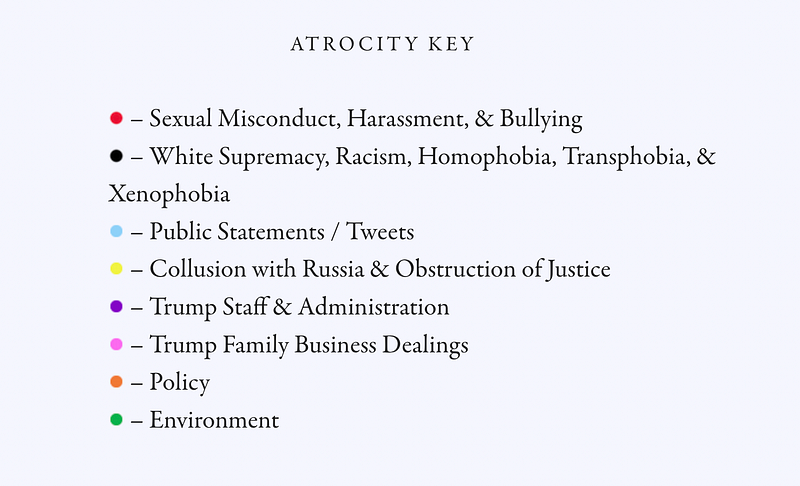
It was a relief to have a page that spelled it all out, that just listed all of it — it made you feel better knowing you weren’t imagining it. But those bulk horrors — wholesale horrors — sometimes helped to mask the true atrocities, the truly morally abhorrent, the sort of mendacities that made you fear for our nation’s soul. The stuff they’ll go to Hell for.
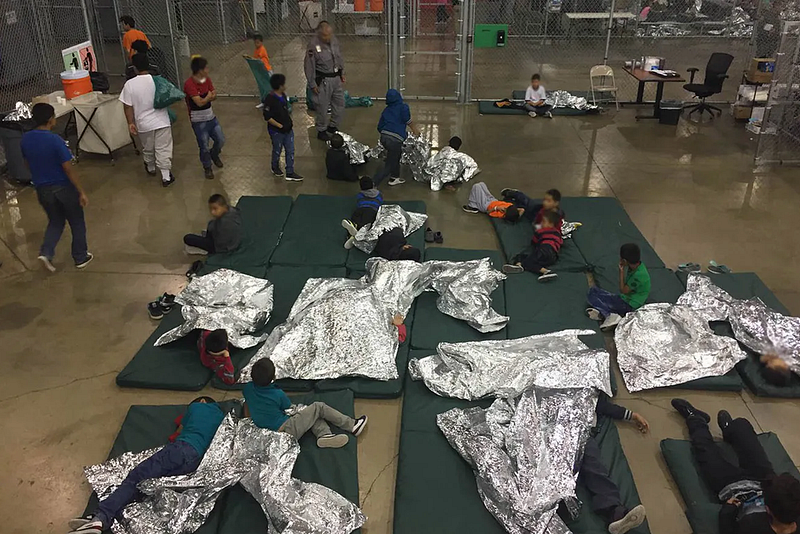
Of all these, the worst, to my mind, was the child separation policy. Sold as a “zero tolerance” approach to illegal immigration, the Trump administration would separate children from their families at the border — with no real plan in place to reunite them — as a way to deter future immigrants from trying to enter the country. I feel obliged to repeat this, out loud, so it does not slip past you, or history: The Trump administration made it a matter of American policy to tear small children away from their parents.
There was an uproar when this happened, as you might expect: I’d argue, until the pandemic, it was the worst of all the Trump scandals. (And there were so many.) But you really cannot say it enough: The Trump administration made it a matter of American policy to tear small children away from their parents.
Do you remember the ProPublica audio of children being ripped away from their parents? Could you listen to anything more awful in your life?
My colleague Olivia Nuzzi at New York magazine played that tape at a press conference from Homeland Security secretary Kirstjen Nielsen. Nielsen, while defending the policy, pretended she didn’t hear it. She went back to referring to the crying kids as “alien youths.”
It was one of the most shameful moments in American history. And I never hear people talk about it anymore.
In a way I get it. That happened more than four years ago now, and, safe to say, we’ve all been through a lot since then. But if we forget this, what can’t we forget?
I bring all this up today because of an incredible investigation by Caitlin Dickerson at The Atlantic, titled “The secret history of the U.S. government’s family-separation policy.” The result of years of research and investigative journalism, the piece exposes just how callous and, frankly, soulless those in charge of the policy were. A few excerpts:
In the summer of 2017, [child therapist Cynthia] Quintana encountered a curious case. A 3-year-old Guatemalan boy with a toothy smile and bowl-cut black hair sat down at her desk. He was far too little to have made the journey on his own. He had no phone numbers with him, and when she asked where he was headed or whom he’d been with, the boy stared back blankly. Quintana scoured his file for more information but found nothing. She asked for help from an Immigration and Customs Enforcement officer, who came back several days later with something unusual: information indicating that the boy’s father was in federal custody. At their next session, the boy squirmed in his chair as Quintana dialed the detention center, getting his father on the line.
At first the dad was quiet, she told me. “Finally we said, ‘Your child is here. He can hear you. You can speak now.’ And you could just tell that his voice was breaking — he couldn’t.”
The boy cried out for his father. Suddenly, both of them were screaming and sobbing so loudly that several of Quintana’s colleagues ran to her office.
Eventually, the man calmed down enough to address Quintana directly. “I’m so sorry, who are you? Where is my child? They came in the middle of the night and took him,” he said. “What do I tell his mother?”
And:
Within days of the start of Zero Tolerance, Matt Albence, one of Tom Homan’s deputies at ICE, expressed concern that if the parents’ prosecutions happened too swiftly, their children would still be waiting to be picked up by HHS in Border Patrol stations, making family reunification possible. He saw this as a bad thing. When Albence received reports that reunifications had occurred in several Border Patrol sectors, he immediately sought to block the practice from continuing, contacting at least one sector directly while also asking his superiors — Tom Homan, Ron Vitiello, and Kevin McAleenan — for help. “We can’t have this,” he wrote to colleagues, underscoring in a second note that reunification “obviously undermines the entire effort” behind Zero Tolerance and would make DHS “look completely ridiculous.” Albence and others proposed “solutions” such as placing parents whose prosecutions were especially speedy into ICE custody or in “an alternate temporary holding facility” other than the Border Patrol station where their children were being held. This appears to have happened in some cases.
Albence also suggested that the Border Patrol deliver separated children to HHS “at an accelerated pace,” instead of waiting for federal contractors to pick them up, to minimize the chance that they would be returned to their parents. “Confirm that the expectation is that we are NOT to reunite the families and release” them, Albence wrote. (Albence declined to comment for this article.)
It is difficult not to shake with rage reading those excerpts … and there are dozens more like them in the piece. (Again: Read it.) It is an incredible piece of journalism, but, more important, it reveals just how truly ghastly — depraved, deranged, purely evil — those in power were. This is important not just because we should never forget what they did. It’s important because they are trying to get back in power. They are going to try to do this again.
There are new, different worries and woes to deal with today, and they are of paramount importance as well. But, in a way, we must ration our outrage to make sure it have the maximum force when it is most applicable. Thousands upon thousands upon tens of thousands of children’s lives, destroyed forever. There are still hundreds, and maybe more, of families who have still not been reunited. And there has been no public reckoning. Dickerson’s story features several of the policy’s architects getting off the phone with her because they have to pick up their own children from school without once noting their complicity in thousands of families never being able to do that again.
The story is the definitive account of one of our country’s most shameful moments. There are times to try to curb one’s anger, if just for one’s own mental health. This is not one of those times.
Will Leitch writes multiple pieces a week for Medium. Make sure to follow him right here. He lives in Athens, Georgia, with his family and is the author of five books, including the Edgar-nominated novel How Lucky, now out from Harper Books. He also writes a free weekly newsletter that you might enjoy.


