
The Challenger Disaster Revisited from a Positive Perspective
How the geniuses lied to us
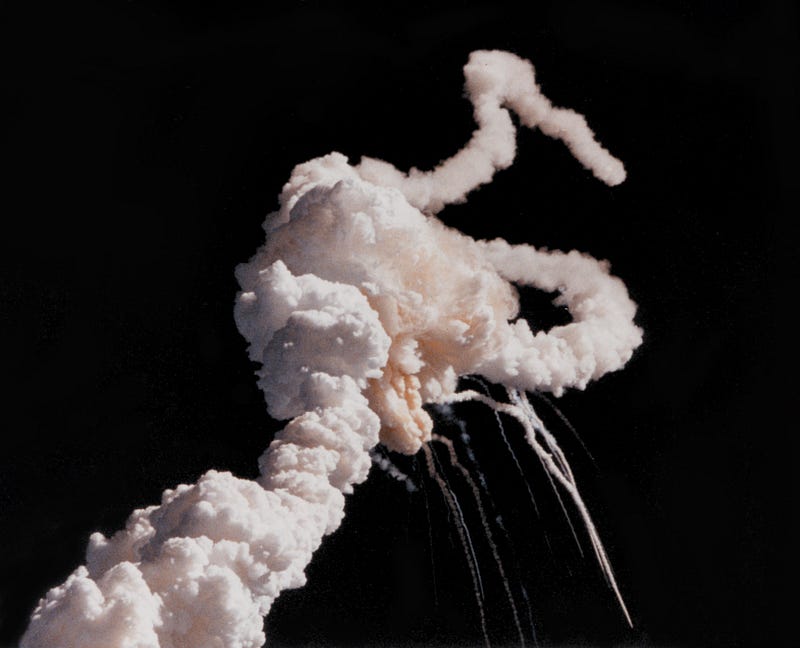
I am generally a very positive person. One aspect of this, is I have an intention to learn from every mistake I make, and that I see other’s make. While doing this, I always balance this point of view with an awareness of how anger, lust, greed, vanity, attachment, and cognitive bias often define how even brilliant people of influence make choices.
I often look to history to remind me of how strange and dysfunctional it can all get. With this in mind I recently, returned to what is now commonly called the Challenger Disaster.
In the aftermath of the accident, NASA was criticized for its lack of openness with the press. The New York Times noted on the day after the accident that “neither Jay Greene, flight director for the ascent, nor any other person in the control room, was made available to the press by the space agency.” In the absence of reliable sources, the press turned to speculation.
“The space agency,” wrote space reporter William Harwood, “stuck to its policy of strict secrecy about the agency that long prided itself on openness.”
Ultimately a Presidential Commission on the Space Shuttle Challenger Accident was formed. Also known as the Rogers Commission (after its chairman), the commission was formed to investigate the disaster. The commission members included the astronauts Neil Armstrong and Sally Ride, the legendary test flight pilot Chuck Yeager and the Nobel prize-winning physicist Richard Feynman, among others.
The commission worked for several months and published a report of its findings. According to the Rogers Commission Report, the Challenger accident was the result of a failure in the O-rings sealing a joint on the right solid rocket booster, which allowed pressurized hot gases and eventually flame to “blow by” the O-ring and make contact with the adjacent external tank, causing structural failure. The failure of the O-rings was attributed to a faulty design, whose performance could be too easily compromised by factors including the low temperature on the day of launch.
More broadly, the report also considered the contributing causes of the accident. Most salient was the failure of both NASA and Morton Thiokol to respond adequately to the danger posed by the deficient joint design. Rather than redesigning the joint, they came to define the problem as an acceptable flight risk. The report found that managers at Marshall had known about the flawed design since 1977, but never discussed the problem outside their reporting channels with Thiokol — a flagrant violation of NASA regulations. Even when it became more apparent how serious the flaw was, no one at Marshall considered grounding the shuttles until a fix could be implemented. On the contrary, Marshall managers went as far as to issue and waive six launch constraints related to the O-rings. The report strongly criticized the decision-making process leading to the launch of Challenger, saying “it was seriously flawed: failures in communication … resulted in a decision to launch 51-L based on incomplete and sometimes misleading information, a conflict between engineering data and management judgments, and a NASA management structure that permitted internal flight safety problems to bypass key Shuttle managers.”
One of the commission’s best-known members, was theoretical physicist, and Nobel Prize winner, Richard Feynman. During the hearings he famously demonstrated on televised, how the O-rings became less resilient and subject to seal failures at ice-cold temperatures by immersing a sample of the material in a glass of ice water. Feynman was critical of flaws in NASA’s “safety culture”, so much so that he threatened to remove his name from the report unless it included his personal observations on the reliability of the shuttle, which appeared as Appendix F.
Here he argued that the estimates of reliability offered by NASA management were wildly unrealistic, differing as much as a thousandfold from the estimates of working engineers. “For a successful technology,” he concluded, “reality must take precedence over public relations, for nature cannot be fooled.” Feynman wrote that while other members of the Commission only met with NASA and supplier top management, he also sought out the engineers and technicians. That is how he became aware of the O-ring problem.
He also noted that one of the Commission’s main worries concerned the type of leather binding in which to present the report to the President. It would seem to most intelligent and clear-thinking people that honest statistics about what happened would take precedence over concern for the type of leather binding in which to present the report to the President. Sadly, this is not how most cheaters operate — Especially cheaters with PhDs.
Here is Feynman at the hearing…
Here is a Medium story on this subject that you might enjoy @productthink
Here is one from the archives on lying @LewisCoaches
This story is an excerpt from my Module for making the best choices, from my online Course, “The Self Improvement Lifestyle”. To learn more email me at [email protected]
Author: Lewis Harrison is an executive coach and a professional futurist (forecaster). He is the creator of the Ask Lewis Mentoring Method as well as HAGT — Harrison’s Applied Game Theory. He is the Executive Director of the International Association of Healing Professionals an educational organization that offers programs around the world in Intentional Living. He is also Independent Scholar, with a passion for knowledge, personal development, self-improvement, creativity, innovation, and problem-solving. You can read all of his Medium stories at [email protected].
For a decade, Lewis was the host of a humor-based Q & A talk show on NPR (National Public Radio) affiliated WIOX FM in NY.
“I am always exploring trends, areas of interest, and solutions to build new stories upon. Please share this article with others. It is appreciated.
If you have any ideas you would like me to write about, just email me at [email protected] or check out all of my books, blogs, and videos through my portal www.asklewis.com


