
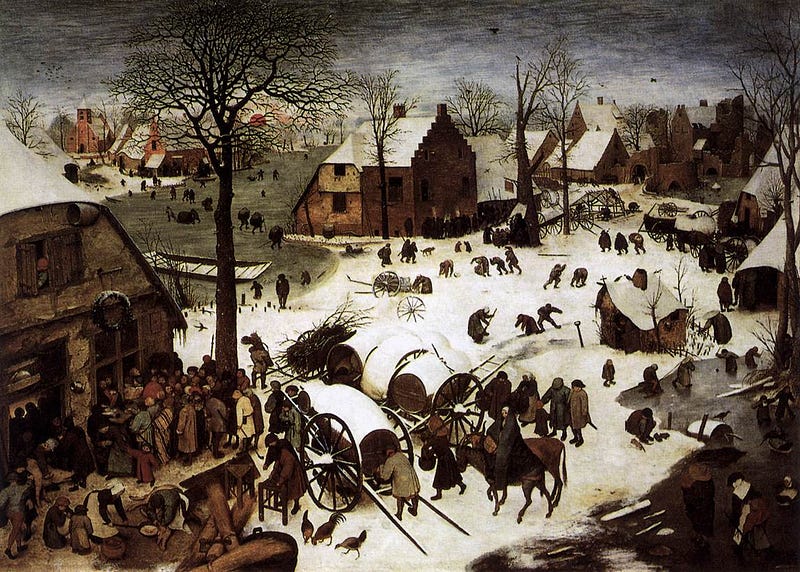
‘The Census At Bethlehem’ (1566) by Pieter Breughel The Elder & ‘Nativity’ (1305) by Giotto
The sacred and the profane at Christmas
“And it came to pass in those days that a decree went out from Caesar Augustus that all the world should be registered… So all went to be registered, everyone to his own city. Joseph also went up from Galilee, out of the city of Nazareth, into Judea, to the city of David, which is called Bethlehem, because he was of the house and lineage of David, to be registered with Mary, his betrothed wife, who was with child.”
— Luke 2:1–5, New King James Version (Bible)
“The poetic justice of cause and effect Respect, love, compassion This is my church” — Faithless, God is a DJ
I don’t think it is a sweeping generalization to say that the Nativity or the birth of Jesus is the archetypal image and now modern-day meme that is so representative of the Christian world or what is left of it at Christmas. It still tries to capture the religious significance as best it can in the modern world with our children dressing up and performing the Nativity at school. And of course, the countless beautifully condensed Xmas cards with the Nativity covered from all aesthetic iterations — and angles and Angels — both simple and sublime.
The iconic Nativity portrayal as we now take it for granted is the birth of Jesus/Christ with his mother paramount, Joseph somewhat side-lined as a venerated onlooker, and included are the shepherds and various animals in a simple wooden enclosure. This image of a combined ethereal and prosaic inclusivity was first conceived by Giotto in 1305 and has still — I believe — not been surpassed in any Nativity painting since. It has been the template for future masterpieces but never altered in its compositional elements.
Yes, that’s right Giotto created this image at the very beginning of the 14th century. Although Giotto still had the Byzantine cave in the background where all previous Nativity images were constructed, he had moved the scene closer to the Biblical narrative and a new pictorial rendition. His adaptation is both more literal and a subtle but significant change in the dialogue between man and God; with Jesus/Christ being now part human and part of the transcendent immateriality of Christian eschatology.
Giotto has perfectly captured the duality of those responsible for the birth of Jesus/Christ. Yet Joseph remains somewhat a difficult issue — both husband and father yet almost an outsider. His portrayal here by Giotto captures the position and place of Joseph. There is joy and wonder at the birth but for Joseph, it is not so simple. Giotto has given a profound humanity to his image of Joseph.
His incredible fresco was just one of a cycle for the Scrovegni Chapel in Padua. But this singular piece of revolutionary imagery moves Jesus/Christ into our human and corporeal world. It is Mary who is lying down having just given birth and takes her son into her motherly embrace to succour.
She is watched over by Angels who will no doubt report back to his omnipotent Father that all is well. But it is the inclusion of the shepherds and the animals who watch the birth which brings the Immaculate Conception into the real human world of birth and death and joy and suffering. This one image from a cycle of fresco images by Giotto brings Jesus/Christ into the cycle of life. Our lives.
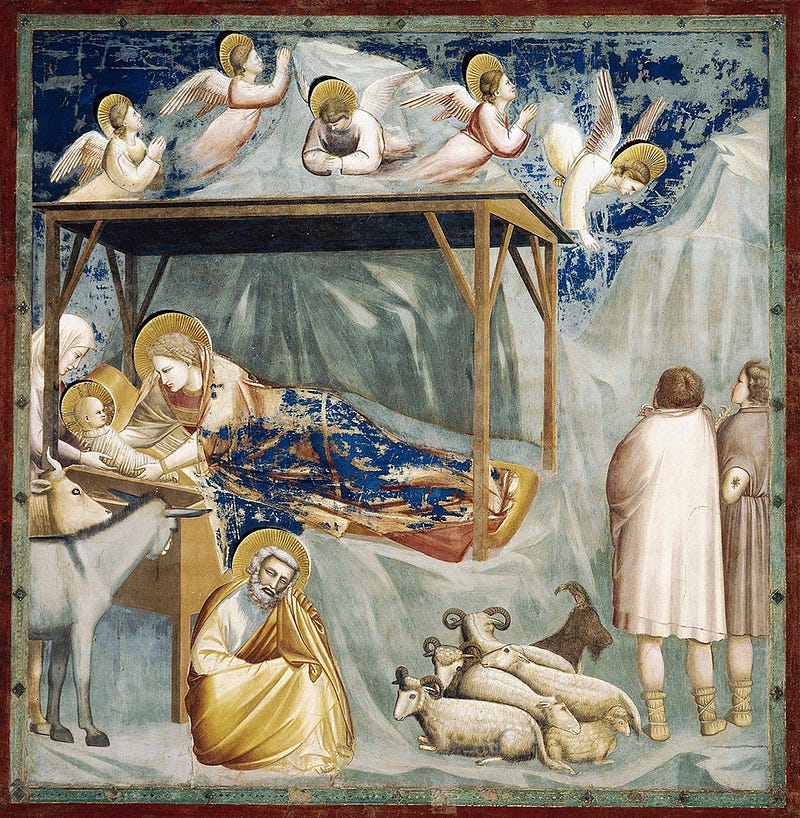
Joseph is rather a forlorn and disconsolate figure who sits on the ground not looking at his wife and son. He has his Halo — well earned — but he seems closest to the ass that brought them to Bethlehem. I feel rather sorry for Joseph who has kept them safe on their long journey to fulfil both an Emperor’s decree and a God’s decree.
Joseph and the ass also appear in Pieter Breughel The Elder’s masterpiece of that very decree by Emperor Augustus — his Census — that led to the birth in a barn in Bethlehem. This time Mary is riding the ass that appears in Giotto’s Nativity scene. She and Joseph and the ox are in the middle bottom of the painting. Mary is looking at us. It has been a long journey and her cloak is rather coarse and not painted in the usual blue to signify the Virgin Mary. It has been a hard journey.
Pieter Breughel has placed that historic census in Palestine into a contemporary setting of a Flemish village in winter at sundown where there is such frenetic activity. One thing is certain there will still be no room at the Inn for Joseph and Mary.
They are making their way to the Census office on the left of the painting where scores of people are already trying to give their name to a scribe working for the Spanish administration in the southern Netherlands. This ‘office’ has a Hapsburg double-headed eagle visible on the front. Authority resides here.
At the time of the census in Palestine, the territory was under Roman occupation, and in Breughel's painting, another brutal occupation is taking place in the Netherlands by the Hapsburgs. But the ordinary folk in the painting are getting on with their lives in the bitter cold and having quite a lot of fun. It is one of the first paintings in Western art to feature a significant snow landscape which was in truth art imitating life as this was one of the worst winters ever recorded in Northern Europe and was part of the “Little Ice Age”.
Images depicted in paintings such as Breughel’s, data from ships’ logs and scientific reports of the time, and other historical writings have shown that many parts of Europe experienced cooler-than-normal conditions during this time which lasted from the early 14th century through the mid-19th century. That is a fascinating tale for another day.
It is this deep humanism for the ordinary folk in Breughel’s painting that I love so much. And the reality with which Breughel depicts such a historical event as the census in Bethlehem but with a wonderful twist. It is taking place in very similar contemporaneous political circumstances. Both events are portrayed not as divine interventions or Immaculate Conceptions but as the hue and cry of being human in exceptionally harsh conditions. Both Palestine and the Netherlands were Occupied Territories.
However, in the painting, the castle to the right of the painting is falling down yet the Church to the far left is resplendent and in immaculate condition. Rome has fallen and so will the Hapsburgs is the message and the spirituality of the ordinary folk will outlast all Empires based upon the commonality inherent in the human condition.
The painting in minute detail shows this common mutuality in work and play and in the journey of Mary and Joseph whose son will die at the hands of a now ancient Empire. How many sons have died by the cruel machinations of power and Empire? Breughel’s masterpiece is a political painting of human resistance and of being simply, human.
There is a detail in the painting that is timeless for the male sex at least. (Women have the blessing and heavy responsibility of birth and of slaughtering the pigs it seems.) A man just to the left of the hollowed-out tree which is a drinking den — I assume — known as The White Swan, is urinating against the wall. It could be the wall of the local merchant’s house. Of which he would be aware.
Feudalism was ending in the Netherlands and this could be a symbolic image of the transformation to a more mercantile, free-flowing fiat economy. Maybe. Or just the male sex relieving a full bladder in a time-honoured fashion? I am more inclined to the symbol of transition. Symbols are everywhere in the painting such as those innumerable wheels. And one at the very epicenter of Breughel’s composition.
Our changing climate could well bring such unexpected significant snowfall again and the scenes depicted in the painting would be replicated by us in our modern world. Mary and Joseph are now economic migrants or illegal (?) immigrants looking for somewhere to bring up their child in peace and safety; the crowds outside the census office like the shoppers fighting to get the bargains on Boxing Day; and the children playing with their new gadgets and toys whether indoors or outside in the snow; the Church still there and the castles of Empires still being built and still turning to ruination as the cycle of occupation continues.
It is still all here nearly 500 years later as the overtly religious renditions of the Nativity give way to the political and social crises we now face in 2024 and beyond just as Breughel captured in his rarely painted tangential event but deeply resonating and for me: a political masterpiece.
Merry Christmas.


