
AMBLING THROUGH AZERBAIJAN, GEORGIA, AND ARMENIA
The Caucasus: Azerbaijan, Part 2 of 3
Settling into Baku
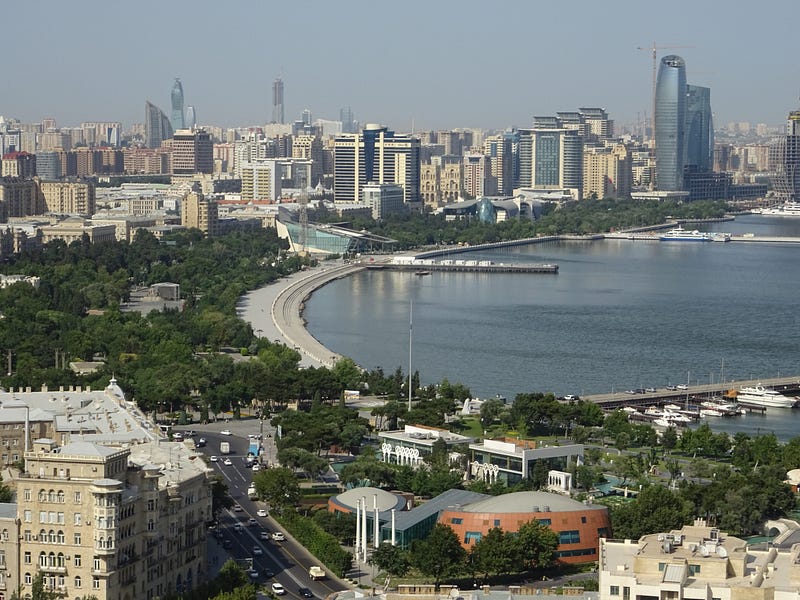
First full day after arrival
This is supposed to be the last day of the heat. Hope so, anyway.
The non-functioning Internet meant that I couldn’t get onto Facebook to contact Dia, an American friend who lives here with her family. I didn’t have her phone number.
What to do? It finally dawned on me to download Facebook’s Messenger, which I don’t use on my phone, as a means of being able to make contact. That worked!!
I caused an electrical disaster this morning. I had neglected to ask Rahib to show me how to turn on the stove. I couldn’t figure out which button turned on which element. Eventually, one of them worked. I was unaware, though, that the electric kettle was sitting on one of the elements that had been turned on. I smelled something funny, which must have been burning plastic, and then all the electrical power went out.
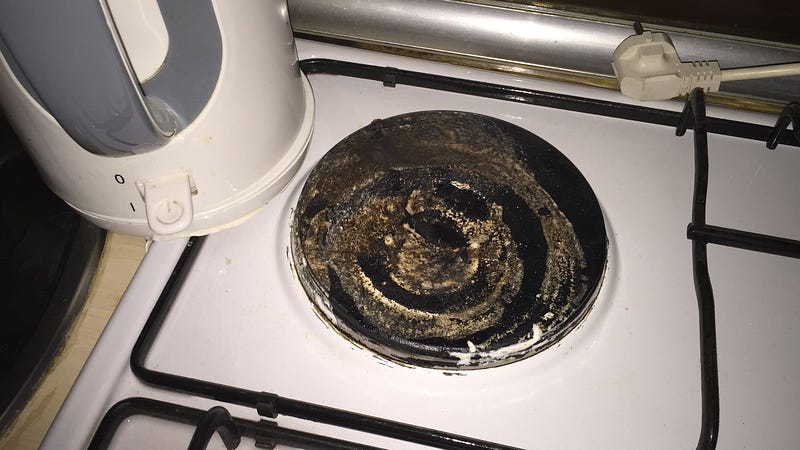
I contacted Rahib to let him know. When he came by later in the day to check on the air conditioner getting fixed, he confirmed that it was just the emergency switch that turned off the electricity, but that I had ruined the electric kettle. I told him I would find a replacement by the end of the day.
I took some items that needed sewing repairs to a nearby shop and then headed out for a walk without having a destination. I eventually found a metro station, which was only one stop from the end of the line. I took it to the end of the line and decided to go outside to see what was there. It turned out to be the Old City.
As I walked around within the gates of the Old City, I could see that it was filled with souvenir shops. It seems to me that “Old City,” wherever in the world one may go, is synonymous with “tourist trap.” Dia told me the name of her nearest metro station, so shortly after noon I met her there. It was the only station I had seen so far with tunnels that were filled with shops. I tried four times to exit at the monument she told me about, but kept on leaving in the wrong place. Thanks to text messaging, we eventually found each other.
We went to the house to chat and catch up, and then, while Andrew and Nicholas were doing some exercise, Dia and I headed out to see some of the local sights.
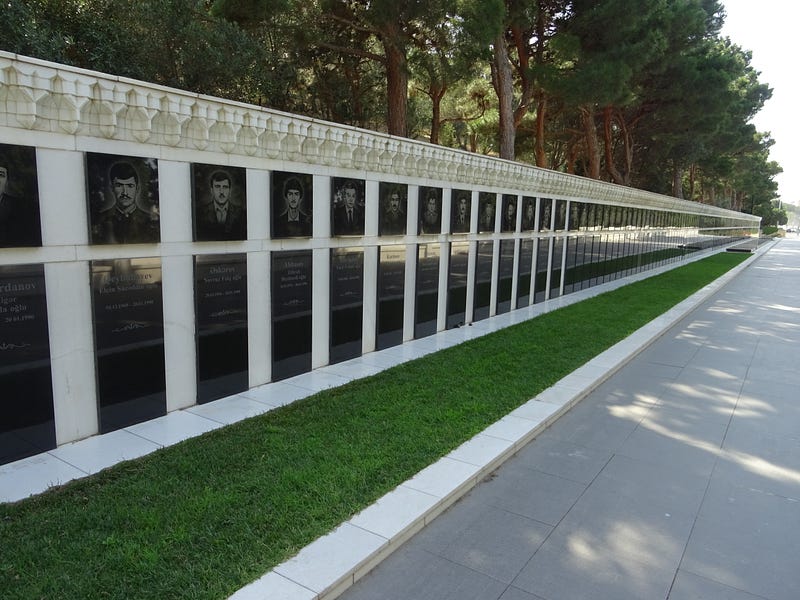
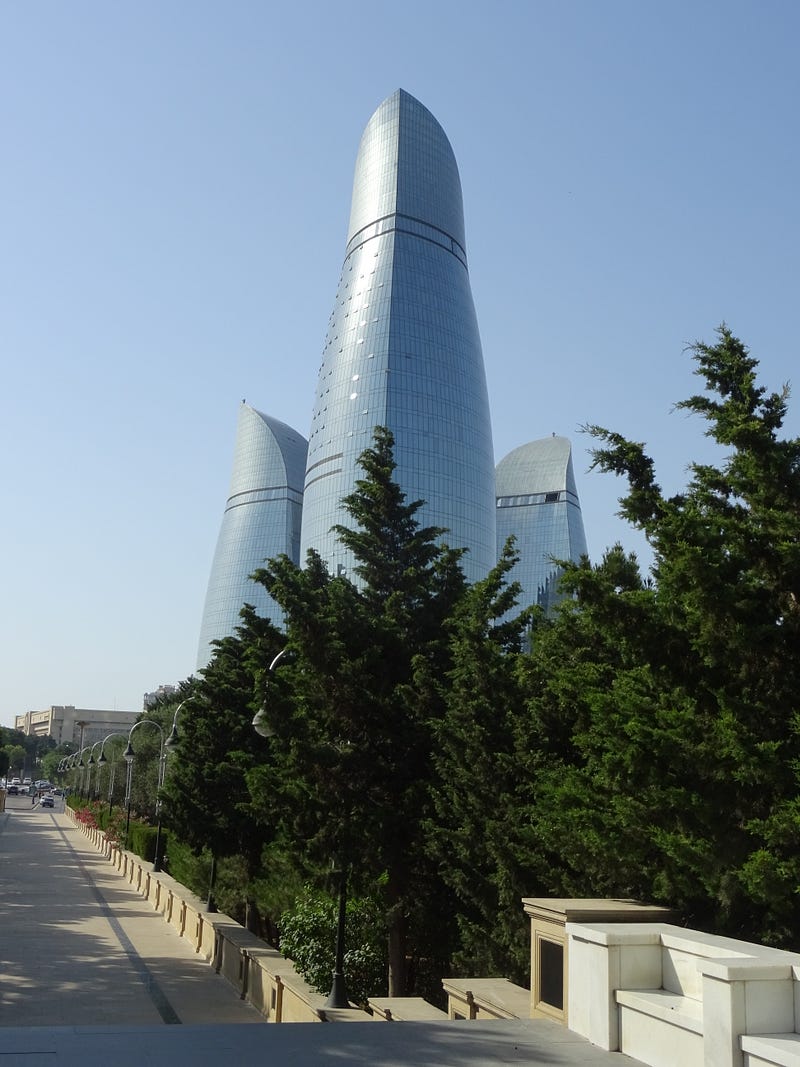
First up were the Flame Towers, one of which houses an elegant Fairmont Hotel. Across the road from that was a park that contained a lookout onto the bay and Martyrs’ Alley, a monument to the people who were killed in a massacre by the Soviet Army in 1990.
We collected the boys at the house and then headed out to a shopping mall for dinner at a food court. I was most pleased to find a place specializing in Middle Eastern food, so I settled for tabouli and hummus.
Shortly after I placed my order, the guy who took the order offered me some bread. Remembering what Rahib told me, I refused at first. But then, I had the feeling that he was offering to me without expecting payment, so I went to my Translate app and typed in “free?” He nodded. I accepted.
One of the stores in the mall had electric kettles, so I bought a new one to replace the one I had damaged earlier that day.
Dia and the boys dropped me off near my apartment. Before I entered, I thought, It’s so nice out now. I’m not even going to need that air conditioner. When I entered the apartment, though, it was quite warm in there, so the first thing I did was to turn on the air conditioner, to see if it worked. It did!
The air conditioner is located above the entry door. The kitchen alcove and bathroom are located along the hallway leading to the only room. The hallway area has been getting comfortably cool, but that cooler air is just not reaching the room where my bed is. So, even with an air conditioner in good repair, it’s less than optimal.
I took the water kettle out of the box, filled it with water, and prepared to give it a test run. To my surprise, the plug on the kettle does not match the electrical outlet in the kitchen.
I’ve never been in a place where you can buy an appliance and not have the plug fit into outlets in the same country. That’s crazy.
Second day
I began my day by picking up my work that the tailor down the street had mended. I noted something curious when I gave him the 7 AZN for the job: he took 2 AZN and slipped them in his pocket, and then took the 5 AZN to put somewhere else. The cash register? Not sure because I left the shop. The laundry place was not open and did not have a sign indicating when it would open. So I contacted Dia to see if I could do laundry at her house; she said yes. She also invited me to bring along my computer so that I could use the Internet, because it wasn’t working in the Airbnb apartment.
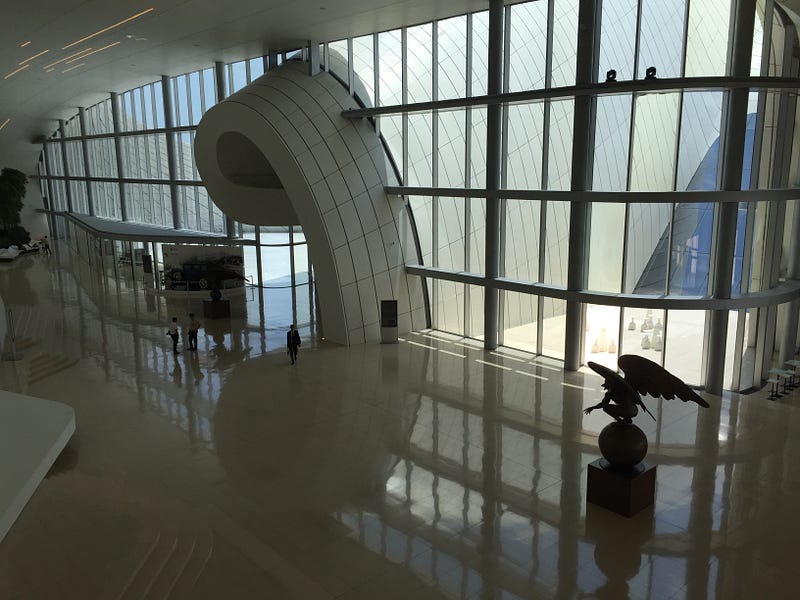
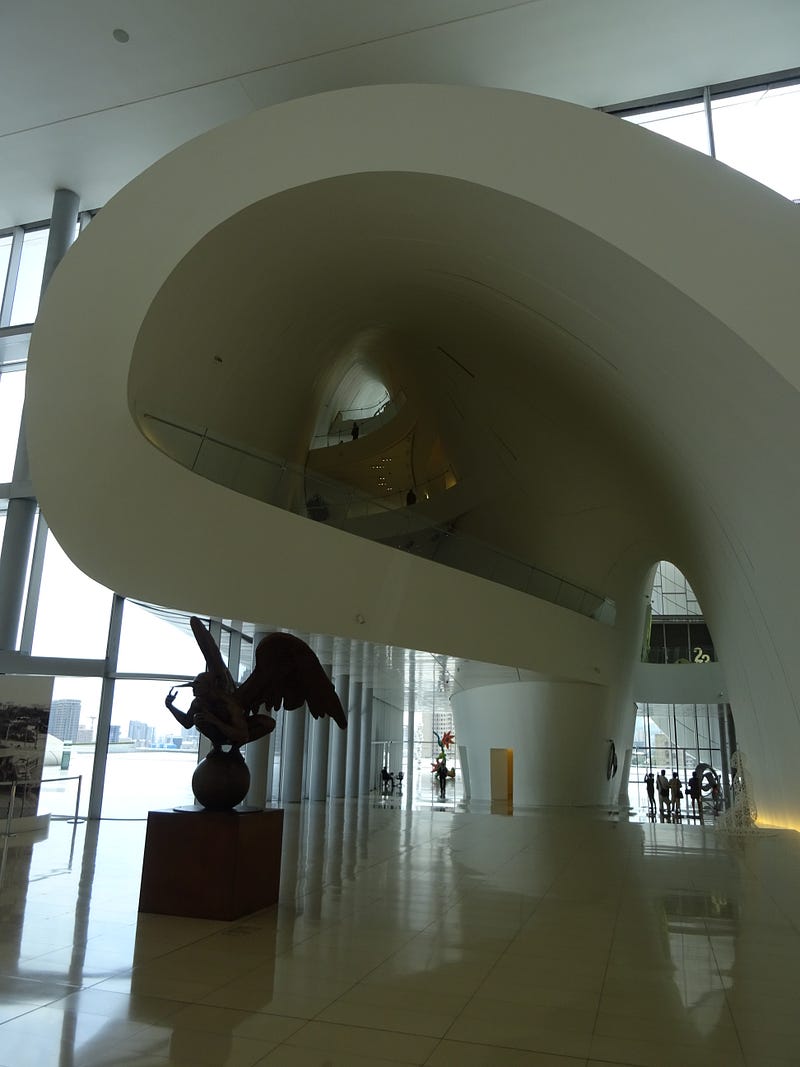
After doing the laundry and hanging out in the house for a bit, we drove to our first stop: the Haydar Aliyev Centre, a concert hall and exhibition space designed by Zaha Hadid, the architect who died last year.
What an amazing building that is, in all ways. Dia and the boys had never been inside. We didn’t realize that there were also some art galleries in there.
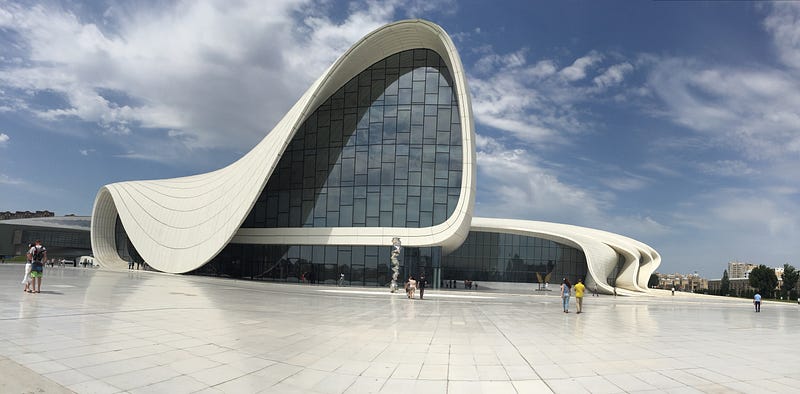
The building itself and the surrounding ground are white. When the sun came out in full force, the effect was blinding, as I didn’t have sunglasses.
Our second stop was the Nobel Museum, which is called Villa Petrolea, the building that served as the home of Alfred Nobel and was appropriately named since he and his brothers earned their money with petroleum. I hadn’t known anything about the Nobel brothers - Alfred, Robert, and Ludvig - and their connection to Baku. This is the place where they made their fortune, and it is, evidently, the source of the funding for Alfred Nobel’s prize money distributed every year in Norway [for the Peace Prize] and Sweden [for all the other prizes].
The area around the home is in disrepair, to the point that it appeared abandoned. There were also no signs indicating that it was there, so it’s a good thing that Zaur, our driver, knew where he was going.
The building was completely shut down, with no lights on. And here we were, on a Thursday afternoon at around 15:30.
A cleaning woman pointed the way to a snack bar area, which was, surprisingly, open. I got a beer for only 1 AZN ($.60).
Meanwhile, Zaur went around the building and began knocking on doors. After about five minutes, somebody not only opened the door, but invited us in, and gave us a tour in English.
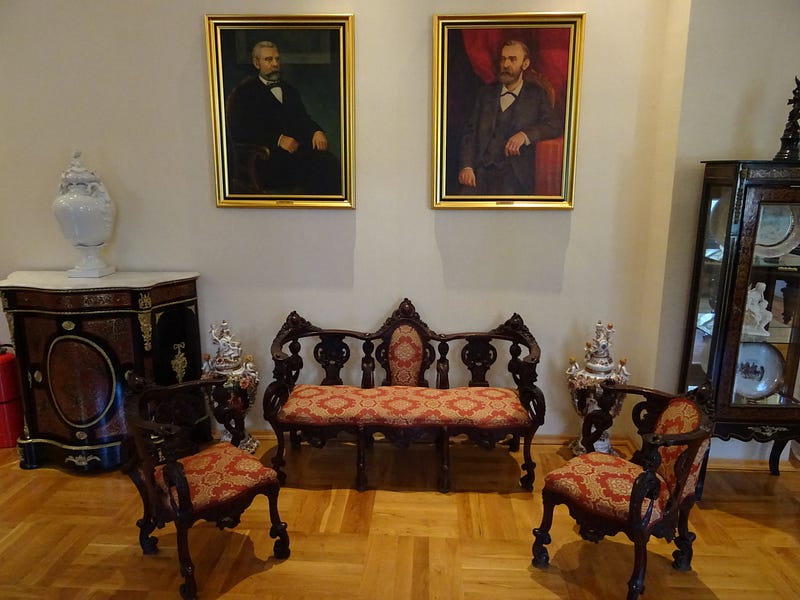
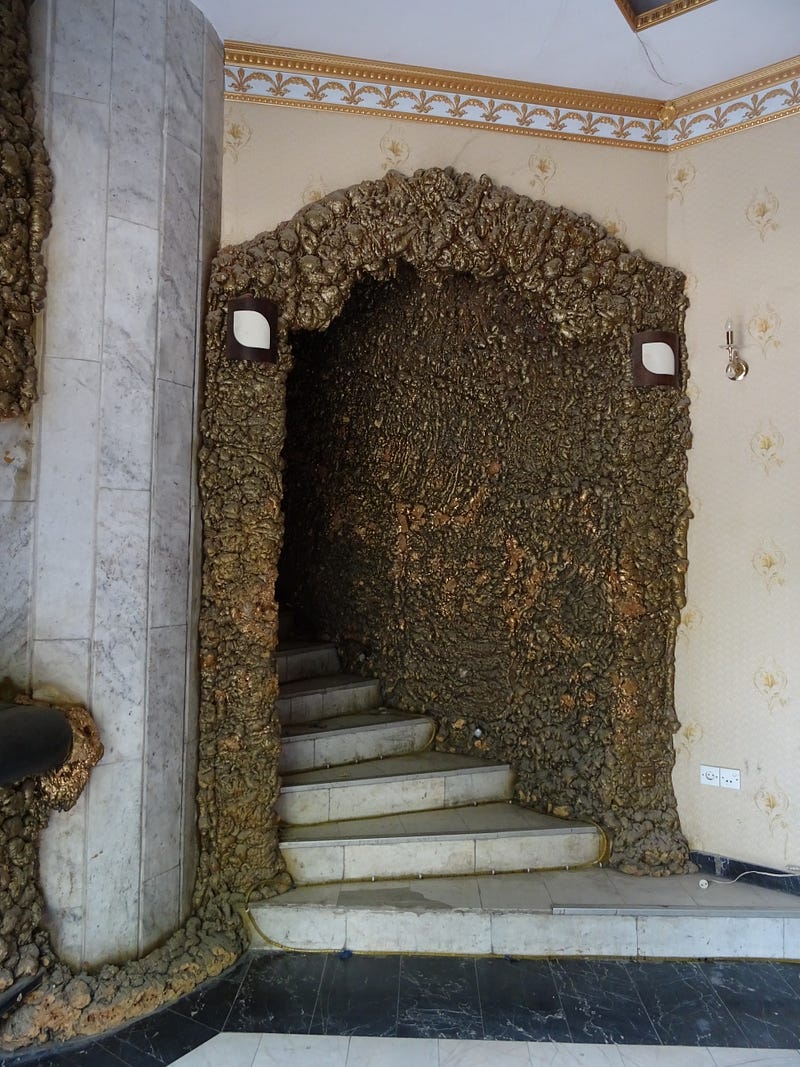
The home was beautiful, and it was also puzzling as to why it was not open to visitors.
After that, we headed back to the family’s house and hung out until Justin came home after work. We had a nice dinner together and then took a walk with the dog and a few of the cats around the compound in which the family lives.
Even though the temperature was showing as 82°F/ 27°C on my phone, it was quite breezy and cool. I’m glad that the oppressive heat of my arrival day has dissipated.
Third day
It was overcast in the morning, and that was great.
As I have been walking about, it’s been easy to see what a hodgepodge of cultures coexists here: East, West, Soviet, European, Middle Eastern, ancient, and modern. There is also a tremendous variety in the facial features of the residents.
I headed out to backtrack on a road where I had ridden by, but not walked. I wanted to take some photos of buildings I had seen.
I stopped at a supermarket that Rahib had said was very expensive. As I looked around I saw that they had soy milk and almond milk. I agreed with Rahib: was the most expensive soy and almond milk I have ever seen overseas: 11.50 - 13 AZN (USD 6.82 - 7.71).
That supermarket was part of a mall, and when I left the mall, I saw that there was an airport-style security checkpoint entry that I had bypassed.
Down the road, I entered another mall so that I could use the restroom, and had to go through security.
After taking the photos I wanted, I headed to the Museum of Modern Art, which is a small area of a modern apartment building. Upon going through security at the entrance, and emptying my pockets for the third time today, the guard questioned me about my small water bottle, and wanted me to leave it with him.
I had reached the limit of my impatience with this fear-based society, so I packed up my stuff and left the building.
I got on a random bus and took it to the end of the line, where there was a metro station. Upon my departure from the bus, I saw an area that had something like a snack bar, with tables in the shade, and several guys at tables drinking beer. One couple had what appeared to be a tomato salad, but the server said there was no more available. Another guy had a beer and a dish of garbanzo beans, and they looked good.
As a means of asking the price, I showed the calculator app on my phone to the server. He showed me it was 1 AZN for the beer and .70 AZN for the garbanzos. That was a grand total of USD 1. Bargain prices in Baku!
I took the metro to the end of the line where the Old City is located and walked along The Boulevard to the Carpet Museum.
When I entered the Carpet Museum, once again I had the security check. So tedious. They have an elevator in this fairly new building, but every time I tried to use it, staff came by to discourage me, telling me to use the escalators. Using the up escalators was an excellent option for going through the museum to see everything: Go up to the second floor, walk the entire length of the exhibition, and then, at the end of that floor, there was the up escalator to ascend to the third floor. But in order to go down, it meant walking the entire length of the museum once again, on every floor. Using the elevator made more sense. What didn’t make sense was being castigated by staff for using it.
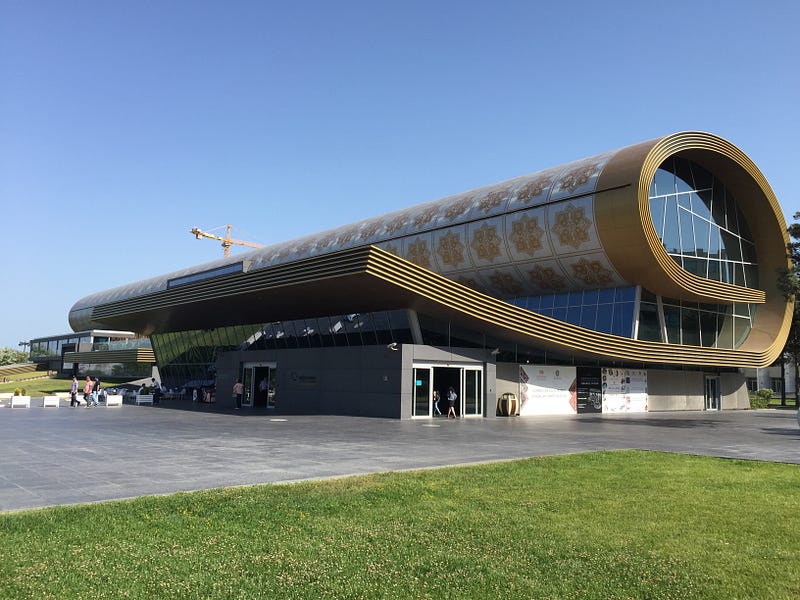
Upon leaving the building, I stopped in the gift shop to buy a postcard. The clerk told me I would need to show the receipt to the security guard at the exit. The guard took the receipt. All that for a 1 AZN ($.60) postcard!
I began walking The Boulevard, which is quite beautifully situated adjacent to the bay, and headed back to my apartment.
There is a huge number of smokers here. At one point, along The Boulevard, I could see that cost of tobacco is evidently not an impediment, with a pack of cigarettes ranging from AZN 1 (USD .59) to AZN 1.60 (USD .94).