
“The Cat’s Whiskers”
An idiomatic expression for elegance! But more significant.
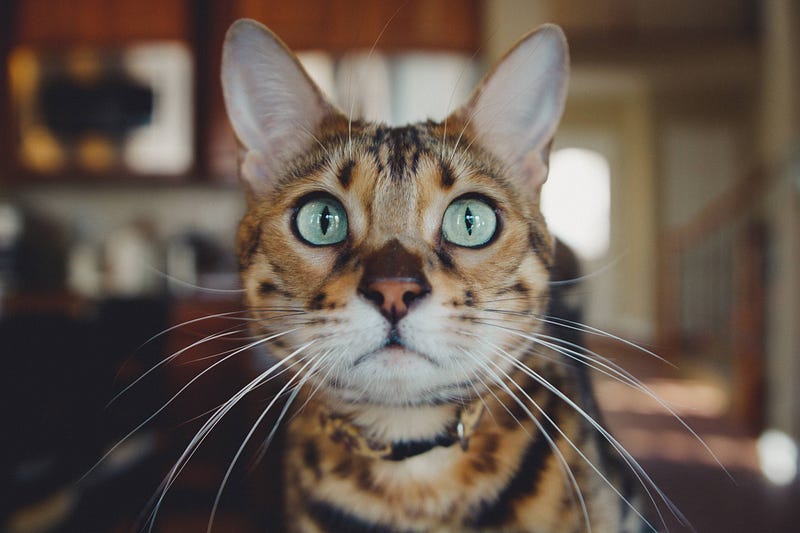
What to know about the real cat whiskers?
My fascination with my kitty buddies leads me to study how they operate and what makes kitties lovable to all cat lovers. I write about their whiskers today.
Whiskers develop from hair follicles like other hairs, but they stand out on a cat’s body. Whiskers are coarser & thicker than regular hair. Their roots are three times deeper.
I noticed if I touch my kitty’s whiskers, he will close his eyes. Sam rolls on his back & rubs his whiskers across my hands. A sign of affection. (Ref; Debra Pirotin's book on Complete cat training.)
Whisker-twitching
I often see the twitching of whiskers when my cat watches birds in the yard or scouts below fence crevices for bugs or other animals.
When a cat is sick, its whiskers will droop low. (My Vet brought this to my attention when the cat was ill).
The function of whiskers
Whiskers are essential to aid navigation and sensation. Cats have dozens of movable whiskers (vibrissae) on parts of their body & faces.
Kitty whiskers permit the cat to receive information on the width of a gap and the location of objects in the dark. Achievement of this feat occurs by the direct touch of an object and by sensing air currents.
Whiskers trigger blink reflexes to protect the eyes from damage. The strategic position of the whiskers occurs;
a) above the eyes,
b) on the chin,
c) near the ears,
d) above the upper lip,
e) on the forelegs.
The exact pattern and location of whiskers vary with the breed of the cat. Most cats have twelve whiskers arranged in four rows on each cheek.
Whiskers are more than interesting facial features.
- Whiskers highlight a cat’s facial features.
- They frame the eyes-sort of like eyebrows and emphasize the muzzle when the kitty “smiles.”
- Whiskers guide the cat through daily functions. These specialized hairs aid vision & help the kitty navigate their environment like the antennae on insects.
- Although whiskers are ‘tactile’ hairs, scientific studies reveal that they don’t feel anything. Transmission of information to sensory cells occurs. (Ref; Lynn Buzhardt DVM-VCA)
- Whiskers are body balancers; Proprioceptor sensory organs at the end of their whiskers send messages to the brain to keep the cat aware of the position of every part of its body—the reason cats always land on their feet.
- Whiskers are radar sensors; cats have great senses of hearing & smell. Whiskers help with near vision since distant vision is good in cats.
- Whiskers detect faint vibrations caused by changes in air currents. It helps the cat hunt and locate food bowls or favorite toys at night.
- Whiskers communicate the cat's emotions; If the kitty feels threatened, he pulls his whiskers on his muzzle taut, flairs them, and directs them forward towards the threat.
- Whiskers are protectors; these sensitive hairs respond when touched by the smallest particles. If a speck falls on a whisker above his eye, the cat will blink & shake his head, fling it off to protect his eye from injury.
Whiskers Need Protection
A part of the cat’s brain devotes attention to processing data from touch sensors. 40% of the brain’s sensory area aligns with a part of the body with whiskers. Each whisker occupies valuable neurological regions of the cat’s brain. (Ref; Lynn Buzhardt DVM-VCA hospitals.org)
Whiskers are essential to the cat’s ability to function with safety inside & outside. It is paramount never to pull, pluck or cut the cat’s whiskers.
Neuroscience is of particular interest.
The sensitivity of whiskers is high because follicles are rich in blood vessels & nerves. Science compares the sensitivity of whiskers to human fingertips. (Lynn Buzhardt DVM VCAhospitals.org).
A large part of the brain of whisker specialist mammals involves processing nerve impulses from the whiskers.
Information from the vibrissae transmits to the cat’s brain via the Trigeminal nerve & to the sensory complex in the brainstem, the Thalamus, and the barrel cortex. (Lynn Buzhardt DVM, VCA.)
Injury to the cat’s whiskers will decrease his special awareness, and confusion will occur. As guardians & pet parents of these precious pets, we must be mindful and protect the cat’s whiskers.
References
Debra Pirotin DVM, and Sherry Suib Cohen- ‘The first complete guide to intelligent cat training.’
LynnBuzhardt DVM-VCA / https://VCAhospitals.com