
Extinctions have consequences
The Catastrophic Consequences of Moa Extinction in New Zealand
The extermination of New Zealand’s giant, flightless bird, the moa, was fast, but the consequences have lasted centuries.
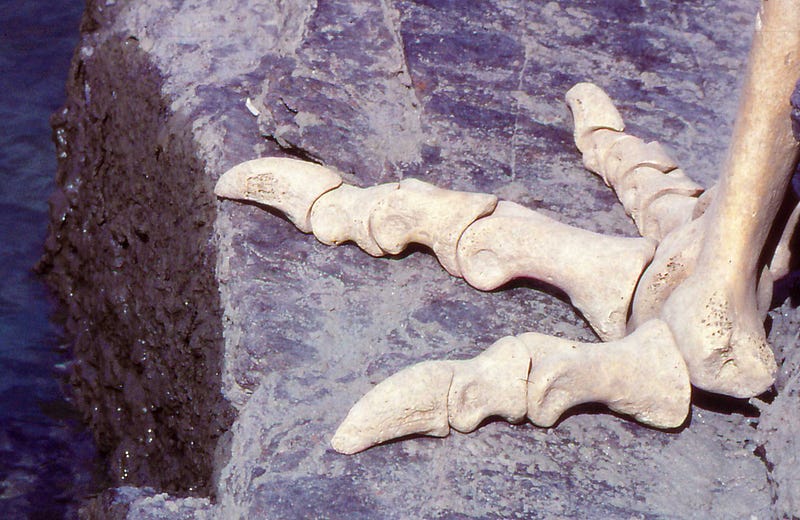
Sometime back in the early 1970s, my sister (who was less than ten at the time) tripped over a moa bone. At least, that’s how the story got back to me, who was stuck in school. My mother and sister were walking across a New Zealand swamp (back in the days when no-one thought twice crossing unfenced farmland). Cattle hooves had probably compacted the surrounding peat so that the large bone had been left projecting upwards.
Moa was an entirely flightless bird that once lived in New Zealand — think ostrich, but far more massive, and quite unlike the ostrich, had no wings at all. Swamps in various parts of New Zealand have thousands and thousands of moa bones buried in their peat, representing many, many individuals. The treasure trove of bones that they preserve has been an absolute ‘gold mine’ in the study of this now extinct bird (see the book ‘The Lost World of the Moa’ by Trevor Worthy).
New Zealand, as it turns out, was the last large, habitable place on Earth, to have been discovered. Antarctica is bigger but is not habitable. Lord Howe Island (to the east of Australia) seems to have escaped human attention until 1788 but is tiny. We can now pin the date of human arrival in New Zealand down to within a few years.
Based on radiocarbon dates of seeds that had been gnawed by the Pacific rat (an animal which had to have been bought to New Zealand by early colonists), Wilmshurst et al. (2008) dated the earliest evidence of humans in New Zealand to c. 1280 A.D. However, since the publication of that paper, a new study has argued for an even more recent date — the early 14th century (Jacomb, et al., 2014).
Let’s imagine that the first canoe load of people landing on the shores of Aotearoa (the name they quickly gave it: ‘cloud-long-white’). Having just come from a small tropical atoll in the Pacific, they would have been stunned beyond belief at what lay in front of them. Possibly a bit pissed that it was so cold — but on the upside, it was stocked with masses of clueless flightless birds. With what I imagine was an early example of the Māori sense of humour, they pointed at one and said: “Moa!” — the island word for ‘chicken’. And promptly ate it.
Early Polynesian archaeological sites in New Zealand have a lot of moa remains — clear evidence that they, and their eggs, were eaten in large numbers. The associated artifacts— like large rock knives used to butcher the moa and jewelry made from moa bones, led to the recognition of a ‘moa hunter culture’ in New Zealand (Duff, 1956). Remarkably, signs of violence, like weapons or defensive structures, are rare (or absent) at this time. It seems fair to say that inter-tribal aggression was just not a thing. Aotearoa was a land of plenty.
But everything seemed to have changed around the middle of the fifteenth century. A display that used to be in the Otago Museum in Dunedin, made a huge impression on me when I was a kid (I think the display has since been removed). It was a ‘peel’ from the side of an archaeological excavation pit further south in New Zealand (Papatowai). Over a couple of meters or so, it showed an abrupt transition from dark soil at depth, with large chunks of moa bone scattered through it— to a solid mass of shell and fish bone above. The transition between these two was roughly dated to around AD 1450. That initial digging and interpretation were largely by the archaeologist Les Lockerbie. Another archaeologist, Jill Hamel (1977, 1978), was later to base her PhD in the area and continued with research on the site.
That one archaeological site apparently encapsulated the dramatic change in southern New Zealand when rampant consumption of moa rapidly declined, as it was hunted out, and was replaced by fish and shellfish (see various works by Lockerbie, e.g. 1953). However, subsequently, more detailed work by other researchers has indicated that this interpretation is far too simple (Anderson and Smith, 1992). In essence, they showed that the two-phase, ‘moa-to-fish’, stratigraphy was fortuitous, and depended on where that first excavation hole had been dug.
It was kind of disappointing to see a simple, iconic story shown to be wrong (aren’t they so often?), but as the authors emphasized, the extinction of the moa must still have caused the basic trend from eating lots of moa, to sea food and small birds, that Lockerbie thought he was documenting — and in fact, might have happened far more quickly than Lockerbie imagined.
Several researchers have since focused-on the extinction dynamics of the moa — which involved both hunting and habitat-change (e.g. Anderson 1989a; Holdaway et al, 2014; Holdaway and Jacomb, 2000; Perry et al. 2014). The startling conclusion of Holdaway and Jacomb (2000) was that in any one area, the moa were exterminated within 100, or even 50 years, and that moa were “effectively extinct within 160 years of colonization”. Their arguments have come under fire (Wilkes, 2000), but later analysis of radiocarbon dates across New Zealand (Perry et al., 2014) concluded that by the early 15th century, there were too few moa to effectively hunt, and they became regionally extinct 30–50 years later.
Of course, some moa may have lingered on in the most remote parts of New Zealand, perhaps becoming opportunistic prey to small human groups hunting for other resources, such as rocks. Some reports have suggested that moa might even have existed in remotest Fiordland into early European days (mid 19th century), although Anderson (1989b) concludes these reports are not particularly credible. On the other hand, Berentson (2012) recounts that mysterious tracks found in Fiordland by James Hector in 1863 might well have been made by moa. In any case, as he says, by the time the wave of European-introduced predators, such as weasels, had extended to these far corners, it was all over for the moa.
Discounting possible ‘tail-enders’, at approximately the same time that moa became effectively extinct, massive forts (called ‘pa’) began to be built around New Zealand/Aotearoa (Schmidt, 1996). For example, if you look around the Auckland sky-line, you’ll see a bunch of these, where isolated hills were shaped with terrace and ditches and lined with now lost wooden palisades. These were not all ‘forts’ in the European sense, as some of them were fortified food storage and gardening areas (Davidson, 1984) — but you get the point — these are a clear sign that life was getting tough. With the extinction of the moa, some form of carrying capacity was likely overstepped.
It’s not difficult to connect the dots between the extinction of the plentiful easy to get, food in the form of moa, and the aggression implied in building forts soon after (Tim Flannery did just that, in his book ‘The Future Eaters’). New Zealand society and ecology clearly changed fundamentally around this period. Culturally it passed from ‘moa hunting’ to what has been called ‘Classic Maori’ (Golson, 1959). As well as the ‘forts’, the archaeological signature of this phase includes hand-weapons. These were all for ‘close-combat’ - fire-arms and bows and arrows were absent. If you were a Maori warrior, your business was done face to face.
Warfare became endemic, slavery was widespread, cannibalism certainly existed as well— although the degree to which it was related to the destabilization of Māori culture by the later arrival of Europeans (and by their morbid fascination in the topic!) is a question discussed by Paul Moon, in his 2008 book: ‘This Horrid Practice: The Myth and Reality of Traditional Maori Cannibalism’.
It was into this hostile environment that Europeans (from another aggressive culture) wandered from the end of the 17th century - and did one of the worst things imaginable. Importantly to the Europeans, and to the subsequent history of New Zealand, the country has a native plant called flax (Phormium). It’s entirely different from the flax of Europe, but just like it, its leaves are full of strong fibers. With laborious processing, these fibers can be isolated and turned into rope. The Europeans needed rope for their ships, and organized Māori to do that hard work of extracting flax fibers. The incentive they used — and this is where things get truly, evilly cynical, was to pay them in muskets.
Given the tense local scene, the first Māori to get hold of guns immediately appear to have looked at their neighbours — the ones they had been feuding with for a few generations and thought “Great! Now we can end this once and for all…”
This set off a massive arms race, whereby Māori were desperate to acquire a musket — or risk the total annihilation of their tribe. The details of this process were documented by Urlich (1970), who showed that within 15 years, almost every fighting male across New Zealand’s North Island, had got himself a musket. As missionary George Clark related (quoted in Urlich, 1970):
“For a musket a New Zealander will make great sacrifices, he will labour hard and fare hard for many months to obtain his musket, in fact it is his idol he values it above all he possesses, he will not only part with his slaves for one, but even prostitute his children to diseased sailor [sic] for one of those instruments of destruction.”
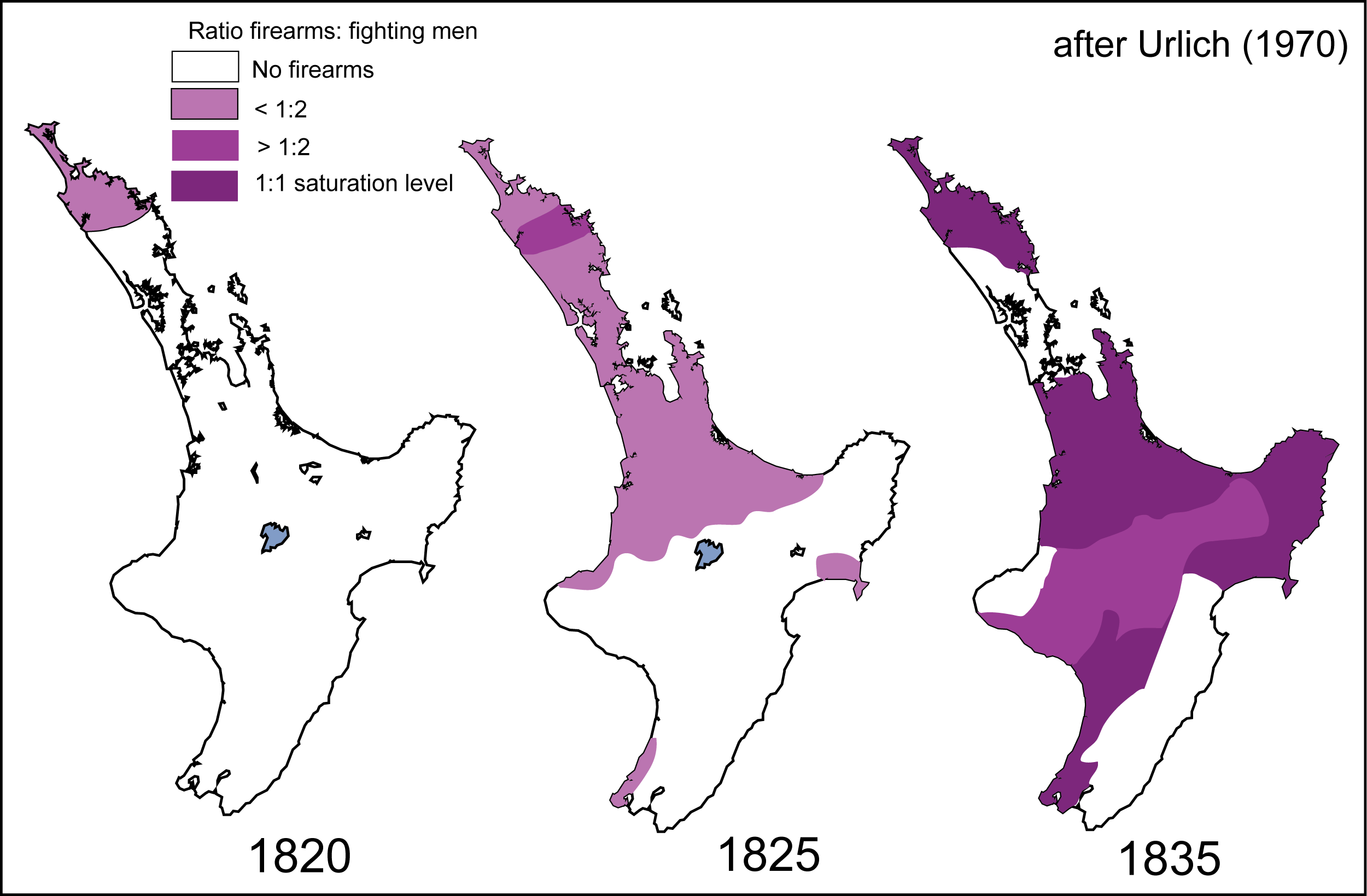
Those ‘Musket Wars’ and the later wars between Māori and European eventually passed. These days, New Zealand/Aotearoa has an overseas image as some sort of ‘paradise’. However, it has far more than its fair share of social problems. It is a long way now from the rather idyllic place it seems to have been 600–700 years ago.
In their book, ‘The Spirit Level: Why More Equal Societies Almost Always Do Better’, Richard Wilkinson and Kate Pickett point the finger at ‘social inequality’ for a range of social ills. Throughout the book, graphs of the prevalence of things like suicide, depression and teen pregnancy, typically indicate New Zealand up in the top-right quadrant. The book prompted much discussion (heated debate!) and led to a second book, ‘The Inner Level: How More Equal Societies Reduce Stress, Restore Sanity and Improve Everyone’s Well-Being’, with more emphasis on how many other researchers had come to the same conclusions. It’s clear that New Zealand has become a very un-equal society, and it seems we are paying the price. But within this broader phenomenon, one group is doing particularly badly — the indigenous Māori.
Māori “utterly dominate the child murder records, dominate the domestic abuse charges, assault and murder statistics”.
This quote comes from Alan Duff’s recent book, ‘A Conversation with My Country’. Duff is famous as the author of an earlier book ‘Once Were Warriors’, which was then adapted as a successful movie. Those statistics involve crime, but others to do with health, are similar.
The question is, that if the basic problem in New Zealand is inequality — why is it that Māori are so badly effected? A simple answer might be ‘Racism!’, which certainly exists here, but there are other points of view, with more nuance, and I’ll give just one.
Duff argues that by European contact, an aggressive ‘warrior society’ had evolved in New Zealand (essentially, this is what is represented in the archaeological record as the ‘Classic Maori’ phase). In that culture, in his words:
“men had to prove their worth by extreme violence. In that society the violence was rewarded”, but … “in the current one it’ll get you jailed.”
Duff makes a strong connection with parenting. In a ‘warrior society’ certain values are either promoted or neglected by parents to be instilled in their children. Despite the ‘need’ for a warrior society having now passed, those parental values might take some time to catch up. Duff particularly emphasises books — or rather the lack of them in most Māori homes. In his experience, too many Māori parents do not see the value of books, and their children grow up in book-less households — and they in-turn pass this value on (There are some stellar exceptions to an apparent Māori disinterest in books).
Duff has stirred plenty of outrage with his views, but this is not the place to analyse them. For his part, Duff identified a general lack of childhood books as one thing where he could make a positive change — and helped set up a charitable foundation to supply needy children with books. I’ll leave it to the psychologists to work out if a ‘warrior society’ might ultimately express as a disinterest in books, but the idea seems plausible to me. If that’s the case, then something that happened centuries ago, the extinction of the moa, may have had very long consequences indeed. It led to a hostile social environment, which might be echoed in some of our social problems of today.
Getting back to that swamp where my sister tripped over a moa bone, you could idly think that the bete-noir of moas actually were swamps. With not even a vestige of wings, once one blundered in and got its huge feet stuck (see my featured image), that was its end. The unfortunate giant bird would simply slot itself into the mire, and then die among so many of its relatives. In one famous swamp, Pyramid Valley, it has been estimated that around 2,000 moa were trapped in just 1.2 Ha (about 3 acres, Duff, 1955). However, those swamps were death-machines over a long time — thousands of years. One or two trapped moa per year seems to have been sustainable. It was only once humans arrived, that the balance was quickly upset.
In the specific sense, the Polynesians certainly eliminated the moa, but in the broader sense it would be a mistake to single that group out. Consider if New Zealand had remained undiscovered until the Spanish or Dutch happened across it in the sixteenth or seventeenth century. My bet is that they would have organised a Pacific and Indian-Ocean-wide trade in dried moa meat and moa omelettes in a couple of years flat. With European firearms, the moa may have taken ten years to go functionally extinct, rather than fifty. Point being, the basic issue of over-exploitation of nature is a very human problem.
Extinctions can have long consequences and may bite us in odd ways…
References
Anderson, A. 1989a. The mechanics of overkill in the extinction of New Zealand Moa. Journal of Archaeological Science, 16,137–151.
Anderson, A. 1989b. On evidence for the survival of moa in European Fiordland. New Zealand Journal of Ecology, 12: 39–44.
Anderson, A. and Smith, I. 1992. The Papatowai site: new evidence and interpretations. Journal of the Polynesian Society, 101:129–158
Berentson, Q. 2012. Moa: The Life and Death of New Zealand’s Legendary Bird. Craig Potton Publishing, Nelson.
Davidson, J. 1984. The Prehistory of New Zealand. Longman Paul, Auckland.
Duff, R. 1955: Further report on excavations at Pyramid Valley Swamp, Waikari, North Canterbury: Foreword. Records of the Canterbury Museum, 6: 253–255.
Duff, R. 1956. The moa-hunter period of Maori culture. Canterbury Museum bulletin; no. 1.
Duff. A. 1990. Once Were Warriors. Tandem Press.
Duff. A. 2019. A Conversation with my Country. Random House, NZ.
Flannery, T. 2002. The Future Eaters: An Ecological History of the Australasian Lands and People. Grove Press.
Golson, J. 1959. Culture change in prehistoric New Zealand. In J.D. Freeman and W.R. Geddes (Eds.), Anthropology in the South Seas: Essays presented to H.D. Skinner, pp. 29–74. Thomas Avery, New Plymouth.
Hamel, G.E. 1977. Prehistoric man and his environment in the Catlins, New Zealand. Unpublished Ph.D. dissertation, University of Otago.
Hamel, G.E. 1978. Radiocarbon dates from the moa-hunter site of Papatowai, Otago, New Zealand. New Zealand Archaeological Association Newsletter, 21:53–4.
Holdaway, R., Allentoft, M., Jacomb, C., Oskam, C., Beavan, N., & Bunce, M. (2014). An extremely low-density human population exterminated New Zealand moa. Nature Communications, 5, 5436. doi:10.1038/ncomms6436.
Holdaway, R. N., & Jacomb, C. (2000). Rapid extinction of the moas (Aves: Dinorinthiformes): Model, test, and implications. Science, 287,2250–2254.
Jacomb, C., Holdaway, R.N., Allentoft, M.E., Bunce, M., Oskam, C.L., Walter, R., and Brooks, E. 2014. High-precision dating and ancient DNA profiling of moa (Aves: Dinornithiformes) eggshell documents a complex feature at Wairau Bar and refines the chronology of New Zealand settlement by Polynesians. Journal of Archaeological Science, 50:24–30.
Lockerbie, L. 1953 Further Excavation of the Moa-Hunter Site at the Mouth of the Tahakopa River, Journal of the Polynesian Society, 62:13–32.
Moon, P. 2008. This Horrid Practice: The Myth and Reality of Traditional Maori Cannibalism.
Perry, G. L., Wheeler, A. B., Wood, J. R., & Wilmshurst, J. M. (2014). A high-precision chronology for the rapid extinction of New Zealand moa (Aves, Dinornithiformes). Quaternary Science Reviews, 105,126–135.
Pickett, K. and Wilkinson, R.G. 2009. The Inner Level: How More Equal Societies Reduce Stress, Restore Sanity and Improve Everyone’s Well-Being. Penguin Press.
Schmidt, M. 1996. The commencement of pa construction in New Zealand prehistory. Journal of the Polynesian Society,105: 441–460.
Urlich, D.U. 1970. The introduction and diffusion of firearms in New Zealand 1800–1840. Journal of the Polynesian Society, 79: 399–410.
Wilkes, O. 2000. Were moas really hunted to extinction in less than 100 years? Archaeology in New Zealand, 43:112–120.
Wilkinson, R.G. and Pickett, K. 2009. ‘The Spirit Level: Why More Equal Societies Almost Always Do Better’. Allen Lane.
Wilmshurst, J.M., Anderson, A.J., Higham, T.F.G., Worthy, T., 2008. Dating the late prehistoric dispersal of Polynesians to New Zealand using the commensal Pacific rat. Proc. Natl. Acad. Sci. U. S. A. 105 (22), 7676e7680
Worthy, T.H. 2002. The Lost World of the Moa: Prehistoric Life of New Zealand. Indiana University Press.


