
The Cashless Effect: What Behavioral Science Says About Sticking to a Budget
Why you might benefit from changing the way you pay
Have you ever heard of the Envelope Budgeting Method? It’s a financial management system built on putting cash into separate envelopes for different parts of their budget. For example, I might put $200 in an envelope marked “groceries” or $50 into an envelope marked “water bill.” This budgeting method can be useful for those who feel their money seems to “slip away” on small purchases.
There are a few reasons why using cash might make it easier for people to stick to a budget. One is a behavioral science principle called the Cashless Effect.
What is the Cashless Effect?
The Cashless Effect says that the more tangible payments are, the more psychologically painful it is to spend money. It’s why people on a budget find it easier to track their spending when they use cash instead of credit cards or pay every month versus having an auto-debit or subscription.
The Cashless Effect is related to a concept called “pain of payment” which describes the psychological pain caused by parting with money. The more painful it feels to pay, the less people tend to spend. The easier and less painful it is to pay, the easier it is to spend money.
The Cashless Effect states that the more tangible payments are, the more psychologically painful it is to spend.
The Cashless Effect has been studied in lots of different contexts and appears to be generally universal. For example, in one study, researchers found that people spent more when apartment laundry rooms took cards instead of coins.
In another study, researchers at MIT asked people to bid for a pair of tickets to a sporting event. One group was told they’d be paying with a credit card, and the other group was told they’d be paying with cash. The credit card group bid up to 72% more for the tickets than those who were told they’d be paying with cash.
Why? Because even the idea of using a credit card is less painful than the idea of paying with cash. The thought of using a credit card divorced the study subjects from the psychological pain of payment — even in hypothetical situations.
How Planning for the Cashless Effect Helps People Stick to a Budget
Credit cards and recurring subscriptions, two common payment methods, are examples of the Cashless Effect at work. These methods do two things that make it easy to “set and forget” the payment. These methods do two things by making payments less painful:
- They remove friction from the payment experience
- They set up a default that’s hard to change
What Is Friction?
Friction basically describes how hard it is to get something done. A “friction point” is a concept that originated in product design. Friction points are moments where you’re trying to get something done but come up against a mental or physical obstacle. If we use the example of paying a bill, friction points might include:
- Only being able to pay using a physical check
- Having to call in to confirm every time you make a payment
- Being forced to login and re-enter your payment account information every month
When people use a subscription or auto-debit, they can remove friction from a payment experience. And this might be a good or bad thing depending on what that payment might be.
What Are Defaults?
Defaults are pre-set choices that take effect if you do nothing. A monthly subscription is a great example of a personal finance default.
Studies have shown that people rarely change their default behaviors. Microsoft found that 95% of people kept all default settings on software — even for critical features like autosave.
The most cited example of defaults is in the area of organ donation rates. In countries where citizens are automatically opted-in to an organ donation program, most people are organ donors. But in those countries where people are asked to opt-in to organ donation, fewer people join.
For example, in France, an opt-out country, 99.98% of people are organ donors. In Germany, where people must actively opt-in to donate, only 12% of people are organ donors.
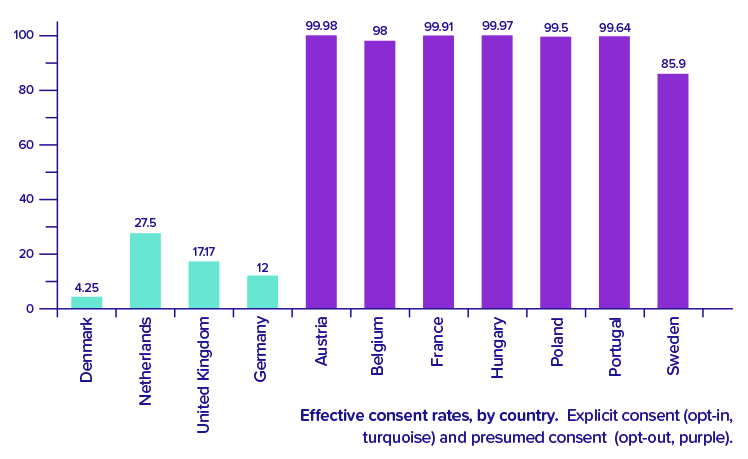
Why do defaults work? When it comes to thinking, people are lazy. Defaults provide a shortcut and allow us to “set and forget” things like recurring monthly payments or subscriptions. Since defaults don’t require people to make a mental effort, they can reduce that pesky “pain of payment.”
The Bottom Line
The Cashless Effect can make it hard to stick to a budget for some. But, for others, increasing convenience by reducing friction and creating defaults is worth the risk to their budget. And whether the Cashless Effect is good or bad often depends on how it’s being applied.
I’ve used the Cashless Effect to better stick to my budget (Please bear in mind that I’m not a financial advisor. I’m just a behavior change strategist who likes to experiment on herself!). I started by considering the following questions:
- How much friction, or difficulty, is there in my current monthly outgoings?
- How can I test the idea of paying with cash rather than a credit card or subscription?
- Is there a way to inject the “pain of payment” into my budget in a way that drives the best outcome?
🧠Want to learn more about solving impossible problems, learning faster, changing habits, and making better decisions? Then check out our free newsletter, Growth Habits Lab by clicking here.
You’ll even get a free eBook when you join, “25 Cognitive Biases and How to Avoid Them.”


