
The Case For Watching The Most Disturbing Movie Ever Made
Pasolini’s Salò is more than a brutal cinematic masterpiece. It’s the perfect allegory for today’s media culture and global politics.
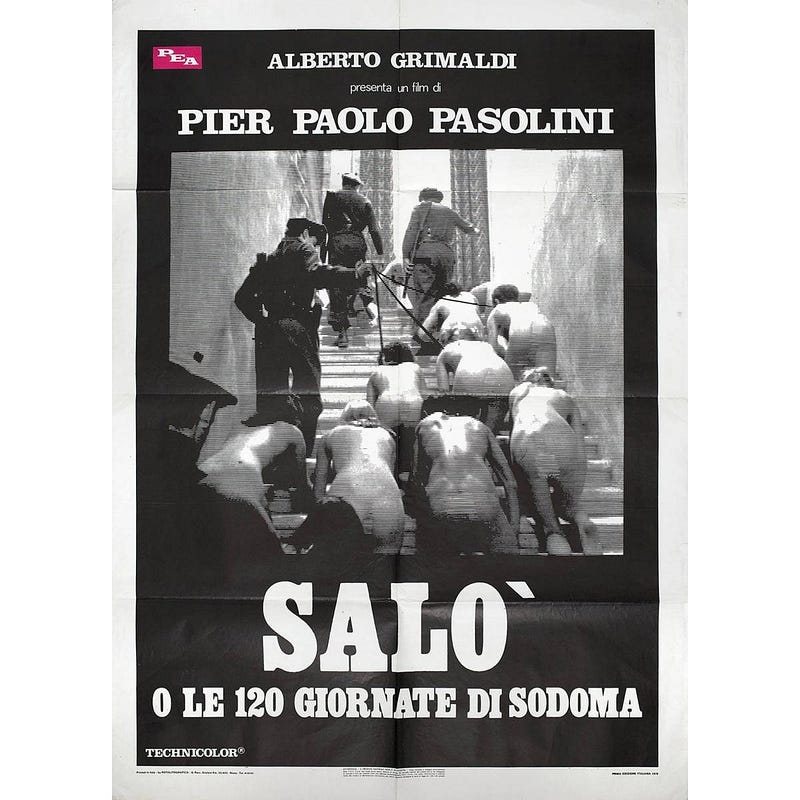
There are certain things we do in life out of a sense of duty, even though we know full well it’ll be unpleasant and give us recurring nightmares. Visiting tourist attractions like Auschwitz, Tuol Sleng Prison, Jallianwalla Bagh in Amristar, and Hiroshima’s A-bomb memorial fall into this category, as does reading books like Iris Chang’s The Rape of Nanking or Mein Kampf. Some take this to the extreme, like author and journalist Christopher Hitchens did when he willingly subjected himself to waterboarding so as to determine whether or not it constituted torture. (Spoiler alert: it did.)
There are other things we do that we know will disturb us to the core — not so much out of a sense of duty but out of a morbid sense of curiosity. Such was my longstanding fascination with Pier Pasolini’s controversial film Salò, or the 120 Days of Sodom, which I had never watched but I had read about with a combination of revulsion and fascination. Like a Canadian school child trying to decide whether or not to put his tongue on a frozen chain-link fence, I spent several year daring myself to watch it before finally steeling myself to the challenge one night.
After having watched the film — and processed it extensively — I was forced to the conclusion that this particular film might also belong in the first category, together with Iris Chang and Tuol Sleng.
First, a warning. Salò is every bit as shocking a film as film critics and historians have asserted. Far from a pleasant movie-watching experience, watching it is the cinematic equivalent to being voluntarily waterboarded, Hitch-style. It is one of the few films I’ve ever watched that made me feel physically sick, and it did result in several nights of disturbing dreams. But it also caused me to think very deep thoughts about topics that recent world events have caused me to focus much of my writing on, such as fascism, authoritarianism, and the human species’ capacity for cruelty — which was clearly the intended purpose of the film from the standpoint of the fascinating auteur behind it.
Pier Paolo Pasolini was a man far ahead of his time. This is of course said about a great many artistic visionaries to the point where it’s become a cliche, but in the case of the great postwar Italian cinematographer, man of letters, and all-around shit-disturber, this meant he was very much a fish out of water in his own time. A social and sexual nonconformist with complicated political views (He was a jaded communist who fell afoul of his ICP comrades over what he saw as their entrenched classism and Stalinist impulses.) as a painfully self-aware defender of the downtrodden (and connoisseur of cruelty), Pasolini probably would have felt right at home in the era of 4chan, incels, the dark web, #metoo, and President Donald Trump.
The more one persists in reading about Pasolini, the more one gets the picture of a millennial born who came of age in the wrong century. For one thing, he was an artist who refused to be contained by media at a time when jumping from cinema to philosophy to poetry to dramaturgy and back to cinema, all the while vacillating between straight-up politics and art for art’s sake, was a lot harder than it is today. It is easy to imagine P3 as a devotee of social media; were he alive today he would no doubt be hosting some extremely risqué podcast — part Marc Maron, part Dan Savage, part Killer Mike.
As for his macabre cinematic output — and his deeply disturbing swan-song statement Salò, or the 120 Days of Sodom in particular, it’s tempting to say that his oeuvre would barely raise an eyebrow in today’s jaded world, with its ubiquitous internet porn, ultra-violent video games, and no-privacy social media landscape. Tempting but wrong. At nearly 43 years of age (released within days of the director’s violent murder in November 1975), Salò is still quite possibly the most horrifying film ever made. Sure, there are plenty of subsequent films that outdo it in terms of graphic displays of sadism (A Serbian Film and the Human Centipede franchise spring to mind), but such films appear to exist merely to make audience members wretch on cue. Salò, by contrast, is a cinematic wrecking ball designed to demolish every single laudable thought any of us have ever had about ourselves, which it succeeds in doing — and as such remains more or less peerless.
No, Salò remains every bit as horrifying a spectacle as it must have seemed to its original 1975 audiences, when the film was almost immediately banned in most western countries. If anything, it’s an even harder film to watch now than it was at its inception, as many of the themes it grapples with feel all too close to the bone in 2018. Back in 1975, Salò could easily be written off as the perverted imaginings of a twisted creative mind. Our 2018 world, by contrast, is one in which casual threats of sexual sadism are a fact of life for any female, queer, or trans YouTuber, virtually every fetish imaginable is up for grabs on digital media, and the world’s most powerful man is a fascist libertine with a well-attested appetite for inflicting cruelty.
We are, in a very real sense, the Salò Generation, and Pasolini is our Cassandra speaking from the grave. As such, this extremely hard to watch cinematic allegory for fascism and the corruption of power is well worth watching. That said, it is a deeply unsettling film, one that will invariably (assuming you’re not a total monster) rattle you to the core, probably give you nightmares, and without doubt make you spend next however many weeks trying to process what you just watched. Suffice it to say, viewer discretion is STRONGLY advised.
Movies based on classic works of literature are rarely “better than the original” but Salò, always the anomaly, is very much an improvement on the Marquis de Sade’s dreadful 1785 novel The 120 Days of Sodom that inspired it. (I once tried to read the book but found it more laborious and convoluted than disturbing, and ended up putting aside out of frustration.) The original oeuvre does appear to be cut more from the Serbian Film cloth, a work of violent pornography designed purely to rattle uptight 18th century sensibilities — and little else.
There’s nothing political about the original book. The film, by contrast, is very much a social and political polemic, leveraging the Marquis’ original framework as an expose for the logical reductions of fascism and absolute power.
The film centres on a quartet of wealthy, corrupt elites in the erstwhile Republic of Salò (1943–1945), a Nazi puppet state in northeastern Italy (which also included parts of modern-day Croatia and Slovenia) that was Italy’s last fascist stronghold during World War II. The four libertines (identified simply as the Duke, the Bishop, the Magistrate, and the President) kidnap eighteen teenagers, who they proceed to subject to four months of increasingly violent and sadistic mental, physical, and sexual torture at a countryside chateau, while being egged on a trio of middle-aged prostitutes who recount tales of sexual depravity, which the protagonists act out on their prisoners. The four-part structure of the story (Anteinferno, Circle of Manias, Circle of Shit, and Circle of Blood) is an obvious nod to Dante’s Divine Comedy, which is arguably as important an influence on the film as Sade’s writings.
While the violence and sadism portrayed in the film is frighteningly brutal, the film’s capacity to disturb comes not so much from the violent acts themselves (By modern “torture porn” standards it’s not even that graphic.) but much more from the cinematography, the actors’ performances, the prolonged silences, and the juxtaposition of acts of unspeakable cruelty with scenes that succeed in being undeniably funny and unsettlingly cute and endearing. There is indeed a Pythonesque quality to Salò, with the four libertines analogous to malevolent Italian versions of the Upperclass Twit of the Year competitors — silly walks and all, with the parlour courtesans reminiscent of Carol Cleveland’s sexualized caricatures in the Flying Circus series.
Another aspect of Salò that makes the film especially disturbing is that it more or less forces the viewer to adopt the point of view of the abuser. Unlike the typical horror movie, where the audience member automatically sides with the victims, Pasolini makes this very difficult to do, both by making the child victims themselves remarkably hard to relate to — especially as the film progresses and the prisoners increasingly turn against one another in the hope of saving their own lives. From the outset to the end, the victims are completely stripped of their humanity, and the camera work itself reinforces this dehumanization, portraying them as completely interchangeable pieces of meat (with a few notable exceptions, when victims assert their humanity in striking fashions), and as a result the tortures meted out against them end up seeming trivial and even boring.
While the victims in the film are shells of human beings with little for the viewer to latch onto emotionally, the four libertines doing the abusing are fascinating paradoxes — at once terrifying exemplars of the corrosive nature of absolute power but also mundanely human figures who spend most of the film appearing bored and dissatisfied. (Arthur Schopenhauer’s famous quote about the two enemies of human happiness being “pain and boredom” seems particularly à propos in this film.) For men who enjoy absolute power over their human prey, the libertines never appear to be enjoying themselves — their infliction of cruelty more akin to the angry urges of an addict in withdrawal than of a person partaking in forbidden pleasures. Fun — even of a pathological sort — is completely absent in Salò, even among those who can quite literally do anything they want at any time.
The film does have one solitary moment of uplifting heroism in the form of an illicit affair between one of the chateau’s armed guards and a black servant girl, portrayed memorably by Eritrean-Italian actress Ines Pellegrini. The affair, which is all too quickly snuffed out by the four libertines, is the moment of the film where Pasolini’s personal politics come to the fore, in which two characters lay claim to the humanity that everyone else in the story has forfeited, if only for an instant. The end of the affair is perhaps the only emotionally satisfying moment in the film, in which the naked guard (Enzo) stoically raises a fist in a communist salute before being shot to death by his employers together with his erstwhile lover.
The rest is pure, unadulterated cruelty. The atrocities committed by the four libertines and their hired goons (a quartet of young male soldiers referred to as “studs” — supposedly handpicked based on the size of their male members) are as remarkable in their banality than in their cruelty, while the prisoners, when given ample opportunity to generate sympathy from the audience, spectacularly fail to do so. In the end, the film’s disturbingness stems from how thoroughly it dehumanizes the viewer, by inuring them to the victims’ suffering and making them question their own basic decency as human beings in the film’s aftermath. For several days after watching it I found myself questioning how I could possibly have sat through what I had just watched.
The main takeaway from Salò is that all of us possess the capacity to victimize. The collaborators, soldiers, and even some of the child victims themselves are walking testaments to the results of the Milgram experiment and other similar tests, as well as books like Christopher Browning’s Ordinary Men, which have demonstrated how frighteningly brittle the human conscience is in circumstances that promote cruel and inhumane behaviour. In Salò, the viewer finds him or herself enlisted among the ranks of the collaborators, and over the course of steadily ramped up savagery, ends up being a perfectly willing collaborator in the form of voyeur — just like the four libertines who conclude the film peering through binoculars at the hideous torture-execution of the select group of prisoners singled out for having displeased their masters in various ways. They are us, and we are them.
Why, then, would anybody willingly sit down to watch this shabby little shocker of a film? Salò is ultimately a morality play, a cartoon-caricature depiction of what fascism (or any form of totalitarianism) does to everyone involved, from its innocent victims to the powerful people at the top of the totem pole. The four libertines are not unlike most if not all authoritarian leaders in history in that their tyrannical impulses becoming increasingly untethered over time, starting out as moderate firm handedness and culminating in unmitigated cruelty. Of the 20th century’s most notorious despots — Hitler, Mao, Nicolae Ceaușescu, Saddam Hussein, Idi Amin, Robert Mugabe etc. — all became increasingly paranoid and tyrannical as time went by, while benefitting a steady supply of willing torturers and executioners. As such, Salò is the perfect microcosm for every despotic regime that has ever existed, or is likely to exist in the future.
Which brings me to the current occupant of 1600 Pennsylvania Avenue NW. Donald Trump has, as far as anybody knows, never forced his dinner guests to consume literal human excrement (although reading his Twitter feed often feels like that), nor has he force-fed nail-studded biscuits to young women or tortured anybody with knives or branding irons. However, his penchant for inflicting unnecessary cruelty on everybody from his political allies (think Chris Christie, Sean Spicer and others) to young children (there are obvious Salò parallels to be found in the White House’s current policies vis-à-vis children of undocumented immigrants).
Further, like Pasolini’s libertines, Trump’s mood generally vacillates between various shades of foul, even in the midst of gratifying his most base of political impulses. Has there ever before been an American president whose overall tone as Commander-in-Chief has been more negative? This is a leader for whom everything is a “witch hunt”, a “conspiracy” by the traffickers of “fake news”, and for whom a vast swath of human experience and circumstance is best captured by the adjective “sad”. Sad. There could be no better description of Pasolini’s swan song film than “sad” — Salò is effectively the sum total of everything “sad” about the human species. It’s also Donald Trump’s favourite adjective, with the possible exceptions of “huge” and “great”. Sad.
Sadly, ahem, Trump’s authoritarian impulses are far from unique in today’s world. Across the globe democracy is in retreat, and authoritarian leaders like Putin, Xi, Kim the Third, Erdoğan, Maduro, Duterte, Orbán, Prayuth, Hun Sen, and others are beginning to appear disturbingly normal. And Trump is not the only alleged democrat who’s been overseen treating such leaders like respectable statesmen. In April of this year, former Canadian prime minister Stephen Harper raised eyebrows both in Canada and abroad for offering congratulatory words to Hungarian president Viktor Orbán for his election victory, despite the latter’s systematic undermining of his country’s constitutional order and rule of law. We are normalizing these people, and while we remain (in most of the world at least) a long ways away from a return to Kolyma, Dachau, and Unit 731, these horror shows did not show up overnight, but rather as a result of slow, banal desensitization.
This is why Pasolini’s Salò still matters — perhaps now more than ever. It hits home the lessons of despotic governance and absolute power in the most tender spot in the human psyche — the abuse of children — and it does so in a way that no History Channel documentary on the rise and fall of the Third Reich ever could. History documentaries make for good history lesson content, but it’s still very easy to remain psychologically detached from it, even though Hitler’s victims were real living breathing human beings. By contrast, Salò, even though the victims are completely fictitious, is beyond chilling. We can’t help but see ourselves in the story, and NOT as the victims. Pasolini ensures this from start to finish.
If America, Canada, or whatever country you happen to be reading these words from do end up forfeiting the safeguards of democratic governance and opting for authoritarian rule, we will all have to own part of that. And unlike at the end of Salò, there will be no cute little dance at the end of said descent into fascism. And there will be no amiable Italian director to yell “cut” at the end.
Watch the film if you want. Or don’t. I won’t be held responsible for any recurring nightmares or days spent wallowing in a vague sense of hopelessness about the future of humanity that might result. It’s a very hard watching experience, but one, I suspect, that serves as a useful inoculation against any possible fascist contagion. In the absence of a proven inoculation against susceptibility to fascist ideas, Salò might be the closest thing on offer.