
The Cardinal Virtues of Stoicism
Four Pillars of Stoic Practice
Well-being is attained by little and little, and nevertheless is no little thing itself. — Zeno of Citium
The term Cardinal Virtues pops up quite frequently when you begin to read about Stoic Philosophy and whilst you may or may not already be familiar with the Cardinal Virtues of Stoicism, we wanted to highlight the importance of Virtue in the Stoic sense and how you could potentially put it into practice under the guise of the ancients who’ve already done so many moons ago.
The Stoics believe that virtue is the only key to true happiness…
To begin with, the virtues are one of the key pillars of Stoic practice, you will need to familiarise yourself with them if you wish to follow loosely in the footsteps of the ancients. Whilst we aren’t certain of the origin of the Virtues, it’s likely they date back to the time of Plato or even Socrates. Also, the Stoics regard virtue in general terms as living in harmony with Nature. Virtue or excellence (aretê) in the Stoic way, could be defined as a set of values or qualities that are integral to leading a good, and fulfilling life. The Stoics believe that virtue is the only key to true happiness, and they truly aspired to live a life free of passions, because they are ultimately a disturbance and detrimental to the soul. Their belief in rational emotional responses to situations, is bolstered by the constant accumulation of wisdom through experience and practice.
The Greek and Roman era Stoics in particular wrote at length about “appropriate acts” and “perfect acts” in relation to virtues. A person must have the correct understanding of the actions they have performed — more specifically, the person must construct a response with all the virtues in mind simultaneously. By using this definition of being virtuous, it could be argued that most people are not considered to be virtuous, as most people fail to constantly bear in mind ‘the laws of life as a whole’ in order to solve a specific problem.
I really like Prof. Chris Gill’s description concerning the topic of virtue:
…a form of expertise or skill, knowledge how to live well in every way, a form of knowledge that shapes the whole personality and life.
Part of the reason we’re writing this article stems from a conversation I had with someone about living a life according to virtue derived around the principle of living in “accordance with nature or reason” as mentioned above. I found that this individual had been looking at Stoicism for guidance and perhaps ultimately as a way of living. When confronted with this question, I gave the answer that it’s entirely up to you.
Stoicism by design is a Philosophy of life, and its teachings are not set in stone. You don’t need to treat it as a diktat (for lack of a better term). You can still potter around with the ethical boundaries of Stoicism without following its core teachings to the letter, especially where physics is concerned (a lot has been discovered since the late era Roman Stoics were kicking around).
If I can touch on my practice briefly, I tend to use the core virtues as a moral code so to speak, a reminder of committing to them when I can, and in that respect, they have formed the outer sphere of how to choose to operate in my daily life. As I don’t follow a religious path, they’ve become my go-to guide when I fall short, and especially where I could have chosen to do better in certain areas. Whether that’s working, dealing with relationships, or personal etiquette. Having a physical or visual reminder of the cardinal virtues around me, definitely helps me keep tabs on how I’m choosing to live daily.
If you’re interested in how I practice the virtues myself and indeed my associated shortcomings in living with them, I recently did an interview with What is Stoicism? Where I talk at length about Stoic practice in general.
Defining the Virtues
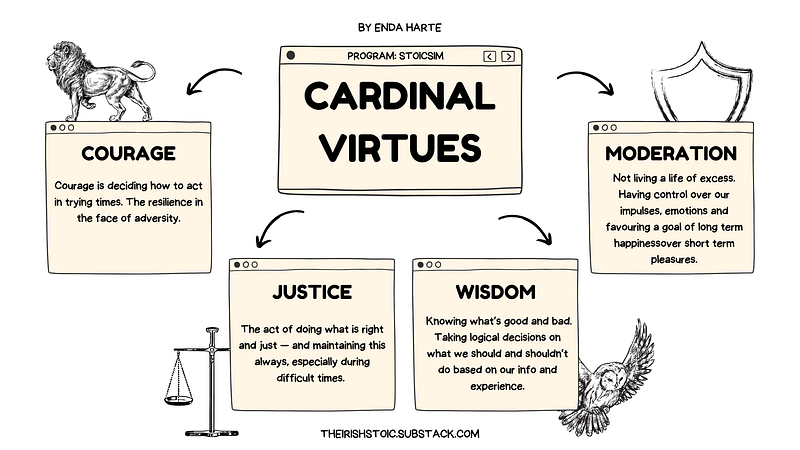
So… if you’re not familiar with the core virtues, what are they, and how can they be defined? The Stoics elaborated by creating a taxonomy for virtue, dividing it into four main types:
*The Greek wording is difficult to fully translate into English and has been open to much speculation, however this is as good a place as any to start to understanding their meaning.
phronêsis (prudence/practical wisdom): The knowledge of knowing what’s good and bad. Taking logical decisions on what we should and shouldn’t do based on our knowledge and experience.
dikaiosunê (justice/morality): The act of doing what is right and just — and maintaining this always, especially during difficult times. This idea of justice is about doing right by your community and how we act around others in accordance with the law. From a Stoic standpoint, justice is a duty to others around us and should guide decisions, especially through tumultuous times.
andreia (fortitude/courage): Courage is deciding how to act in trying times. Despite what many think, it is not the absence of anxieties and fears, but the way someone acts despite their anxiety and fear. The resilience in the face of adversity.
sôphrosunê (temperance/moderation): Relates to moderation in every aspect of life. Not living a life of excess, having control over our impulses, emotions (good and bad), and favouring a goal of long term happiness and contentment over short term pleasures.
My friend and renowned Stoic writer, Donald Robertson, describes these as a Stoic code of honour in his writings, in that we should ultimately believe that doing what is right is in our own best interests because it allows us to flourish as human beings. He separates the virtues into four easy to remember categories based on the original descriptions:
Love the truth and seek wisdom Act with justice, fairness, and kindness toward others Master your fears and be courageous Master your desires and live with self-discipline
Stoics on the Life of Virtue
The Stoics and their contemporaries wrote quite a bit about the subject and were quick to bring up the idea of reminding oneself of role models, because virtue cannot be learned just by way of theory, it requires tangible example and practice.
I’ll begin with Cicero’s De Inventione, and even though the statesman wasn’t exclusively a “Stoic” in the traditional sense, nonetheless he’s a contemporary source for Stoic practice and writings. Below, he provides a fairly concise description of the virtues as a “habit of the mind”.
Virtue is a habit of the mind, consistent with nature, and moderation, and reason. … It has then four divisions — prudence, justice, fortitude, and temperance. Prudence is the knowledge of things which are good, or bad, or neither good nor bad. … Justice is a habit of the mind which attributes its proper dignity to everything, preserving a due regard to the general welfare. … Fortitude [i.e., courage] is a deliberate encountering of danger and enduring of labour. … [And] temperance is the form and well-regulated dominion of reason over lust and other improper affections of the mind.
Marcus Aurelius, who was emperor of Rome and an avid surveyor of Stoicism for the majority of his life, at the time writes in his journal:
When you wish to delight yourself, think of the virtues of those who live with you; for instance, the activity of one, the modesty of another, the liberality of a third, and some other good quality of a fourth. For nothing delights so much as the examples of the virtues when they are exhibited in the morals of those who live with us and present themselves in abundance, as far as is possible.
Epictetus who was once a slave and upon gaining his freedom began teaching Philosophy exclusively said:
If virtue promises happiness, prosperity and peace, then progress in virtue is progress in each of these for to whatever point the perfection of anything brings us, progress is always an approach toward it.
When asked by a student what words of wisdom would help a person thrive (in relation to living by courage) he said:
Two words should be committed to memory and obeyed by alternately exhorting and restraining ourselves, words that ensure we lead a mainly blameless and untroubled life: persist and resist.
Virtue, according to Seneca the Younger, the Roman statesman and advisor to the incredibly loathsome Emperor Nero, were about how you lead your life — it’s a practical and theoretical aspect of philosophy. Virtue was about living according to reason.
Virtue depends partly upon training and partly upon practice; you must learn first, and then strengthen your learning by action. If this be true, not only do the doctrines of wisdom help us but the precepts also, which check and banish our emotions by a sort of official decree.
Putting the Virtues into Practice
If after this explanation of the virtues you feel like this fits in with your current mode of operating, or you’re in need of a code to follow, then one thing I can suggest is creating a sequence internally where you ask yourself the next time you’re faced with a decision — “am I undertaking this with the Cardinal Virtues in mind?” or “is this decision, Wise, Just, Courageous or with Moderation as the end goal”. Obviously, it is completely dependent on the situation you find yourself in and subject to constant practice.
If in your daily life you find yourself struggling to remind yourself about these phrases, one way you can implement them into your life and permeate the virtues into your psyche is by using tokens in the form of challenge cards, coins, or visual elements like a poster or framed photo in order to give you a constant reminder of the virtues and can encourage you to coincide with following their traits.

Some modern practitioners, myself included, take part in small acts of self-restraint which, in a way, can help us prepare for adversities or increase our discipline and gratitude for what we currently have without seeking more. This includes foregoing certain pleasures if you are fortunate enough to have them in the first place, like:
- Sleeping on the floor for a night with a light blanket as coverage (as Marcus Aurelius is noted to have in his adolescence).
- Eating minimally for a week and not feasting on anything but what is necessary for your daily sustenance (Musonius Rufus discussed his primarily vegetarian diet and anything beyond this was just not relevant).
- For me, it’s something as simple going to the gym or martial arts training in the wee hours of the morning, just to prove I have the discipline and self-restraint not to lie in bed and start the day with purpose.
When we mention these practices, start with something attainable and be mindful of what you choose to undertake, you don’t need to go all Diogenes of Sinope on us.
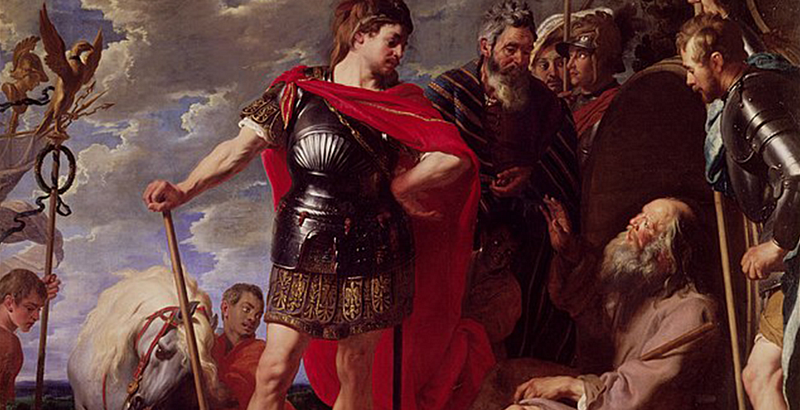
The Stoic teacher Musonius Rufus once gave advice to a Syrian King. He argued that it is a King’s duty to, “possess self-control, frugality, modesty, courage, wisdom, magnanimity”, and he believed that the only way to effectively practice these virtues was to study philosophy. The King wanted to express gratitude for this advice and offered Musonius Rufus anything he wanted, the only thing Musonius Rufus asked for was assurance that the King would abide by these virtues.
I’ll leave you with the words from the Philosopher king in own personal journal on the very subject which I find particularly comforting:
If, at some point in your life, you should come across anything better than justice, prudence, self-control, courage — than a mind satisfied that it has succeeded in enabling you to act rationally, and satisfied to accept what’s beyond its control, and if you find anything better than that, embrace it without reservations, it must be an extraordinary thing indeed, enjoy it to the full.
But if nothing presents itself that’s superior to the spirit that lives within — the one that has subordinated individual desires to itself, that discriminates among impressions, that has broken free of physical temptations, and subordinated itself to the gods, and looks out for human beings’ welfare — if you find that there’s nothing more important or valuable than that, then don’t make room for anything but it.
- Marcus Aurelius, The Meditations
If it’s sufficient for an emperor of Rome to live by these virtues, then it’s surely worth a try for all of us. At the end of the day, the virtues of the Stoics are the key to how we live happy and free lives. The Stoics ultimately shun complexity and worship simplicity as a key to living well.


