
The Calm Before the Storm
Thoughts on the political and social mess we are in
1. To hell in a handbasket…
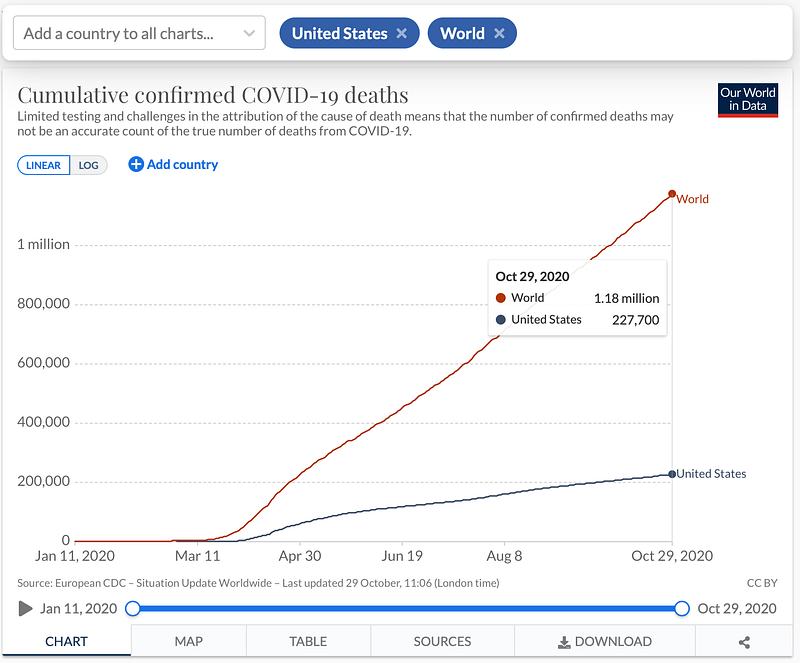
The world is going to hell. We no longer have politicians who view leadership as embracing personal hardships and sacrifice in order to serve the people. Instead we have a deeply selfish president who doesn’t care about the office he holds, his responsibilities for governing, or the people. And we have his supporters who share his lack of concern, empathy, and humanity. Such people value their own supposed personal freedoms and conveniences over the lives of their family, friends, neighbors, and broader community. With less than 5% of the world’s population, we Americans claim almost 20% of the world’s 1.18 million COVID-19 deaths. This president and his supporters have Made America Hell, not great.
Do we caring humans throw in the towel? Bury our head in the sand and wish the badness away? Wring our hands and pace the track on our rugs? Curl up into a fetal ball and suck both thumbs at once?
Are we made of such flimsy stuff?
Hell no!
We go out and vote, even for an imperfect candidate like Biden, to remove an even greater threat to our lives like Trump. And we help friends and strangers to vote as well.
2. Life is hard…
The world has always been a hard place to live in. Humans and monkeys have an innate fear of snakes, suggesting that these limbless animals slaughtered our ancestors enough to exert an evolutionary pressure — to build in us a deeply instinctual fear of them.
The same goes for our innate fear of human strangers. People in ancient times who lacked a fear of strangers probably didn’t pass their carefree genes onto us. Instead, those ancestors who harbored an innate distrust of strangers survived to pass along their genes. Their fear. Their distrust. This tells us that life has always been brutal and hard. And that we humans have always been at the root of that brutality, and have been the unnatural selectors behind our own evolution, behind our instinctual fears.
Seemingly in contradiction to that distrust, we have also inherited a profoundly social nature and scientists are beginning to understand the genetics of this core human trait. Our ancestors survived because they built a broader social network, beyond the nuclear family, within the tribe (and eventually between neighboring tribes). Those who were unable to form such social bonds did not survive.
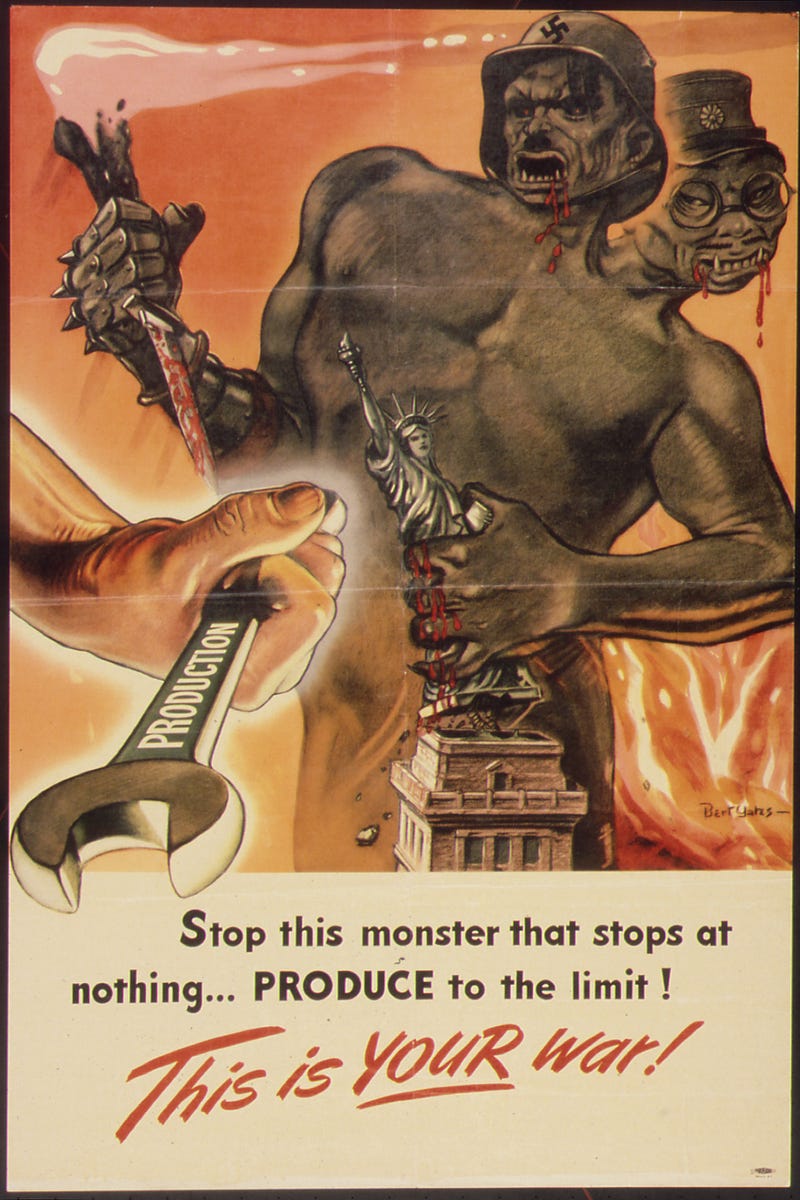
But an innate desire to cluster into tribes was insufficient for the broader success of humans — against other humans. Humans thrived if they could harness both the social/tribal instinct and the contradictory fear of strangers (humans outside of a defined society) — while also dampening that same fear of other strangers (humans within that society). We demonize our enemies during war, which graphically shows how we harness that innate fear of foreign strangers to force a closer bonding with our fellow-citizen strangers — so that together we will fight and kill the enemy.
These contradictory humans and their societies thrived beyond all imaginings. Today those same contradictory humans excel at things like building skyscrapers, national art galleries, moon landings, megalopolises, and, well… genocide and total war. Immense accomplishments no individual could achieve alone.
The first cities, perhaps Eridu in Sumeria, or Damascus, or as my 7th grade son just informed me — Mohenjo-daro in the Indus valley… these must have seemed like an alien hive of scum and villainy to those hunter-gatherers still out in the steppes and plains of the Neolithic age. The slanders in the bible against Sodom and Gomorrah (which still echo today) reflect that ancient hatred of cities. But those cities were also the first metastasizing cells of our success.
Those ancient cities were a contradiction between our social/tribal instincts and our fears of strangers, since one could not know everyone within a city. Yet cities (despite all the problems they engender like stresses and diseases caused by crowding) demonstrated the benefits of straddling that contradiction — by counteracting the brutality of life.
3. An antidote to Life…
Ancient humans and societies built additional tools for dealing with this brutal life.
Religions and philosophies helped ancient humans make sense of this senseless life, to care and hope despite an uncaring universe. Evidence suggests religious and philosophical thought must have predated cities, and even modern humans, since we’ve found intricate burials with valued items dating to at least the Neanderthals. Controversially, we think a deeply inaccessible chamber in the Rising Star cave system in South Africa might be the burial grounds of Homo naledi who lived between 2 to 4 million years ago. Chimpanzees perform a rain dance — do the roots of religion extend so far back in time to the common ancestor of humans and chimps?
Although religious feelings probably have deep roots in our hominid lineage, the advent of cities probably ramped up the pressure to refine, domesticate, and supercharge religions. There had to be a mechanism to justify and homogenize the individual members of a society, to forge individuals into a more cohesive entity.
There is no doubt that the earliest leaders first leaned on brute force, extortion, and bribery to hold a society together. We see such primitive “strongman” behavior in our president today here in America, and in many third-world totalitarian countries like North Korea and other failed states, as well as in criminal organizations and gangs like the Mafia. They exemplify the ancient and reptilian drive to use force as a primary political tool.

While Hitler and Stalin and Mao all demonstrated the efficacy of brutality and intimidation in controlling vast swathes of population, even the dullest strongman usually quickly recognizes the limits of pure strength as a political tool.
An infinitely more refined and efficient political tool is religion.
The close alliance between political power and religion is evident in every ancient society we are aware of. Despite the cynical aphorism that religion is the opiate of the masses, religion clearly brings something useful to the table.
Karl Marx, who first made that opiate statement (that we all misuse today), used the opiate analogy to suggest the usefulness and effectiveness of religion to dull the pain of life. The full quote is:
“Religion is the sigh of the oppressed creature, the heart of a heartless world, and the soul of soulless conditions. It is the opium of the people.” — Karl Marx
Marx was not saying, as we imply when we use the phrase today, that religion is a tool cynically employed by the political elite to pacify a restless, uneducated, and ignorant polity (though that may be more or less true depending on the state and political players). Marx, instead, acknowledged that life was painful, and that religion helped people to get through life. Marx did have concerns about the dulling effects of religion, but nonetheless, he gave religion its due.
Science is far better equipped to answer most of the fundamental questions that religion tried to provide about the world (no, it was not six days and a breather on the seventh). But science did not, does not, and cannot answer any of the moral and ethical questions. In fact, scientists do no better than any other group of people in self-policing moral and ethical behavior. There is no built-in compass within science by which to formulate satisfactory moral and ethical frameworks. Witness the scientists who conducted the horrific syphilis study on black Americans without their subject’s knowledge or consent. The almost unanimous backing of eugenics among scientists of the day.
Religion, on the other hand, was a natural vehicle for disseminating moral and ethical principles. That does not mean, however, that religion is necessary for that purpose. Philosophy as a discipline suffices for a comprehensive discussion of the proper individual and social rules of conduct.
4. Duuudism…
Philosophy huh? I ain’t a philosopher. But let me propose a new philosophy. One we can call Duuudism. And Duuudism is summarized as:
Life is hard. But duuudes have to act, and make imperfect choices for the greater good, for our fellow duuudes.
“Duuude”, in this construct, is an omni-sex, omni-age, omni-race, omni-religion, even omni-species pronoun. Duuudes, we are all Duuudes.
While I like the sounds of that all-inclusive, life-affirming acceptance, there is something squishy and hollow and unsatisfactory in that. Each of us are unique and individual duuudes, and each of us desires acknowledgement of that uniqueness. We don’t want to be known as ant #13,356,785,344 in colony #465De546A. There is an important contradiction here — that we want the fairness inherent in each of us being treated equally, but desire the recognition of being unique. Each of us has talents (and weaknesses) that separate us from our neighbor.
We hold these truths to be self-evident, that all duuudes are created equal, that they are endowed by their Creator with certain unalienable Rights, that among these are Life, Liberty and the pursuit of Happiness.
Despite the flaws inherent in our founding fathers (white duuudes who kept black duuudes as slaves) they wrote a fundamentally beautiful and aspirational document in the Declaration of Independence. This short, fiery statement acknowledged the broader equality due to all people (though they named only men, and probably intended to only mean propertied white men), while also acknowledging our uniqueness in our individual pursuits of Life, Liberty and Happiness.
But what compelled these wealthy, propertied, white duuudes to write such lines? They were unhappy. Life was hard. They were being brutalized by other duuudes. The first lines of the Declaration of Independence hints at their discontents:
When in the Course of human events it becomes necessary for one people to dissolve the political bands which have connected them with another and to assume among the powers of the earth, the separate and equal station to which the Laws of Nature and of Nature’s God entitle them, a decent respect to the opinions of mankind requires that they should declare the causes which impel them to the separation.
The founding fathers then enumerated their grievances with the King of England through the long middle section of this document.
And they closed with their declaration, and their actions:
We, therefore, the Representatives of the united States of America, in General Congress, Assembled, appealing to the Supreme Judge of the world for the rectitude of our intentions, do, in the Name, and by Authority of the good People of these Colonies, solemnly publish and declare, That these united Colonies are, and of Right ought to be Free and Independent States, that they are Absolved from all Allegiance to the British Crown, and that all political connection between them and the State of Great Britain, is and ought to be totally dissolved; and that as Free and Independent States, they have full Power to levy War, conclude Peace, contract Alliances, establish Commerce, and to do all other Acts and Things which Independent States may of right do. — And for the support of this Declaration, with a firm reliance on the protection of Divine Providence, we mutually pledge to each other our Lives, our Fortunes, and our sacred Honor.
Life is hard. Duuudes seeks to dominate, subjugate, and kill other duuudes. Humans, men and women and those of the full sexual spectrum between, of all races, of all ages, seek to dominate and brutalize the lives of other humans. Life is hard.
Survival and happiness require effort, thought, and action. All demonstrated by the founding fathers in their revolution from England, their Declaration of Independence, and their living document the Constitution of the United States.
The most fundamental right that our founding fathers sacrificed their lives for, was the right of representation, and ultimately our voices in government through voting.
The single most important point of being active and voting, is that the decisions and people we vote for may not be optimal, perfect, ideal, or even what we want.
But we are adults. We know not everything can be exactly as we want, or even close to what we want. But we, as adults, make hard choices, and do our duty nonetheless. That duty may go up to and include giving our lives for the rights of others. But here, today, we are not asking for a life. We are asking for each of us to swallow a little unpleasantness if necessary, and to just go and vote.
Life is hard. But we have to act, and make imperfect choices for the greater good.
Joe Biden is no more perfect than any of our founding fathers.
But each and every one of us is duty bound to go and vote for him, and to remove the far more imperfect, dangerous, and autocratic person who is currently sitting in the chair of the President of the United States.
That is the philosophy of Duuudism.
Get out there and vote, duuudes! And help your fellow duuudes to do the same.


