
Film Review
The Caine Mutiny Court-Martial (2023) — Kiefer Sutherland rivals Bogart in William Friedkin’s final film
A naval officer stands trial for mutiny after taking command from a ship’s captain he felt was acting in an unstable way…
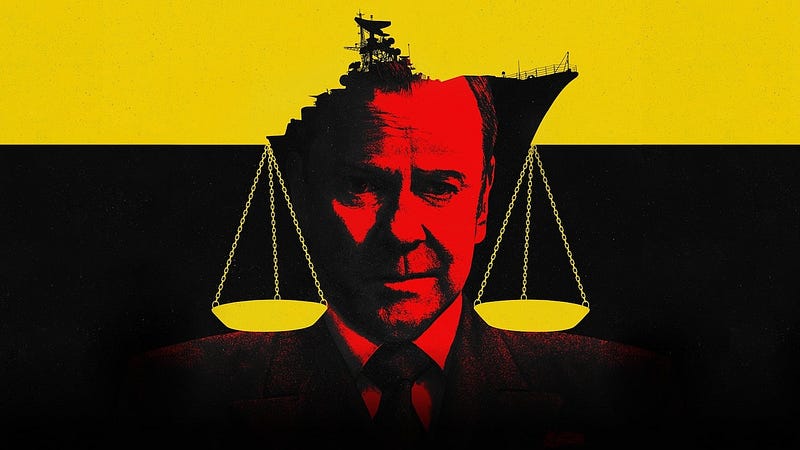


Herman Wouk’s 1951 novel The Caine Mutiny has been adapted for cinema and TV at least ten times, but the best-known version by far remains Edward Dmytryk’s of 1954, with Humphrey Bogart delivering one of his most memorable performances as the insecure, neurotic Captain Queeg.
William Friedkin’s final film, which premiered at the Venice International Film Festival in September 2023 shortly after his death, follows Robert Altman’s 1988 made-for-TV version and many other adaptations by technically adapting not the novel itself but Wouk’s own stage version. It thus omits the shipboard sequences prominent in Dmytryk’s film, instead concentrating on the legal drama that unfolds after one of Captain Queeg’s officers relieves him of his command and is accused of mutiny.
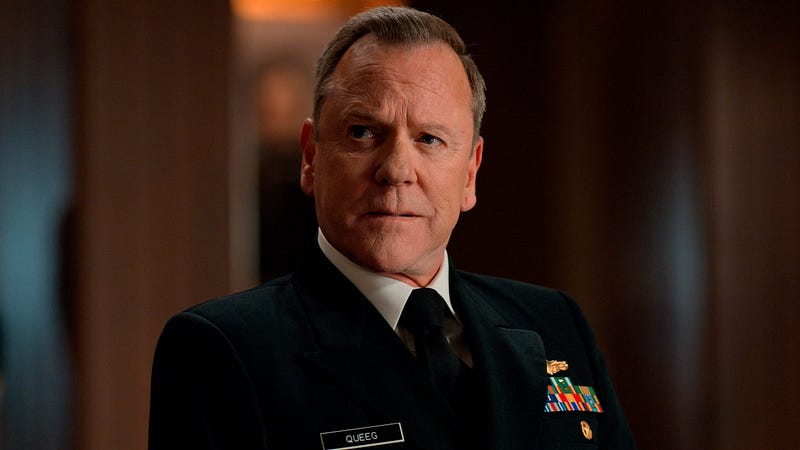
The 1954 film casts an unavoidable shadow over Friedkin’s version, and comparisons between Kiefer Sutherland and his predecessor Bogart are equally inevitable. But Sutherland emerges from this comparison admirably, reflecting an inspired casting choice. Though the newer film perhaps lacks the dramatic breadth of its ancestor, with a narrower narrative focus and tighter spatial constraints, it compensates with equally strong performances and an inherently gripping storyline.
Friedkin dispenses with any kind of introduction: martial drumming on the soundtrack, a shot of US Navy headquarters in San Francisco, and then a close-up on a row of naval officers’ caps. We’re in the room within a minute and barely leave it thereafter.
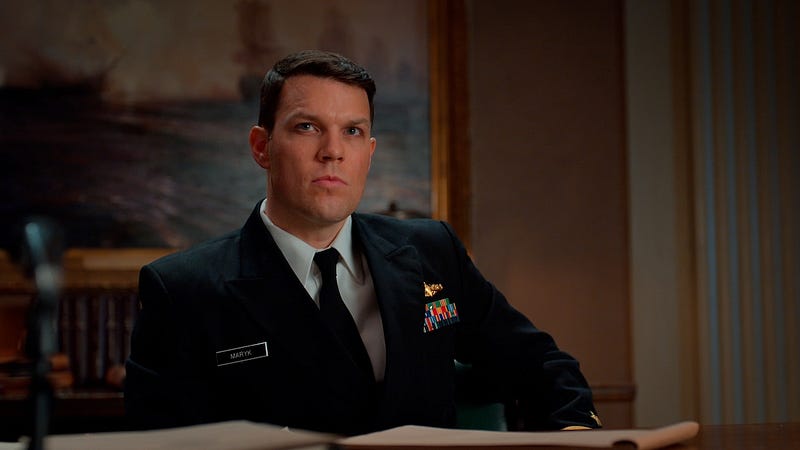
Lieutenant Maryk (Jake Lacy) is on trial. The basic facts are undisputed: while in the Persian Gulf as executive officer (second-in-command) of the minesweeper USS Caine, he took over command from Captain Queeg after a disagreement on how best to evade bad weather. The question is whether he had sufficient justification under naval law to relieve an incompetent commander, or whether his actions constituted a mutiny. An expert witness notes that “panic is a common hazard at sea”, but who panicked to a point that endangered the Caine — Lieutenant Maryk, or Captain Queeg?
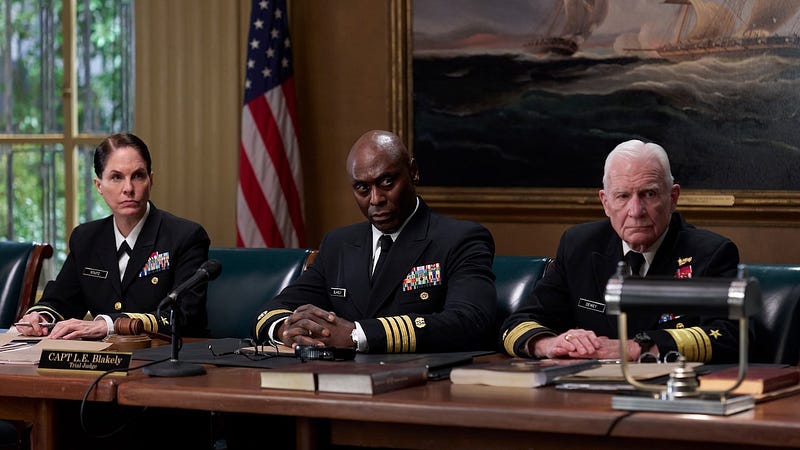
Lieutenant Greenwald (Jason Clarke), Maryk’s lawyer, initially takes a backseat, allowing the prosecutor Lieutenant Commander Challee (Monica Raymund) to dominate the proceedings. Greenwald reluctantly took the case at the last minute, and his defence strategy remains unclear. Captain Blakely (Lance Reddick), the head judge, even queries Maryk’s confidence in his lawyer. But when Queeg himself takes the stand, it becomes apparent that the defence aims to lure the captain into revealing his own instability, thereby proving Maryk’s takeover of the ship justified.
As the court witnesses Queeg’s petty obsessions and vindictiveness over a damaged coffee machine, missing strawberries, and similar trivial matters, the trial of Maryk transforms into a trial of the captain himself. Queeg’s growing paranoia, culminating in his outburst about being “one man against the whole ship” facing an “outright conspiracy”, leaves little doubt: Maryk’s acquittal seems assured, a direct consequence of Queeg’s self-unraveling.
With no action in the traditional sense — almost everything happens within the confines of a single room where characters barely leave their seats — the film’s success hinges entirely on the screenplay and the performances. Friedkin doesn’t waste effort on unnecessary visuals, wisely keeping the camera trained on the speaker (or, in rare instances, on telling details like the steel balls Queeg plays with to calm his nerves). The lack of visual flourishes becomes its own strength, forcing the audience to hang on every word.
My prediction last year that the female lead in The Caine Mutiny Court-Martial would be relatively unimportant turns out to have been wrong. Raymund’s Challee (a role originally written by Wouk as male) seizes the spotlight almost as much as Sutherland’s Queeg and, for most of the movie, eclipses Greenwald and Maryk despite the defence side being the nominal focus.
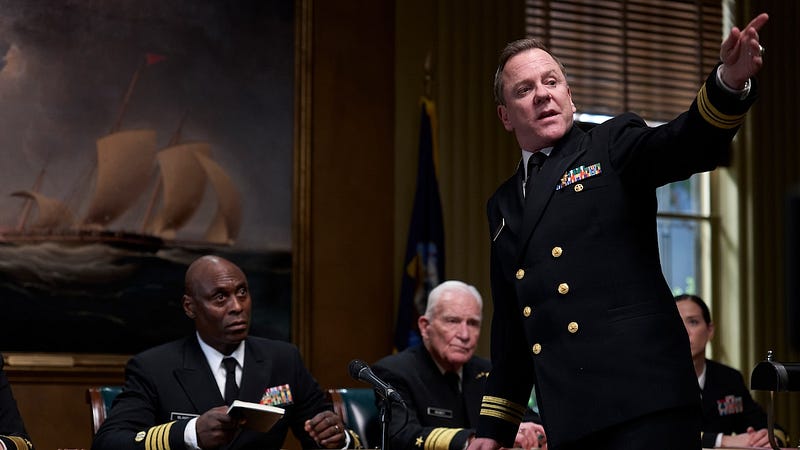
Raymund excels, not least in her ability to keep us guessing at the authenticity of her righteous anger. Clarke as Greenwald delivers a mostly reserved performance by comparison, making his forceful moments all the more impactful. The late Lance Reddick, to whom the film is dedicated, shines with his usual commanding presence. Jay Duplass, fresh off his notable performance in Netflix’s Pain Hustlers (2023), also stands out as a deceptively mild-mannered doctor whose courtroom arrogance sparks a clash with Greenwald. And while some woodenness is evident in the minor roles, that could likely be expected from junior military personnel appearing before a court.
Sutherland’s bravura performance is clearly modelled on Bogart’s, something possibly encouraged by Friedkin, a fervent Bogart admirer who even based the character of Scanlon in Sorcerer (1977) on Bogart’s Dobbs in The Treasure of the Sierra Madre (1948). One is tempted to say Sutherland matches his predecessor’s brilliance. He skilfully holds back, revealing Queeg’s shaky mental state subtly at first: a stutter, a nervous chuckle, a flash of anger, aimless thumb-twiddling. This build-up makes the later scene where Queeg’s warped worldview comes crashing out all the more powerful. Theatrical, yes, but a tour de force nonetheless.
A few things don’t quite convince. While Friedkin updates events to the present day, the title of the novel written by Lieutenant Keefer (Lewis Pullman) — Multitudes, Multitudes — still has a distinctly 1940s/1950s feel, which clashes with its supposed 2020s publication date.
The psychiatry also feels somewhat outdated, and the postscript sequence at a party featuring Greenwald’s unexpected sermon has always struck me as rather tacked-on. As with the title of Keefer’s novel, the scene resonates far more authentically in a mid-20th-century setting than today’s. Greenwald is speaking up for those committed to long-term military service rather than short-timers, but conscription no longer exists within the US military of the 2020s. All service members, at least ostensibly, commit to career paths.
Despite this anachronism, the scene wields considerable dramatic power by prompting the audience to consider whether they should really have taken such pleasure in Queeg’s downfall. Sympathy, rather than scorn, is arguably the more appropriate response.
Capping off a directorial career spanning nearly six decades, The Caine Mutiny Court-Martial may not be remembered as one of Friedkin’s major works, but it sits comfortably inside his oeuvre. While the prominence given to the female character of Challee is unusual, the meticulous focus on the intricacies of (primarily) male professions remains quintessentially Friedkin — few films delve so deeply into the minutiae of wind direction. Similarly, his straightforward, unvarnished directorial style is a hallmark. This isn’t his first foray into courtroom dramas (he tackled Rules of Engagement in 2000 and a 1997 TV adaptation of 12 Angry Men), and his dedication to this genre is palpable. “I’m drawn to people thrust together in tense situations, with no escape,” he once remarked.
While The Caine Mutiny Court-Martial might not dazzle to the same degree as two other recent and acclaimed courtroom movies, Alice Diop’s Saint Omer (2022) and Justine Triet’s Anatomy of a Fall (2023), it’s more than just a historical footnote for Friedkin fans. This well-made courtroom drama captivates from start to finish, and Sutherland’s portrayal of Captain Queeg offers a compelling challenge to the notion that Bogart’s is definitive.
USA | 2023 | 108 MINUTES | 1.78:1 | COLOUR | ENGLISH

Cast & Crew
director: William Friedkin. writer: William Friedkin (based on the novel and play by Herman Wouk). starring: Kiefer Sutherland, Jason Clarke, Jake Lacy, Monica Raymund & Lance Reddick.

Originally published at https://www.framerated.co.uk on January 8, 2024. All copyrighted images come under Fair Use doctrine in US & UK law.