
The Butcher’s End
A personal reflection on Sketch-Up Economics.
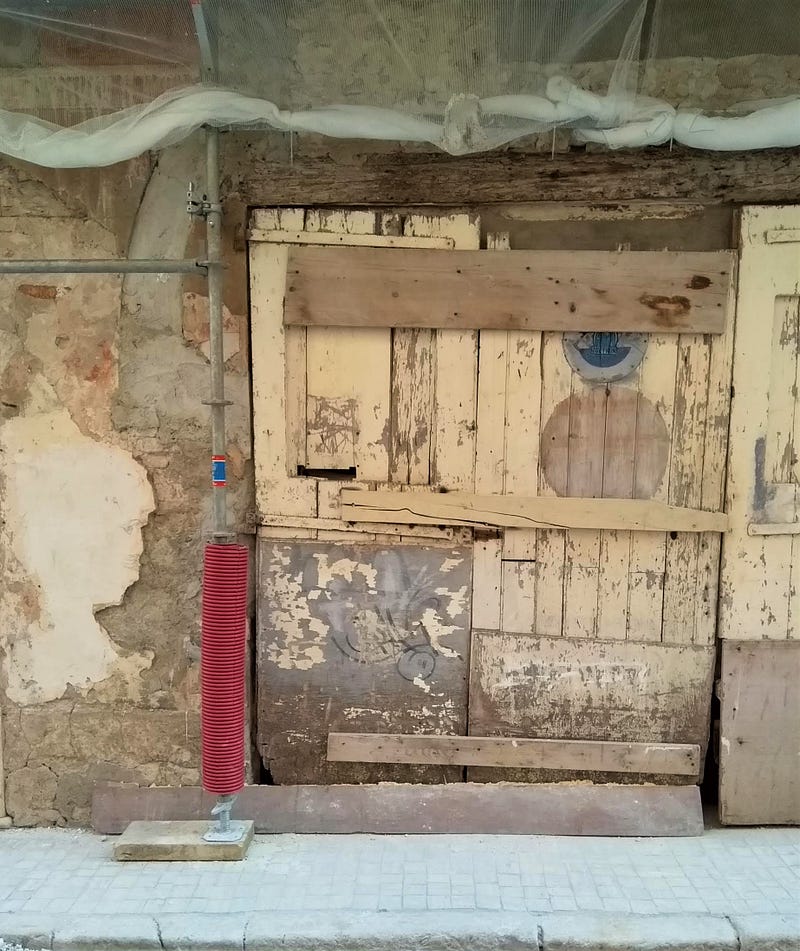
The building opposite my studio is finally having a facelift.
Scaffolding is netted in, and I write to the background music of chisel on cement and falling debris.
The owner has been defending his right to keep the patchwork of painted panelling that has served as a double door to the 16th century building since it was a butcher’s shop — (way back in the mists of time, o Reader!) for years.
It is, after all, an authentic work of art — in his eyes and in mine.
Also, apparently, in the eyes of the tourists who often stop to photograph the faded, but still legible stencilled letters: BOUCHERIE. They stop to marvel at the lump of plaster — just hanging on and shaped into the profile of a woman by our local Banksy. When the arch of Jasmine perfumes the area in April, the street resembles Platform 9 and ¾ at Kings Cross Station, London — people queue for hours to be immortalised in front of this piece of history!
No more. Today the bureaucrats have won.
It is a sad day.
Why does progress and modernism have to look uniform — plastic — designed on Sketch Up??
Why do picturesque tourist haunts insist upon modelling themselves on the ubiquitous Shopping Centre out of town?
This is not a rant against the shock of the new — rather a dispassionate observation that, in my experience, it is precisely the flaws in an otherwise beautiful environment that create interest and highlight the good bits.
If economics is driving this relentless need to make towns and cities interchangeable and they spend money on making them more sustainable — great! If having a facelift creates more comfortable, insulated and therefore cheaper accommodation for locals — bring it on. Hang the shabby chic!
If economics is driving this because of the belief that slapping a coat of beige paint onto a distressed façade will bring in more paying customers — I say: “Stop right now!”.
If people want shopping centres — let them shop in any one of the Malls that surround most towns and cities worldwide these days.
And when they look for beauty in their lives — old stone, wobbly windows, cobbled streets and worn-in facades…or concrete Brutalism — attractive in its starkness — let them find it in their town centres. If there must be tangible progress (and there must!) — remove the belching cars and introduce free public transport.
Now there’s a thought!
I can guarantee that crowds will flock to the authentic — and that they will return, often to a place that allows them to dream and to breathe. They will come back to a place that isn’t already “perfect”, finished — someone else’s dream realised.
People are already well served with little boxes, on a hillside, made of ticky-tacky in most developed countries.
If economics is driving this, my experience is that returns come from giving — or at least, leaving well alone — because if it ain’t broke — why fix it?