avatarOmneya El Sawaf

Free AI web copilot to create summaries, insights and extended knowledge, download it at here

1269

Abstract

">1. Distractions List</h2><p id="2944">I don't remember the origin of this trick, but a friend mentioned it earlier, and it helped. I know that the most amazing inspirations just occur at the moment of trying to work on something else.</p><p id="9402">Did you have an awesome perspective for a new story? Would you like to explore the global warming effect on your daily mood? What about that mesmerizing picture that caught your attention on Instagram, should you travel there next time?</p><p id="25be">Write all of these down! Keep a paper & a pen, and write every random thought that may cross your mind and you are afraid to lose, for later exploration. Then divert back your attention to the mission at hand.</p><h2 id="2293">2. Mental Inventory (Bujo)</h2><p id="de73">If you are in a busy part of your life, you may have a lot of things going on in your mind, sapping your energy. The Mental Inventory is a tool I got from the Bullet Journal method, that is better suited for big-picture planning. All you have to do is get a paper (again!), divide it into 3 columns with the following titles: things you are working on, should be working on, and want to work on.</p><p id="878e">This will give you an overview of all the things that have been roaming in y

Options

our mind, and about their actual value.</p><h2 id="6b15">3. Eisenhower Matrix (All that glitters is not gold)</h2><p id="ec90">Swamped again with tasks? Try this matrix to sort all the tasks you have, or you think you have to do, assessing them on 2 metrics: urgency and importance.</p><figure id="e73d"><img src="https://cdn-images-1.readmedium.com/v2/resize:fit:800/1*ShGCusD4AccwYwuQrZ_sjg.png"><figcaption>Screenshot By Author</figcaption></figure><p id="1ae3">You will end up with 4 kinds of tasks:</p><ol><li><i>Urgent & Important</i>: Should be prioritized to work on.</li><li><i>Urgent but Not Important</i>: Try delegating it to someone else.</li><li><i>Important but Not Urgent</i>: Schedule for later, but don’t ignore or they will move to the Urgent/Important quadrant, and haunt you forever!</li><li><i>Not Urgent and Not Important</i>: Why are they on your mind in the first place? Delete them!</li></ol><h2 id="44c2">Digital or Pen & Paper?</h2><p id="74f6">This is a question that has been without a definite answer for years now. I use both, but usually, pen & paper to avoid being distracted by more digital notifications, I have enough already!</p><p id="89f7">Just use what works best for you & reflect regularly!</p></article></body>

The Busy Mind: How To Sort Your Mental Inventory

Photo by Luis Villasmil on Unsplash

How did you spend that last hour before you came here?

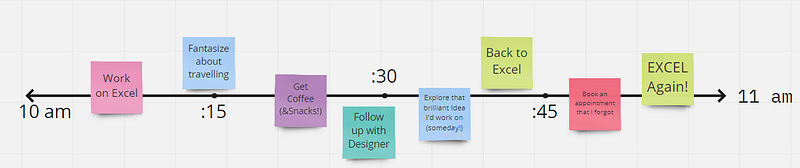
My one hour plan usually looks like this: Finish the monthly financial accounts and follow up with the designer.

Well, how does it really look is something like this:
Screenshot By Author

I usually end up with less time, more tasks, and infinite frustration. With endless distractions, someday projects, and urgent tasks, I get swamped on a daily basis. Sometimes, I even have enough time, but much less energy or attention to do anything worthwhile.

So, I tried using some tricks that would offload my brain, and let me focus on what I am doing at a moment.

1. Distractions List

I don't remember the origin of this trick, but a friend mentioned it earlier, and it helped. I know that the most amazing inspirations just occur at the moment of trying to work on something else.

Did you have an awesome perspective for a new story? Would you like to explore the global warming effect on your daily mood? What about that mesmerizing picture that caught your attention on Instagram, should you travel there next time?

Write all of these down! Keep a paper & a pen, and write every random thought that may cross your mind and you are afraid to lose, for later exploration. Then divert back your attention to the mission at hand.

2. Mental Inventory (Bujo)

If you are in a busy part of your life, you may have a lot of things going on in your mind, sapping your energy. The Mental Inventory is a tool I got from the Bullet Journal method, that is better suited for big-picture planning. All you have to do is get a paper (again!), divide it into 3 columns with the following titles: things you are working on, should be working on, and want to work on.

This will give you an overview of all the things that have been roaming in your mind, and about their actual value.

3. Eisenhower Matrix (All that glitters is not gold)

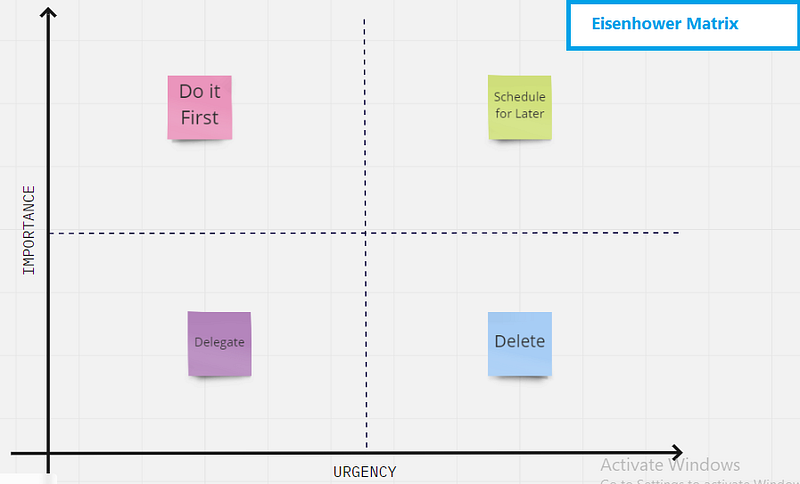
Swamped again with tasks? Try this matrix to sort all the tasks you have, or you think you have to do, assessing them on 2 metrics: urgency and importance.
Screenshot By Author

You will end up with 4 kinds of tasks:

  1. Urgent & Important: Should be prioritized to work on.
  2. Urgent but Not Important: Try delegating it to someone else.
  3. Important but Not Urgent: Schedule for later, but don’t ignore or they will move to the Urgent/Important quadrant, and haunt you forever!
  4. Not Urgent and Not Important: Why are they on your mind in the first place? Delete them!

Digital or Pen & Paper?

This is a question that has been without a definite answer for years now. I use both, but usually, pen & paper to avoid being distracted by more digital notifications, I have enough already!

Just use what works best for you & reflect regularly!

Productivity
Time
Bulletjournal
Task Management
Personal Development
Recommended from ReadMedium