avatarDr Michael Heng

Free AI web copilot to create summaries, insights and extended knowledge, download it at here

2199

Abstract

2><p id="3288">While business management would require the alignment of product and services with customers’ expectations of quality in the marketplace, the management of business excellence involves the alignment of business strategy, organisation behavior, and the global environment.</p><p id="045d">To use the <a href="https://readmedium.com/7-starting-points-to-transform-your-orgnisation-1d4c5a32bb54"><b>organisation itself as a strategy for business excellence</b></a> is not a new idea. Lawrence and Lorsch have highlighted the need for organisations operating in dynamic environments to be able to assume various flexible, differentiated, and structural patterns, each of which is in fact a multiplicity of interconnected, mutually supporting sub-organisations.</p><p id="addf"><b>Flexibility is the only plausible winning strategy to deal with uncertainties in the business environment.</b></p><p id="c8f5">Peter Drucker has also emphasised strategy and organisational culture as the two fundamentals of a business organisation that have to be managed particularly well in any successful management of change.</p><p id="e2f2">The importance of people, purpose, and processes in the management of business excellence is further reiterated by Kanter who believes that when people choose actively to manage the turbulence in the environment, they <b>“do more than predict the future, they invent it”</b>.</p><p id="a352">Establishing a conscious, unifying sense of purpose is the first crucial step in organisational transformation. It binds people to their organisation. The resulting passion which permeates organisational efforts and activities in all functional areas, and driven by a visionary leadership, has in a few organisations become their most powerful competitive factor in securing a sustainable and enduring business excellence.</p><h2 id="bcd2">The following illustrates the 4 objectives of Business Excellence Management:</h2><figure id="b682"><img src="https://cdn-images-1.readmedium.com/v2/resize:fit:800/1*eDESi73-tx7n5kUdYiU5Jg.jpeg"><figcaption>Illustration by Author</figcaption></figure><p id="a8c5">Formerly known for their unique style as total quality management,

Options

these organisations are the forerunners of a total quality organisation whose peculiar management approach sets them apart from other organisations.</p><p id="e134">Today, <b>“total quality organisations”</b> have outgrown their earlier bounded mindset to embrace a more holistic <a href="https://readmedium.com/embracing-the-business-excellence-ideology-108d464f27e5"><b>Business Excellence management (BizXMgt)</b></a> approach.</p><p id="598b">A <b>BizX organisation</b> is distinguished from conventional management by its corporate culture based on the ideology of BizX which is totally and completely motivated by an entirely different set of management pre-requisites.</p><h2 id="2b60">In a BizX organisation, the business of management is Excellence. The new corporate culture of Business Management Excellence is illustrated below:</h2><figure id="8960"><img src="https://cdn-images-1.readmedium.com/v2/resize:fit:800/1*tVpa2UfNi0E-F9RDeyvqXQ.jpeg"><figcaption>Illustration by Author</figcaption></figure><div id="ff7d" class="link-block"> <a href="https://readmedium.com/whats-wrong-with-current-management-ed50b1c86361"> <div> <div> <h2>What’s Wrong with Current Management?</h2> <div><h3>Urgent Updates Needed in 4 Themes</h3></div> <div><p>medium.com</p></div> </div> <div> <div style="background-image: url(https://miro.readmedium.com/v2/resize:fit:320/1*HRVLvDNkuKfYwwrhL_3NxA.jpeg)"></div> </div> </div> </a> </div><figure id="69a6"><img src="https://cdn-images-1.readmedium.com/v2/resize:fit:800/1*EHOZJPDSil8rVJb99RO14A.jpeg"><figcaption><b>Image by OpenClipart-Vectors from Pixabay</b></figcaption></figure><h2 id="d06a">Please enjoy my recent Articles.</h2><p id="be1c"><b>You can also <a href="https://thefuturistoracle.medium.com/subscribe">subscribe</a> to my stories and social media posts via your email. Enjoy more interesting Articles by signing up to Medium here: <a href="https://thefuturistoracle.medium.com/membership">https://thefuturistoracle.medium.com/membership</a></b></p></article></body>

The Business of Management is Excellence

This is the New Culture of Business Management Excellence

Illustration by www.inlpcenter.org

Management today has to move beyond its focus on a strategy that merely seeks to define a rational product-market position, towards a sense of purpose that envelops its employees’ passion and commitment. It must look deep beneath organisations as simple structures and apply a process-based perspective that integrates and links the individual competencies and capabilities that exist within the organisation.

Increasing globalisation and rapid technological innovations create an ever-smaller world constantly in a state of revolutionary flux. As a result, organisations nowadays operate in highly complex and dynamic environments.

When an organisation is viewed in terms of processes, it acquires a flexibility characteristic and enhances confidence in the management of change. The effective management of change is undisputedly the single greatest challenge for management as it enters the new millennium. A better world beckons, making it imperative for management to adapt by transforming itself into relevance or face the prospects of oblivion.

A radical restructuring of current management paradigms is necessary to precede a consequential transformation of the organisation. Various prescriptions in the recent past decade seeking to reengineer, delayer, downsize, rightsize, redesign and reform the organisation are symptomatic of desperate management attempts to come to terms with the emergent and unforgiving business environment.

Business no longer begins and ends with profitability. Likewise, business management ceases to be defined just by market share and sales growth.

The business of management has become the management of excellence.

While business management would require the alignment of product and services with customers’ expectations of quality in the marketplace, the management of business excellence involves the alignment of business strategy, organisation behavior, and the global environment.

To use the organisation itself as a strategy for business excellence is not a new idea. Lawrence and Lorsch have highlighted the need for organisations operating in dynamic environments to be able to assume various flexible, differentiated, and structural patterns, each of which is in fact a multiplicity of interconnected, mutually supporting sub-organisations.

Flexibility is the only plausible winning strategy to deal with uncertainties in the business environment.

Peter Drucker has also emphasised strategy and organisational culture as the two fundamentals of a business organisation that have to be managed particularly well in any successful management of change.

The importance of people, purpose, and processes in the management of business excellence is further reiterated by Kanter who believes that when people choose actively to manage the turbulence in the environment, they “do more than predict the future, they invent it”.

Establishing a conscious, unifying sense of purpose is the first crucial step in organisational transformation. It binds people to their organisation. The resulting passion which permeates organisational efforts and activities in all functional areas, and driven by a visionary leadership, has in a few organisations become their most powerful competitive factor in securing a sustainable and enduring business excellence.

The following illustrates the 4 objectives of Business Excellence Management:
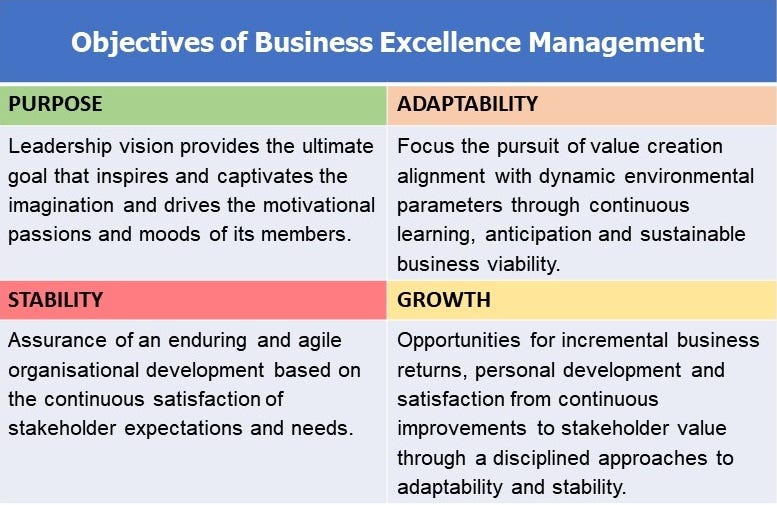
Illustration by Author

Formerly known for their unique style as total quality management, these organisations are the forerunners of a total quality organisation whose peculiar management approach sets them apart from other organisations.

Today, “total quality organisations” have outgrown their earlier bounded mindset to embrace a more holistic Business Excellence management (BizXMgt) approach.

A BizX organisation is distinguished from conventional management by its corporate culture based on the ideology of BizX which is totally and completely motivated by an entirely different set of management pre-requisites.

In a BizX organisation, the business of management is Excellence. The new corporate culture of Business Management Excellence is illustrated below:
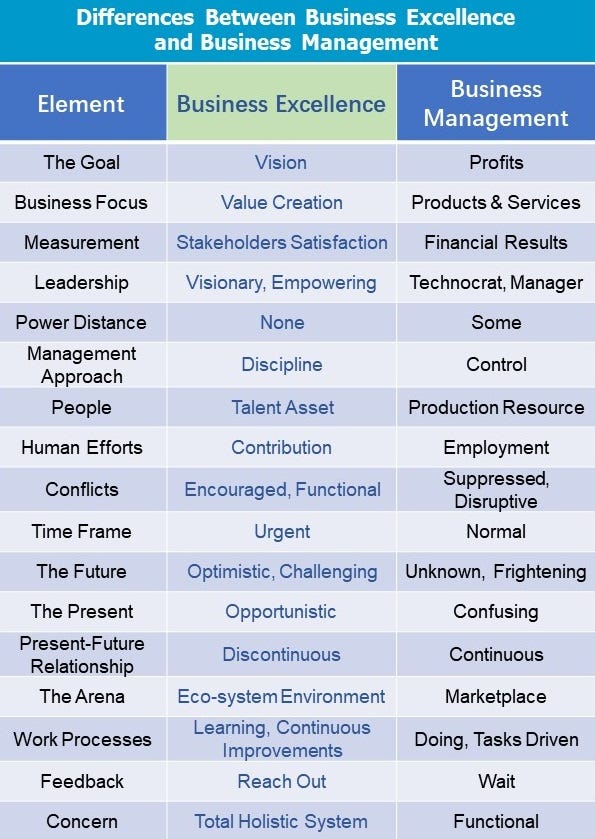

Illustration by Author
Image by OpenClipart-Vectors from Pixabay

Please enjoy my recent Articles.

You can also subscribe to my stories and social media posts via your email. Enjoy more interesting Articles by signing up to Medium here: https://thefuturistoracle.medium.com/membership

Management
Mindset
Leadership
Strategy
Innovation
Recommended from ReadMedium