
The Burden of Multitasking
Task Switching Reduces Efficiency and Raises Fatigue

As an aspiring therapist doing her second rodeo of graduate school, I’ve worked, volunteered, and studied across multiple interdisciplinary projects that required consultations with many business-savvy professionals.
I also once worked in human resources, where my psychological research skills came in handy, especially where business processes were often blended with employee engagement and retention.
When we are busy, we sometimes find ourselves doing a lot of different things at the same time. However, contemporary research shows that over a long period of time, doing many tasks at once can actually lower your overall productivity.
This shouldn’t be a great surprise.
When you’re focussed on one thing exclusively, your attention reserves are satiated long enough to get it done. Then, you can move onto the next pursuit, take a break, and then work some more.
As your cognitive resources dwindle throughout the day, that’s your body’s way of telling you that it’s time to take a break and work on something else. This something else can be less intellectually demanding, like doing yoga, exercising, watching TV, napping, and many more.

However, time and time again, people are expected to multitask like there’s no tomorrow. For example, a demanding manager may think that checking your emails, while writing a research report, on top of filing and scanning folders within 1 hour is the best use of your time.
Optimizing Our Time With Matrices
In an ideal world, it would be better to do each task, one at a time, based on the importance, urgency, and doability of each task.
If we follow the time management matrix pioneered by American educator and businessman Stephen R. Covey, we can compartmentalize the various items in our lives in a much more organized way.
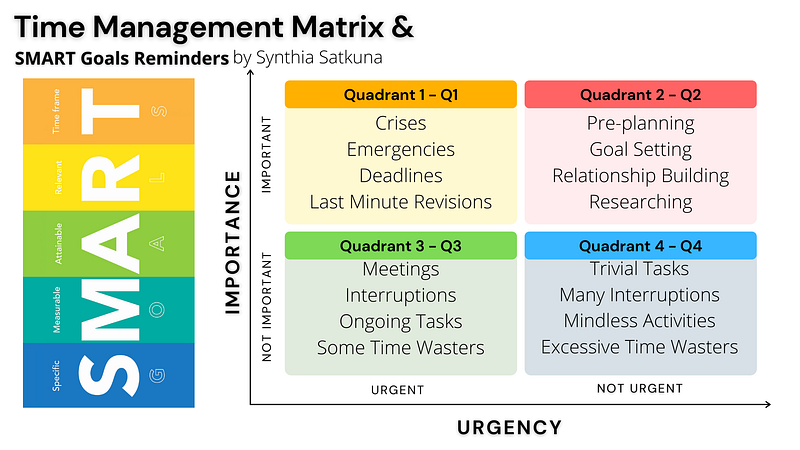
For example, in the picture designed by yours truly, our lives are made up of many tasks. If we break up these tasks, we have:
- Quadrant 1, where the most important and urgent items are prioritized, like imminent deadlines and immediate crises.
- Quadrant 2, where the important but not so urgent tasks can be pre-planned, in anticipation of emerging problems and tasks like those in Quadrant 1.
- Quadrant 3, where you will find not so important but urgent tasks, that constantly interrupt our time, but are expected.
- Quadrant 4, where items are not as important but can be done while taking a break. These items are not replacements for beneficial coping mechanisms.
While considering these four quadrants, the most optimized tasks are the ones located in Quadrant 2. Through time and effort, it might be easier to pre-plan and anticipate potential crises rather than facing them at the last possible second.
Your Brain is Like an Air-Traffic Control Centre
Harking back to contemporary psychological research, psychologists have identified that the brain is typically not optimized to do two heavy-duty things simultaneously.
As time stretches onward, we will get tired and we will get fatigued.
Even if you don’t feel the effects now, you will likely feel them at another time, depending on your specific situation. The best way to conceptualize our tasks is to visualize an air-traffic control centre.

When we are multitasking, we code and switch from one item to another, often in quick succession. This is what is called “juggling” and there is usually a cost associated with this constant code-switching.
Sometimes, this cost is time.
For example, let’s say task 1 is similar to task 2, and both require doing some kind of research and mathematical calculations. Task 1 requires 1 hour of your life. Task 2 also requires 1 hour of your life.
Without multitasking, perhaps you’re spending 2 hours at a minimum with a 10-minute break thrown in the middle, making it 2 hours and 10 minutes.
Instead, multitasking may cause you to get both parts done in 2 hours or more. On top of that:
- You’re much more tired
- There was no self-care break
- You might have even wandered into timewasting activities
Overall, the next time you’re multitasking, just be mindful of your cognitive loads. It’s okay to sometimes do two things at once, such as talking to a friend while sorting boxes, but it’s not as appropriate to write two lab reports simultaneously.
In the wise words of Idries Shah,
“Enlightenment must come little by little — otherwise it would overwhelm.”
For more articles from the author, please read:


