avatarDark Energy Articles

Free AI web copilot to create summaries, insights and extended knowledge, download it at here

4434

Abstract

cient Egyptians, it should be noted that the ancient people living in the land on the Nile only slightly resembled modern Egyptians. In 2017, scientists at Parabon NanoLabs examined DNA extracted from male corpses found in the city of Abusir el-Meleq, buried between 1380 BC and 425 AD.</p><p id="2493">Using the technique of forensic DNA phenotyping (which makes it possible to determine facial features and other key features of appearance based on analysis of genetic material), the researchers were able to determine that the men had Middle Eastern or typical Mediterranean features. That is, <b>light brown skin, eyes and dark-colored hair.</b></p><p id="e6e3">The custom of body adornment was widely practiced by representatives of many ancient civilizations. Egyptians decorated their faces with makeup. It is worth noting that this practice was common not only among women, but also among men and children. At first, makeup had a typically practical function — it protected the face from sunlight. Over time, it gained a religious dimension.</p><figure id="2964"><img src="https://cdn-images-1.readmedium.com/v2/resize:fit:800/1*P8Q1ZFII_e2C1CevcXurjQ.jpeg"><figcaption>Louvre Museum Ancient Egypt face to face — [Photo: Fil22plm, <a href="https://creativecommons.org/licenses/by-sa/4.0">CC BY-SA 4.0</a>, via <a href="https://commons.wikimedia.org/wiki/File:Louvre_Museum_Ancient_Egypt_face_to_face.jpg">Wikimedia Commons</a>]</figcaption></figure><p id="a595"><b>Egyptians did not know sugar</b>, and made sweets from fruits. The average inhabitants of the country ate two meals a day. They fed mainly on fish, poultry, vegetables and fruits. They drank primarily water and milk (although they were familiar with more caloric beverages like wine and beer). So it’s not particularly surprising that representatives of the lower classes were mostly thin.</p><p id="d040">The elite could afford four meals a day, consisting of more caloric dishes, and barley beer often found its way to their tables. It can therefore be assumed that their physiques were more massive. However, it should be noted that in ancient Egypt a slender, athletic figure was most desirable. This is confirmed by temple reliefs, which almost do not depict obese people.</p><figure id="b6b8"><img src="https://cdn-images-1.readmedium.com/v2/resize:fit:800/1*4lm6Fl2Eb_SFun-fZOl_8g.jpeg"><figcaption>[Photo: © Vyacheslav Argenberg / <a href="http://www.vascoplanet.com/">http://www.vascoplanet.com/</a>, <a href="https://creativecommons.org/licenses/by/4.0">CC BY 4.0</a>, via <a href="https://commons.wikimedia.org/wiki/File:Memphis,_Pharaoh_Rameses_II,_Ancient_Egypt.jpg">Wikimedia Commons</a>]</figcaption></figure><h1 id="bd08">How did the ancient Egyptians live?</h1><p id="d1ab">Speaking of ordinary Egyptians and the elite of the ancient land, it should be mentioned that, as in the modern world, social divisions were clearly delineated in Egyptian society. The houses of ordinary residents of the land on the Nile were clearly different from the villas where the elite lived.</p><p id="f421">Most Egyptians lived in simple houses built on a rectangular or square plan. The building material was silt bricks, and the clay needed to make them was extracted from the Nile. The roofing was made from tree branches. Such buildings had an area of about 40 square meters and were usually divided into four rooms.</p><p id="a833">The first room, which welcomed guests, was the most sumptuous. Such a room was usually decorated with at least one column, and in richer houses — two columns. Being the most expensive, stone supports were the most desirable. Not everyone could afford them. Most Egyptians decorated their homes with wooden columns, which they painted to resemble granite ones.</p><figure id="ae9f"><img src="https://cdn-images-1.readmedium.com/v2/resize:fit:800/1*UPwToxO5TrrBxnJBUQEXKA.jpeg"><figcaption>[Photo: Dosseman, <a href="https://creativecommons.org/licenses/by-sa/4.0">CC BY-SA 4.0</a>, via <a href="https://commons.wikimedia.org/wiki/File:%C3%84gyptisches_Museum_und_Papyrussammlung_book_of_dead_for_Neferini_9973.jpg">Wikimedia Commons</a>]</figcaption></figure><p id="f673">The centerpiece of the Egyptian home was the family room, which served the household both during the day and at night. A large platform was set up in the center of the room for sitting and sleeping.</p><p id="2fed">The function of the chamber behind the

Options

family room was adapted to the needs of the residents. It was usually treated as a place of work or storage. The last and also the most important room in an Egyptian house was the kitchen. This part of the development was not roofed.</p><p id="722a">It is worth mentioning that multi-generational families living in Egyptian houses shared their four corners with animals, both domestic (the cat warded off rodents, and the dog guarded the house and/or helped in hunting) and household animals.</p><p id="eb93">Egyptian elites had a much larger living space at their disposal. Their villas consisted of up to dozens of rooms, where servants lived in addition to the family. Such a house was surrounded by a vegetable garden, which also included a small water reservoir for raising fish.</p><h1 id="ab02">Beliefs of the Egyptians</h1><p id="1067">Religion played an extremely important role in ancient Egypt. Their faith was polytheistic, meaning that they worshipped many gods. <b>Each administrative center had its own deity</b>. According to researchers, there were more than <b>800 different deities</b> in the religion of the ancient Egyptians.</p><p id="bb4d">The inhabitants of the land on the Nile imagined the gods as people with the head of an animal. At the same time, they also professed belief in demigods, but to these beings they did not erect temples.</p><p id="f625">A special place in ancient Egyptian beliefs was held by the belief in life after death. Egyptians believed that the dead come back to life. That’s why the dead were embalmed and buried with special anointing, often with a rich deposit.</p><figure id="1b65"><img src="https://cdn-images-1.readmedium.com/v2/resize:fit:800/1*rL-Yg38JODMv3P3AJEk4Kg.jpeg"><figcaption>God Re (Ra) — [Photo: Osama Shukir Muhammed Amin FRCP(Glasg), <a href="https://creativecommons.org/licenses/by-sa/4.0">CC BY-SA 4.0</a>, via <a href="https://commons.wikimedia.org/wiki/File:Stela,_from_Thebes,_Egypt._8th_to_4th_century_BCE._The_god_Ra-Horakhty_appears._National_Museum_of_Scotland,_Edinburgh.jpg">Wikimedia Commons</a>]</figcaption></figure><p id="0231">While the religions of ancient Egypt mandated the worship of many deities, a few gods held a particularly high position in the beliefs, such as Re, Osiris, Thot, Anubis and Horus. Egyptian symbols were also associated with religion.</p><h1 id="8f5a">Life in ancient Egypt</h1><p id="2e08">How did the ancient Egyptians live? It can be said that their daily life was systematized and subject to certain laws. In ancient Egypt, no monetary system was known, so the remuneration for work was certain goods. In some settlements, those who worked were given a house and food. Those who staked their lives on greater independence raised animals.</p><p id="f91f">Contrary to the view perpetuated over the years, <b>slavery was not the basis of the Egyptian economy.</b> Of course, rulers used forced laborers, but these were most often prisoners of war. Egyptians conscripted into these structures had to “earn it” with a serious crime.</p><p id="a4f0">Slaves were not at all treated in a barbaric manner. <b>An example would be the builders of the pyramids, for whom first aid stations were organized.</b> They had feeding stations at their disposal, and could also use hospitals, so it cannot be said that their fate was more difficult than that of the average Egyptian doing hard labor.</p><div id="596e" class="link-block"> <a href="https://readmedium.com/a-strange-glowing-vortex-has-appeared-in-the-night-sky-over-hawaii-what-is-it-ad2fa2f01852"> <div> <div> <h2>A strange glowing vortex has appeared in the night sky over Hawaii. What is it?</h2> <div><h3>A visual phenomenon has been spotted over Hawaii. It is a bright vortex, resembling a rotating spiral galaxy. SpaceX is…</h3></div> <div><p>medium.com</p></div> </div> <div> <div style="background-image: url(https://miro.readmedium.com/v2/resize:fit:320/1*YfA8nJzSH3f0tjHnGsjaRQ.jpeg)"></div> </div> </div> </a> </div><p id="38cb"><b>Cool that you made it to the end of this article. I will be very pleased if you appreciate the effort of creating it and leave some claps here, or maybe even start following me. It would be nice if you also left a tip! Thank you!</b></p></article></body>

The builders of the pyramids were not slaves at all. How did the ancient Egyptians live?

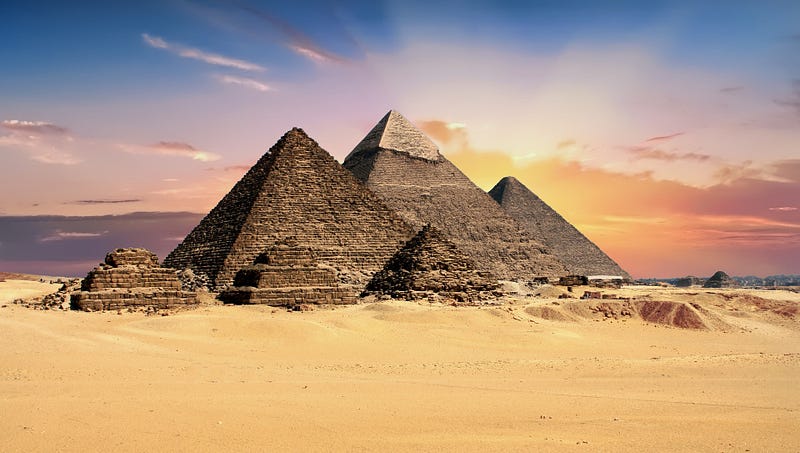
What did the ancient Egyptians look like and how did they live? What did their homes look like? What deities did they worship? Let’s take a little closer look at one of the most fascinating civilizations of antiquity.
[Photo: Pete Linforth from Pixabay]

The heritage of ancient Egypt remained hidden under the desert sand for nearly 2,000 years. Thanks to the work of archaeologists, today we have knowledge that illuminates the darkness of the distant past and allows us to answer many intriguing questions.

To them we owe the invention of papyrus, which from today’s perspective is a milestone in the development of civilization. They are credited with some of the oldest astronomical discoveries. They invented the first sundial, abacus, balance and well. They developed an effective method of embalming corpses. The achievements of ancient Egypt can be multiplied and multiplied, but today we will look not at Egyptian inventions and discoveries, but at the life of the inhabitants of this land, remarkable in every way.
[Photo: Juan Carlos Fonseca Mata, CC BY-SA 4.0, via Wikimedia Commons]

When did the ancient Egyptians live?

Speaking of the ancient Egyptians, what we have in mind is a civilization that lived in parallel with the Mesopotamian one, which developed in the northeastern part of Africa, on the lower Nile. During the Predynastic period, which lasted from the 6th to 4th centuries BC and preceded the establishment of a centralized state, many cultures existed and developed in the area. Their representatives arrived there as early as the end of the 7th century BC, when the environment in the lands they had inhabited earlier began to desertify.

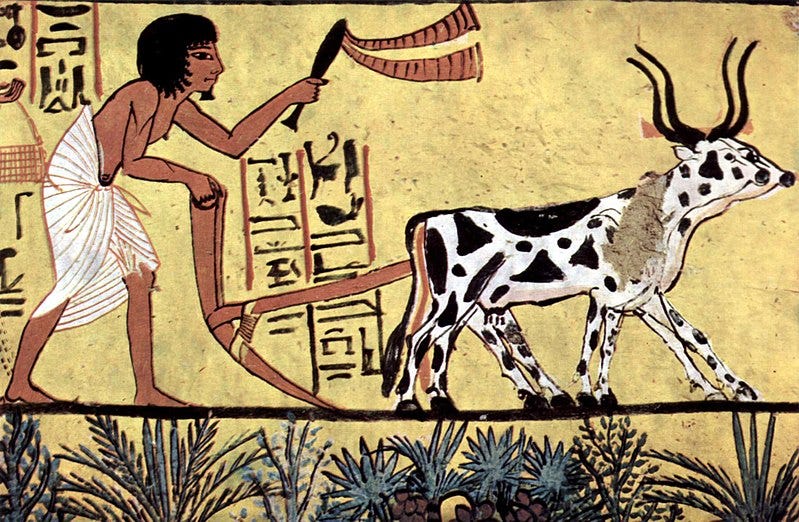
The people who arrived in the Nile valley and delta began to develop the area with an agricultural and farming economy. Over time, stonemasonry and pottery began to develop, and the settlers themselves established trade contacts with the inhabitants of nearby areas.
[Photo: Painter of the burial chamber of Sennedjemالعربية: رسام حجرة دفن سننجم, Public domain, via Wikimedia Commons]

The peoples who settled the land began to form two main cultural circles: the Upper, which was centered around the Nile Valley, and the Lower Egyptian, centered around the Nile Delta. Around 2850 BC, the unification of the two states took place. This was accomplished by Menes, the ruler of Upper Egypt. This event should be considered the actual beginning of the existence of ancient Egyptian civilization.

From a historical point of view, the history of Egyptian statehood should be divided into three periods: Old, Middle and New State. They were separated by three periods of disintegration, called Transitional Periods (First, Second and Third). In the first century BC, the Decline Period occurred. This is the time of Assyrian and Persian domination. When Alexander of Macedon made his great conquests, the Hellenistic period in Egypt’s history came. The decline of the statehood of ancient Egypt began in 31 BC, when the troops of Octavian Augustus entered the country. By 30 BC. Egypt was already a Roman colony.

What did the ancient Egyptians look like?

When describing the appearance of ancient Egyptians, it should be noted that the ancient people living in the land on the Nile only slightly resembled modern Egyptians. In 2017, scientists at Parabon NanoLabs examined DNA extracted from male corpses found in the city of Abusir el-Meleq, buried between 1380 BC and 425 AD.

Using the technique of forensic DNA phenotyping (which makes it possible to determine facial features and other key features of appearance based on analysis of genetic material), the researchers were able to determine that the men had Middle Eastern or typical Mediterranean features. That is, light brown skin, eyes and dark-colored hair.

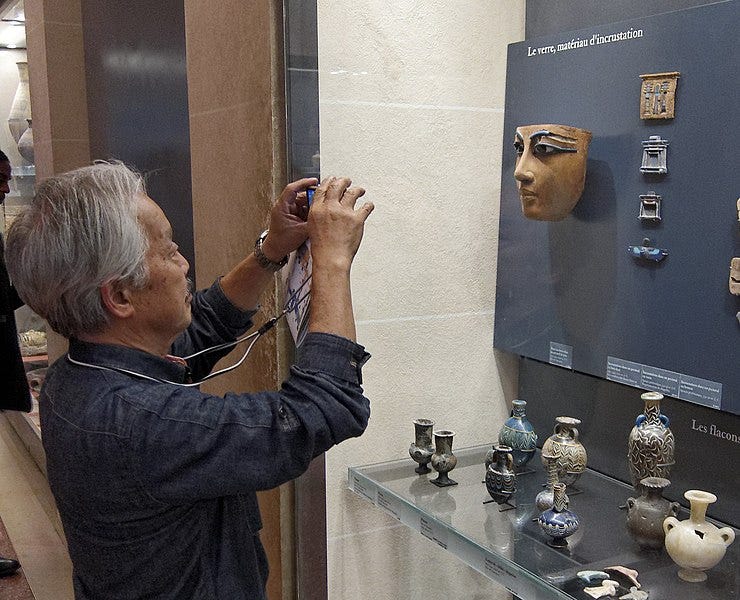
The custom of body adornment was widely practiced by representatives of many ancient civilizations. Egyptians decorated their faces with makeup. It is worth noting that this practice was common not only among women, but also among men and children. At first, makeup had a typically practical function — it protected the face from sunlight. Over time, it gained a religious dimension.
Louvre Museum Ancient Egypt face to face — [Photo: Fil22plm, CC BY-SA 4.0, via Wikimedia Commons]

Egyptians did not know sugar, and made sweets from fruits. The average inhabitants of the country ate two meals a day. They fed mainly on fish, poultry, vegetables and fruits. They drank primarily water and milk (although they were familiar with more caloric beverages like wine and beer). So it’s not particularly surprising that representatives of the lower classes were mostly thin.

The elite could afford four meals a day, consisting of more caloric dishes, and barley beer often found its way to their tables. It can therefore be assumed that their physiques were more massive. However, it should be noted that in ancient Egypt a slender, athletic figure was most desirable. This is confirmed by temple reliefs, which almost do not depict obese people.
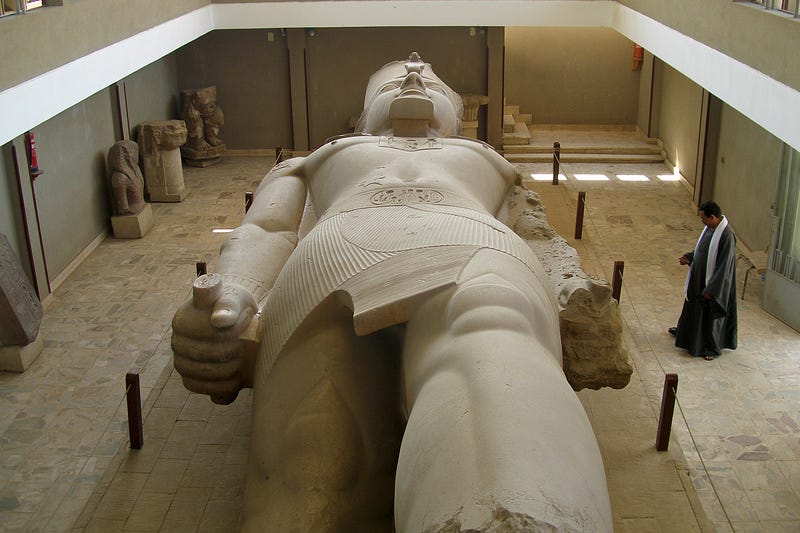
[Photo: © Vyacheslav Argenberg / http://www.vascoplanet.com/, CC BY 4.0, via Wikimedia Commons]

How did the ancient Egyptians live?

Speaking of ordinary Egyptians and the elite of the ancient land, it should be mentioned that, as in the modern world, social divisions were clearly delineated in Egyptian society. The houses of ordinary residents of the land on the Nile were clearly different from the villas where the elite lived.

Most Egyptians lived in simple houses built on a rectangular or square plan. The building material was silt bricks, and the clay needed to make them was extracted from the Nile. The roofing was made from tree branches. Such buildings had an area of about 40 square meters and were usually divided into four rooms.

The first room, which welcomed guests, was the most sumptuous. Such a room was usually decorated with at least one column, and in richer houses — two columns. Being the most expensive, stone supports were the most desirable. Not everyone could afford them. Most Egyptians decorated their homes with wooden columns, which they painted to resemble granite ones.
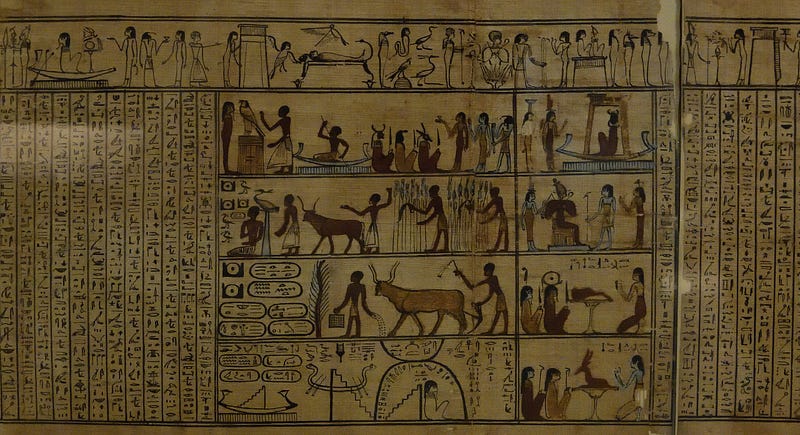
[Photo: Dosseman, CC BY-SA 4.0, via Wikimedia Commons]

The centerpiece of the Egyptian home was the family room, which served the household both during the day and at night. A large platform was set up in the center of the room for sitting and sleeping.

The function of the chamber behind the family room was adapted to the needs of the residents. It was usually treated as a place of work or storage. The last and also the most important room in an Egyptian house was the kitchen. This part of the development was not roofed.

It is worth mentioning that multi-generational families living in Egyptian houses shared their four corners with animals, both domestic (the cat warded off rodents, and the dog guarded the house and/or helped in hunting) and household animals.

Egyptian elites had a much larger living space at their disposal. Their villas consisted of up to dozens of rooms, where servants lived in addition to the family. Such a house was surrounded by a vegetable garden, which also included a small water reservoir for raising fish.

Beliefs of the Egyptians

Religion played an extremely important role in ancient Egypt. Their faith was polytheistic, meaning that they worshipped many gods. Each administrative center had its own deity. According to researchers, there were more than 800 different deities in the religion of the ancient Egyptians.

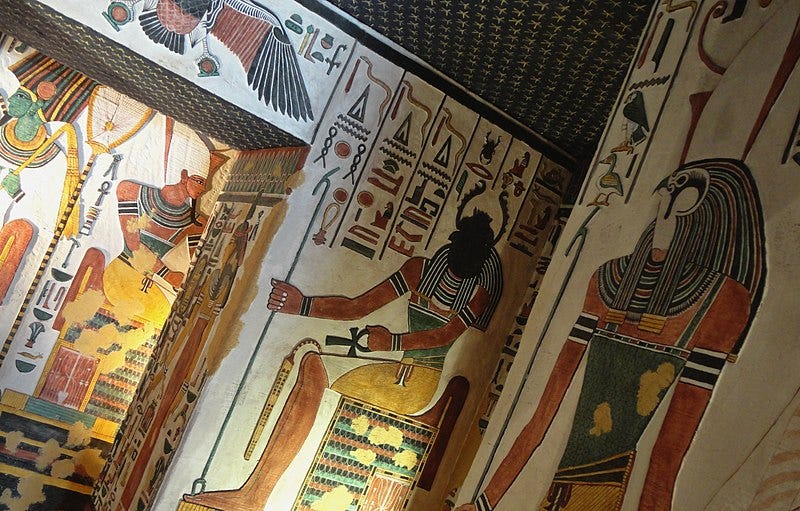
The inhabitants of the land on the Nile imagined the gods as people with the head of an animal. At the same time, they also professed belief in demigods, but to these beings they did not erect temples.

A special place in ancient Egyptian beliefs was held by the belief in life after death. Egyptians believed that the dead come back to life. That’s why the dead were embalmed and buried with special anointing, often with a rich deposit.
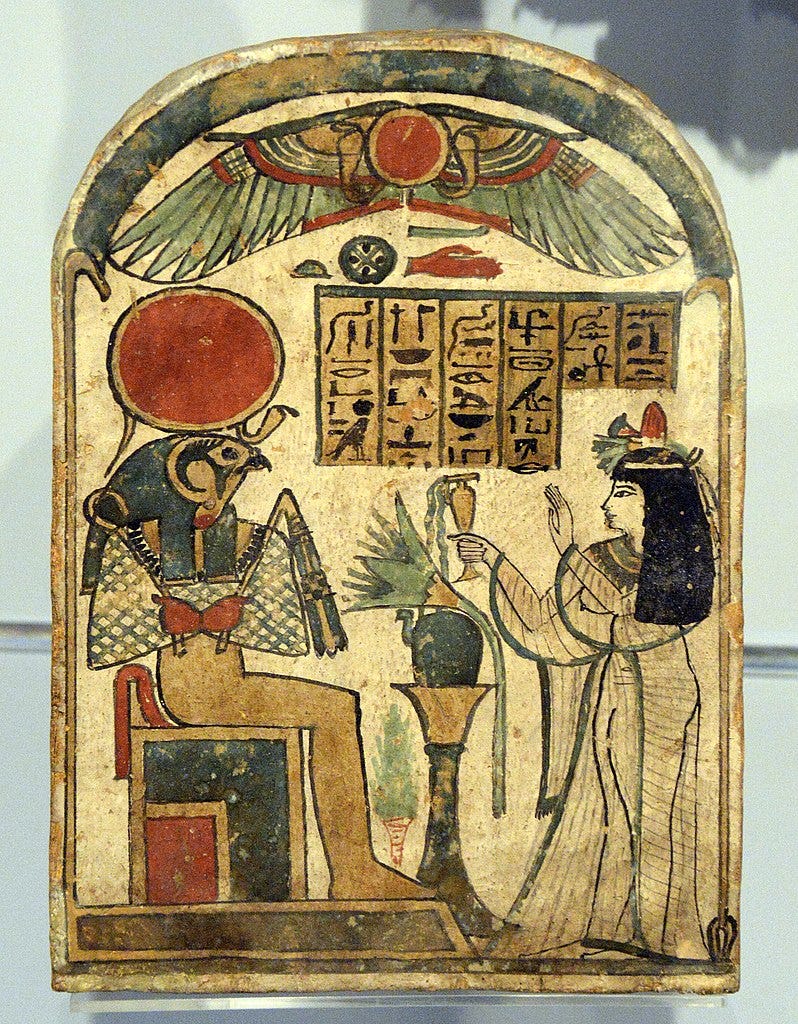
God Re (Ra) — [Photo: Osama Shukir Muhammed Amin FRCP(Glasg), CC BY-SA 4.0, via Wikimedia Commons]

While the religions of ancient Egypt mandated the worship of many deities, a few gods held a particularly high position in the beliefs, such as Re, Osiris, Thot, Anubis and Horus. Egyptian symbols were also associated with religion.

Life in ancient Egypt

How did the ancient Egyptians live? It can be said that their daily life was systematized and subject to certain laws. In ancient Egypt, no monetary system was known, so the remuneration for work was certain goods. In some settlements, those who worked were given a house and food. Those who staked their lives on greater independence raised animals.

Contrary to the view perpetuated over the years, slavery was not the basis of the Egyptian economy. Of course, rulers used forced laborers, but these were most often prisoners of war. Egyptians conscripted into these structures had to “earn it” with a serious crime.

Slaves were not at all treated in a barbaric manner. An example would be the builders of the pyramids, for whom first aid stations were organized. They had feeding stations at their disposal, and could also use hospitals, so it cannot be said that their fate was more difficult than that of the average Egyptian doing hard labor.

Cool that you made it to the end of this article. I will be very pleased if you appreciate the effort of creating it and leave some claps here, or maybe even start following me. It would be nice if you also left a tip! Thank you!

Egypt
History
Life
Life Lessons
Culture
Recommended from ReadMedium