
The Brilliance of ‘Your Name’
An analysis of Makoto Shinkai’s ode to love
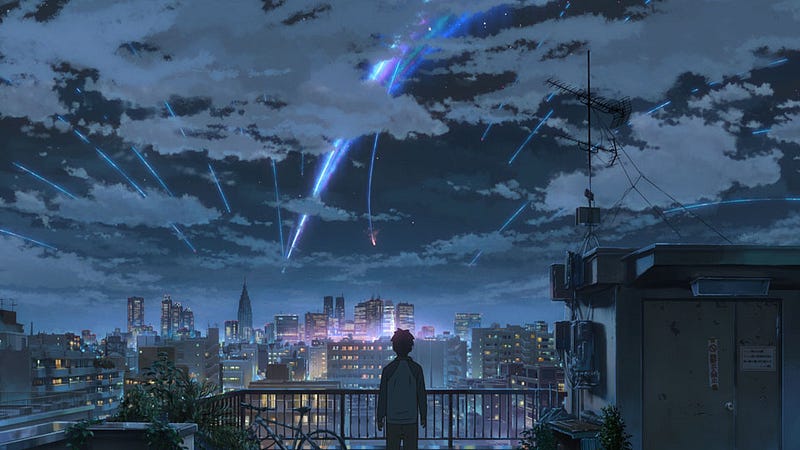
I went into Your Name (Kimi no Na wa) expecting a cute, Freaky Friday style coming-of-age romance — which I got. However, I was not prepared for everything that came along with this stunning tale of two teens and their unbelievable connection.
I’ve seen some people disregard Your Name — arguing that it’s too convoluted and illogical. And honestly speaking, I don’t disagree. The narrative is hard to follow which can make it difficult to fully immerse yourself in the story. But the thing about this film is that it needs to be considered in its entirety. It’s not your standard love story, in fact, it’s less of a story and more of an ode to love. It’s art in its purest. Let me explain…
The Concept of Soulmates
I want to start with the end — when Mitsuha and Taki meet for the third time. The moment comes with a wave of satisfaction for the viewer. After the two had gone through so much to try to find each other, they are finally together.
Why do we feel such a strong sense of relief from the scene? Well, ignoring technical devices for a moment, we’re relieved because it gives us what we want — a soulmate. It plays on the hope we have that there’s someone out there who we’re destined to be with. You don’t know who they are but you know when you meet them — when everything clicks as if you’ve known each other for years.
Mitsuha and Taki’s story is a visual representation of what it feels like to find your soulmate. Some of us may have been lucky enough to have experienced those feelings and are taken back to them upon watching. Others, like myself, follow the story and get as close as the imagination allows to that feeling.
Your Name, whether you believe in them or not, allows us to experience what it's like to have a soulmate. Returning to the aforementioned technical devices — if Shinkai’s vision hadn’t been so expertly portrayed the film wouldn’t have succeeded in giving us such a rare experience. A film with the ability to make us feel what we don’t know is a testimony to its brilliance.
It is a film that makes us practice empathy.
The Union of Love
Your Name is ripe with symbolism — with the kuchikamizake and the red yarn being the most explicit. These symbols show the union of love and how it physically connects two individuals.
When you love someone and let them into your life, you’re giving them a part of you. Mitsuha gives Taki the red yarn. That red yarn is part of her identity, she wears it every day, people are shocked when they see her without it. By offering Taki the red yarn she’s offering herself. Conversely, when Taki chooses to wear the red yarn, he shows that he accepts Mitsuha and wants to share a life with her. The red yarn is the bond that is love.
If that wasn’t enough, to really hammer in the idea that when it comes to love you give someone a part of yourself, there’s the kuchikamizake which Taki drinks. As in, he drinks a part of Mitsuha… You get the picture.
Basically, the film exposes the vulnerability that is required to love. In order to have that union, you have to be willing to give up part of yourself. Not only that, but you also have to be willing to accept a part of someone else.
The idea of giving up part of yourself is scary. But for the union of love you’re willing to face those fears.
Love Changes You
Love can give you courage. It can make you crazy. You can act like an entirely different person because of love. The character development of Taki and Mitsuha shows just how much love can change you.
The plot’s premise of Taki and Mitsuha switching bodies is quite a literal interpretation of love’s ability to change a person. However, that’s not how Your Name makes the viewer understand that change.
At the start of the film, Mitsuha is timid whilst Taki is quick-tempered. Through experiencing life as the other person they gain new perspectives. The exciting and vibrant streets of Tokyo bring Mitsuha out of her shell, going as far as to arrange a date with Miss Okudera. Life in the reclusive village of Itomori allows Taki to explore a gentler side of himself as he embraces the spiritual lifestyle of the Miyamizu family.
However, it’s at the film's climax that we fully grasp how much Mitsuha and Taki have developed. In their attempt to save the Itomori townspeople from the comet, Mitsuha and Taki, for the first time while still being in their own bodies, are said to be acting differently. Previously, any of their behaviours that had been considered crazy by other characters occurred when they had switched bodies. But as Taki tries to find Mitsuha and Mitsuha tries to complete Taki’s plan to save Itomori — their friends and family consider them crazy, not their usual selves.
Through a gradual character arc that builds up to a point whereby Taki and Mitsuha are doing things they never would have before, the power that love has over the mind is put forward to the viewer. Taki and Mitsuha’s actions seem rational to us, with the knowledge that we have — of course, they should use a bomb to set off an emergency broadcast in order to save hundreds of people. But it is love that has created that rational. If it wasn’t for Taki loving Mitsuha would he have gone to such means to save the town? Would we have justified his obsession if love wasn’t its driving force?
We justify unusual actions of the characters by love.
Love Doesn’t Always Make Sense
As mentioned, the plot of Your Name can be confusing. The characters actions can be bizarre, details can go over your head, the nonlinear narrative plot is hard to follow. Itomori doesn’t even have a café — how can you believe in a plot with details as ridiculous as that? But when you take a step back and look at the message of the film, the complicated elements piece together.
Love doesn't have to make sense. Despite the fact that things don’t always add up — when it comes to love we can’t stop ourselves from feeling it, believing it. Parts of Your Name simply have to be accepted. We could try to pull apart every detail and give it a logical explanation but that’s not the film’s intention. We’re meant to enjoy it as it is, even if we don’t understand it all. We’re to treat the watching experience as the experience of being in love.
The film, as a representation love, teaches us to accept the fact that love doesn’t always make sense.
Love Transcends
There’s a fantastical feel to Your Name — the gorgeous scenery, the whimsical animation and dreamy colour palette, the spiritual tone laced throughout. The film is truly a romantic’s vision of love, capturing the magic in it.
However, the movie is still very much based in the real world. The landscape of Tokyo replicates actual parts of the city, the characters have authentic personalities and relationships. The film has elements of fantasy but stays very much grounded in reality, demonstrating how love transcends.
Mitsuha and Taki defy the laws of time with their love. You see, love can make people go beyond their conceptual limit. The things that you do with love are better than anything you do without it. What you thought was impossible can be achieved when you give it all your love.
Undercurrents of hope and determination leave us feeling like anything is possible.
With all this being said, if there’s one word to describe Your Name, it has to be timeless. Although the film isn’t nearly old enough to be considered out-dated, it isn’t an issue it’ll have to worry about in the future.
That’s the brilliance of this film. You can watch it again and again and unravel more, interpret it differently, connect to parts you didn’t before. I know that my takeaways from it are based on where I currently stand with love. If I watched it again having just had my heart broken maybe I’d consider it a cruel taunt to the lonely rather than the messages of a hopeless romantic. No viewing experience of Your Name is the same.
For as long as love continues to make an impact, so will Your Name.


