
The Brilliance of Step One
There’s a lot of wisdom in the 12 Steps — and the first one in particular
I often hear people in early recovery say things like ‘Wow! The 12 Steps are so cool; everyone should know about them!’
I agree — they need not just be for people recovering from addiction.
So, with that in mind, I’m going to share with you, gentle reader, my take on the beauty of Step One.
When the founding fathers of Alcoholics Anonymous got the idea of helping people stop drinking, they saw that it was a big deal to actually stay stopped. Sure, it was difficult to stop drinking for most hardened alcoholics, but it was even harder to stay sober long term.
So they came up with what they called the 12 Steps of Alcoholics Anonymous which I’ve printed out and photographed here:
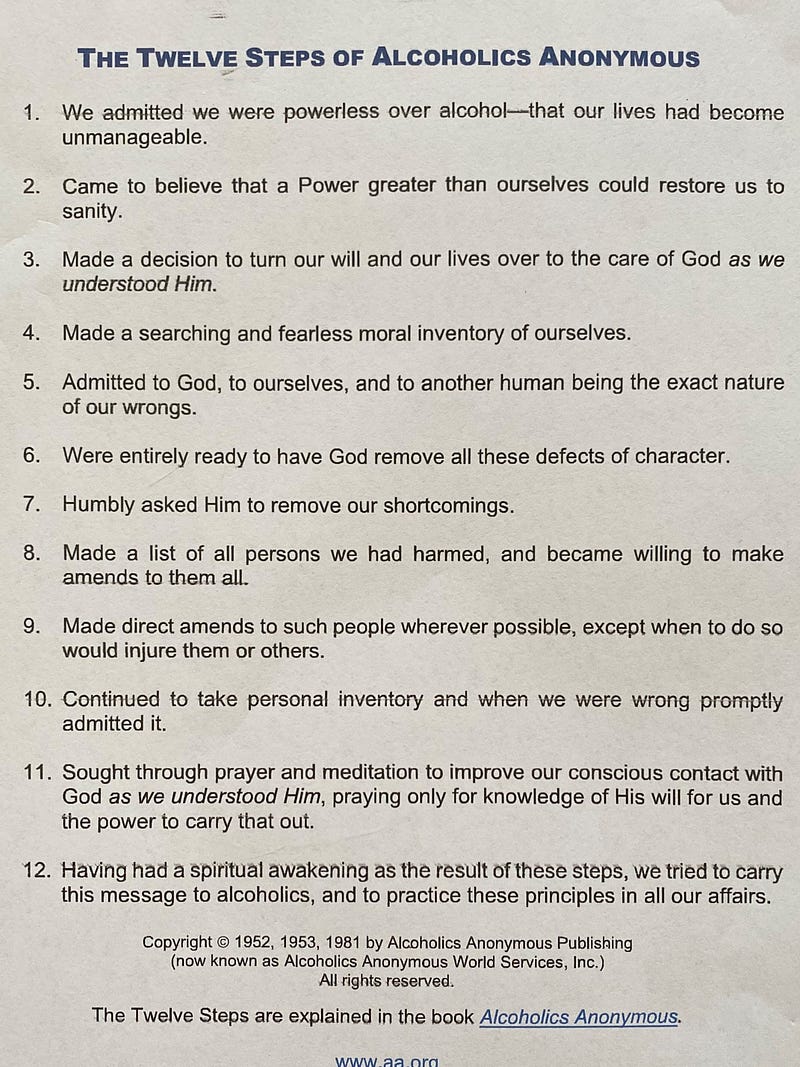
For the purposes of this story, however, I’m focusing just on Step One, which is, in my opinion, the most important.
Step one is pretty crucial to understand, in a heartfelt way, if you want long-term sobriety — or to change addictive behavior such as sexual acting out (sex addiction), gambling, debting etc.
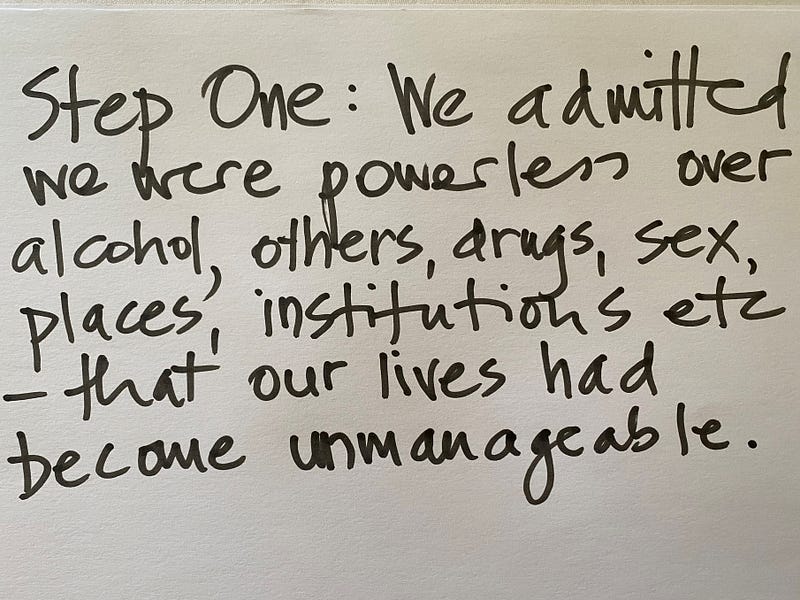
I’ve reimagined Step One in the first picture because this story is all about how multi-applicable it is as a way of coping with life’s slings and arrows. When you apply the philosophy of Step One to your troubles, you can let go of the angst. It’s the railing against the thing you can’t control that causes the problem.
There are two key words in the first step — powerless and unmanageable. Powerless means ‘can’t control’ and ‘unmanageable’ means consequences.
Even though we keep suffering the consequences, we keep doing the same thing over and over — and that’s the definition of addiction right there. Practicing the same behavior, expecting a different outcome.
Often the thinking will be something along the lines of ‘Just one drink will be all right.’ But when was one ever enough? Trying to control the number of drinks never works for an alcoholic.
The first part of Step One, the idea of powerlessness, is counter-intuitive. Giving up the fight. How many times have you gritted your teeth and thought: I’ll just stop tomorrow! I just need to try harder. Or others have said ‘Just stop, why don’t you?’
Normal people can just stop. They don’t understand the compulsion that people with addiction suffer from. The need to drink despite knowing you’ve got a problem. Or the overwhelming need to use your drug of choice, but at the same time knowing it’s a real issue in your life and everyone’s saying it and you just can’t stop.
Or spending hours and hours online, watching porn and not being able to stop even though you’re missing work, or can’t perform with your partner, or you’re racking up debt with paying for sex workers.
Let me count the ways
When I think of Step One I think of surrender — giving up the fight. That’s powerlessness, right there.
I imagine the white flag that old-school armies would wave when they’d lost too many men and they knew that to continue the battle would only lead to more death. So they admitted defeat and put down their weapons, surrendering.
That’s what we do when we admit we can’t control alcohol (or other drugs or addictive behaviors) — and have come to the terrible conclusion that in fact it’s ended up controlling us.
It takes a lot of courage to admit defeat — alcohol (or whatever) has beaten us into submission and trying to control how much we drink really doesn’t work any more.
‘One drink is too many and 1000 is never enough,’ as the old saying goes. It’s the first one that gets us into trouble.
The good thing about Step One is that we can apply it across the board. When you admit that you’re powerless (can’t control) in relation to people, places and things, it can be enormously helpful.
I witnessed a scary road-rage incident the other day where one big thug actually got out of his car, held up the line of traffic, and went over to the driver of a car that he’d narrowly missed after the other dude had cut in front of him.
In an effort to control the other dude — i,e. intimidate him — this thug was threatening and abusive.
I became frozen with fear that he’d turn on me next. I felt like saying something but knew that to stay silent was best. I was powerless over the thug and knew for sure my life would become unmanageable if I tried to control him myself by telling him he was being a dick.
As I’m driving, I take evasive action a couple of times each trip, I reckon, and these days I just shrug and don’t even sweat it. If someone behaves like a dick in traffic, there’s not much I can do except keep out of their way, right? If I get all bent out of shape at another person’s dickish driving habits, I choose suffering.
I don’t like to suffer unnecessarily
When I make the conscious decision to let go of the need to control the thing that’s messing me up, it’s a huge relief. I simply can’t control how another person behaves towards me or thinks about me. I’m powerless over them and if I try to control them, there will be consequences (my life becomes unmanageable). I’ll get bent out of shape, my blood pressure will rise, and I might even get a headache.
In the case of the thug, I might’ve got the bash.
I tried very hard to stop drinking, but just couldn’t until I learned how to stay stopped by understanding the very simple philosophy of Step One.
A couple of years into my recovery from alcohol and other drugs, I was accepted into the graduate program at Hazelden where I was trained, as an addictions therapist, in 12 Step facilitation.
It was a fascinating study because there’s a lot of wisdom in the 12 Steps. Those old founding fathers really knew a thing or two.
Thanks for reading.
Find me at www.solutionsauckland.com
Find my e-book novel here: