avatarTim Ward, Mature Flâneur

Free AI web copilot to create summaries, insights and extended knowledge, download it at here

5755

Abstract

ion>Sheep (white dots) and cattle(black dots) on a ranch near Tekapo.</figcaption></figure><p id="209b">Legal sheep ranching in the high country followed soon after MacKenzie’s arrest. But it was hard going. Only large leaseholds of several thousand acres were big enough to support profitable herds. Even so, several bitter winters in the late 1800s killed many sheep. Today, it’s still a tough business, as wool prices have declined globally. The government removed some farm subsidies in the 1990s, and now reviews leaseholds to make sure they are complying with what some farmers see as excessive environmental regulations.</p><div id="a01d" class="link-block"> <a href="https://interactives.stuff.co.nz/2020/05/high-country-farming-vanishing-lands/?cid=app-iPad"> <div> <div> <h2>Vanishing Lands: High country farming at risk</h2> <div><h3>High country farmers fear government reforms threaten their generations of work in one of the world's most stunning…</h3></div> <div><p>interactives.stuff.co.nz</p></div> </div> <div> <div style="background-image: url(https://miro.readmedium.com/v2/resize:fit:320/0*LVhk6fiH1WysfQp1)"></div> </div> </div> </a> </div><p id="f94a">According to the <a href="https://interactives.stuff.co.nz/2020/05/high-country-farming-vanishing-lands/?cid=app-iPad">Stuff article</a> (above), farmers make the case that they do a better job of caring for the land than the government does on areas it has set aside for conservation. The latter get overrun with invasive species and pests like rabbits and wallabies (introduced from Australia), which farmers work vigilantly to reduce on the land they control.</p><figure id="4cdc"><img src="https://cdn-images-1.readmedium.com/v2/resize:fit:800/1*[email protected]"><figcaption></figcaption></figure><figure id="91b9"><img src="https://cdn-images-1.readmedium.com/v2/resize:fit:800/1*[email protected]"><figcaption>This fruatrated farmer posted a sign to keep uninvited tourists off his land. We turned around at this point, not wishing to press our luck!</figcaption></figure><p id="f25c">Ranchers are also removing the “wilding pines” which their fathers’ generation planted for supplementary timber income. These trees have become a nightmare, as seedlings spread like wildfire through pastureland, and their roots soak up whatever available moisture there is in the ground. These trees take over a landscape in just a few years, unless someone has a powerful incentive to cut them and burn them — and pull new saplings out by the roots. Teresa and I saw this ourselves the day we drove along the Lake Tekapo coast, as we passed a smouldering heap newly-cut pines.</p><figure id="f40e"><img src="https://cdn-images-1.readmedium.com/v2/resize:fit:800/1*y65YzMaBiEB2DP1_AvyVTg.jpeg"><figcaption></figcaption></figure><figure id="1a92"><img src="https://cdn-images-1.readmedium.com/v2/resize:fit:800/1*4gKTEvmZEeRuD_yJ5MWYEg.jpeg"><figcaption>Left: Wilding pines proliferate in the river valley behind Tekapo; their roots suck the land dry. Right: newly removed wilding pines, a Sysiphian task.</figcaption></figure><p id="e16a">As ranchers struggle to hang on, citizens of the little town of Tekapo look to tourism and science for their economic future. The draw: Tekapo’s dark night sky. Why is the sky so dark? Because there is no light beneath it. To the north, east, and south the nearest population centers are more than 150 kilometres distant. Looking to the west, there is nothing but a few sheep farms between Tekapo the coast of Australia, some 4,000 km away. As a result, this whole region has been declared the “Aoraki Mackenzie International Dark Sky Reserve.” It is the largest gold-standard International Dark Sky Reserve in the world.</p><p id="556f">And so, the “Hole in the Middle” has become a window to the heavens.</p><div id="013f" class="link-block"> <a href="https://www.darkskyproject.co.nz/"> <div> <div> <h2>Dark Sky Project (formerly Earth & Sky) — Stargazing in Tekapo</h2> <div><h3>Discover the dark sky reserve at Lake Tekapo, New Zealand — one of the world’s best places for stargazing. Book our…</h3></div> <div><p>www.darkskyproject.co.nz</p></div> </div> <div> <div style="background-image: url(https://miro.readmedium.com/v2/resize:fit:320/0*0DOTNeKHw3K-kYfa)"></div> </div> </div> </a> </div><p id="cac1">Right next to Tekapo is a little mountain, Mount John. On its peak, four world-class telescope observatories and a dozen other instruments have been erected by the <a href="https://www.canterbury.ac.nz/science/facilities/field-and-research-stations/mount-john-observatory/facilities/">University of Canterbury</a>. Its astronomy department conducts research projects on Mount John, as well as sharing the facilities with other astronomers from around the world.</p><figure id="1bd0"><img src="https://cdn-images-1.readmedium.com/v2/resize:fit:800/1*[email protected]"><figcaption>The view from Mount John</figcaption></figure><figure id="fb02"><img src="https://cdn-images-1.readmedium.com/v2/resize:fit:800/1*eLg3RURPSjr4vdIGkFqyXw.jpeg"><figcaption></figcaption></figure><figure id="4809"><img src="https://cdn-images-1.readmedium.com/v2/resize:fit:800/1*xC1CzavSiUKrOZgzZf1VOA.jpeg"><figcaption>Left: Selfie moment for tourists on Mount John, with the town of Tekapo in the background. Right: Celestial cappucino from the Mount John cafe. I like

Options

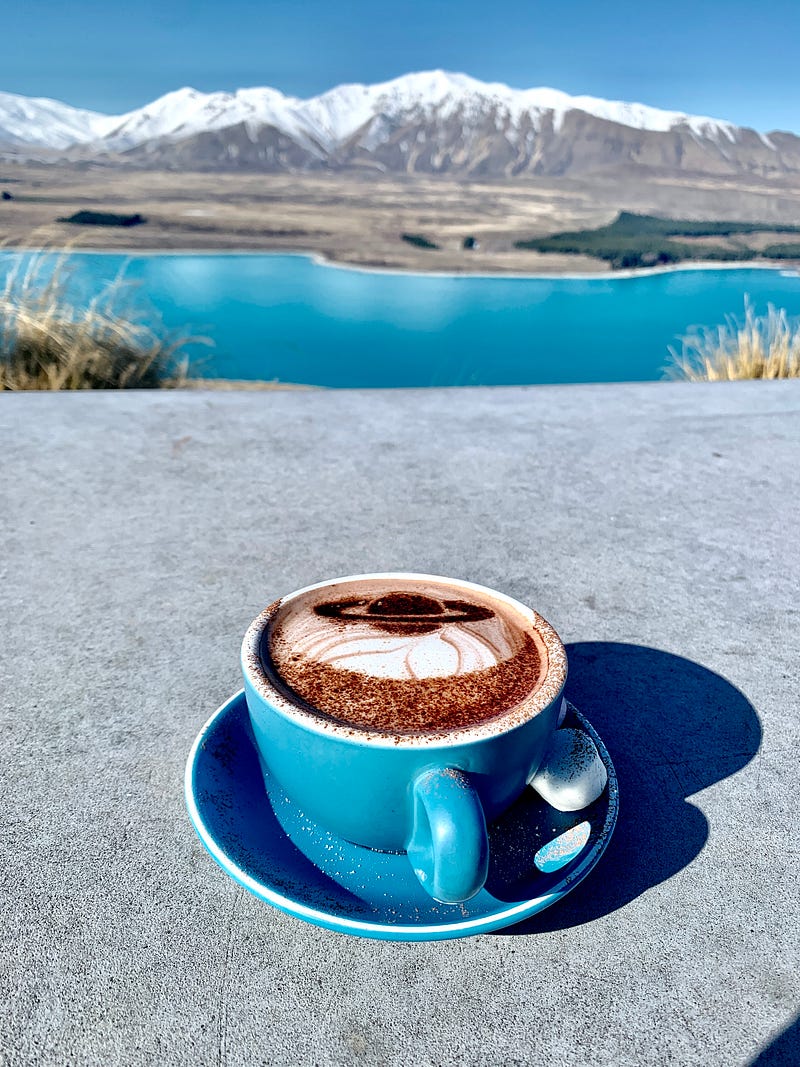
how the color of the cup matches the lake. Note the cinnamon Saturn on the foam</figcaption></figure><p id="ed2e">The enterprising Dark Sky Experience Company, in partnership with the university and Ngāi Tahu Tourism, have set up a cluster of activities that take a hundred or so tourists each night, in two or three batches, to Mount John to watch the heavens though their telescopes. It gives them the best view of the Southern Sky in the world. The company center in Tekapo includes a beautiful display about Māori astronomy, and the legends of the ancestors contained within traditional Māori constellations.</p><p id="fe23">The Dark Sky tours are so popular that they were sold out all but one night during the four days Teresa and I stayed in Tekapo. Unfortunately, the night we were due to go, cloud cover had rolled in and the tour was cancelled. But we didn’t mind so much. Just stepping outside our door on a moonless night was all we needed.</p><p id="920a">The Milky Way arced above us so brightly it looked as if we were seeing it from the outer space. I’m fortunate to have seen the Milky Way from Canada’s far north. But the view from Tekapo was even clearer. I could see with my naked eyes thousands of individual, roughly-spherical, three-dimensional shapes that were distant stars, or clusters of stars, within our galaxy. It was less like a milky way and more like celestial bubble tea, with tiny globes of light suspended in the black bowl of night. I could sense the depth, the <i>spaciousness</i> of space.</p><p id="915a">I craned my neck till it hurt from looking up. I felt as if I could fall into the cosmos. Why was gravity holding my feet to the ground, I wondered? That seemed so ridiculous, when there was so much infinity drawing me skyward.</p> <figure id="28c4"> <div> <div> <img class="ratio" src="http://placehold.it/16x9"> <iframe class="" src="https://cdn.embedly.com/widgets/media.html?src=https%3A%2F%2Fwww.youtube.com%2Fembed%2FuB_x072dkXQ%3Fstart%3D10%26feature%3Doembed%26start%3D10&amp;display_name=YouTube&amp;url=https%3A%2F%2Fwww.youtube.com%2Fwatch%3Fv%3DuB_x072dkXQ&amp;image=https%3A%2F%2Fi.ytimg.com%2Fvi%2FuB_x072dkXQ%2Fhqdefault.jpg&amp;key=a19fcc184b9711e1b4764040d3dc5c07&amp;type=text%2Fhtml&amp;schema=youtube" allowfullscreen="" frameborder="0" height="480" width="854"> </div> </div> </figure></iframe></div></div></figure><p id="bd3b">The Dark Sky Project points to humanity’s global addiction to light, and that the cost of this addiction is the loss of the night sky. Their website sums up their vision and their purpose:</p><p id="d5fc"><i>Millions of children across the world will never see a star, let alone appreciate the Milky Way. We believe that, together, we can change this. The night sky should be accessible to everyone on the planet — tonight, tomorrow and into the future.</i></p><p id="35ba">I’d never thought about this before. I’ve worked with many development experts at the World Bank for whom rural electrification, including street lighting, is taken for granted as a universal good. Kids can study at night, and working late is safer for those who would otherwise walk home in the dark. Economists study satellite images of the earth at night in order to correlate the illumination of countries with their level of economic development. More light at night has been an <i>unquestioned</i> marker of progress.</p><p id="3b75">But how do we quantify the cost of the loss of the dark night sky culturally, psychologically, <i>spiritually</i>? We don’t.</p><p id="e249">The Dark Sky Reserve Project recommends corporations shut off their lights and that residents close their curtains at night. In places like Tekapo, these measures have become local bylaws, simply because the town has realized the darkness is good for business. Even so, as tourism has boomed in Tekapo, new hotels have been built. The lights of one of them shone visibly from our backyard, so we still had to shield our eyes from that direction as we scanned the stars. Air B&Bs have also proliferated. Tourists in the new digs don’t always follow the rules about keeping their curtains shut at night. There seems to be no enforcment for the local dark-sky bylaws. Will Tekapo be able to expand much further without tainting the very night sky that makes it popular? Or will town officials succeed — in a good way — in keeping its citizens in the dark?</p><p id="4585">Imagine, if you will, a world in which everywhere the night sky is dark, a world in which the cosmos shines bright in all our lives each and every evening. How would it change us, as a species, if all we needed to do is look up to be reminded of our humble place in the universe, and to lose our tiny selves, with all our cares, in the infinity of space?</p><p id="6730">***</p><p id="627e">Please check out my new travel book, <i>Mature Flâneur: Slow Travel Through Portugal, France, Italy and Norway:</i></p><div id="b0fb" class="link-block"> <a href="https://www.collectiveinkbooks.com/changemakers-books/our-books/mature-flaneur-slow-travel-europe"> <div> <div> <h2>Mature Flâneur from Changemakers Books</h2> <div><h3>In the aftermath of the pandemic, author Tim Ward and his wife, Teresa, decided to leave their home and professional…</h3></div> <div><p>www.collectiveinkbooks.com</p></div> </div> <div> <div style="background-image: url(https://miro.readmedium.com/v2/resize:fit:320/0*kWETryRqrV_FuWQZ)"></div> </div> </div> </a> </div></article></body>

Mature Flâneur Down Under

The Brightest Stars in the Darkest Sky

New Zealand’s Dark Sky Project at Lake Tekapo
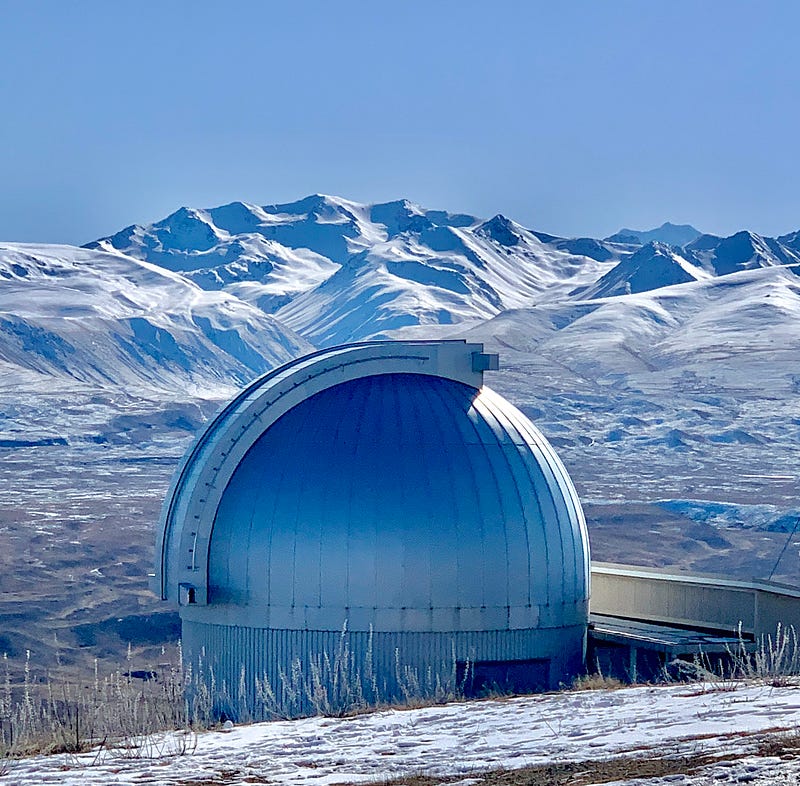
Observatory at the peak of Mount John, Tekapo. All photos by Tim Ward

Have you ever wondered what the stars look like in the darkest sky in the world? I just found out.

We left Aoraki Mount Cook on a bright winter’s day in mid August. Sunlight bounced off the glacial waters of Lake Pūkaki as we drove south along its shoreline, reflecting the light as a deep turquoise hue. Teresa (my beloved spouse) and I were only traveling 90 minutes down the road to the next glacial lake, Lake Tekapo, in MacKenzie County. This ‘high-country” of New Zealand’s South Island is known to the local Māori tribe, the Ngāti Tahu, as the “Hole in the Middle.”
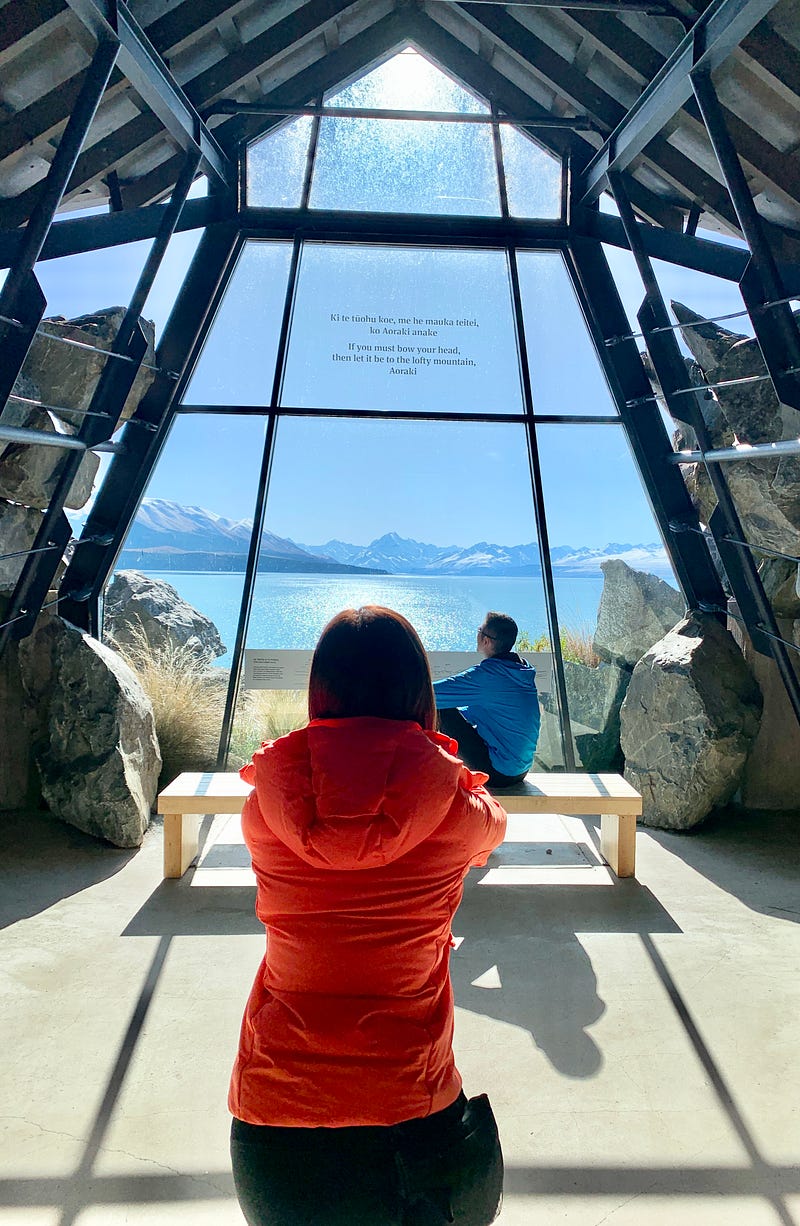
The perfect Instagram spot, inside the pavilion at the scenic viewpoint of Lake Pūkaki. To get to this amazing view of Aoraki Mt. Cook one has to pass the photos and cultural history of the “Hole in the Middle.” The viewpoint is actually a Māori “honey pot” for educating tourists about the land dispute!

We stopped along the way at a stunning viewpoint at the end of Lake Pūkaki that featured a Māori pavilion which explained the region’s curious moniker. According to the display, in 1848 the Ngāti Tahu tribe sold 14 million acres of plains land to the New Zealand Government. The tribe intended that the boundary would be the foothills of the mountains. However the government assumed control of all the land from the foothills right up to the Southern Alps. Many Ngāti Tahu found themselves suddenly landless, And, when tribe members travelled to their traditional resource camps for summer hunting and fishing, they were suddenly treated as trespassers.
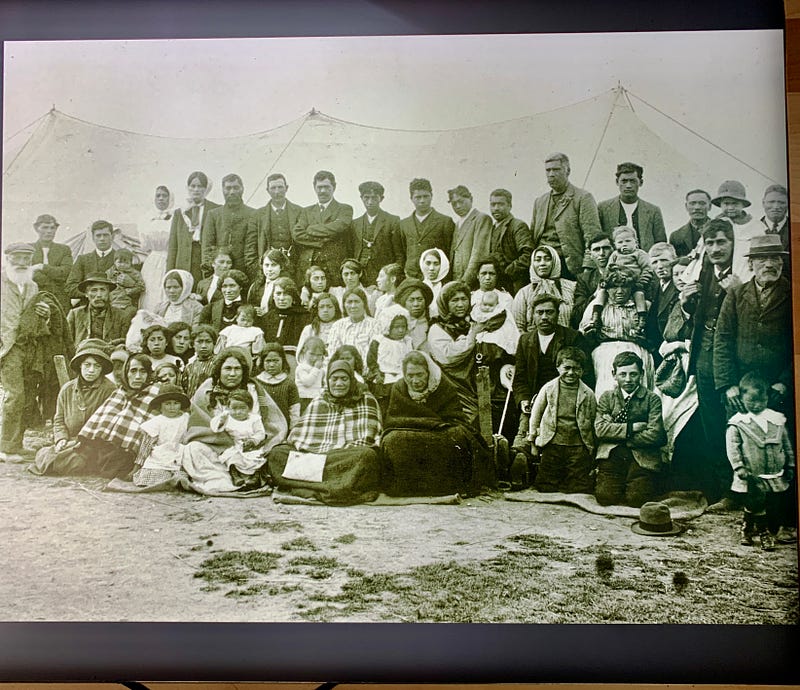
Some of the Ngāti Tahu tribe members who staged a peaceful protest against the seizure of their lands (my photo of the plaque at Lake Pūkaki).

In 1877, over 100 Ngāti Tahu tribe members staged a peaceful protest over the injustice of the “Hole in the Middle,” camping out on their traditional land — until they were forcibly removed two years later. The dispute has never been resolved, but work is underway to address it right now. The government has agreed to renegotiate areas of historical cultural value for the tribe, and so an extensive cultural mapping project is underway that will build a Ngāti Tahu Atlas. This will establish a historical-cultural claim for their case of ownership. I’ve never heard of anything like this “cultural atlas” project before, and I wonder if it could serve as a template for native land claims in other countries?

One of the biggest upsides of restoring tribal ownership of the “Hole in the Middle” is that the Māori have always seen themselves as custodians of the land. “People perish, but land is permanent,” is a Māori saying I have come across several times. The current environmentally-progressive New Zealand government has made many deals with the Māori in the past several years to return their stolen lands under the aegis of joint conservation stewardship. To me, this is an exciting way forward for the country. It also marks a change of direction for the “Pākehā” (British settler) population, after 150 years of treaty violations and the ecological damage to the land. It’s the rare case where one right corrects two wrongs.
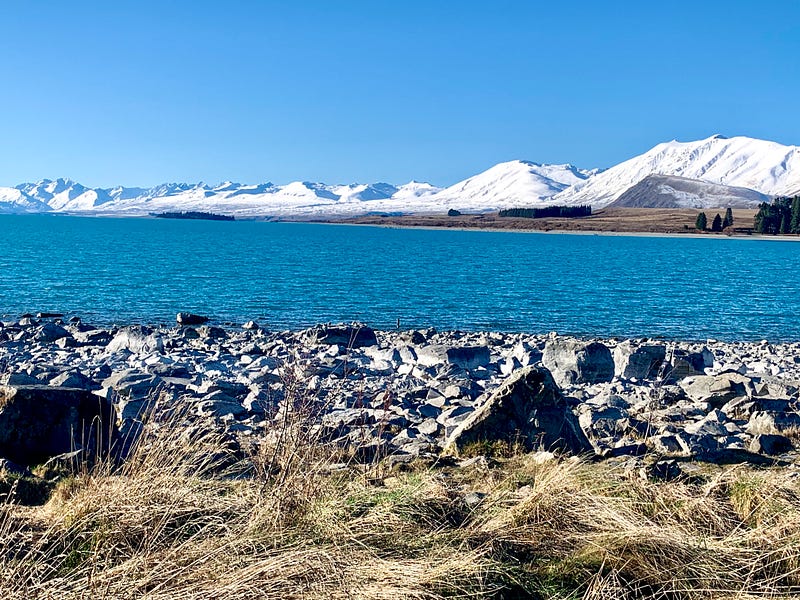
Lake Tekapo: dive in with your eyes. The water’s cold.

The natural value of the “Hole in the Middle” is simply that it is pretty much a hole — empty of most human development. It’s a harsh, dry landscape, and one of the last places in New Zealand to be converted into pasture. It is also stunningly beautiful. Driving in along the Number Eight Highway into Lake Tekapo in wintertime is visually overwhelming: The turquoise lake is ringed on three sides by rough, tan hills covered in fresh, white snow. It’s a palate of perfect colors. It makes me wish I were a painter, simply to have the excuse to stand by this stark shore, brush in hand, and gaze across the water for hours.
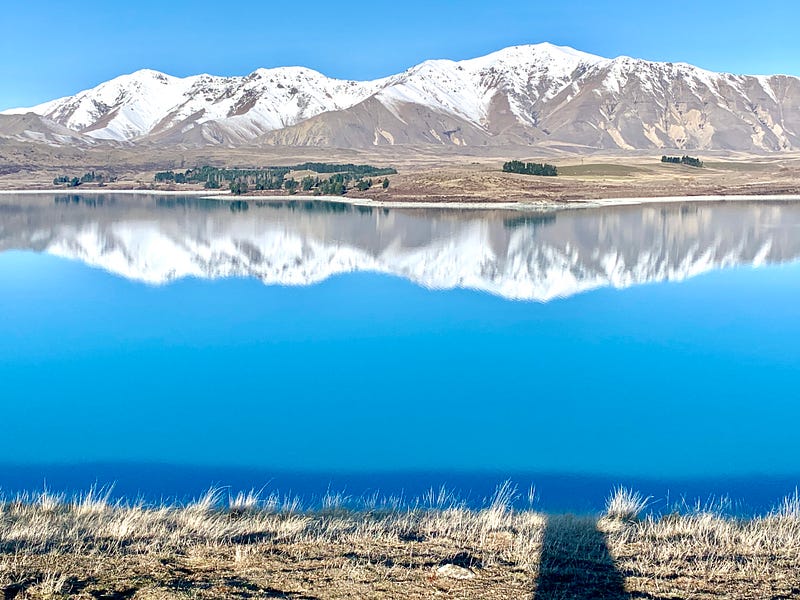
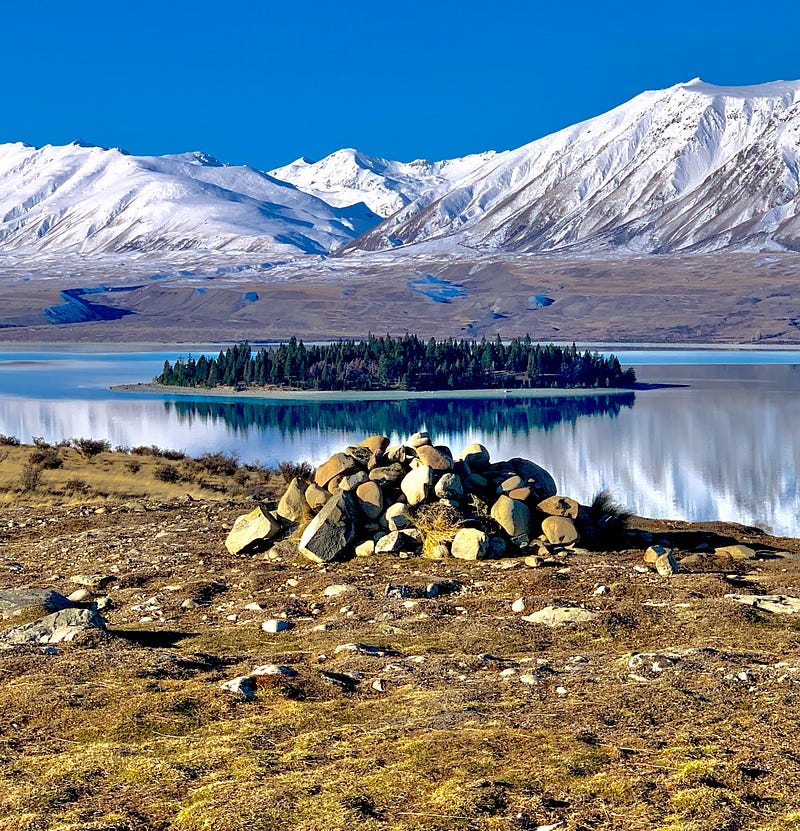
Views of Lake Tekapo

The first European to arrive at Lake Tekapo was a Scotsman, James Mackenzie. In 1855 Mackenzie drove a flock of stolen sheep into this high country, sure that no one would ever find them way up here. The law caught up with MacKenzie, eventually. However, catching him proved easier that rounding up his stolen sheep, scattered in the hills. History is funny, though. Mackenzie the thief has been immortalized — this whole county, plus a nearby mountain range, was named after him — while the men who persued him in the name of justice are long forgotten.
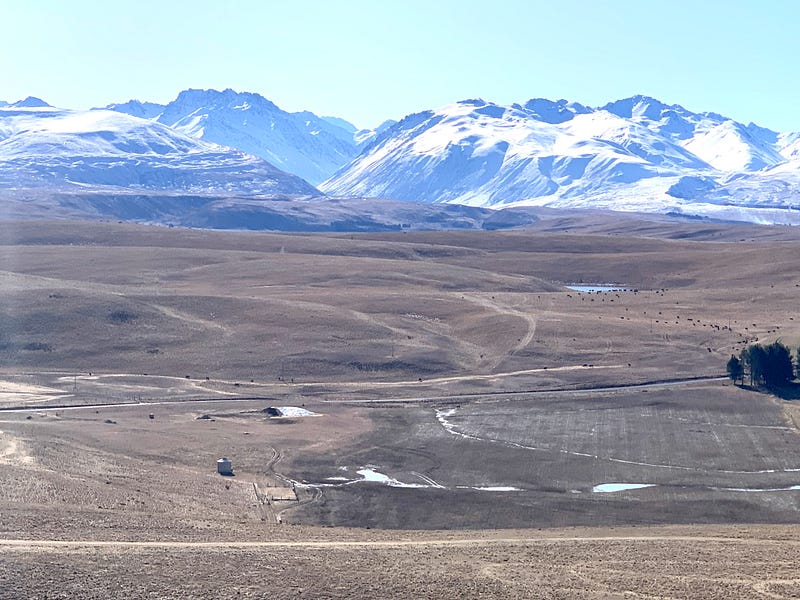
Sheep (white dots) and cattle(black dots) on a ranch near Tekapo.

Legal sheep ranching in the high country followed soon after MacKenzie’s arrest. But it was hard going. Only large leaseholds of several thousand acres were big enough to support profitable herds. Even so, several bitter winters in the late 1800s killed many sheep. Today, it’s still a tough business, as wool prices have declined globally. The government removed some farm subsidies in the 1990s, and now reviews leaseholds to make sure they are complying with what some farmers see as excessive environmental regulations.

According to the Stuff article (above), farmers make the case that they do a better job of caring for the land than the government does on areas it has set aside for conservation. The latter get overrun with invasive species and pests like rabbits and wallabies (introduced from Australia), which farmers work vigilantly to reduce on the land they control.
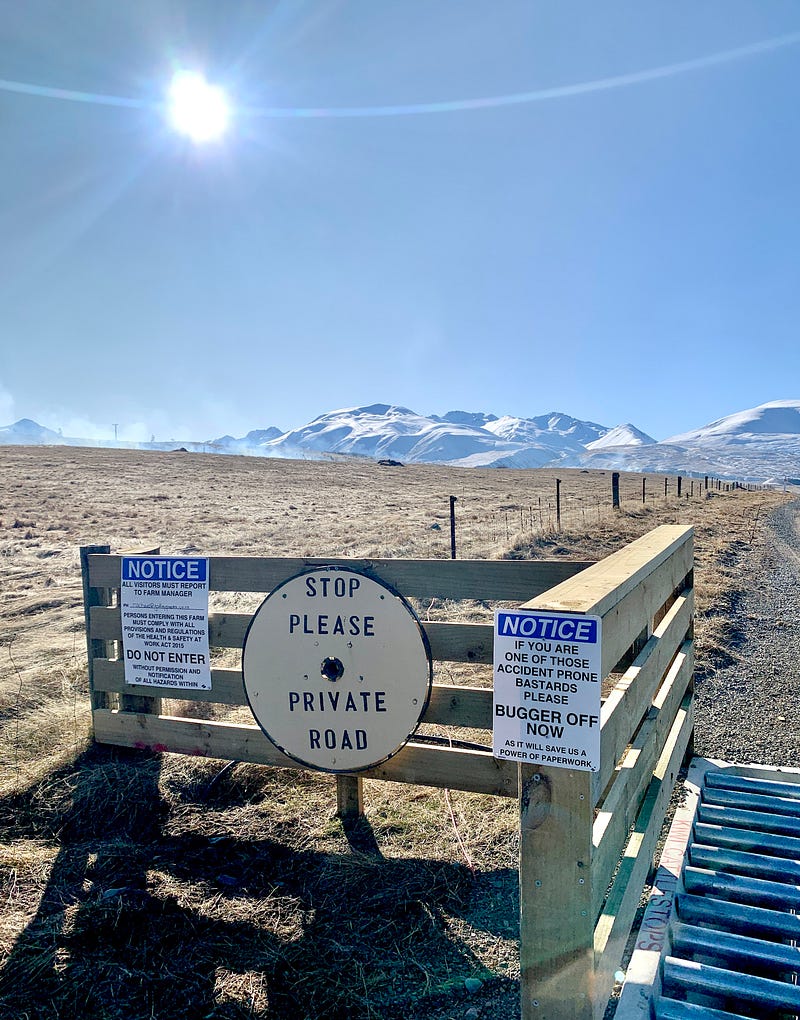
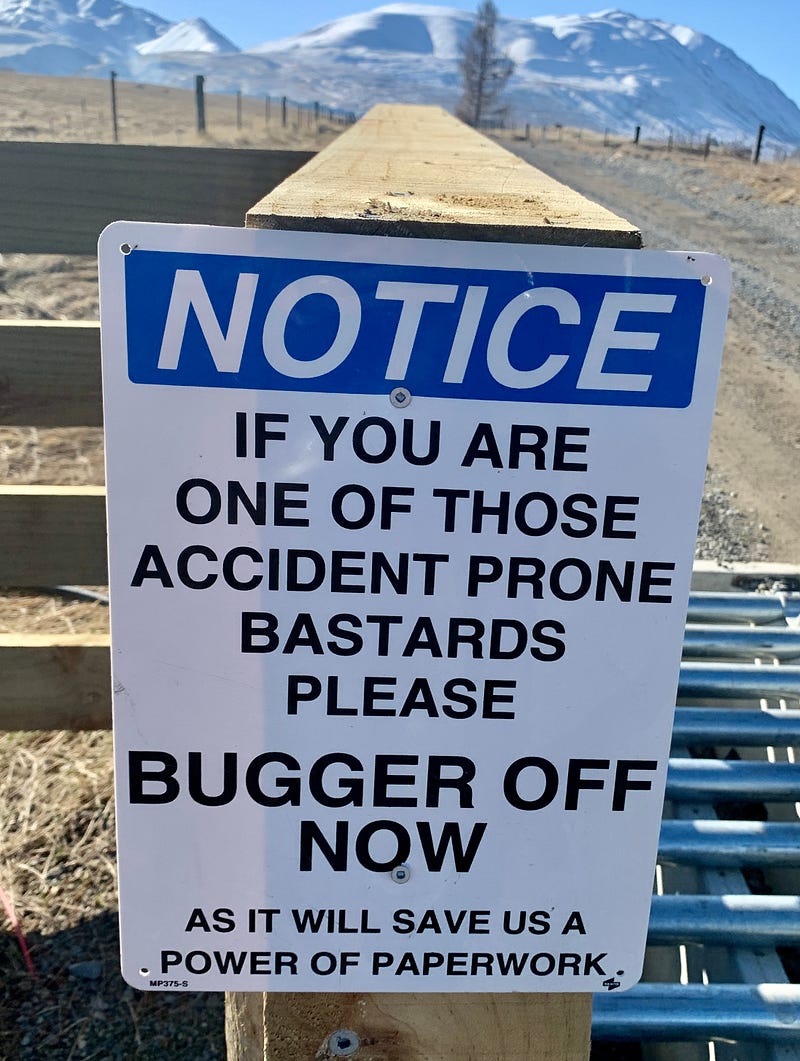
This fruatrated farmer posted a sign to keep uninvited tourists off his land. We turned around at this point, not wishing to press our luck!

Ranchers are also removing the “wilding pines” which their fathers’ generation planted for supplementary timber income. These trees have become a nightmare, as seedlings spread like wildfire through pastureland, and their roots soak up whatever available moisture there is in the ground. These trees take over a landscape in just a few years, unless someone has a powerful incentive to cut them and burn them — and pull new saplings out by the roots. Teresa and I saw this ourselves the day we drove along the Lake Tekapo coast, as we passed a smouldering heap newly-cut pines.
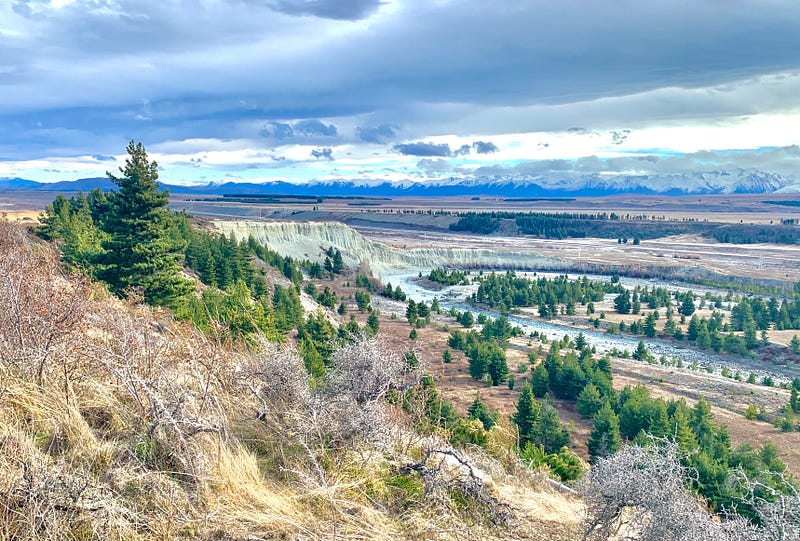
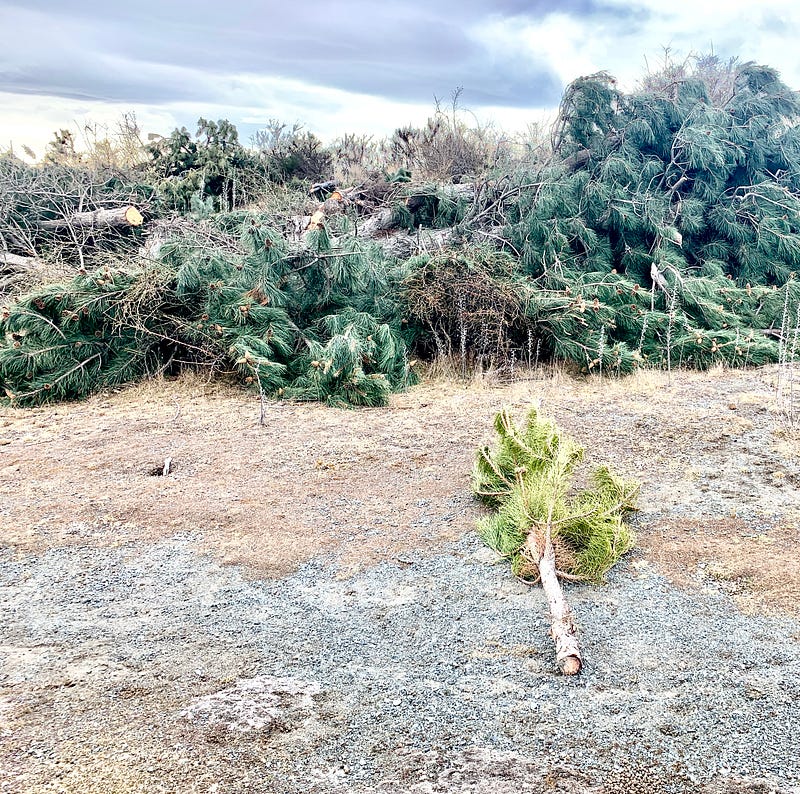
Left: Wilding pines proliferate in the river valley behind Tekapo; their roots suck the land dry. Right: newly removed wilding pines, a Sysiphian task.

As ranchers struggle to hang on, citizens of the little town of Tekapo look to tourism and science for their economic future. The draw: Tekapo’s dark night sky. Why is the sky so dark? Because there is no light beneath it. To the north, east, and south the nearest population centers are more than 150 kilometres distant. Looking to the west, there is nothing but a few sheep farms between Tekapo the coast of Australia, some 4,000 km away. As a result, this whole region has been declared the “Aoraki Mackenzie International Dark Sky Reserve.” It is the largest gold-standard International Dark Sky Reserve in the world.

And so, the “Hole in the Middle” has become a window to the heavens.

Right next to Tekapo is a little mountain, Mount John. On its peak, four world-class telescope observatories and a dozen other instruments have been erected by the University of Canterbury. Its astronomy department conducts research projects on Mount John, as well as sharing the facilities with other astronomers from around the world.
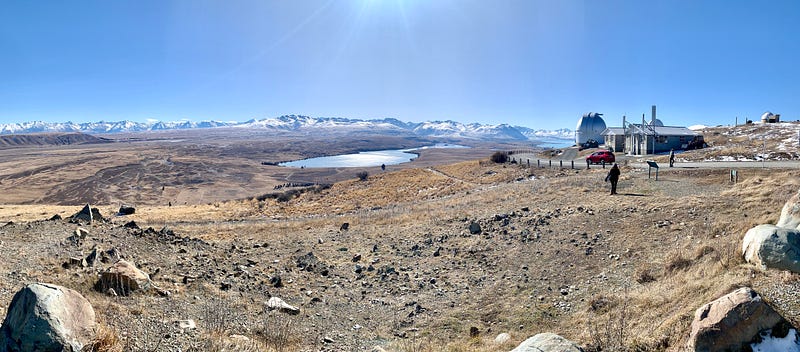
The view from Mount John
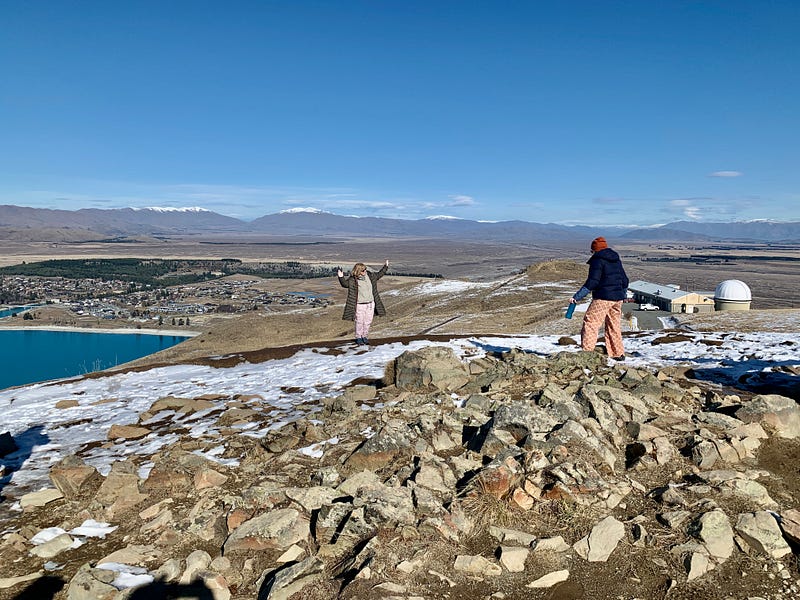
Left: Selfie moment for tourists on Mount John, with the town of Tekapo in the background. Right: Celestial cappucino from the Mount John cafe. I like how the color of the cup matches the lake. Note the cinnamon Saturn on the foam

The enterprising Dark Sky Experience Company, in partnership with the university and Ngāi Tahu Tourism, have set up a cluster of activities that take a hundred or so tourists each night, in two or three batches, to Mount John to watch the heavens though their telescopes. It gives them the best view of the Southern Sky in the world. The company center in Tekapo includes a beautiful display about Māori astronomy, and the legends of the ancestors contained within traditional Māori constellations.

The Dark Sky tours are so popular that they were sold out all but one night during the four days Teresa and I stayed in Tekapo. Unfortunately, the night we were due to go, cloud cover had rolled in and the tour was cancelled. But we didn’t mind so much. Just stepping outside our door on a moonless night was all we needed.

The Milky Way arced above us so brightly it looked as if we were seeing it from the outer space. I’m fortunate to have seen the Milky Way from Canada’s far north. But the view from Tekapo was even clearer. I could see with my naked eyes thousands of individual, roughly-spherical, three-dimensional shapes that were distant stars, or clusters of stars, within our galaxy. It was less like a milky way and more like celestial bubble tea, with tiny globes of light suspended in the black bowl of night. I could sense the depth, the spaciousness of space.

I craned my neck till it hurt from looking up. I felt as if I could fall into the cosmos. Why was gravity holding my feet to the ground, I wondered? That seemed so ridiculous, when there was so much infinity drawing me skyward.

The Dark Sky Project points to humanity’s global addiction to light, and that the cost of this addiction is the loss of the night sky. Their website sums up their vision and their purpose:

Millions of children across the world will never see a star, let alone appreciate the Milky Way. We believe that, together, we can change this. The night sky should be accessible to everyone on the planet — tonight, tomorrow and into the future.

I’d never thought about this before. I’ve worked with many development experts at the World Bank for whom rural electrification, including street lighting, is taken for granted as a universal good. Kids can study at night, and working late is safer for those who would otherwise walk home in the dark. Economists study satellite images of the earth at night in order to correlate the illumination of countries with their level of economic development. More light at night has been an unquestioned marker of progress.

But how do we quantify the cost of the loss of the dark night sky culturally, psychologically, spiritually? We don’t.

The Dark Sky Reserve Project recommends corporations shut off their lights and that residents close their curtains at night. In places like Tekapo, these measures have become local bylaws, simply because the town has realized the darkness is good for business. Even so, as tourism has boomed in Tekapo, new hotels have been built. The lights of one of them shone visibly from our backyard, so we still had to shield our eyes from that direction as we scanned the stars. Air B&Bs have also proliferated. Tourists in the new digs don’t always follow the rules about keeping their curtains shut at night. There seems to be no enforcment for the local dark-sky bylaws. Will Tekapo be able to expand much further without tainting the very night sky that makes it popular? Or will town officials succeed — in a good way — in keeping its citizens in the dark?

Imagine, if you will, a world in which everywhere the night sky is dark, a world in which the cosmos shines bright in all our lives each and every evening. How would it change us, as a species, if all we needed to do is look up to be reminded of our humble place in the universe, and to lose our tiny selves, with all our cares, in the infinity of space?

***

Please check out my new travel book, Mature Flâneur: Slow Travel Through Portugal, France, Italy and Norway:

New Zealand
Globetrotter
Observatory
Flaneur
Travel
Recommended from ReadMedium