
The Brand Loyalty
A Case Study : Dialog Axiata , Sri Lanka

Brand loyalty is the positive association consumers attach to a particular product or service, and dedicated to purchase the same product or service repeatedly, regardless of a competitor’s actions or changes in the environment. Most of the people are brand loyal and this study is trying to understand the brand loyalty towards the telecommunication service provider over the other competitors in the country.
Product Introduction
The basic requirement of a telecommunication service provider is to obtain an uninterrupted communication between the people, irrespective of the distance, location, and the time. Out of the five-telecommunication service providers in Sri Lanka, Dialog Axiata, is believed to be the market leader, in term of the island-wide coverage, service differentiation and customer base.
However, it is known that the telecommunication brand Dialog is charging higher prices than its competitors are. The switching cost is zero to minimal when changing the telecommunication brand in Sri Lanka. Even though there are no restrictions to change the telecommunication service provider, many users stick with the brand Dialog.
At the same time, all of the competitive telecommunication brands provide satisfactory island-wide coverage similar to Dialog. Due to these reasons, the brand rigidity of the Dialog customers are beyond the mere pros and cons of the product per se. Therefore, it needs to understand the reasons behind the brand loyalty towards the Dialog telecommunication provider.
The Purchasing Process
The revolution of wireless phones reach Sri Lanka in the late nineties. Back then, the mobile phones were a luxury good and very few owned a one. With the development of technology, the number of telecommunication providers in the country increased.
Dialog is one of the oldest telecommunication providers to reach the country. During the early years of operation, the brand Dialog charged a premium price while the rest is only one-tenth of its price. Dialog had a higher net asset value with telecommunication infrastructure, which was incomparable with the others. With this strength, the Dialog was able to provide competitive coverage and service to the customers.
When it comes to today, all the telecommunication provides have a higher net asset value with similar telecommunication infrastructure. However, most of the consumers believe the Dialog is still superior as they experienced many years back. Due to this perception, most of the customers stay loyal and brand rigid. They refuse to switch the brand Dialog, though the other telecommunication providers give the same service even at a lesser cost.
The behavior of purchasing the Dialog and the brand loyalty can explained through the Perception and Attitude, which are the two main driving forces of the purchasing decision.
1. Perception
According to (Solomon, 2016), ‘Perception is the process by which people select, organize, and interpret sensations. We obtain the stimuli from the environment, organize it within ourselves, and later interpret the same. Since this process mostly happen unconsciously, it is important to understand the process that affects the brand loyalty towards Dialog. The perceptual process had further elaborated in the figure.
Perceptual process

1.1 Selection
As indicated in the figure, the perception starts with a selection of a stimulus. Stimulus is an interesting and exciting quality. Though there are many stimuli around, we mostly focus on few to make the purchase decision and some related stimulus have identified below;
- Position
Dialog has been the market leader for a longer period and therefore it has positioned as a premium brand in the consumer minds. Hence, the purchase of the product gives a feeling of using a luxury brand.
- Word of mouth
The comments made by most of the Dialog users are positive. The positive word of mouth created a feeling of worth having it, which influenced the brand loyalty.
- Music
The music in the advertisements is pleasing and giving a feeling of prestige. However, the theme music plays for a few seconds it has given a unique identity as well. Hence, the music gives the feeling of belonging to claim that ‘I’m also a part of it’.
- Color, Ambience, and Staff
The theme colors and logo of Dialog are attractive, vibrant, and creative. The ambiance at the service outlets is also pleasant and unique which gives a luxury appearance compared to others. At the same time, the staff in Dialog are also very helpful and competent. Hence, it is easy to be with the Dialog not solely for communication purposes but also for all the other service requirements.
1.2 Organization
Through the obtained stimulus, Dialog has positioned as a reputed, luxury, and quality product in the consumers mind. The only contradicting stimuli is the feeling of wasting money, which is justified by the outstanding performances of the brand. Based on the organization of the stimuli consumers can make few interpretations according to their beliefs and understanding.
1.3 Interpretation
Few interpretations can be made based on the selection and organization of the stimulus obtained.
a. How to interpret the Brand Superiority?
Dialog is better as it has good island-wide coverage. It has coverage even to rural areas, where the competitor networks do not have. It is easy to contact the help desk and get the required information and instructions. The service centers are providing the services even at extended hours, which is convenient for many. Due to all these reasons, it can be interpreted that Dialog as a better service provider than the competitors do.
b. How to interpret the Brand Rigidity?
Though the competitor brands are cheap, it is insufficient to select another service provider, as Dialog has given the feeling of self-esteem. It is ‘The Most Prestige Brand’ to use with innovation and technology. At the same time, the company is stable and making good profits, which evident the possibilities of providing better services in the future.
c. How to interpret the behavior of recommending the product to others?
Consumers of Dialog usually recommend the brand to others and encourage non-users to shift their service provider. This is backed by the “Me too” attitude. Hence, many Dialog customers tend to convince the other users to be a Dialog customer, without any financial benefit.
Apart from the perception, the consumer attitudes towards the brand also affect the behavior of brand loyalty.
Though Dialog is providing an intangible service, most of the stimulus is tangible through which the product has well positioned in the mind of consumers.
2. Attitude
According to Hoyer et al. (2013) ‘An attitude is an overall evaluation that expresses how much we like or dislike an object, issue, person or action’. According to the table, the composition of an attitude can be revealed.
Composition of Attitudes
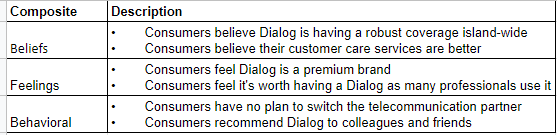
As depicted in the table, the attitude towards Dialog can be elaborated based on beliefs, feelings, and behavioral aspects. Consumers’ belief on Dialog’s performances are all positive, through which they feel it’s a prestige to have a Dialog. Due to those beliefs and feelings, consumers are brand loyal and have no intention to move into another brand, irrespective of the benefits provided. This consistency can be further understood through the cognitive dissonance theory.
2.1 Cognitive Dissonance
According to cognitive dissonance theory, many individuals try to see the consistency in their cognitions, where the same can be seen at the brand loyalty towards Dialog. Consumers have been consistent in their opinion of using a Dialog without moving to any other brand for a reasonably long period.
At the same time when consumers see price advantages given by the rival products; they always justify their behavior by thinking that Dialog provides a better service than any other competitor does. This behavior supports interpretation under the theory, where a dissonance arises; there is an automatic justification to be consistent on the same behavior.
Conclusion
The brand loyalty of the customers towards Dialog has been consistent for a longer period, to which the perception and the attitude has played a major part. When the customers became brand loyal it’s difficult to convince other competitive products in the market. Therefore, if a company wants to have a solid customer base, the best tactic to follow is to create a Strong Brand Loyalty.


