
The ‘Bolívar Soberano’ Untangled: Three Ways to Understand This New Venezuelan Crisis
August brings a new chapter in a never-ending debacle that is changing Latin America as a whole. Here are three questions+answers to see why.
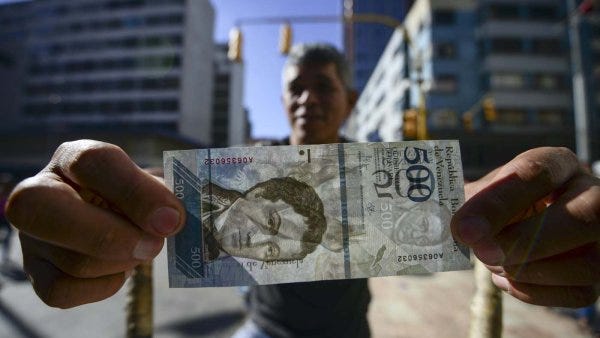
By today you should have seen some tweets, headlines or videos saying something about Venezuela’s currency, small businesses shutting down and people rushing to stock up food.
On Monday 21st, businesses were closed for two main reasons: to calculate how they will charge for their goods and/or to support a strike against Maduro’s measures.
But if you haven’t, then here’s a three-line summary that you can memorize to sound all well-informed and smart:
Venezuela’s currency -the ‘bolívar’- was worth so little, and hyperinflation was soaring so bad, that the government came up with renaming its currency as the ‘bolívar soberano’, promising to make it more valuable. In number language, it sort of works like this: 1 ‘bolívar soberano’ is worth 100,000 old ‘bolívares’ (to do a quick calculus, just chop 5 zeroes on the old bills). Oh, and there’s also the ‘petro’, a government bitcoin that will back the ‘bolívar soberano’.
Say what? There’s a cryptocurrency involved?
So now we go with the first question: What is the ‘petro’?
The first way to see Maduro’s announcement is that he’s gone all the way to unexplored soil. Worse than Interestelar and The Last Days on Mars altogether (you sci-fi creeps know what I mean). The petro was launched in March this year and yes, it’s the first cryptocurrency created by a Latino government (or a government at all). All this crypto stuff have to be backed up by something, at least formally speaking. In this case, Maduro says it’s supported on oil, gas, gold and diamonds reserves.
But why would a country need to create a parallel currency at all? The structural reason is very particular of the Venezuelan economy: they import everything but produce pretty much nothing worth of exportation. The government has been printing money to ease the lack of income (#NotOk). As of now, they have little to zero sources of income and selling a cryptocurrency to who knows who can, theoretically, bring money in. How much is a petro worth? According to Maduro, $60. Not a fixed price, though.
[Warning: this part gets complex] What’s more appalling about this is that Venezuela is pretty much telling the world that their unit of account, the legal way for a country to value their goods and debts, will ignore the dollar… Meaning, Venezuela is set to ignore how everyone else in the world is valuing legal commerce and credit. Cryptocurrencies are still far from being considered a unit of account, as our friend Robert Cookson explains it here:
Second obvious question: what does it all mean for the Venezuelan economy?
It means two things, as far as I have researched. First, the petro will most likely fail to generate income for the country and to transform it into a “digital economy,” as the petro website says. It’s a shady thing. Just one example: the Initial Coin Offer, which is like the IPO of a company’s share in the stock market, has reached USD 5,000 million, says the government. This CryptoCompare site says funds raised are USD 750 million, but it shows no trading activity.
Alejandro Nieto (@vacasueca) saw the future and wrote about the petro on “El blog salmón” [ESP] back in December 2017, when Maduro had just made the announcement. Nieto wrote: “The petro could ease the hyperinflation spiral. If it’s well designed, it could set an algorithmic limit to the money printing […] On the other hand, it’s also interesting to note what the petro won’t be good for stopping the Venezuelan crisis.” How come? Because the Venezuelan crisis, in the long term (which is what really matters now), has to do with a government that has long lost credibility, a huge unpaid debt, close-to-zero national production and oil’s dependency.
Second, it opens the door for money laundering. Really, who’s trading or will want to trade this? I interviewed Venezuelan journalist Andrés Segovia (@ReporteroAndres), also an active member of political party Vente Venezuela, and he was blunt about what the petro really means:
“Since Venezuela is not getting income from oil, the government is trying to turn this country into a big money laundering machine. Let’s say I have USD 100,000 coming from shady activities, now I can turn them easily into petros. They [politicians in power] are going to launder their own money with it.”
All in all, as pointed out by the FT editorial, these are desperate, not-much-to-expect-from measures. The change of currency comes along with other measures that have surprised most economists and Venezuelans themselves. One of them is the rise of the minimum salary by 35x. Now Venezuelans will be making an average of USD 30 a month… Not all of them of course. Being this the fifth rise this year, Venezuelans don’t find much solace in it:
“Most people in Venezuela assume the rise in the base salary is due to hyperinflation, even if they don’t understand much about monetary policy. You won’t be happy about it, unless you work with the government or believe in its revolution. Nevertheless, the rise has been brutal this time. When Maduro said on TV that the rise would be of ‘180 million [old] bolívares’, some people thought he said the wrong number, because it was too much,” says Andrés.
Here are more Venezuelans explaining why they don’t expect much from their new minimum salary:
How does this affect Latin America?: a bigger exodus is happening right now and neighbor countries don’t know what to do
This will mostly affect South America, mainly Colombia, Ecuador, Peru, Brazil, Argentina, and Chile. These countries aren’t used to get massive amounts of immigrants in such a short notice, so most of them basically got scared and took some measures that are being highly criticized, although getting support, too, as you might imagine. Here’s a summary of them:
This is not a minor thing to consider in terms of the cultural shift South America is about to go through. Depending on where you’re from in South America, it will be very easy to support a xenophobic discourse without even recognizing it, because some countries have never had such huge immigration, specifically of vulnerable, poor people, in years.
Just to make a quick comparison: Chile has been getting an influx of Haitians for some years now, after a terrible earthquake devastated the country, as well as of Peruvians, since the economic crisis of 1980, but Peru has not ever experienced such immigration in the modern era. I mean, for Peru, the word “migrant” within the country has often meant people moving out from the highlands and the jungle areas to the capital city, Lima, and that happened in the 50s and the 70s. I’ve always thought it’s a crazy thing to consider a person from your country like that, but that’s how centralized we are… Truth is, Peruvians aren’t used to deal with faces different than their own.
Andrés Segovia, our fellow Venezuelan insider for this article, shared a personal story to illustrate the exodus is not a thing of the moment, and that it will continue happening:
“I’m the youngest person in my family living in Venezuela now. I only have my mom, an uncle and older cousin here. Everybody left. The latest data says 5,000 people arrived to Peru in one day a week ago. I believe it.”
Hell has broken loose a bit more. The exodus figures are so astonishing that The Economist made them its Daily Chart this past Monday. One of the conclusions were: Venezuelan forced displacement might surpass the Syrian crisis.
Next time someone mentions Venezuela, now you know 2018 marks a new era not only for one country but a whole region.


