The Bizarre Mathematics of Democracy
Singapore Lessons from GE2020 General Elections
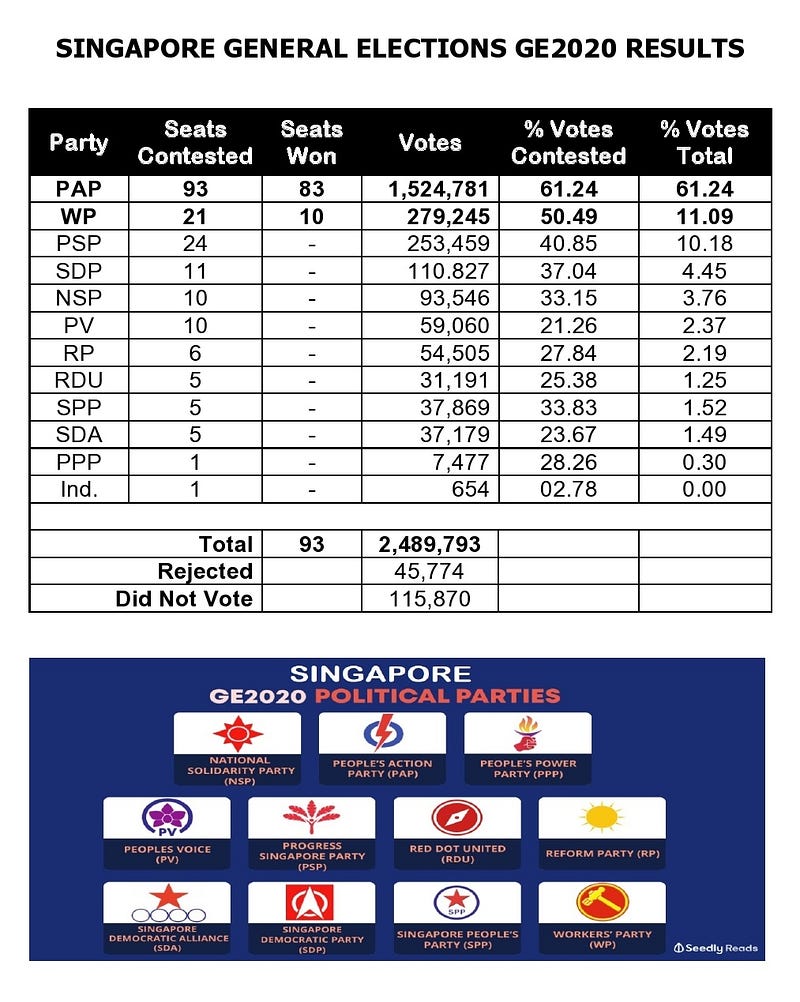
Singapore has more than 20 registered political parties. In the recent General Elections (GE2020) held on 10 July, the ruling People’s Action Party (PAP) won 61.24% of the popular vote. This translated to 83 (89.2%) of the 93 Parliamentary seats, with the remaining 10 (10.8%) going to the Workers’ Party (WP). In the vibrant Singapore democracy, 191 candidates from 11 political parties and 1 Independent contested every seat in this Singapore’s “Crisis” General Elections.
Prime Minister (PM) Lee Hsien Loong correctly pointed out that the results reflected “broad-based support for the PAP” (because) “Singaporeans understand what is at stake and why we must come together to uphold our national interests.” PM Lee vowed “to use this mandate responsibly to deal with COVID-19 and the economic downturn to take us through the crisis safely and beyond”.
This article looks at the actual popular votes to obtain a better understanding of the Singapore democracy model and its system of democratic governance selection.
In terms of actual electoral affirmation by voters, the PAP is supported by 61.24% and the WP by 11.09% of the votes. These figures changed dramatically when adjusted for only the Constituencies won respectively. In the event, the PAP obtained 56.4% vs 6.47% for the WP. What happens then to 37.13% of the total votes which were cast for candidates who did not win? Which political party represents the 37.13% in Parliament?
The mathematics of Democracy is baffling for those less familiar with its purpose and motivation. Parliament is seated by Members of Parliament (MP) representing their respective political Constituencies. The secrecy of the vote means that each MP would represent all the voters in his Constituency, including those who did not vote for him/her and those who spoiled their vote or did not vote. Therefore, the PAP with 61.24% of the votes received occupies 83 (89.2%) of the 93 Parliamentary seats, with the remaining 10 seats (10.8%) going to the Workers’ Party (WP) who received 11.09% of the total votes. As the Majority in Parliament, the PAP thus forms the Government.
The Government represents the interests of every voters regardless of how and for whom they voted.
Every voter is represented in Parliament, whether or not he/she has voted for his/her MP. Even the WP would also represent the 122,234 voters (or 4.9% of the total electorate) who voted for the PAP in its Aljunied GRC, Sengkang GRC and Hougang SMC combined. Likewise, the PAP would also continue to represent its supporters as well as the other 38.76% non-PAP voters.
WHAT DOES POLITICAL REPRESENTATION MEAN?
The Singapore Parliament, like the population, is not divided ideologically like, say, in the United States (USA), United Kingdom (UK), European Countries or Malaysia. There is no appealing to those who are Conservatives or Liberals, Socialists or any other shades of political ideology. During their hustings, Opposition Parties advocated things like “no blank cheques”, “diverse voices”, “equality”, “social justice”, “lesser foreign workers”, “freedom of speech” and similar esoteric issues.
The lack of political education in schools did not equip a vast number of voters with the understanding of politics and the necessary intellectual and emotional defense tools, and thus rendered them gullible and susceptible to popular trends and radical ideas from other countries like the USA, UK, Hong Kong and Europe. The general absence of critical thinking skills and debating training at the Secondary, Post-Secondary and University levels further stunted a fuller political maturity of Singaporeans.
All elections are about the future. The vast number of the electors are more concerned with municipal matters such as town cleanliness, responsiveness of maintenance teams, bus transportation routes and timing, MRT rapid transit efficiency, law and order, schools and convenient facilities … etc.
Parliament represents the majority interests of the people and MPs vote to support policy solutions to produce the greatest good for the largest number.
ADDRESSING GE2020 ISSUES
The 2 major core issues during GE2020 at the National level included the slow and delayed rollout of the generous financial covid19 packages which resulted in more than 30,000 on a waitlist as well as several hundreds or thousands small businesses on another waitlist for a payroll support scheme. This is an unfortunate, almost fatal, self-inflicted unforced error on the part of an otherwise efficient Government.
The other major GE2020 core issue was a “real” perception reinforced by strong subjective and intellectual emotions of an arrogant, elitist, unfeeling and uncaring PAP. These feelings are however generally not shared by most residents in their neighbourhoods even as they interact regularly with their MPs during their Walkabouts and weekly Meet-the-People Sessions (MPS) when they seek the MPs’ assistance to petition Governmental departments to consider their purported grievance favourable.
The Civil Service could be a possible source of the perception of an arrogant system lacking in public empathy and compassion for the pain and sufferings of the ground folks. Technology now replaces fast responsiveness and face-to-face communications. Emails replies require at least 5 days, payments takes weeks and there is no convenient hot-lines where a trained, motivated and willing staff would engage residents on urgent issues. Compulsory eAppointments and large waiting rooms, even with appointments, easily convey the absence of respect, empathy and public sensitivity. Overall, there is little sense of public servant leadership in the Civil Service, which is blamed on the PAP, who is seen as the proxy for Government, and made the convenient patsy for Civil Service unfriendliness.
Parliament, across Party lines, cannot become complacent or judgmental by being dismissive of such “real” perception. Rather, program initiatives are imperative to demonstrate that the Government bureaucracy is humble enough to respect, appreciate, embrace and engage their emotions and (unfounded) deep-seated suspicions of our power and authority.
WHITHER DEMOCRACY IN SINGAPORE?
Many news reports have conveniently highlighted an 8.7% swing from the PAP’s 69.9% share in GE2015. This comparison is fortunately wrong since the September GE2015 was held then against the backdrop where Singaporeans were still in grief mourning the demise of its long-time leader Lee Kuan Yew only in March 2015.
The GE2020 Results (Below) shows no evidence of any groundswell of anti-PAP sentiments in GE2020. The Prime Minister himself, and his Ang Mo Kio GRC Team of Candidates, was awarded an outstanding personal mandate and endorsement of 72%, even as the PAP overall vote share was 61.24%.
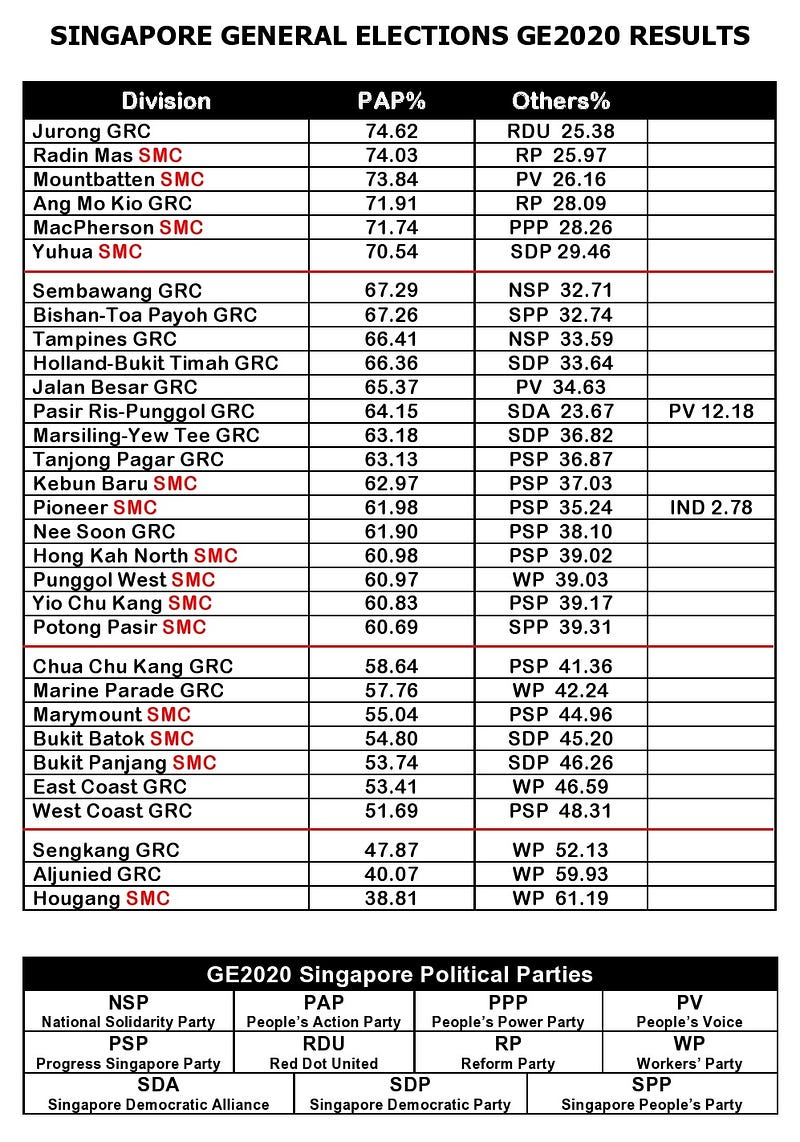
GRC — Group Representative Constituency
SMC — Single Member Constituency
There is no one best form or style of Democracy.
True, governmental accountability and fairness are important. The cry for “no blank cheque” went unheeded because to the vast number of the informed and educated electorate, only governmental performance matters. The Singapore electorate has consistently returned the PAP to legitimate power in accordance with the tremendous public trust in a government known for its transparency and anti-corruption values.
Factually, unrestricted public access to open parliamentary proceedings, verbatim Hansard records of Parliament debates, mandated regular elections, open governmental contracting practices, detailed reports of oversight committees as well as frequent regular conversations with political leaders and elected officials all point beyond conclusive evidence of accountability, transparency and fairness.
In GE2020, other than the Workers’ Party, no other Opposition Party Leaders obtained enough votes for Parliamentary seats. This is not a failure of democracy in Singapore, just the failure of leadership and imagination on the part of the Opposition. 93 Candidates from 10 Opposition Parties contested GE2020. Only 10 Opposition Candidates, which included 4 new, were elected.
The mathematics of Democracy in Singapore which determines the winners to be those “first past the finish line” discounted rhetorical, esoteric and intellectual arguments. As in previous General Elections, they also ruled out most Opposition Leaders who failed to articulate such other “diverse” interests which have not been already considered by PAP MPs or the government.
The mathematics of Democracy provides a decision-making frame for making choices among who shall and how to govern. Democracy is not a quality management standard with a checklist of best practices and good conduct procedures. A simple Majority shall form the Government, it’s as simple as that.