avatarRandy Runtsch

Free AI web copilot to create summaries, insights and extended knowledge, download it at here

7920

Abstract

ds and 30 more spread between <a href="https://www.dnr.state.mn.us/state_parks/park.html?id=spk00235#homepage">Minneopa State Park</a> and the <a href="https://mnzoo.org/">Minnesota Zoo</a>.</p><p id="3efa"><b>Caprock Canyons State Park in Texas</b> — The steep and colorful canyons and bluffs in <a href="https://tpwd.texas.gov/state-parks/caprock-canyons">Caprock Canyons State Park</a> are home to the <a href="https://tpwd.texas.gov/state-parks/caprock-canyons/bison/story">Texas Bison State Herd</a>. As of 2017, over 150 bison dwelled in the park.</p><p id="8033"><b>Catalina Island in California</b> — A movie production company brought bison to Catalina Island, located off the coast of southern California, in 1924. The company made the film <a href="https://www.imdb.com/title/tt0016480/?ref_=fn_al_tt_1"><i>The Vanishing American</i></a>, based on a novel by Zane Grey. Today, <a href="https://en.wikipedia.org/wiki/Catalina_Island_bison_herd">the herd</a> includes about 150 animals.</p><p id="2094"><b>Custer State Park in South Dakota</b> — Nearly 1,300 bison roam the hills and prairies of <a href="https://gfp.sd.gov/parks/detail/custer-state-park/">Custer State Park</a> in the Black Hills of western South Dakota. The 71,000 acre park features an 18-mile <a href="https://custerresorts.com/activities/scenic-drives/wildlife-loop/">Wildlife Loop Road</a>, where bison and other wildlife can be viewed in open grasslands and on pine-dotted hills.</p><p id="ad3c"><b>Delta Junction State Bison Range in Alaska</b> — The bison herd at <a href="http://www.adfg.alaska.gov/index.cfm?adfg=deltajunctionbison.main#:~:text=History%20of%20the%20Delta%20Junction%20Bison%20Range.%20In,movements%20of%20bison%20to%20reduce%20damage%20to%20agriculture.">Delta Junction State Bison Range</a>, near the Delta River in Alaska, was established in 1928 when 23 animals were transplanted from the National Bison Range in Moiese, Montana. The population reached 400 in 1947, and hunting permits were issued beginning in 1951. Hunting is still allowed to maintain a pre-calving population of 275 to 300 bison.</p><p id="3d3a"><b>Denver Mountain Parks in Colorado</b> — Denver Parks and Recreation maintains herds of bison in <a href="https://www.denvergov.org/Government/Departments/Parks-Recreation/Parks/Mountain-Parks/Bison-Conservation">Genesee Park and Daniels Park</a>.</p><figure id="eec6"><img src="https://cdn-images-1.readmedium.com/v2/resize:fit:800/0*ZGIqH8K4aXm3YS5Z"><figcaption>Bison in winter in Yellowstone National Park in Wyoming. Bison use their heads to move away snow for access to grass and other plants below. Photo by the author.</figcaption></figure><p id="0221"><b>Fort Niobrara National Wildlife Refuge in Nebraska</b><a href="https://www.fws.gov/refuge/Fort_Niobrara/">Fort Niobrara National Wildlife Refuge</a>, located in northwestern Nebraska, is home to various wildlife, including the Greater Prairie Chicken, elk, and a herd of roughly 350 bison.</p><p id="7cd9"><b>Fort Peck Indian Reservation in Montana</b><a href="http://www.fortpecktribes.org/fgd/buffalo.htm">Fort Peck Indian Reservation</a>, in northeastern Montana, manages a herd of about 200 bison. According to the reservation’s website, bison on its Turtle Mound Buffalo Ranch roam 13,000 acres of badlands, rolling hills, and bluffs. The site advertises hunting, so you may wish to contact the reservation to ask whether wildlife viewing is possible.</p><p id="2674"><b>Fort Worth Nature Center in Texas</b> — The <a href="https://www.fwnaturecenter.org/about-the-fort-worth-nature-center-refuge/">Fort Worth Nature Center and Refuge</a> manages a small herd of bison on 200 of its 3,627 acres. According to the <a href="https://naturecenterfriends.org/index.php/bison-herd/">Friends of Fort Worth Nature Center</a>, the herd includes one adult bull, 13 cows, and calves, and yearlings from previous years. The center started with three animals from the Wichita Mountains Wildlife Refuge in Oklahoma in 1973.</p><p id="bf9c"><b>Henry Mountains Bison Herd in Utah</b> — The U.S. Bureau of Land Management (BLM) oversees nearly 2 million acres in the <a href="https://utah.com/henry-mountains#:~:text=The%20Henry%20Mountains%20are%20the%20home%20of%20the,winter%20and%20the%20higher%20areas%20during%20the%20summer.">Henry Mountains</a> of southeastern Utah. The BLM claims that its 200 bison comprise the only free-roaming herd in the 48 contiguous states. The Utah Division of Wildlife resources issues about 44 permits to hunt the bison each year.</p><p id="1072"><b>Jester Park Bison and Elk Educational Plaza in Iowa</b><a href="https://www.polkcountyiowa.gov/conservation/parks-trails/jester-park/">Jester Park</a> is located on the northwest shore of Saylorville Lake near Des Moines, Iowa. The park’s <a href="https://www.polkcountyiowa.gov/media/j5yjeqsc/elk_bison_brochure1.pdf">bison and elk educational plaza</a> holds a small bison herd.</p><p id="eb78"><b>Joseph H. Williams Tallgrass Prairie Preserve in Oklahoma</b> — The 39,650 acres of <a href="https://www.nature.org/en-us/get-involved/how-to-help/places-we-protect/tallgrass-prairie-preserve/">Tallgrass Prarie Preserve</a>, located in northeastern Oklahoma, is the largest remaining tallgrass prairie in the world. Owned by <a href="https://www.nature.org/en-us/">The Nature Conservancy</a>, the preserve manages some 2,500 bison.</p><figure id="7663"><img src="https://cdn-images-1.readmedium.com/v2/resize:fit:800/0*Iobx9y5SGfnKry-K"><figcaption>Bison graze on grass and other plants for up to 8 to 10 hours each day. Photo by the author.</figcaption></figure><p id="cf7a"><b>Land Between the Lakes National Recreation Area in Kentucky</b> — In southwestern Kentucky, bison and elk roam free in a 700-acre enclosure in the <a href="https://www.landbetweenthelakes.us/seendo/attractions/elk-bison-prairie/">elk and bison prairie</a> within the Land Between the Lakes National Recreation Area. The pen features a 3.5-mile paved loop road.</p><p id="df49"><b>Maxwell Wildlife Refuge in Kansas</b><a href="https://www.maxwellwildliferefuge.com/">Maxwell Wildlife Refuge</a>, in central Kansas, manages herds of bison and elk. The area offers trail rides and tram (“covered wagon”) rides to view bison and other animals up close.</p><p id="4da8"><b>Nachusa Grasslands in Illinois</b><a href="https://www.nachusagrasslands.org/">Nachusa Grasslands</a>, in north-central Illinois, hosts a <a href="https://www.nachusagrasslands.org/bison.html">bison herd</a> with 90 to 130 animals, depending on the season. Established in 2014 by <a href="https://www.nature.org/en-us/">The Nature Conservancy</a>, the herd roams 1,400 acres of rolling hills in the 3,800-acre preserve.</p><p id="8b2e"><b>National Bison Range in Montana</b> — The <a href="https://www.fws.gov/refuge/national_bison_range/">National Bison Range</a>, a unit of the U.S. Fish and Wildlife Service, is located on 18,800 acres of the <a href="https://csktribes.org/">Flathead Indian Reservatio</a>n in western Montana. The range’s herd varies from 350 to 500 bison. It serves as the central point for bison research in the U.S. Two roads provide access to prime viewing areas.</p><p id="9e4e"><b>Neal Smith National Wildlife Refuge in Iowa</b> — Drive the 5-mile auto tour route through <a href="https://www.fws.gov/refuge/Neal_Smith/">Neal Smith National Wildlife Refuge</a>, located about 30 miles east of Des Moines, to view bison and elk. Roughly 50 to 70 bison live year-round in an 800-acre enclosure.</p><p id="e4d5"><b>Prairie State Park in Missouri</b> — A wild bison herd wanders the tallgrass prairie of <a href="https://mostateparks.com/park/prairie-state-park">Prairie State Park</a> in southwestern Missouri.</p><p id="b62d"><b>Ted Turner Ranches throughout the U.S.A.</b><a href="https://www.tedturner.com/turner-ranches/">Ted Turner</a> owns about 2 million acres

Options

of private and ranch land in North America. <a href="https://tedturnerreserves.com/">Ted Turner Reserves</a> manages approximately 45,000 bison across various sites.</p><p id="e751"><b>Theodore Roosevelt National Park in North Dakota</b><a href="https://www.nps.gov/thro/index.htm">Theodore Roosevelt National Park</a>, with its North and South units in western North Dakota, is named for the 26th President of the United States. The park is home to bison in both units. Park managers maintain a herd of about 200 to 400 animals in the South Unit and 100 to 300 animals in the North Unit.</p><figure id="1eb4"><img src="https://cdn-images-1.readmedium.com/v2/resize:fit:800/0*m84j7Uj5_wnHjI4G"><figcaption>A wild bison bullfight in Theodore National Park in August 2020. After several minutes, the bull on the left retreated down the hill. Photo by the author.</figcaption></figure><p id="5a59"><b>White Horse Hill National Game Preserve in North Dakota</b><a href="https://www.fws.gov/refuge/White_Horse_Hill/">White Horse Hill National Game Preserve</a>, on the southern shore of Devils Lake in east-central North Dakota, manages a herd of 20 to 30 bison. The Theodore Roosevelt administration founded the site as a national park in 1904. Hiking trails and a 4-mile scenic drive meander through the preserve.</p><p id="43a7"><b>Wichita Mountains Wildlife Refuge in Oklahoma</b><a href="https://fws.gov/refuge/wichita_mountains/">Wichita Mountains Wildlife Refuge</a>, in southwestern Oklahoma, is one of 556 refuges managed by the U.S. Fish and Wildlife Service. It features roughly 650 bison. The grasslands of the refuge’s mixed-grass prairie escaped the plow because of rocks near the surface.</p><p id="4c18"><b>Wind Cave National Park in South Dakota</b> — While perhaps best known for its cave system that features <a href="https://en.wikipedia.org/wiki/Boxwork">boxwork</a> and <a href="https://en.wikipedia.org/wiki/Frostwork">frostwork</a> formations, bison, elk, and other wildlife roam the prairie and hillsides of <a href="https://www.nps.gov/wica/index.htm">Wind Cave National Park</a> in the southern Black Hills. According to <a href="https://en.wikipedia.org/wiki/Wind_Cave_bison_herd">Wikipedia</a>, the bison herd features 250 to 400 animals and is one of four free-roaming and genetically pure herds on the continent.</p><p id="5e69"><b>Yellowstone National Park in Wyoming, Idaho, and Montana</b> — Because of its hydrothermal and geologic features, <a href="https://www.nps.gov/yell/index.htm">Yellowstone National Park</a> became the world’s first national park on March 1, 1872. The park is famous for its wildlife as well. About <a href="https://www.nps.gov/yell/learn/nature/bison.htm">4,680 bison lived in the park</a> in 2020. They can be seen year-round in the Hayden and Lamar valleys, in the grasslands in summer, and near hydrothermal features in the winter.</p><figure id="e7bb"><img src="https://cdn-images-1.readmedium.com/v2/resize:fit:800/0*LXmc2pwKpEf94e28"><figcaption>A bison bull rests in Yellowstone National Park in Wyoming. Photo by the author.</figcaption></figure><h2 id="e74c">Canada</h2><p id="c8c1"><b>Elk Island National Park in Alberta</b><a href="https://www.pc.gc.ca/en/pn-np/ab/elkisland">Elk Island National Park</a>, near Edmonton in eastern Alberta, has herds of plains bison and wood bison. The <a href="https://www.pc.gc.ca/en/pn-np/ab/elkisland/nature/eep-sar/bison">Like Distant Thunder</a> page tells Canada’s bison conservation story.</p><p id="7c55"><b>Mackenzie Bison Sanctuary in The Northwest Territories</b> — The Mackenzie Bison Sanctuary, on the north shore of Great Slave Lake in The Northwest Territories’ southeastern region, hosts Canada’s only genetically-pure and tuberculosis-free bison herd. There seems to be no official website for the reserve, but <a href="https://cusjc.ca/catalyst/project/roaming-the-range-why-canadas-bison-are-moving-out/">this site</a> shares helpful information.</p><p id="535f"><b>Prince Albert National Park in Saskatchewan</b> — Vast <a href="https://www.pc.gc.ca/en/pn-np/sk/princealbert">Prince Albert National Park</a>, in central Saskatchewan, is home to the <a href="https://www.pc.gc.ca/en/pn-np/sk/princealbert/nature/bisons">Sturgeon River plains bison herd</a>. The herd, established with 50 animals in 1969, grew to over 450 animals between 2006 and 2008. Today, the herd includes about 120 animals.</p><p id="982d"><b>Wood Buffalo National Park in Alberta</b><a href="https://www.pc.gc.ca/en/pn-np/nt/woodbuffalo">Wood Buffalo National Park</a> is located in northern Alberta and preserves and protects an example of Canada’s Northern Boreal Plains. It is Canada’s largest park and one of the largest in the world. It may be best-known as the home of the <a href="https://www.pc.gc.ca/en/pn-np/nt/woodbuffalo/decouvrir-discover/science_nature/bison">largest free-roaming and self-regulating bison herd</a> in the world. Its 3,000 animals are free to wander through the park’s plains and forests.</p><figure id="0745"><img src="https://cdn-images-1.readmedium.com/v2/resize:fit:800/0*9pwM3nvtNSA5mpjR"><figcaption>Bison of various ages walk through the grassland in Yellowstone National Park in Wyoming. Photo by the author.</figcaption></figure><h2 id="13a3">Mexico</h2><p id="3af8"><b>Janos Biosphere Reserve in Chihuahua</b><a href="https://en.wikipedia.org/wiki/Janos_Biosphere_Reserve">Janos Biosphere Reserve</a> is a nature preserve in the state of Chihuahua, Mexico. In 2009, Janos received 23 bison from the Wind Cave National Park herd in South Dakota. By May 2017, 138 bison lived at Janos.</p><p id="ae46"><b>Maderas del Carmen in Coahuila</b><a href="https://en.wikipedia.org/wiki/Maderas_del_Carmen">Maderas del Carmen</a> is located in the state of<b> </b>Coahuila de Zaragoza in northern Mexico. The reserve is on the south bank of the Rio Grande River, across from Big Bend National Park in Texas.</p><p id="1b64"><b>Ranch El Uno in Chihuahua</b><a href="http://www.nagrasslands.org/rancho-el-uno/">Rancho El Uno</a>, in the Janos Valley within the Janos Grasslands within the state of Chihuahua, is owned by <a href="https://www.nature.org/en-us/">The Nature Conservancy</a>. A herd of about 50 free-range bison roam 1,400 hectares (3,459 acres) of the 18,500 hectare (45,417 acre) preserve.</p><h1 id="28cf">Bison within Zoos</h1><p id="fb14">While wild bison herds live in refuges and parks throughout North America, many smaller groups live in zoos. A list of zoos that feature bison is beyond the scope of this article. But use your favorite web browser to search for a zoo near you.</p><figure id="2da6"><img src="https://cdn-images-1.readmedium.com/v2/resize:fit:800/1*WvH0I6ArSSFUeTbgSwGigQ.jpeg"><figcaption>Two young bison bulls tussle in the snow in Yellowstone National Park in Wyoming. Photo by the author.</figcaption></figure><h1 id="e2fd">Summary</h1><p id="c8fe">The near-extermination of the American bison is a great American tragedy. But there is hope. Through protection and intensive management, bison populations thrive and continue to grow.</p><p id="591b">Public herds, private herds, and zoos throughout North America preserve and protect the magnificent bison. They offer opportunities to witness the largest animal on the continent.</p><h1 id="334d">About the Author</h1><p id="84be">Randy Runtsch is a writer, data analyst, programmer, photographer, cyclist, and adventurer. He and his wife live in southeastern Minnesota, U.S.A.</p><p id="ffd1">Watch for Randy’s upcoming articles on public datasets to drive data analytics insights and decision-making, programming, data analytics, photography, bicycle touring, and more. You can see some of his photographs at <a href="https://randallruntschimages.shootproof.com/">shootproof.com</a> and <a href="https://www.shutterstock.com/g/rruntsch">shutterstock.com</a>.</p></article></body>

Discover The Bison Herds of North America

Between 30 and 60 million American bison roamed North America in 1800. Nearly extinct 100 years later, today, over 362,000 animals thrive in public and private herds. Many are open for visits by the public.
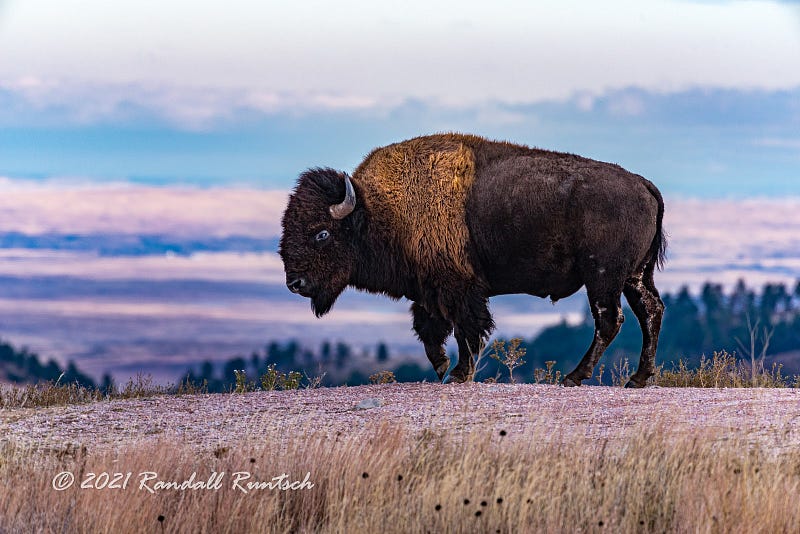
A bison bull stands atop a hill in Badlands National Park in South Dakota. Photo by the author.

“Historically the buffalo had more influence on man than all other Plains animals combined. It was life, food, raiment, and shelter to the Indians. The buffalo and the Plains Indians lived together, and together passed away.” Walter Prescott Webb, The Great Plains (Ginn and Company, 1931).

The Magnificent American Bison

The American bison (Bison bison), commonly known as the buffalo, is an even-toed ungulate. The largest land animal in North America, its vast herds once roamed wild on the Great Plains.
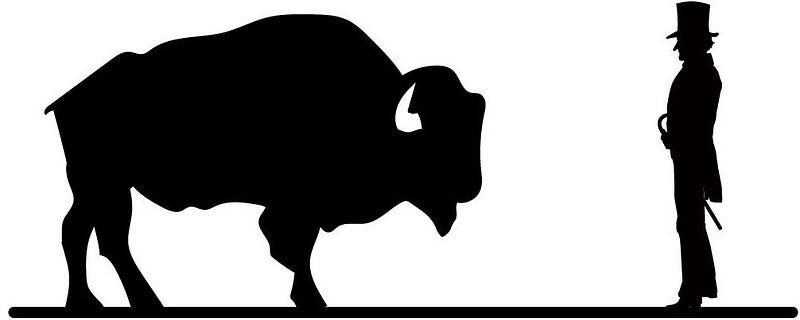
Adult bison bulls stand as tall as six feet at the shoulder. Image by Kazumi Runtsch and used with permission.

Bulls feature broad shoulders, massive heads covered in wiry fur, and upturned horns. With weights up to 2,000 pounds, they measure up to six feet at the shoulder. Cows feature narrower shoulders, smaller heads with wiry fur, and upturned horns. They weigh up to 1,100 pounds and can reach a height of four to five feet at the shoulder.

Bison calves weigh 30 to 70 pounds at birth.

Bison are muscular and powerful animals that can turn faster than horses. While they often appear calm, their mood can change quickly. They can run at speeds of up to 35 miles per hour.
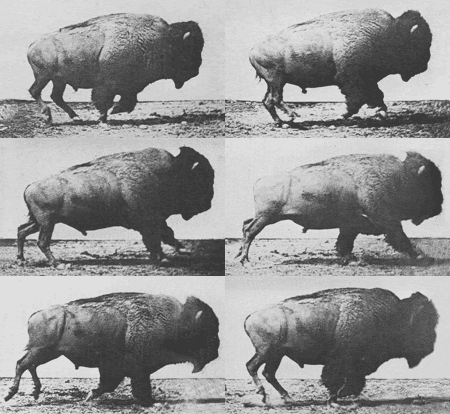
Animated sequence above show a bison galloping. The photos were taken by Eadweard Muybridge (died 1904), and first published in 1887. Animation by Waugsberg, 2006–7–16. Public domain image from Wikipedia.

Bison were nearly exterminated by 1900. Due to legal protections, they have somewhat recovered and live in public and private herds, and in zoos, throughout the United States, Canada, and Mexico.

Bison hold a prominent place in American lore. While no longer commonplace, you can view them in many locations in North America.
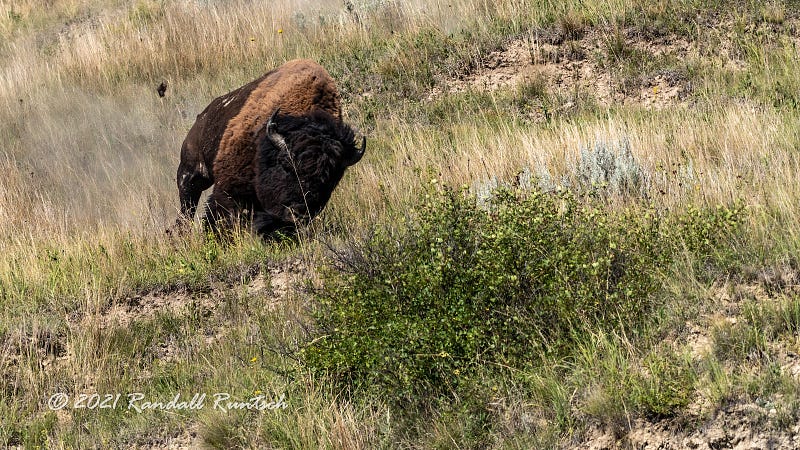
A bison bull runs from a fight with another bull in Theodore Roosevelt National Park in North Dakota. Photo by the author.

From Prominence to Slaughter to Recovery

In the late eighteenth century, as many as 60 million bison roamed North America. The animals were the primary food source of indigenous peoples in the Great Plains. These Native Americans respected the bison. They harvested what they needed and used all parts of the animals for meat, clothing, blankets, tools, teepees, and more.

In his biography, Lakota elder John Fire Lame Deer described Native Americans’ integral relationship with bison and declared:

When you killed off the buffalo you also killed the Indian — the real, natural, “wild” Indian.

In the 1800s, bison were slaughtered for sport by hunters and impacted by bovine diseases. By 1889 their population had dwindled to 541 animals.
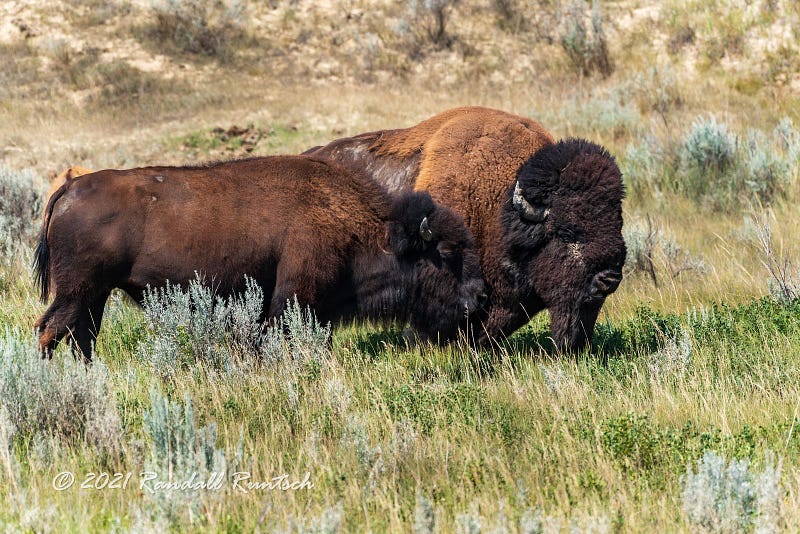
Bison graze in the grasslands of Theodore Roosevelt National Park in North Dakota. Photo by the author.

According to the U.S. National Park Service, the first efforts were underway to protect bison as early as 1776. In 1864, the Idaho State Legislature passed a law to protect bison, but they were already gone from the state. The U.S. Congress passed, and the president signed, the first national legislation designed to preserve the animals in 1894. By then, the species was nearly extinct.
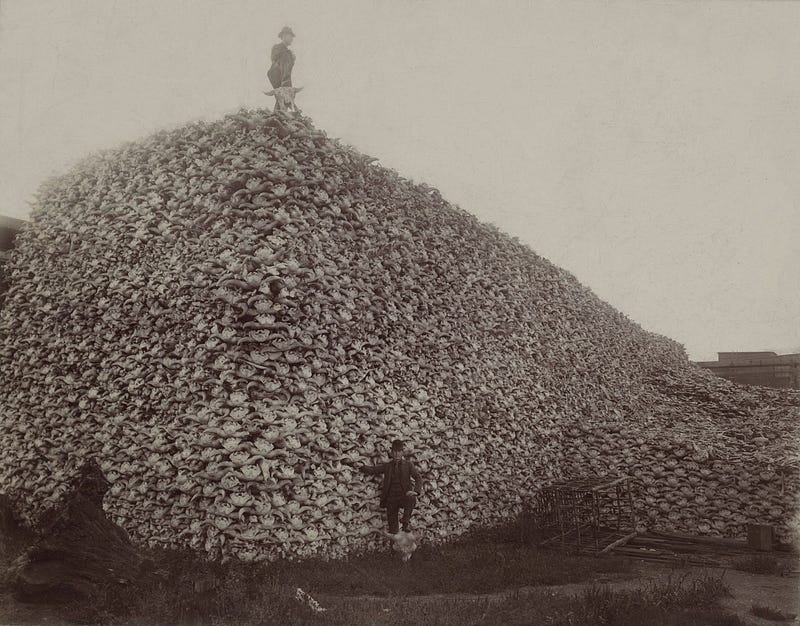
1870s photo of bison skulls piled up in Detroit, Michigan. Factories ground them up as fertilizer. Public domain photo from Wikipedia.

The bison protection law made the killing of a bison without a permit punishable by a $1,000 fine or imprisonment. The government strictly enforced the law.

Soon, government units and private citizens established public and private herds. The National Bison Association estimates that roughly 362,000 bison live in North America today.

Safely Viewing Bison

Bison are massive, powerful, and can move quickly. They are protective, unpredictable, and can be dangerous. When viewing them, remain at a safe distance. Follow the guides linked below to stay safe.

Yellowstone National Park — This U.S. National Park Service Safety page describes many ways to stay safe near bison and other wildlife.

Parks Canada — The Be bison wise page on the Parks Canada website provides a comprehensive list of safety tips to apply when near bison.
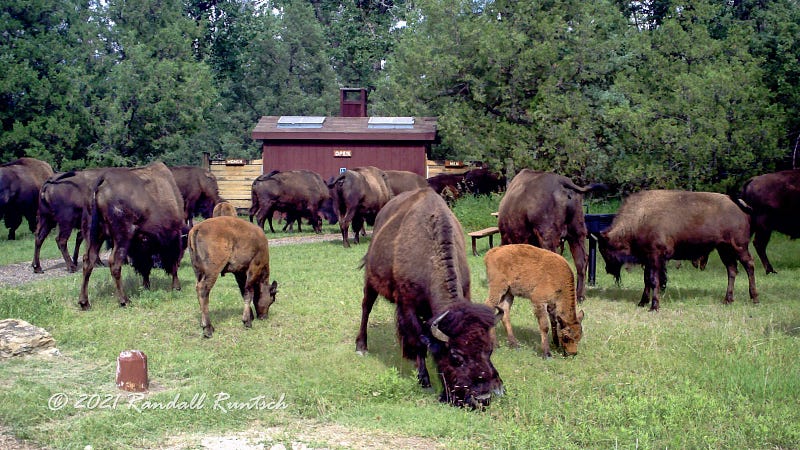
Members of a bison herd graze in Cottonwood Campground in Theodore Roosevelt National Park in North Dakota. Photo by the author.

Bison Herds in North America

Today, you can view bison in many public and some private herds throughout North America. Yellowstone National Park, located mainly in Wyoming, is home to the largest and most famous herd.

United States

Antelope Island State Park in UtahAntelope Island State Park, on Antelope Island within The Great Salt Lake, hosts a herd of 550 to 700 bison. In the 1800s, entrepreneur John Dooly, Sr. bought the island for one million dollars and formed the Island Improvement Company. In 1893, he brought twelve bison to the island, including four bulls, four cows, and four calves.

Badlands National Park in South Dakota — The rugged beauty of Badlands National Park is home to a herd of about 1,200 bison. In 1963, the National Park Service transported 50 animals from Theodore Roosevelt National Park to this historic native range in the badlands.

Blue Mounds State Park in Minnesota — Most of the Minnesota Bison Conservation Herd lives within a pen in Blue Mounds State Park in southwestern Minnesota. The herd includes about 100 animals at Blue Mounds and 30 more spread between Minneopa State Park and the Minnesota Zoo.

Caprock Canyons State Park in Texas — The steep and colorful canyons and bluffs in Caprock Canyons State Park are home to the Texas Bison State Herd. As of 2017, over 150 bison dwelled in the park.

Catalina Island in California — A movie production company brought bison to Catalina Island, located off the coast of southern California, in 1924. The company made the film The Vanishing American, based on a novel by Zane Grey. Today, the herd includes about 150 animals.

Custer State Park in South Dakota — Nearly 1,300 bison roam the hills and prairies of Custer State Park in the Black Hills of western South Dakota. The 71,000 acre park features an 18-mile Wildlife Loop Road, where bison and other wildlife can be viewed in open grasslands and on pine-dotted hills.

Delta Junction State Bison Range in Alaska — The bison herd at Delta Junction State Bison Range, near the Delta River in Alaska, was established in 1928 when 23 animals were transplanted from the National Bison Range in Moiese, Montana. The population reached 400 in 1947, and hunting permits were issued beginning in 1951. Hunting is still allowed to maintain a pre-calving population of 275 to 300 bison.

Denver Mountain Parks in Colorado — Denver Parks and Recreation maintains herds of bison in Genesee Park and Daniels Park.
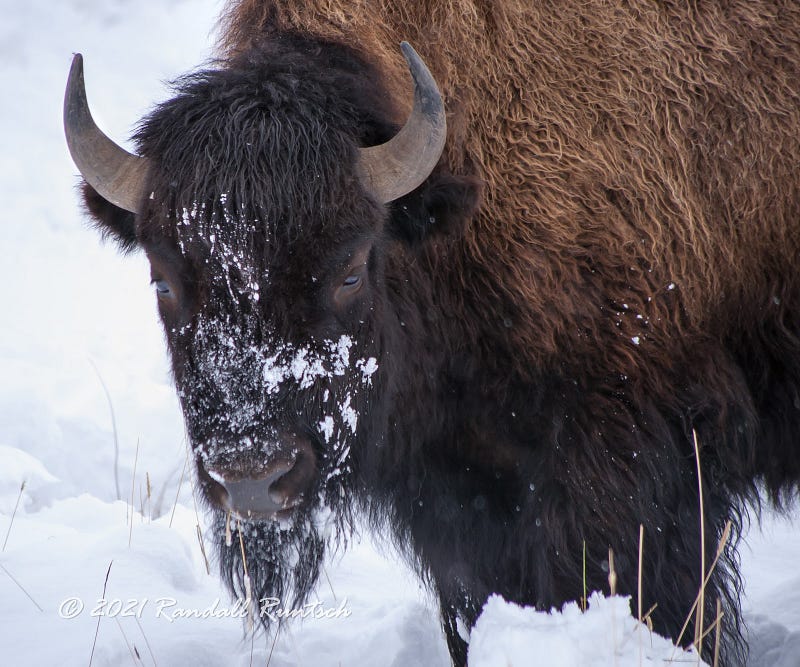
Bison in winter in Yellowstone National Park in Wyoming. Bison use their heads to move away snow for access to grass and other plants below. Photo by the author.

Fort Niobrara National Wildlife Refuge in NebraskaFort Niobrara National Wildlife Refuge, located in northwestern Nebraska, is home to various wildlife, including the Greater Prairie Chicken, elk, and a herd of roughly 350 bison.

Fort Peck Indian Reservation in MontanaFort Peck Indian Reservation, in northeastern Montana, manages a herd of about 200 bison. According to the reservation’s website, bison on its Turtle Mound Buffalo Ranch roam 13,000 acres of badlands, rolling hills, and bluffs. The site advertises hunting, so you may wish to contact the reservation to ask whether wildlife viewing is possible.

Fort Worth Nature Center in Texas — The Fort Worth Nature Center and Refuge manages a small herd of bison on 200 of its 3,627 acres. According to the Friends of Fort Worth Nature Center, the herd includes one adult bull, 13 cows, and calves, and yearlings from previous years. The center started with three animals from the Wichita Mountains Wildlife Refuge in Oklahoma in 1973.

Henry Mountains Bison Herd in Utah — The U.S. Bureau of Land Management (BLM) oversees nearly 2 million acres in the Henry Mountains of southeastern Utah. The BLM claims that its 200 bison comprise the only free-roaming herd in the 48 contiguous states. The Utah Division of Wildlife resources issues about 44 permits to hunt the bison each year.

Jester Park Bison and Elk Educational Plaza in IowaJester Park is located on the northwest shore of Saylorville Lake near Des Moines, Iowa. The park’s bison and elk educational plaza holds a small bison herd.

Joseph H. Williams Tallgrass Prairie Preserve in Oklahoma — The 39,650 acres of Tallgrass Prarie Preserve, located in northeastern Oklahoma, is the largest remaining tallgrass prairie in the world. Owned by The Nature Conservancy, the preserve manages some 2,500 bison.
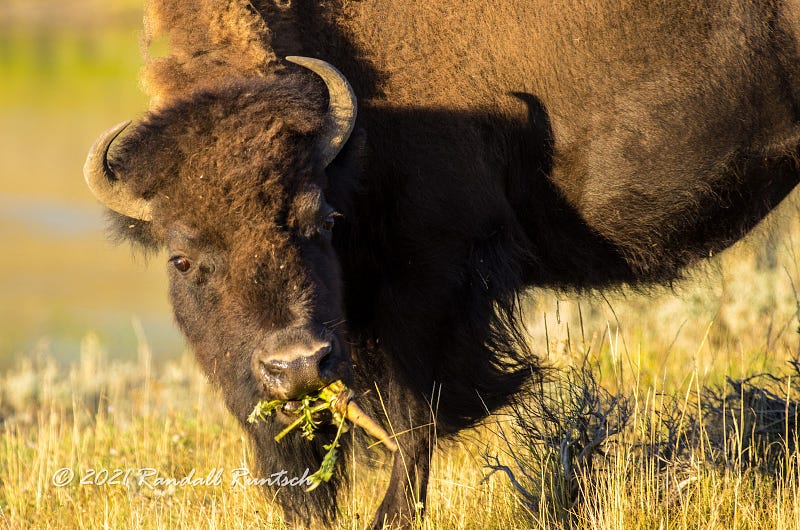
Bison graze on grass and other plants for up to 8 to 10 hours each day. Photo by the author.

Land Between the Lakes National Recreation Area in Kentucky — In southwestern Kentucky, bison and elk roam free in a 700-acre enclosure in the elk and bison prairie within the Land Between the Lakes National Recreation Area. The pen features a 3.5-mile paved loop road.

Maxwell Wildlife Refuge in KansasMaxwell Wildlife Refuge, in central Kansas, manages herds of bison and elk. The area offers trail rides and tram (“covered wagon”) rides to view bison and other animals up close.

Nachusa Grasslands in IllinoisNachusa Grasslands, in north-central Illinois, hosts a bison herd with 90 to 130 animals, depending on the season. Established in 2014 by The Nature Conservancy, the herd roams 1,400 acres of rolling hills in the 3,800-acre preserve.

National Bison Range in Montana — The National Bison Range, a unit of the U.S. Fish and Wildlife Service, is located on 18,800 acres of the Flathead Indian Reservation in western Montana. The range’s herd varies from 350 to 500 bison. It serves as the central point for bison research in the U.S. Two roads provide access to prime viewing areas.

Neal Smith National Wildlife Refuge in Iowa — Drive the 5-mile auto tour route through Neal Smith National Wildlife Refuge, located about 30 miles east of Des Moines, to view bison and elk. Roughly 50 to 70 bison live year-round in an 800-acre enclosure.

Prairie State Park in Missouri — A wild bison herd wanders the tallgrass prairie of Prairie State Park in southwestern Missouri.

Ted Turner Ranches throughout the U.S.A.Ted Turner owns about 2 million acres of private and ranch land in North America. Ted Turner Reserves manages approximately 45,000 bison across various sites.

Theodore Roosevelt National Park in North DakotaTheodore Roosevelt National Park, with its North and South units in western North Dakota, is named for the 26th President of the United States. The park is home to bison in both units. Park managers maintain a herd of about 200 to 400 animals in the South Unit and 100 to 300 animals in the North Unit.
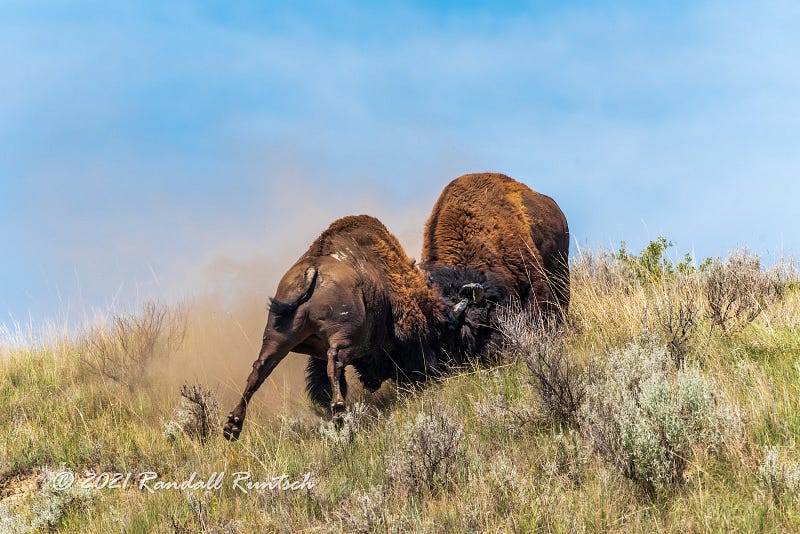
A wild bison bullfight in Theodore National Park in August 2020. After several minutes, the bull on the left retreated down the hill. Photo by the author.

White Horse Hill National Game Preserve in North DakotaWhite Horse Hill National Game Preserve, on the southern shore of Devils Lake in east-central North Dakota, manages a herd of 20 to 30 bison. The Theodore Roosevelt administration founded the site as a national park in 1904. Hiking trails and a 4-mile scenic drive meander through the preserve.

Wichita Mountains Wildlife Refuge in OklahomaWichita Mountains Wildlife Refuge, in southwestern Oklahoma, is one of 556 refuges managed by the U.S. Fish and Wildlife Service. It features roughly 650 bison. The grasslands of the refuge’s mixed-grass prairie escaped the plow because of rocks near the surface.

Wind Cave National Park in South Dakota — While perhaps best known for its cave system that features boxwork and frostwork formations, bison, elk, and other wildlife roam the prairie and hillsides of Wind Cave National Park in the southern Black Hills. According to Wikipedia, the bison herd features 250 to 400 animals and is one of four free-roaming and genetically pure herds on the continent.

Yellowstone National Park in Wyoming, Idaho, and Montana — Because of its hydrothermal and geologic features, Yellowstone National Park became the world’s first national park on March 1, 1872. The park is famous for its wildlife as well. About 4,680 bison lived in the park in 2020. They can be seen year-round in the Hayden and Lamar valleys, in the grasslands in summer, and near hydrothermal features in the winter.
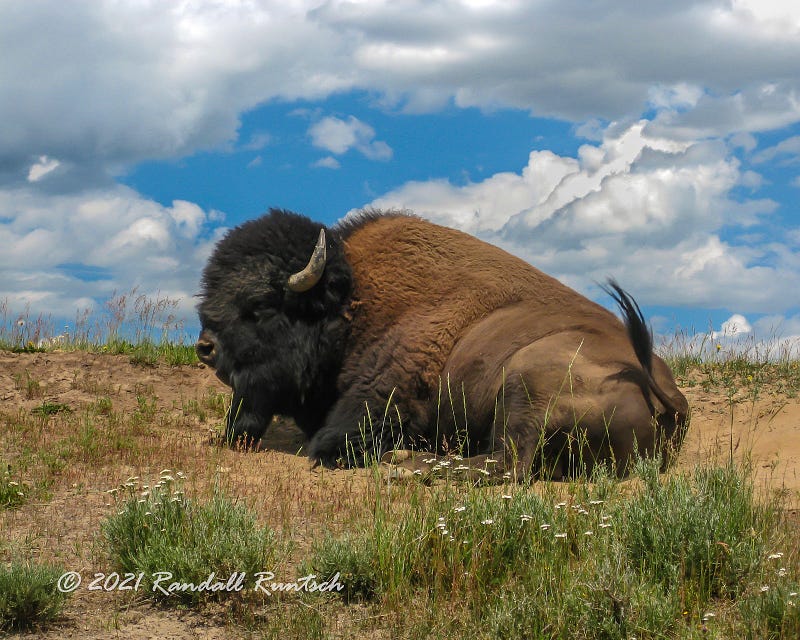
A bison bull rests in Yellowstone National Park in Wyoming. Photo by the author.

Canada

Elk Island National Park in AlbertaElk Island National Park, near Edmonton in eastern Alberta, has herds of plains bison and wood bison. The Like Distant Thunder page tells Canada’s bison conservation story.

Mackenzie Bison Sanctuary in The Northwest Territories — The Mackenzie Bison Sanctuary, on the north shore of Great Slave Lake in The Northwest Territories’ southeastern region, hosts Canada’s only genetically-pure and tuberculosis-free bison herd. There seems to be no official website for the reserve, but this site shares helpful information.

Prince Albert National Park in Saskatchewan — Vast Prince Albert National Park, in central Saskatchewan, is home to the Sturgeon River plains bison herd. The herd, established with 50 animals in 1969, grew to over 450 animals between 2006 and 2008. Today, the herd includes about 120 animals.

Wood Buffalo National Park in AlbertaWood Buffalo National Park is located in northern Alberta and preserves and protects an example of Canada’s Northern Boreal Plains. It is Canada’s largest park and one of the largest in the world. It may be best-known as the home of the largest free-roaming and self-regulating bison herd in the world. Its 3,000 animals are free to wander through the park’s plains and forests.
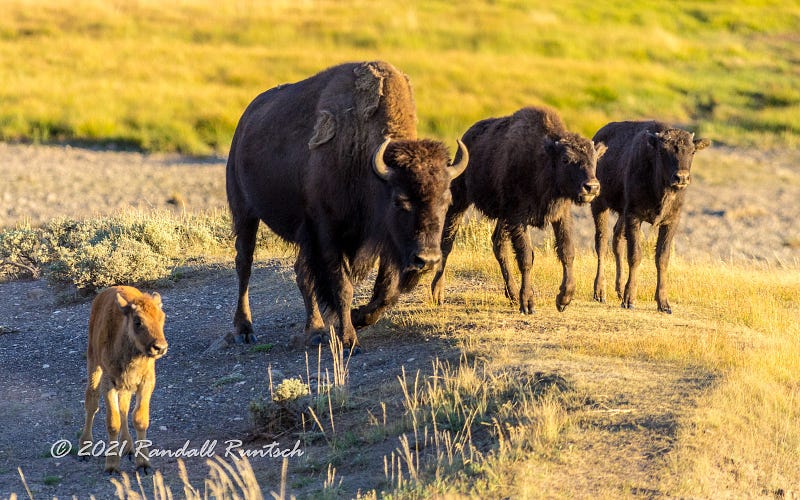
Bison of various ages walk through the grassland in Yellowstone National Park in Wyoming. Photo by the author.

Mexico

Janos Biosphere Reserve in ChihuahuaJanos Biosphere Reserve is a nature preserve in the state of Chihuahua, Mexico. In 2009, Janos received 23 bison from the Wind Cave National Park herd in South Dakota. By May 2017, 138 bison lived at Janos.

Maderas del Carmen in CoahuilaMaderas del Carmen is located in the state of Coahuila de Zaragoza in northern Mexico. The reserve is on the south bank of the Rio Grande River, across from Big Bend National Park in Texas.

Ranch El Uno in ChihuahuaRancho El Uno, in the Janos Valley within the Janos Grasslands within the state of Chihuahua, is owned by The Nature Conservancy. A herd of about 50 free-range bison roam 1,400 hectares (3,459 acres) of the 18,500 hectare (45,417 acre) preserve.

Bison within Zoos

While wild bison herds live in refuges and parks throughout North America, many smaller groups live in zoos. A list of zoos that feature bison is beyond the scope of this article. But use your favorite web browser to search for a zoo near you.
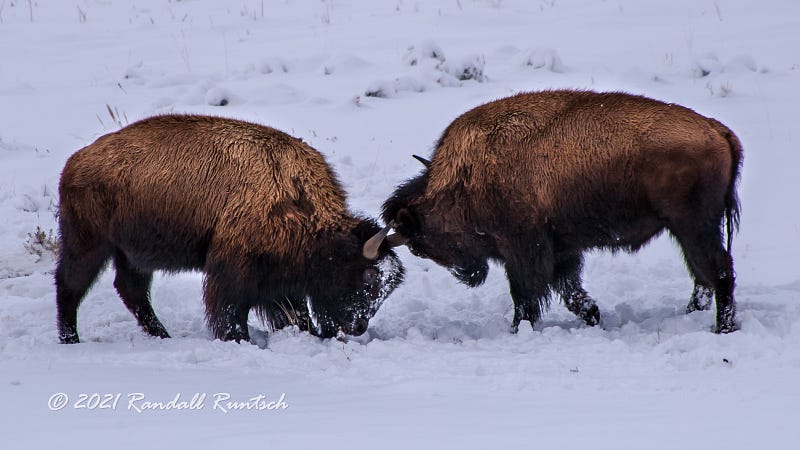
Two young bison bulls tussle in the snow in Yellowstone National Park in Wyoming. Photo by the author.

Summary

The near-extermination of the American bison is a great American tragedy. But there is hope. Through protection and intensive management, bison populations thrive and continue to grow.

Public herds, private herds, and zoos throughout North America preserve and protect the magnificent bison. They offer opportunities to witness the largest animal on the continent.

About the Author

Randy Runtsch is a writer, data analyst, programmer, photographer, cyclist, and adventurer. He and his wife live in southeastern Minnesota, U.S.A.

Watch for Randy’s upcoming articles on public datasets to drive data analytics insights and decision-making, programming, data analytics, photography, bicycle touring, and more. You can see some of his photographs at shootproof.com and shutterstock.com.

Wildlife
Photography
Travel
Outdoors
Nature
Recommended from ReadMedium