
The Birds’ Christmas Carol
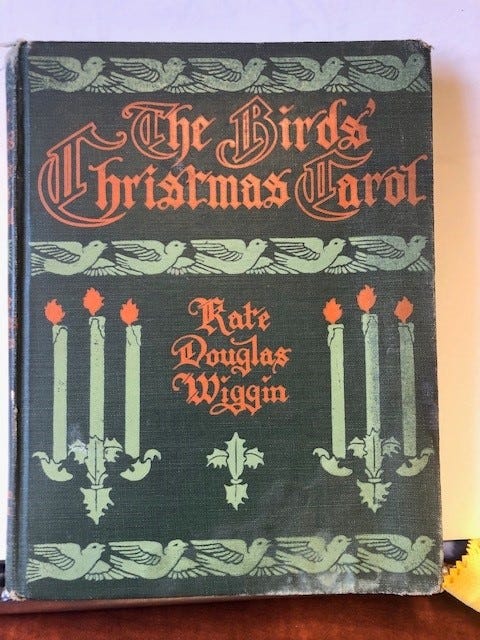
Books shape our lives and soothe our restless souls. Books teach us lessons about life and living. Family. Traditions. History. My mind has only ever been uplifted, enlightened, or educated by books. Antique books are a passion for me, and I collect literature from 1880 to 1910, in particular the “Lifestyle” books that instruct on how to live your life. Past writings have showcased a few of those books in my MEDIUM stories, however, I must include this wonderful book by Kate Douglas Wiggin.
Because I have worked in the Death Care Industry for the past decade, this little book is one that could be used to help introduce the concept of death and dying to school-age children in a very caring and empathetic way. From experience, I can tell you that we do not normalize death or the dying process in our western culture, and we tend to live our lives as if we are immortal and that death will never visit us or our household. We do a disservice to children in this regard.
Kate Douglas Wiggin (September 28, 1856 — August 24, 1923) was an American educator, author, and composer. She wrote wonderful children’s stories, most notably the classic children’s novel Rebecca of Sunnybrook Farm, and she composed collections of children’s songs. She started the very first free kindergarten in San Francisco in 1878 (called the Silver Street Free Kindergarten). Along with her sister during the 1880s, she also established a training school for kindergarten teachers. Kate Wiggin devoted her adult life to the welfare of children in an era when children were commonly thought of as cheap labor. Her books and stories are relatable to children's feelings and emotions.
The wonderful book I highlight here for you is one that my fourth-grade teacher read to us when I was a child in school in rural Oklahoma in 1964. Because the story impacted me then and has always been a part of my literature history due to the memorable tale told, I hope you will also find your copy. The book has been in reprint many times. The story has been a yearly read for me each year since I found my own copy in the 70s, and I wouldn’t consider it the Christmas season without bringing this wonderful story out to enjoy once again as I savor a Christmas season evening of reading, woodfire and dogs on my lap.
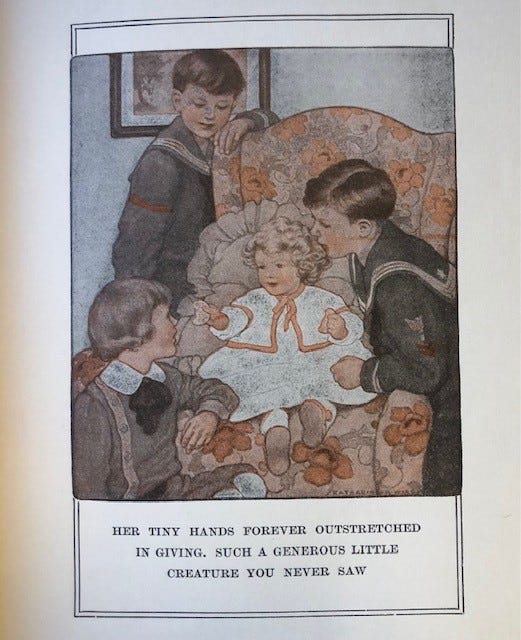
This sweet story of young Carol Bird is timeless in the lessons for young children. Carol is the youngest in a well-to-do family of robust older brothers, and she comes to the family weak of heart from the day of her birth, which falls on Christmas eve. The story unfolds dwelling on the strengths of her character and that of her family rather than this tragedy that compels some elements of the book. The story is of her last Christmas eve and how she chose to spend the season doing for others.
There is a delightful family being raised by a widowed Irishwoman, called “The Ruggelses in the Rear”, as they live in the back of the property carriage house on the family estate in old New England. This struggling Irish mother of eight is doing her best in life, and young Carol chooses to have her Christmas celebration given to this poorer family.
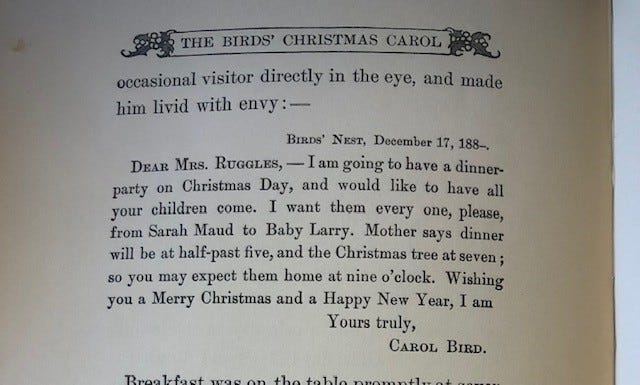
The rich tapestry of the story unfolds in the vivid description of winter life in old New England and the traditions of the time around the Christmas season. Little Carol Bird enlists the help of all of her family in making sure that the Ruggles family has an unforgettable Christmas. Kate Wiggin writes in a rich descriptive narration as she details the frenzy of the Bird household as they all pitch in to not only fulfill Carol’s Christmas wish but to also care for this struggling family. A delightful character is an uncle who comes to visit over Christmas, as well as the older brothers and mother and father as they all prepare for a wonderful Christmas Eve dinner for the poor family little Carol wants to host for the evening.
Descriptions of the Ruggles family in their own preparations to be guests of little Carol Bird in “the big house” on Christmas Eve are absolutely some of the most delightful and fun readings you will find in an excellent children’s book. Although this book has an emotional ending, I do believe that it has valuable lessons for children about death and coping with death and other aspects of real life, and the book does so with sensitivity, compassion, and caring. Do not be deceived by the date of publication. The story holds up well even a century later and will not disappoint.
The positive and uplifting elements of the story are well worth any worry about the sad moments. Acts of charity, generosity, hard work, responsibility to others, and kindness are all well illustrated and supported in this sweet children’s book from the late 1800s. I know that we tend to look for the new, glossy, highly illustrated children’s books of the present but do not discount the richness of children’s literature from the past. There are very valuable and noteworthy books from a century past that will enrich your library and help you with introducing some very important opportunities for talking with children about important aspects of life.