
CHILDHOOD CANCER AWARENESS MONTH
The Biggest Risks to Our Children’s Lives May Be The Most Invisible Ones
A case of childhood leukaemia affecting a beloved friend raised my awareness tenfold of the dangers at bay
Food and Health and Hope
I have a favourite band from my days of protests and hippy gatherings. They were a bunch of fellow protestors, yet they were far more hardcore than I was. They went to all the road protests, nuclear power plant protests, and anti-fracking marches. They wrote the best lyrics, full of uncomfortable truths, hilariously playful yet tragically harrowing, and their songs became the anthems we all remembered.
One of the first songs I ever heard by them was a song called Food and Health and Hope. Whenever they performed it, they dressed up as a bunch of fictional characters that supposedly represented everything the biotech agrochemical company, Monsanto — the company responsible for genetic engineering, DDT herbicide, artificial sweeteners, and so much more — stood for.
There was Mr Round-Up Red, Miss Information 1999, Terminator Gene, FIB Agent Orange, and Miss Candarel (or Sweet ’n’ Low as it’s called in the US).
The song itself contained some horribly blunt lyrics that I would normally be loath to repeat. But the fact that, soon enough after I first heard it, they would ring true a little too close to home is reason enough to put them down here:
“‘Cause we’re Monsanto, that’s right, Monsanto, We’re turning Satan into Santa by giving kiddies cancer, Coming through now, we’re changing you now, The Mother Nature terminators of food and health and hope.” — Seize the Day
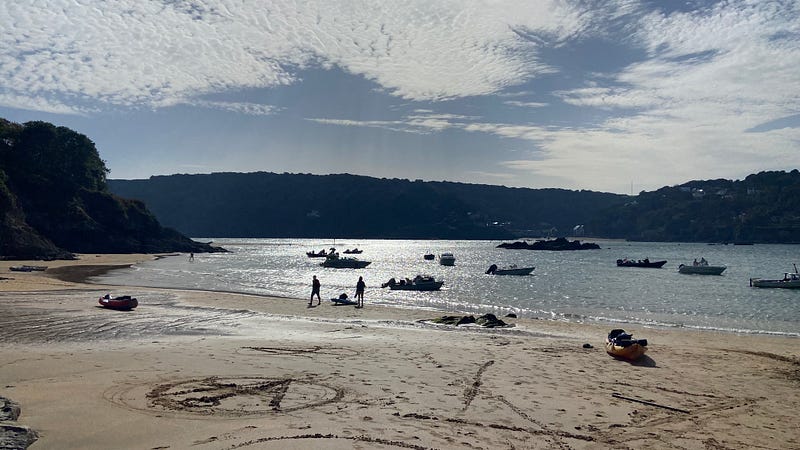
Last week, I had a beautiful day out at the beach in the breathtakingly beautiful Salcombe estuary, with views directly across to another beach where some fond yet bitter memories reside of a time some sixteen years ago.
Like every time I see this beach, those memories threw me straight back there again.
It was early September, with the holiday-makers all now returned home, and I was camping close by with my partner, our two little girls, and our friend, T, and her daughter.
T’s daughter, M, was a precocious child whose personality often dominated in any environment, and kept us entertained. At eight years old, she was a few years older than my eldest, but they had a beautiful friendship that transcended the age difference.
A girl without a shy bone in her, she had an affinity to acting and performing, and was never shy about asking for what she wanted. On this particular day, she demonstrated exactly that.
Together, we headed down to the beach, only to find that it had been taken over by a film crew. They had kindly allocated a small section of the beach to sunbathers like ourselves, while the rest was made up like a 1930s scene.
After a few enquiries, we learnt that it was one of Agatha Christie’s Miss Marple mysteries that was being filmed, and that the actress who was currently playing her, Geraldine McEwan, would soon be arriving at the beach on the famous ferry and sea tractor.
M was beside herself with excitement and left us in no doubt that she would have Geraldine’s autograph by the end of the day, which she did. The meeting with a famous person — and an actress at that — was the highlight of her year.
Happy, bouncing, cheeky, and with more energy than a firecracker is how I remembered her that day.
But just months later, in the depths of winter, that would all change.
My partner and I had set off on 1st January to Kerala in India, and planned to spend the next four or five months travelling with our girls.
Prior to taking my girls to Asia, I had learnt everything I could about how to protect their health while abroad; I had a little handbook on homeopathic prophylactics, and a stash of remedies that mostly kept me from panicking. I felt so very vulnerable as a young mother of two under-fives, and feared deeply for their safety.
England felt so safe in comparison. And yet, merely a couple of weeks after we set off from the safety of home, the news reached us that, following huge blood bruises appearing all over M’s legs late one Sunday evening, her mother rushed her to Accident and Emergency and they spent the night running tests. The test results came back, shocking us and shaking us all to our core.
M was diagnosed with acute lymphoblastic leukaemia (ALL), soon to be rushed up to Bristol Children’s Hospital, where she stayed for six exhausting weeks. And that was only the beginning of what would then become two and a half years of chemotherapy, transfusions and surgery.
It’s not the most unusual story. ALL is the most common form of cancer to befall children and it’s also the most curable. M did recover and by the age of twelve she had a head full of dark bouncy curls again and a restored love of being on stage.
But T, who made every conscious effort any parent could even contemplate to bring her daughter up to be in optimal health, was not willing to take this as “one of those things” and let it go. She felt there had to be an external reason her ultra-healthy daughter, raised on organic vegetables, pure spring water, sunshine and nature, had fallen victim to the very illness we all live in anxious wait of hearing uttered, knowing that the majority of people we know today will get cancer at some point in their lives.
So she went hunting for answers.
T began a private blog to keep friends in the loop with M’s progress. It was unreal to see this happening to some of the warmest, kindest, funniest people we knew.
Over the next three years, I didn’t see them. I only kept in touch with M’s story via the blog, and with her mother via email. The two of them went to live with T’s parents, knowing they would have the comfort and support they needed while M went through chemotherapy treatment. M’s dad also lived nearby and supported the two of them by preparing and bringing homemade meals to the hospital when M was being treated there.
T devoted her life to learning as much as she could about supporting M in the most wholesome ways possible while her body was being ravaged by both cancer and the chemo. From meals rich in fresh organic vegetables to smoothies made with dairy-free, nutrient-dense concoctions. But as she delved, she began to uncover some ugly facts about the possible cause of M’s leukaemia.
Is modern food production killing us?
While T and M lived in a beautiful old cottage in a tiny hamlet surrounded by countryside, they believed they were living surrounded with clean air.
However, the more T investigated the toxins in their environment from radiation caused by wireless electronics to the agricultural practices among the local farmers, she discovered a few worrying facts. Quoting some of her writing,
When M was diagnosed, we had been living for over two years directly next to pesticide sprayed fields. During this time, I had known these fields weren’t organic but my girl was eating a healthy, fresh diet and many other children lived nearby who were perfectly healthy so no alarm bells were ringing in my mind. After M’s diagnosis, a community nurse in the area told us that at one time, no less than 3 children were being treated for leukaemia at the primary school across the (sprayed) field from our home. This is a number way above the national average for childhood leukaemia incidence in a local area. Tests showed that M also had high levels of antimony in her system soon after diagnosis and this is a compound that is present in some pesticides. (Incidentally — I did contact the farmer of these fields and he shared the list of applications he uses on the field and also agreed to hold off the spraying each weekend we stayed in the area for visits. I recommend other rural residents expressing concern and doing the same!)
Learning of this caused T to be more than careful about where she would set up home again once M was through with her treatment. Owing to her need to remain close to family and to the hospital where she had been receiving treatment for the two and a half years of chemotherapy, they remained in the area for another few years and eventually moved back when M was around 16.
I will never know for certain if our proximity to chemically prepared fields was a factor in M’s illness, but even the possibility that it was is more than enough for me to now be very cautious about where we live. Through my research, I cam across the work of the amazingly dynamic pesticides campaigner Georgina Downs, (see her website http://www.pesticidescampaign.co.uk). I remain in contact with her and she has shared a number of stories with me of farmers and rural residents suffering from leukaemia and other horrific conditions as a result of pesticide exposure.
This time they stayed away from agricultural fields by renting in a small and unpolluted town. Later, when T’s father died, leaving her with a healthy inheritance, she was able to buy a house on the elevated moorland where the air is clean and the land not farmed.
T’s writing referenced Georgina Downs, an anti-pesticides campaigner who has had massive acclaim for her work. Georgina has uncovered many stories not dissimilar to M’s, in which rural-living people have become very sick for unexplained reasons, only to learn that their neighbouring fields are being sprayed regularly with substances that are known carcinogens.
We know the government is being made aware of such issues and yet still they remain silent.
If you do an online search for information pertaining to the links between pesticide use and cancer, there is very little that comes up. Yet the knowledge is there. And not much is being done, it seems, to either make the public aware of such things or to find less toxic ways of growing our food.
Perhaps it’s all down to money, power, and influence. Of which companies like Monsanto have a-plenty and their agrochemical industry could easily be competing for government domination.
M’s story woke me up to the fact that even deep in the countryside of one of the cleanest counties in the UK, we never know what there may be in the air, filling our lungs and seeping into our cells as we breathe it in.
Over the years that followed, I met more children whose families’ lives were turned upside-down by the diagnoses of childhood cancer, including ALL as well as other types. This included my cousin’s daughter, living surrounded by paddy fields in Cambodia, and another child here in the Devon countryside.
We can do our best to eat clean, avoid chemical cleaners in the house, and avoid vast quantities of chemicals in our clothing and cosmetics. But we have no control over what is in the air that we breathe unless, by some chance, we happen to know a little girl whose body was being ravaged by cancer, and whose mother was astute enough to look into the possible causes.
Otherwise, we live in blissful ignorance. Until we don’t.
Monsanto was bought by the German chemical and pharmaceutical company, Bayer, in 2018. Presumably, their products are still being used as widely, if not more so.
I may not be able to stand up to huge multinational corporations like these but I can use my words to bring awareness. And I can wish for a healthy future for all of our children and their children.


