
The Biggest Problem With Happiness
And How You Can Fix It

Pursuing happiness for a lot of people is like chasing after the wind. The more you run after it, the more it also go away.
Playing in the background are the invisible hands of Hedonic Treadmill— which explains our tendency to quickly return to a relatively stable level of happiness, despite major positive events or life changes.
So, while it’s probably right that money, physical pleasure, or social status can make us happy — they do so only for a while. And like a never-ending cycle, we left dissatisfied, wanting for more.
Well, this is not a dead-end though. Psychologists have been proving again and again that it is possible to be happier in the long run. But this type of improvement demands a radical change in the way we view happiness itself — which usually somewhat problematic.
And one of the biggest problems is that we tend to view happiness as a utility to be consumed, whereas it’s actually a product to be made. Let me try to explain.
Happiness as a Product
Allegedly, this is the era where happiness is only a pocket away.
You bored? Just scroll on social media and you’ll be happy
Are you feeling sad? Down a couple shots of booze to drown your sadness away
Demotivated by your work? Here’s a new show on Netflix to end your problem
In such ways, it’s easy to view happiness as a utility to be consumed.
But things don’t always run as smooth. There are times when scrolling will get you anxious, Netflix would steer you to hopelessness, and alcohol would make you feel like shit. These are the moments when the notion “Money can’t buy happiness” seems truer than before.
And that’s probably correct.
Why?
Cause you’re not literally buying or consuming happiness, you’re producing it.
Happiness is an emotion, and emotion is a product output made within the brain. The plethora of stimuli you sense — be it an event, a piece of information, food, sex, etc. — is actually an input. But notice that inputs are not directly related to outputs; in between, there is a production process, a.k.a. the way your brain perceives and processes the information itself.
And in terms of happiness, your production process is of utmost importance. This explains why for two people with fairly similar circumstances, one might be happy, and the other miserable. Or why some see the glass half full, while the others half empty.
Input → the production processes → output
Various stimuli → mental processes → Happiness
(I adapted this thinking framework from a Behavioral Scientist, Paul Dolan, from his book “Happiness by Design”)
The Production Process
So what are those production processes?
To name just a few: self-control, mindfulness, stoicism, growth mindset, optimism, modesty, curiosity, courage, integrity, perseverance, kindness, fairness, leadership, humility, prudence, gratitude, forgiveness, spirituality, humor, etc.
Anything that alters the way you perceive events, information, or situation can be adopted as a production process. It comprises a set of values or characteristics that has been passed on and survived over time and culture.
And the good news is there’s no one best version of it, so you can pick one that resonates with your trait and interest. Choose from whom you want to learn it from, and make it a habit.
For example, just for the last couple of months, I’ve been practicing myself the mindset of proactivity. I note some lists of actionable instructions related to the mindset and set it on my daily to-do list. Here’s how it looks:
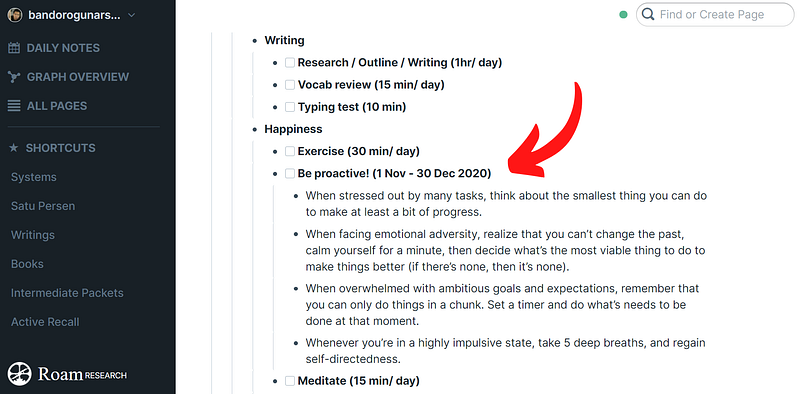
One thing about the brain is that the more you train certain kinds of behavior, the stronger the neural networks related to that behavior would be.
And thanks to that, after only a month, proactivity starts to kick in automatically in me (though there’s still a lot of progress to be made).
So, this is the final takeaway.
Consider that you are a factory, and happiness is one of the main products in your catalog.
While it’s nice to have a grasp about the product you want to make, it’d be nonsense to spend most of the time pondering how good the output would be. It’s also wasteful to spend all day trying to find the best resources of input. Hence, put only enough on those two, and spend most of the rest improving the production processes in which the factory run itself.
Within this framework, I agree with the ancient wisdom stating that one can achieve happiness not by pursuing it directly, but rather by focusing on the values in which happiness resides as a byproduct.
Well, this first sounds like a paradox — but not until we understand the entire picture.


